From the political website Counterpunch
Israel's Cultural Warriors
A Music School Silenced in Gaza
By NADIA HIJAB
There was a music school in Gaza. It was just six months old. The 31 children aged seven to 11 could choose one of five instruments, including the guitar, oud (lute), and piano. Most of the 19 girls gravitated to the guitar and piano while many of the 12 boys showed a preference for the oud.
The school worked out of rented premises in the Palestinian Red Crescent Society building just across the street from the Preventive Security Forces compound in Gaza City. The compound was targeted in the first wave of Israeli bombardments on December 27, and twice more the next day. The five-story building was vaporized; a flat gravel surface is all that remains.
Like other buildings in the neighborhood, the Gaza Music School was shattered; window frames and doors were blown out, and holes were punched in the walls. The force of the blast imploded the four ouds, just like it had the compound.
By some miracle, the children had not yet arrived for their lessons and so were spared the fate of those in other schools in the path of Israeli bombs.
In the midst of all the death and destruction in Gaza, the school's short life rouses particular emotion. That there was such a school at all is astonishing, not just because of the 18 month siege that followed the decades of "de-development" of Gaza under Israeli occupation but also because one might expect it to be contrary to an Islamist social program.
There is almost no musical education in Gaza. The school project was developed in response to community demand, particularly from among the 11,600 children who are members of the Qattan Center for the Child. The Center provides extra-curricular activities and a library for the children. It is impressive: With its 103,000 books, it is one of the largest children's libraries in the Arab world.
The children who attended the Center's music workshops and concerts started asking for more. "They said, 'We want to play instruments too,'" explained Ziad Khalaf, the Ramallah-based director of the Qattan Foundation, which established the school with co-funding from the Swedish development organization SIDA.
The school provided a window on another world for the besieged Gazans. "Many parents sat in on the theory lessons so they could better support their kids' homework," said Khalaf.
The five music teachers include two Russian women married to Palestinian men. They refused to leave Gaza when the border was briefly opened to enable foreigners to flee. For them, Gaza with all its misery and deprivation is still home, just as it is for the 1.5 million other Palestinians living there.
And what about Hamas' supposed social rigidity? Some websites did take a strong line against musical education, complaining that Hamas was allowing music to be taught under its rule instead of the Sharia. But they were ignored. Khalaf emphasizes that the Foundation has experienced full support from all authorities and communities in its different places of operation.
The day after the music school was hit, its coordinator called each of the children and their parents to make sure they were safe, and also to assure them that the school would be repaired, restocked, and reopened as soon as possible.
In Ramallah, the Edward Said National Conservatory of Music is planning a fundraiser soon to help rebuild the school. "Some friends from Amsterdam and London who saw the damage to Gaza music school on the Foundation's website said they will be fundraising to help," Khalaf said.
These plans, too, arouse emotion: Palestinians rebuild even as the rubble rises around them. They have had 60 years to learn how to do so, and show no signs of giving up their quest for their rights -- not even the right to learn how to play a musical instrument.
Nadia Hijab is a senior fellow at the Insitute for Palestine Studies.
Showing posts with label Israel. Show all posts
Showing posts with label Israel. Show all posts
Monday, January 12, 2009


Saturday, November 01, 2008
Israel considers question: ‘Who is a Jew?’
AP/MSNBC
Israel considers question: ‘Who is a Jew?’
Issue heads to higher court after rabbis annul some 40,000 conversions
The Associated Press
updated 4:17 p.m. PT, Sat., Nov. 1, 2008
JERUSALEM - Raised without religion in Maryland, Shannon sought to make a new life for herself as a Jew in Israel.
In a rigorous conversion process, she studied religious law for a year, took a Hebrew name and changed her wardrobe to long skirts and sleeves as dictated by Orthodox Jewish custom. Finally, a panel of rabbis pronounced her Jewish.
But five years later, she and some 40,000 like her have suddenly had their conversions annulled by Israel's Rabbinical High Court. The court says the rabbi who heads a government authority set up to oversee conversions is too liberal in approving them.
The issue, now headed to Israel's Supreme Court, has exposed an intensifying power struggle inside Israel's religious establishment over the age-old question of "who is a Jew." It also threatens to deepen the wedge between Israel and American Jews, who largely follow more liberal schools of Judaism.
While 34-year-old Shannon's Israeli citizenship isn't in jeopardy, the ruling diminishes her religious rights. Many rabbis will no longer oversee basic Jewish rituals for her, such as getting married or receiving a Jewish burial. If she has children, they might not be considered Jewish.
"I'm very worried. I probably will not be able to get married in Israel," she said. "God forbid, if I die, will I be allowed a Jewish burial?"
Definition of Jewishness
Shannon was the woman's given name in the small Maryland farm town where she grew up. She asked to withhold her surname and Hebrew first name for fear of antagonizing the rabbis who hold her fate in their hands. Other converts interviewed by The Associated Press made the same request.
The quest for a definition of Jewishness has dogged Israel from its beginning, and has taken on urgency in recent years as immigrants have poured in, primarily from the former Soviet Union and Ethiopia. Many of them have Jewish roots but are not considered Jewish under Orthodox religious law because they weren't born to Jewish mothers.
Three years ago the government formed the conversion authority to set universal standards, headed by Haim Drukman, a respected Orthodox rabbi who had already overseen tens of thousands of conversions over the years, including Shannon's.
Born to a Jewish father and Christian mother, Shannon became drawn to her Jewish roots, and in 1995 moved to Israel. She didn't meet the Orthodox rabbinate's criteria of Jewishness, so she underwent conversion, approved by Drukman in 2003, and maintains a religious lifestyle to this day, keeping kosher and not working on the Sabbath.
But last March, the state-funded rabbinical court, which has the final say over who is Jewish, reversed her conversion and some 40,000 others overseen by Drukman and his followers.
The rabbis based their ruling on their discovery that a Danish woman whom Drukman converted more than a decade ago did not observe the Sabbath. But the decision was a symptom of a broader struggle.
On one side are ultra-Orthodox hard-liners, who insist converts must embrace their strict interpretation of Judaism for life. On the other side are moderates like Drukman. "There is a commandment to love every Jew and there is a special commandment to love the convert," he says.
An important goal of Drukman's office was to help the more than 300,000 immigrants from the former Soviet Union whose Jewishness was in question.
Rabbi Eliyahu Ben-Dahan, director of the rabbinical courts, said too many people are being converted who aren't genuinely interested in the religion. "Nobody really checked how many of these 300,000 people really wanted to be Jews," Ben-Dahan said.
Divisions between Israeli, American Jews
The decision also has threatened ties with those American Jews who belong to the more liberal Reform and Conservative denominations. The ruling on conversions is seen as another blow to their struggle for recognition in Israel.
"Few crises have so divided Israel from the North American Jewish community," the United Jewish Communities, a U.S. umbrella group that donates hundreds of millions of dollars to Israel each year, wrote to Prime Minister Ehud Olmert in July.
To the group's plea for action, Olmert replied he was "determined" to solve the conversion crisis.
But the same month, Olmert abruptly fired Drukman. He said the law requires the 76-year-old rabbi to retire, but an official said Olmert felt that Drukman's rate of conversions — 3,400 in the three years of his authority's existence — was too slow. The official spoke on condition of anonymity because he was sharing confidential information.
Drukman, speaking to the AP, called the dismissal "foolish and malicious," saying his contract had been renewed only a year earlier.
The Supreme Court is likely to take up within weeks an action brought by Yael, the Danish woman at the heart of the conflict. She converted to marry an Israeli man she met 20 years ago, but during divorce proceedings last year, she acknowledged she did not live by Orthodox rules. The rabbis then invalidated her conversion and everyone else converted by Drukman.
Yael says the rabbis are acting against the spirit of Judaism.
"There is an unwritten law that we should be nice to each other and be human beings, and I always connected this to religion," she said.
Wednesday, October 08, 2008
Falafel Wars (Lebanon: Israel stole our falafel)
Ynetnews
Country's Industrialists Association says Jewish state trying to claim ownership of traditional Lebanese delicacies like tabouleh and hummus, plans international food-related suit
Roee Nahmias
Lebanon is planning on filing an international law suit against Israel for violating a food copyright, Fadi Abboud, president of the Lebanese Industrialists Association, told the al-Arabiya network.
The Lebanese claim is that Israel markets original Lebanese food like tabouleh, kubbeh, hummus, falafel and fattoush which the Lebanese considered their trademarks prior to the establishment of the Jewish state.
Abboud explained that the fact that Israel has been marketing Lebanese delicacies under the same names and ingredients around the world has caused great losses to Lebanon, and that while, “the full extent is unknown, it is estimated at tens of millions of dollars annually.”
Abboud, who prepared a memo on the subject, based his case on the, ”feta cheese precedent” that occurred six years ago.
At that time, France, Denmark and Germany asserted that Greece cannot have a monopoly over the production of this type of cheese. Greece managed to prove in international institutions that it is the cheese’s “originator” and won the case.
Until that point, the three prosecuting countries produced 12,000 tons of cheese a year.
The court ruled that from then on, other countries could not use the name “feta”, as this cheese is “largely associated with Greece’s history and has been produced under this name for 6,000 years.”
Thus, the European Parliament’s Committee on Economic and Monetary Affairs decided to grant Greece the sole right to produce and market the cheese under that name.
The Lebanese official claims that not only does Israel use the names of Lebanese foods but it also markets them in ready-to-eat plastic boxes for European and US consumers as if these were traditional Israeli foods.
According to Abboud, while Lebanon never registered the names and ingredients of these delicacies, “it can refer to the Greece precedent since these foods are historically known as traditional Lebanese foods.”
He also said that the Lebanese Industrialists Association is working on registering all the foods and ingredients and submitting a report to the Lebanese government since only it can appeal to the international courts against Israel and “prevent it from stealing the foods that others produce."
Tuesday, April 11, 2006
Global Brass Bands
New York Times
April 9, 2006
Music
They're With the Band, Speaking That Global Language: Brass
By JOSH KUN
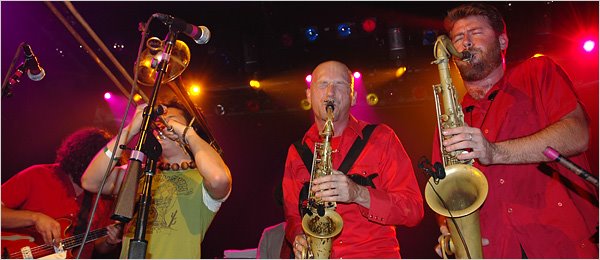
LAST December, the veteran Mexican-American rock band Los Lobos dusted off its 1992 album "Kiko" and performed it live, start to finish, at the House of Blues in West Hollywood. For most of the night it was a standard rock setup, but when it came time for the album closer, a woozy Mexican folk swoon called "Rio de Tenampa," Los Lobos brought out Los Cenzontles, a Northern California banda troupe. While Mexican bandas (brass bands) can have as many as 20 members, Los Cenzontles didn't need much more than a tuba, a trumpet, a thudding bass drum and a pair of clarinets to turn the club into a raucous cantina.
Brass band music can have this effect. The stammering pepper-spray of horns, the crisp snaps of snare rolls: it's precise and excessive at once, a joyous emotional tornado awash in spit, sweat and celebration. No wonder it's one of the world's most-spoken musical languages — from Serbian villages to Manhattan's bustling "gypsy punk scene" to this year's Grammy Awards, where Kanye West reinvented "Gold Digger" by having a marching band play, running through the aisles. Awareness of international brass styles has blossomed in recent years in the United States, thanks in large part to an increase in domestic album distribution deals and more frequent international concert tours.
"You would think that a brass band, which has no strings at all, would be limited in its sound," said Tamir Muskat, the Israeli-born co-founder of Balkan Beat Box, a new-school crew in New York known for wild live shows that mix Balkan horn blasts with electronic beats. "But it's unbelievable what people manage to do with it. There is a whole world of brass out there."
Listen to enough brass band music — whether a slice of Mexican banda or the Romanian group Fanfare Ciocarlia pulling the trigger on a dizzying blast of high-velocity trumpets — and you start to hear the history of the world handed back to you in a horn section. Suddenly, Serbia and Romania could be the alternative birthplace of Brazilian frevo; brass flurries from Gypsy bands in Macedonia and Bulgaria could be lost cousins of the Jaipur Kawa Brass Band from India, the Gangbe Brass Band from Benin or any New Orleans jazz troupe.
The connections are more than theoretical. In the 1860's, thousands of former Gypsy slaves fled Romania for the American South, landing in mostly black neighborhoods. The brass music they brought with them, like that of all Balkan countries, can be traced to the Turks, the original band geeks. Last year's "Blowers From the Balkans" compilation (Topic), which unearthed a trove of early 20th-century Balkan brass recordings, spelled it out loud and clear: it was the Ottoman Empire's janissary bands that turned brass into the lingua franca of Serbia, Macedonia, Romania and Bulgaria.
"The Ottoman empire used brass bands to impress the enemy, walking and playing in front of the first line of soldiers," explained Oprica Ivancea, the lead clarinetist for Fanfare Ciocarlia, a 12-piece band of Romany Gypsies who work out of the remote mountain town of Zece Prajini (population 400) in eastern Romania. "But in the early 19th century, brass got popular in Germany and Austria and because Romanians always want to be like the Germans we began to adapt to their sound as well."
Long before Kelly Clarkson and Jay-Z (and for that matter, long before rock 'n' roll), European military and church bands were the world's top global musical exports. Locals throughout Asia, Africa and the Americas were trained in the ways of the marching band as part of colonialism. As empires dissolved, official bands soon became voluntary village bands, and by the turn of the 20th century most of the world shared an ingrained knowledge of all things brass.
"All brass bands have a link somewhere," Mr. Muskat said. "Ninety percent of all brass bands are based on the same elements. It's all rhythm and horns."
Mr. Muskat's Balkan Beat Box partner Ori Kaplan grew up in Jaffa, Israel, where he watched Egyptian orchestras on television and learned to play Eastern European klezmer clarinet from a Bulgarian trained by Gypsy brass musicians. When Mr. Kaplan moved to New York 15 years ago, though, he wanted nothing of his klezmer past, choosing instead to play in industrial punk bands. That all changed when he heard a CD from Macedonia's top brass band, Kocani Orkestar, and learned about the Gypsy-Turkish fusions of the Bulgarian horn stalwart Yuri Yunakov, another New York City transplant). "I started to listen to Balkan music constantly," Mr. Kaplan said, "I became a brass band freak."
Of brass band enthusiasts in the United States, however, few can top the trumpeter Frank London, whose Klezmer Brass All-Stars have just released their third raucous manifesto of brass globalization, "Carnival Conspiracy." While firmly grounded in both Balkan and klezmer traditions (Mr. London's main gig is with the tradition-bending Klezmatics), "Carnival" makes cross-cultural brass connection its guiding impulse, riffing on the beer hall oompah of Mexican banda and the funk marches of Brazilian frevo and batucada. If the batucada seems like a stretch, it shouldn't: the first Jews in North America were Eastern European immigrants from Recife, Brazil — the capital of Brazilian big band.
"The idea of brass repertoires crossing genres and being assimilated into different traditions has been going on in all of these brass band musics forever," said Mr. London, who in the 1980's also fronted Les Misérables Brass Band, playing music from Pakistan, Serbia and South America (as well as the occasional Jimi Hendrix cover). "For many years, the most popular song for Indian brass bands was 'Tequila.' When you play an Italian feast, you don't just do Italian parade music. At the end you sit down and play opera overtures, then you can do covers of popular music, dance music, jazz music. Most brass bands just have this breadth of repertoire and styles at their fingertips."
Fanfare Ciocarlia have made a career out of this kind of stylistic juggling. They play everything from Russian-influenced Romanian doinas (slow improvised melodies) to Gypsy maneas (melancholy love songs) born in India, and on their latest CD, "Gili Garabdi," tackle an Afro-Cuban rumba alongside versions of the James Bond theme and Duke Ellington and Juan Tizol's "Caravan."
"We play music and dances we learned from our fathers," said Mr. Ivancea, who considers Gili Garabdi a tribute to the shared heritage of Gypsy brass and African-American jazz. "But we also play any tune requested during a wedding or baptism. We provide a service — we have to play what people want to hear."
In 2003, Mr. London decided to test these theories of a single brass family tree on an actual collaboration. So on the Klezmer Brass All-Stars' sophomore outing, "Brotherhood of Brass," he sought out the Hasaballa Brass Band from Cairo and Boban Markovic, a Serbian trumpet king, for a series of reeling geography mashups that imagined Eastern European shtetls and Egyptian markets sprouting up in Serbian villages.
"Over the last few years, I've noticed that my music has become part of a larger global conversation," said Mr. Markovic, who has been known to start his live sets with a version of the theme from "Titanic." "Knowing someone's music is so much easier these days. But I am still mostly trying to communicate with local people, especially communities in the south of Serbia and in the Balkans."
In that spirit, Mr. Markovic's newest album, "The Promise," features his typically kaleidoscopic takes on standard coceks (stomping Gypsy dance tunes), but also dips into the Latin American brass band tradition with "Latino" and "Voz," songs that wouldn't sound out of place on the set list of a Mexican banda. Which makes perfect sense considering that the Mexican brass style — one of the most commercially dominant genres in that country's music industry — was initially inspired by the Franco-Austrian military bands that reached Mexico through the coastal hub of Mazatlán in the 1800's.
"Our brass music is very similar to German music," said Poncho Lizárraga of Banda el Recodo, Mexico's longest-running brass ensemble, founded by Mr. Lizárraga's father, Don Cruz, in 1938. "We just interpreted it differently, turned the polkas into our own rancheras. My father wanted something different from all that music coming from Europe. It was music just for our town, and in the beginning, mostly for people who liked to spend too much time in the cantinas."
More than six decades and 180 albums later (their latest, "Hay Amor," has just been released), Recodo's 17 members are international banda ambassadors who wear matching jewel-studded suits made of black velvet, and their music has become a favorite sample source for hip-hop and electronic acts like Akwid from Los Angeles, Wakal from Mexico City and Nortec Collective from Tijuana. Similarly, the growing popularity of Balkan brass with sample-hunting D.J.'s in the United States and Europe — led by Shantel of Germany, whose "Bucovina Club" nights in Frankfurt ignited an electro-Balkan avalanche — which has been a key factor in introducing the centuries-old music to first-time listeners.
On Shantel's new "Bucovina Club Vol. 2" mix CD, Balkan Beat Box makes an appearance, and he throws a few house beats under cuts from Fanfare Ciocarlia and Mahala Rai Banda, another Romanian band, but mostly he lets the old-school originals speak for themselves: the traditional as the new cutting-edge.
"People are tired of corporate-friendly rock 'n' roll and the cold nihilism of the electronic music scene," said Mr. Kaplan of Balkan Beat Box. "They're hungry for this really sweaty, personal, alcohol-driven, familiar, ceremony-like music. There's something very healthy about all of this interest in brass music. People just want to get back in touch with their feelings."
Wednesday, February 15, 2006
OBITUARY: Shoshana Damari, 'Queen of Hebrew Music'
OBITUARIES
Shoshana Damari, 83; Israeli Singer, 'Queen of Hebrew Music'
From Associated Press
February 15, 2006
Shoshana Damari, whose voice came to embody the emerging nation of Israel and comforted its people during their most trying times, died Tuesday. She was 83.
Damari, who was battling pneumonia, had been taken to Ichilov Hospital in Tel Aviv on Friday and put on life support. Her many friends, as well as leading Israeli singers, congregated around her hospital room in recent days, singing her songs and praying for her recovery.
She made her last public appearance a week ago at the Ami Awards, Israel's equivalent of the Grammys, where she complimented the nation's young generation of singers.
Known as "the queen of Hebrew music" and a recipient of the country's most prestigious cultural prize, Damari entertained Israeli civilians and soldiers for nearly seven decades with her booming alto voice, continuing to perform until shortly before her death.
Acting Prime Minister Ehud Olmert called Damari "one of Israel's cultural greats."
"Her voice and noble image guided us for more than 60 years … through the establishment of the state, through wars and peace, happiness and grief," Olmert said in a statement. "Shoshana Damari was an example for love of humanity, love of the land of Israel and, especially, love for the Hebrew song….
"We will remember her forever as the national voice."
Damari immigrated to Palestine, now Israel, with her family from Damar, Yemen, as an infant in 1924, but her singing featured a distinctive Yemenite pronunciation, adding an ethnic quality to her Hebrew songs.
The diminutive performer was known for her powerful, low-pitched voice that seemed to start from her toes, working its way up her body.
She studied singing and acting and began appearing in public in her teens, performing on radio from the age of 14. She made many recordings and helped soothe the nation during its war of independence in 1948.
In 1988, Damari was awarded the country's top civilian honor, the Israel Prize, for her contribution to Israeli vocal music.
As word of her death spread Tuesday, a wave of nostalgia washed over the country.
Her songs, such as "Kalaniot" (Anemones), were played repeatedly on the nation's main radio stations, evoking memories of a bygone era of innocence. Israeli television also went to special programming Tuesday night, with tributes to her career and the airing of her last interviews and concert performances.
Damari is survived by a daughter who lives in Canada. Funeral plans were not immediately announced.
Sunday, March 27, 2005
A Peace Song in the Middle East
MSNBC
Peace song serenades Palestinians, Israelis
Simultaneous broadcast is latest sign of easing tensions
By Preston Mendenhall
Correspondent
NBC News
Updated: 8:55 p.m. ET March 27, 2005
JERUSALEM - A musical message of peace serenaded Palestinians and Israelis on Sunday, in a simultaneous broadcast to promote reconciliation - the latest sign of easing tensions in the Middle East.
Sung in Hebrew and Arabic, "In my heart" is the creation of Israeli musician David Broza and Palestinian instrumentalist Said Murad, whose brother, Wisam, accompanies Broza on vocals. The ballad is about love and land, an issue at the heart of the Israeli-Palestinian conflict.
"If we succeed in making this music and create this kind of art, it will help put people together," 44-year-old Said Murad said.
Broza and Murad worked with the Voice of Palestine and Israel’s Army Radio to coordinate the broadcast on Sunday morning.
Despite improving relations, there was an undertone of conflict on the airwaves. Army Radio’s Razi Barkai asked a Palestinian radio official whether his station had "stopped incitement messages on your broadcasts." Shortly after taking office in January, Palestinian Prime Minister Mahmoud Abbas ordered anti-Israeli incitement to stop.
Since a landmark Palestinian-Israeli summit, Israel has curtailed military operations and withdrawn forces from several Palestinian towns.
Risk for peace
The musicians took considerable risks by performing together and interspersing Hebrew and Arabic in the song. Broza, 49, traveled to the West Bank to perform the song in a Palestinian village. The two visited each other’s homes during the years it took to complete the project. The Murads live in Palestinian East Jerusalem. Broza lives in Tel Aviv.
"In my heart" is the first song with Hebrew lyrics ever played on Palestinian radio. Its broadcast is a rare appearance for Palestinian artists on Israeli radio.
"I really just think that if we put our minds together, and if we play it right, there will be peace in the Middle East," Broza said in an interview.
Broza is no stranger to the peace movement here. In 1978, a song he penned during Egyptian leader Anwar Sadat’s historic visit to Israel became an anthem for the peace generation.
"It was like watching the first man on the moon," Broza said. "The first Arab leader landing at Ben Gurion airport. It was something."
Rhythm of friendship
Broza and Murad's shared belief in peace grew into a deep friendship and a metaphor for the peace process: two sides getting to know each other at their own rhythm.
"When we met, David said he wanted to start working first. And I said, let’s wait. Let’s get to know each other better," said Murad from his East Jerusalem studio.
Murad and Broza say they admired each other’s work for more than a decade, but it took four years of "meeting and talking about music, politics and everything," Murad said, to write and produce "In my heart."
Bitterness over years of bloodshed won’t disappear overnight. Yet the musicians say they hope their song will succeed where politics have failed, and help to bring harmony to the Middle East.
"If we love the land, if we believe in history, we can create good future for us," Murad said.
Two sides in studio
Already, the recording of "In my heart" has helped to narrow the divide between Israelis and Palestinians.
For the chorus of "In my heart," Broza and Murad brought Palestinian and Israeli children to the studio to learn to sing in each other’s language.
Israeli TV stations featured the song prominently on Sunday night. And so far, radio listeners say they like the sound of hope.
"If children hear this music, they will understand that the land is for everyone, not just for the Jews or Arabs," said Ismail Khalifawi, a Palestinian student in Jerusalem who listened to the broadcast. "The land is for all."
NBC’s Preston Mendenhall is on assignment in the Middle East.
© 2005 MSNBC Interactive
URL: http://www.msnbc.msn.com/id/7309601/
Subscribe to:
Posts (Atom)

