Showing posts with label caribbean. Show all posts
Showing posts with label caribbean. Show all posts
Tuesday, July 14, 2009
Haitian Music Roundtable in The New Yorker
Sasha Frere-Jones has a couple of roundtables with scholars discussing Haitian music. Check out Haitian Music Part 1 and Part 2 from the New Yorker.


Wednesday, April 11, 2007
Cuban Rapper: Fight the Injustice
Cuban Rapper: Fight the Injustice

By Morgan Neill
CNN
HAVANA, Cuba (CNN) -- Working on an old computer with a burned-out monitor, Cuban rapper Aldo Rodriguez painstakingly lays the tracks for his next song.
Sitting shirtless on the edge of his bed, tattoos up and down both arms, the 23-year-old says he's not afraid to speak his mind in the communist country run by Fidel Castro for decades. His lyrics are punchy and edgy, tackling issues that the state would prefer not to be aired.
"I've pointed out the things that seem wrong to me, and the people like it," he says. "They like to hear it because they identify with what they hear in the songs.
"It's not anything bad. It's just the truth, and the people aren't used to hearing it." (Watch a Cuban rapper speak his mindVideo)
His group -- Los Aldeanos, or "The Villagers" -- is one of Cuba's best-known underground hip-hop acts. It's earned credibility with lyrics that condemn racism, police harassment, prostitution and inequality -- criticisms often heard in Cuba's streets, but controlled by the state in the media.
For example, in their song "Ya Nos Cansamos," roughly translated "We're Fed Up," you'll hear these lines:
"They're always saying we're all equal
But you tell me if the doorways are crumbling in the generals' houses.
Of course all the hospitals in Cuba are free
But who do they treat better, the officers, or me?"
Rap has a small but devoted following in Cuba. But driving through Alamar, the neighborhood outside Havana thought of as the birthplace of Cuban rap, it's reggaeton, not rap, that's blaring from the dilapidated apartments these days.
Reggaeton is a danceable mix of rap and reggae. Its thumping, bass-heavy rhythms and often sexually explicit lyrics prove an irresistible combination in Cuba, where dancing sometimes seems the national pastime.
But among young men in particular, rap's aggressive stance has a unique appeal: No other form of music takes on the country's problems so directly. (Watch a Cuban rapper bust a funky beat at a concertVideo)
In an effort to exert its influence over rap, the Cuban government created the Cuban Rap Agency in 2002. The agency promotes about a dozen rappers and produces their albums, but you won't find government critics like Rodriguez on their roster. These underground rappers say they won't be silenced or co-opted by the government.
So, they work out of their homes and distribute their music by hand on homemade CD's copied over and over again.
Rap organizer: State shouldn't meddle with rap
Last year, the nation's Rap Festival was canceled amid uncertainty surrounding Castro's health. The Cuban Rap Agency began co-sponsoring the event in 2002 to the angst of many.
Rodolfo Rensoli organized the rap festival before the state stepped in. He says government limitations have made groups and their fans more rebellious.
"Since the state took over managing the festival, brothers are coming out carrying signs calling for 'social justice' and other demands," he says.
He says it would be a major mistake to try to set limits on the rappers: "Censor them or cut them out, intimidate them or limit the expression of these kids -- that would be horrible."
CNN asked to speak with the director of the Cuban Rap Agency, but was told there is no director of the agency currently. (In fact, it's difficult to get anyone in the government to comment about rap.)
As for Rodriguez, he says he just wants to rap for himself. "I'm one of those who thinks that once you're part of a business -- not just in Cuba, but anywhere in the world -- they make you a slave."
Speaking from the house he shares with his mother and siblings, he assures us he's not opposed to the government, but he won't keep quiet about injustices he sees.
"I'm not against the commandant, or Raul [Castro, in charge since his brother's illness], or any of those people," he says, "I'm young and I've got a right to express myself. Like all the young people in the world, I see something wrong, and I point it out."
Find this article at:
http://www.cnn.com/2007/WORLD/americas/04/11/cuba.rapper/index.html

By Morgan Neill
CNN
HAVANA, Cuba (CNN) -- Working on an old computer with a burned-out monitor, Cuban rapper Aldo Rodriguez painstakingly lays the tracks for his next song.
Sitting shirtless on the edge of his bed, tattoos up and down both arms, the 23-year-old says he's not afraid to speak his mind in the communist country run by Fidel Castro for decades. His lyrics are punchy and edgy, tackling issues that the state would prefer not to be aired.
"I've pointed out the things that seem wrong to me, and the people like it," he says. "They like to hear it because they identify with what they hear in the songs.
"It's not anything bad. It's just the truth, and the people aren't used to hearing it." (Watch a Cuban rapper speak his mindVideo)
His group -- Los Aldeanos, or "The Villagers" -- is one of Cuba's best-known underground hip-hop acts. It's earned credibility with lyrics that condemn racism, police harassment, prostitution and inequality -- criticisms often heard in Cuba's streets, but controlled by the state in the media.
For example, in their song "Ya Nos Cansamos," roughly translated "We're Fed Up," you'll hear these lines:
"They're always saying we're all equal
But you tell me if the doorways are crumbling in the generals' houses.
Of course all the hospitals in Cuba are free
But who do they treat better, the officers, or me?"
Rap has a small but devoted following in Cuba. But driving through Alamar, the neighborhood outside Havana thought of as the birthplace of Cuban rap, it's reggaeton, not rap, that's blaring from the dilapidated apartments these days.
Reggaeton is a danceable mix of rap and reggae. Its thumping, bass-heavy rhythms and often sexually explicit lyrics prove an irresistible combination in Cuba, where dancing sometimes seems the national pastime.
But among young men in particular, rap's aggressive stance has a unique appeal: No other form of music takes on the country's problems so directly. (Watch a Cuban rapper bust a funky beat at a concertVideo)
In an effort to exert its influence over rap, the Cuban government created the Cuban Rap Agency in 2002. The agency promotes about a dozen rappers and produces their albums, but you won't find government critics like Rodriguez on their roster. These underground rappers say they won't be silenced or co-opted by the government.
So, they work out of their homes and distribute their music by hand on homemade CD's copied over and over again.
Rap organizer: State shouldn't meddle with rap
Last year, the nation's Rap Festival was canceled amid uncertainty surrounding Castro's health. The Cuban Rap Agency began co-sponsoring the event in 2002 to the angst of many.
Rodolfo Rensoli organized the rap festival before the state stepped in. He says government limitations have made groups and their fans more rebellious.
"Since the state took over managing the festival, brothers are coming out carrying signs calling for 'social justice' and other demands," he says.
He says it would be a major mistake to try to set limits on the rappers: "Censor them or cut them out, intimidate them or limit the expression of these kids -- that would be horrible."
CNN asked to speak with the director of the Cuban Rap Agency, but was told there is no director of the agency currently. (In fact, it's difficult to get anyone in the government to comment about rap.)
As for Rodriguez, he says he just wants to rap for himself. "I'm one of those who thinks that once you're part of a business -- not just in Cuba, but anywhere in the world -- they make you a slave."
Speaking from the house he shares with his mother and siblings, he assures us he's not opposed to the government, but he won't keep quiet about injustices he sees.
"I'm not against the commandant, or Raul [Castro, in charge since his brother's illness], or any of those people," he says, "I'm young and I've got a right to express myself. Like all the young people in the world, I see something wrong, and I point it out."
Find this article at:
http://www.cnn.com/2007/WORLD/americas/04/11/cuba.rapper/index.html
Wednesday, February 07, 2007
A Chinese National Anthem Error in Grenada
Grenadian police band leader reassigned
By MICHAEL BASCOMBE, Associated Press WriterWed Feb 7, 1:05 AM ET
The leader of a Grenadian police band that performed Taiwan's national anthem at the inauguration of a China-financed stadium has been temporarily relieved of his music duties, an official said Tuesday.
Inspector Bryan Hurst will not lead the Royal Grenada Police Band while investigators determine how his ensemble came to play the anthem of Taiwan instead of its rival to open the $40 million Queen's Park stadium on Saturday, according to police spokesman Troy Garvey.
Garvey said the inquiry into the diplomatic gaffe will "utilize all the resources" of the Caribbean island's national force and that Police Commissioner Winston James was expected to formally apologize to Chinese Ambassador Qian Hongshan.
Qian and scores of blue-uniformed Chinese laborers who built the stadium were visibly uncomfortable as Taiwan's anthem reverberated inside the 20,000-seat venue, which will host matches during the cricket World Cup beginning next month.
Chinese Embassy officials did not immediately return calls for comment on Tuesday.
Meanwhile, the Chinese delegation did not attend a reception hosted by the Ministry of Foreign Affairs for foreign dignitaries Monday evening.
China and Taiwan split in 1949 amid a civil war, and Beijing claims the democratically run island is a renegade province that should not have diplomatic ties with other countries.
The Asian rivals have both campaigned aggressively to win the allegiance of Caribbean nations. Grenada switched diplomatic allegiance from Taiwan to China in 2005.
By MICHAEL BASCOMBE, Associated Press WriterWed Feb 7, 1:05 AM ET
The leader of a Grenadian police band that performed Taiwan's national anthem at the inauguration of a China-financed stadium has been temporarily relieved of his music duties, an official said Tuesday.
Inspector Bryan Hurst will not lead the Royal Grenada Police Band while investigators determine how his ensemble came to play the anthem of Taiwan instead of its rival to open the $40 million Queen's Park stadium on Saturday, according to police spokesman Troy Garvey.
Garvey said the inquiry into the diplomatic gaffe will "utilize all the resources" of the Caribbean island's national force and that Police Commissioner Winston James was expected to formally apologize to Chinese Ambassador Qian Hongshan.
Qian and scores of blue-uniformed Chinese laborers who built the stadium were visibly uncomfortable as Taiwan's anthem reverberated inside the 20,000-seat venue, which will host matches during the cricket World Cup beginning next month.
Chinese Embassy officials did not immediately return calls for comment on Tuesday.
Meanwhile, the Chinese delegation did not attend a reception hosted by the Ministry of Foreign Affairs for foreign dignitaries Monday evening.
China and Taiwan split in 1949 amid a civil war, and Beijing claims the democratically run island is a renegade province that should not have diplomatic ties with other countries.
The Asian rivals have both campaigned aggressively to win the allegiance of Caribbean nations. Grenada switched diplomatic allegiance from Taiwan to China in 2005.
Sunday, December 31, 2006
Richard Egües (1924-2006)
A great obituary from Descarga.com
Richard Egües (1924-2006)
Richard Egües passed away this past September 1st. Richard was, in my opinion, Cuba's greatest charanga flutist of all time. His greatest career accomplishment was his long tenure with Orquesta Aragón from the spring of 1955 through the fall of 1984.
Eduardo Richard Egües was born in the town of Cruces, in the central Cuban province of Las Villas. As a child he also lived in the Las Villas town of Sancti Spiritus and then moved with his parents to the Las Villas Province capital city of Santa Clara (now known as Villa Clara). In Santa Clara Richard learned how to read music and soon became skilled in several musical instruments, such as the piano, clarinet and saxophone. He was also somewhat of a percussionist since versatility was a must in the world of music and the other arts at the time. At Santa Clara he joined his dad as a cymbal player in that city's Municipal Band and later also joined him in Orquesta "Monterrey." These musical experiences and his skills led him to choose the semi-glossy 5 key wooden flute. The flute became his favorite instrument and flute players were in demand at the time, due to the popularity of successful charanga groups such as Arcaño, Melodias del 40 and others.
Around the late 40's Richard Egües was recommended to Orquesta Aragón of Cienfuegos' founder, director and bass player Orestes Aragón Cantero. Aragón needed someone to fill in for the orchestra's co-founder and flute player Efrain Loyola, who was taking some time off for personal reasons. Richard filled in for Professor Loyola with success. In 1949 Orestes Aragón became ill, decided to retire and leave Orquesta Aragón under the direction of its first violinist, Rafael Lay, Sr. About a year later, in 1950, Professor Loyola decided to leave the orchestra to form his own group under the name of Orquesta "Loyola." Rafael Lay sought Richard Egües and offered him the vacant position left by Loyola, but for reasons best known to him, Richard refused. Rafael Lay then offered the vacancy to his longtime friend and childhood buddy Rolando Lozano who was also a greatly skilled flute player. However, five years later Rolando Lozano accepted an offer from Orquesta America's director and chorus singer, Ninon Mondejar, to join America in Mexico City. Lozano left for Mexico accompanied by his brother Clemente who was also a skilled flute player. Rafael Lay then sought Richard Egües to replace Lozano and, this time, Richard accepted and joined Aragón.
The acquisition of Richard Egües proved to be the key to an even greater success by Orquesta Aragón and soon it occupied the number #1 spot in popularity in Cuba. It was a perfect union. Around July of 1955, Lay, by popular demand of audiences in Havana, decided to move Orquesta Aragón from their native Cienfuegos in Las Villas to Havana. And there shortly afterwards Cuba's outstanding radio station Radio Progreso contracted Orquesta Aragón. The orchestra continues to play there to this day. Since both Richard Egües and Rafael Lay were proficient, to say the least, in playing their instruments and both had a natural love for classical music, together they made musical history, creating a unique style in playing Enrique Jorrin's Cha Cha Cha rhythm, earning Aragón the surname, "Estilistas de Cha Cha Cha" or "The Stylists of the Cha Cha Cha." Their unique style included injecting classical music passages into their special arrangements giving Orquesta Aragón a unique seal of identification which greatly pleased not only connoisseurs but the demanding and unforgiving Cuban public in general, elevating Orquesta Aragón to international fame status in a short period of time.
However, Richard Egües still had other sources of income as he fine-tuned pianos as a part time activity and often a then increasingly popular radio announcement could be heard on Radio Progreso as star program host and radio announcer Pimentel Molina said, "Richard Egües fine tunes pianos, please contact Richard at such and such phone number or go directly to his home at Desague St. in Havana and make sure to tell Richard, Pimentel Molina sent you." It was business creating not just more business but also new friendships and connections. Soon Richard was fine tuning virtually every piano in Havana. How he managed to squeeze so much in one day never ceased to amaze. Richard never stopped free-lancing and participated in various All-Star recordings such as Gema's Lp "Los Mejores Musicos de Cuba" which included fellow luminaries like Bebo Valdés, El Negro Vivar, Tojo Jimenez, Tata Guines and many others as well as the famous and successful all star Panart Cuban Jam Sessions.
To fathom the deep influence classical music had on both Egües and Lay, just one example of many I'd like to mention is the clever, matching and timely injection of "Rondo Capriccioso," a classical music piece composed specially for violin solos, authored by French classical music maestro "Saint-Saens" in the musical intermission of Osvaldo Alburquerque's successful bolero-cha cha cha, "No Puedo Vivir." Other similar additions in their extensive recorded and non-recorded repertoire preceded and followed keeping Orquesta Aragón at the top. The late Mongo Santamaria was once quoted as saying that the difference between the two most prominent of Orquesta Aragón's flute players, Rolando Lozano and Richard Egües, was that Lozano was the "street flute player," much like Arcaño and Fajardo to name just a couple and Egües was the "classical flute player." It was a most accurate assessment.
During the fall of 1957, when Orquesta Aragón reigned supreme in Cuba and in most of the world of Latin music, an incident almost cut short or at least greatly hindered Richard Egües' career. A jealous woman nearly succeeded in blinding him by pouring a liquid acid cleanser on his eyes as he was waking up one morning. Every newspaper, tabloid and magazine in Cuba carried the scandalous story. Richard was fortunate that he was immediately taken to the nearby "Hospital de Emergencia," the "Emergency Hospital" in Carlos III Ave. (near my house) and there, thanks to the timely and quick intervention of eye specialists, they were able to save his eyesight. There was still some minimal damage for which his eyeglass prescription had to be changed to a stronger one. In about 2 months he recovered and Richard was back with Orquesta Aragón. This scary experience compelled Richard to compose and record for RCA with Aragón the bolero-cha "Asi Es Mejor" featuring a beautiful solo vocal by Aragón's then lead singer Jose "Chino" Olmo. Unfortunately only its flip side, "Cha Cha Cha El Satelite" has been found and re-issued in recent years, but "Asi Es Mejor" is still shelved in the RCA vaults or has vanished. During his two months absence due to the acid incident, Richard was replaced with Efrain Loyola's son Jose "Loyolita" Loyola, also a highly skilled flute player, who had experience with Aragón as he had previously replaced Richard during the winter of 1956-57, during a brief absence by Richard in which he had oral surgery and then made a trip to visit his family in his native Santa Clara. At the time another RCA recording was scheduled and "Loyolita" can be heard on that recording playing with Aragón in Felix Molina's cha cha cha, "Eso No Lo Aguanto Yo" and on its flip side was the beautiful "Cha Cha Cha Navideño," or "Christmas Cha Cha Cha" also, unfortunately, never released on either LP or CD.
Some of the Richard Egües' compositions he recorded with Orquesta Aragón, were "Desconsiderada," "Picando de Vicio," "El Trago," "La Muela"(inspired by his oral surgery), "Por Que Me Tienes Asi," "Cero Penas," "Sabrosona or Tan Sabrosona" jointly with Rafael Lay, the great danzon-cha "Gladys" and of course his milestone hit and composition "El Bodeguero" recorded by virtually every artist and group in the world, definitely his biggest money making super hit song. It is virtually impossible to keep track of all the awards both national and international won by Richard with "El Bodeguero" (the Grocer) not to mention the royalties, which kept pouring in decades after he composed it and first recorded it with Aragón during the winter of 1955-56. It was astonishing to see at the time in Havana, original 45 rpm RCA Camden, New Jersey, editions of "El Bodeguero" and its flip side "Señor Juez" delivered to record stores everywhere in the morning disappear from the shelves that same day by noon time or at least early afternoon. Record shops clerks would hide a few remaining copies for friends and customers and do exactly the same thing again and again with subsequent editions. Camden just couldn't keep up with the demands, until it finally subsided somewhat about 9-10 months later! I've never seen anything like it in my entire life. "El Bodeguero" was and perhaps still is unprecedented in both national and international popularity.
Richard Egües and the Orquesta Aragón became inseparable like bread and butter, etc. But in life all good things must come to an end. On August of 1982, Rafael Lay, Sr. was killed in an automobile accident on his way to his native Cienfuegos, Las Villas. Richard Egües was named interim director of Orquesta Aragón, until November 1984 when he decided to leave "for health reasons" and was replaced as director by violinist Rafael Lay Bravo, Rafael Lay's son. It must be said that in 1976 Richard stopped playing the five key wooden flute and substituted it for the least stressful "Bohemme" metal flute due to a kidney ailment. The five key wooden flute requires more pressure and stress to play than the metal ones. After he left Orquesta Aragón, Richard founded the "Orquesta Richard Egües" and recorded an LP album for Egrem, however the new group was not very successful and disbanded, an unusual happening for his brilliant career. Richard returned to free-lancing and played and recorded with other groups, some of which were the new and reorganized Orquesta America, also Felix Reyna's then new and re-organized Orquesta Estrellas Cubanas and around 2000 a successful all-star CD for the Lideres label entitled Richard Egües & Friends- Cuban Sessions. It should be also mentioned that the Richard Egües lineage continued in the world of Cuban music as his son Rembert Egües, a superbly talented musician, has directed various musical groups and orchestras in Cuba, starting his musical career with Orquesta Sensacion in which he substituted for its director and founder Rolando Valdés.
Last month I read in Descarga about the death of Richard Egües and I am honored to write this article as a hearfelt memorial to one of Cuba's most brilliant musicians and composers of all time. Cuba and Latin music lovers everywhere will never forget our dearly departed longtime friend Richard Egües.
May God embrace him as he enters his kingdom and may he give him eternal rest and peace.
Luis de Quesada, NYC
Richard Egües (1924-2006)
Richard Egües passed away this past September 1st. Richard was, in my opinion, Cuba's greatest charanga flutist of all time. His greatest career accomplishment was his long tenure with Orquesta Aragón from the spring of 1955 through the fall of 1984.
Eduardo Richard Egües was born in the town of Cruces, in the central Cuban province of Las Villas. As a child he also lived in the Las Villas town of Sancti Spiritus and then moved with his parents to the Las Villas Province capital city of Santa Clara (now known as Villa Clara). In Santa Clara Richard learned how to read music and soon became skilled in several musical instruments, such as the piano, clarinet and saxophone. He was also somewhat of a percussionist since versatility was a must in the world of music and the other arts at the time. At Santa Clara he joined his dad as a cymbal player in that city's Municipal Band and later also joined him in Orquesta "Monterrey." These musical experiences and his skills led him to choose the semi-glossy 5 key wooden flute. The flute became his favorite instrument and flute players were in demand at the time, due to the popularity of successful charanga groups such as Arcaño, Melodias del 40 and others.
Around the late 40's Richard Egües was recommended to Orquesta Aragón of Cienfuegos' founder, director and bass player Orestes Aragón Cantero. Aragón needed someone to fill in for the orchestra's co-founder and flute player Efrain Loyola, who was taking some time off for personal reasons. Richard filled in for Professor Loyola with success. In 1949 Orestes Aragón became ill, decided to retire and leave Orquesta Aragón under the direction of its first violinist, Rafael Lay, Sr. About a year later, in 1950, Professor Loyola decided to leave the orchestra to form his own group under the name of Orquesta "Loyola." Rafael Lay sought Richard Egües and offered him the vacant position left by Loyola, but for reasons best known to him, Richard refused. Rafael Lay then offered the vacancy to his longtime friend and childhood buddy Rolando Lozano who was also a greatly skilled flute player. However, five years later Rolando Lozano accepted an offer from Orquesta America's director and chorus singer, Ninon Mondejar, to join America in Mexico City. Lozano left for Mexico accompanied by his brother Clemente who was also a skilled flute player. Rafael Lay then sought Richard Egües to replace Lozano and, this time, Richard accepted and joined Aragón.
The acquisition of Richard Egües proved to be the key to an even greater success by Orquesta Aragón and soon it occupied the number #1 spot in popularity in Cuba. It was a perfect union. Around July of 1955, Lay, by popular demand of audiences in Havana, decided to move Orquesta Aragón from their native Cienfuegos in Las Villas to Havana. And there shortly afterwards Cuba's outstanding radio station Radio Progreso contracted Orquesta Aragón. The orchestra continues to play there to this day. Since both Richard Egües and Rafael Lay were proficient, to say the least, in playing their instruments and both had a natural love for classical music, together they made musical history, creating a unique style in playing Enrique Jorrin's Cha Cha Cha rhythm, earning Aragón the surname, "Estilistas de Cha Cha Cha" or "The Stylists of the Cha Cha Cha." Their unique style included injecting classical music passages into their special arrangements giving Orquesta Aragón a unique seal of identification which greatly pleased not only connoisseurs but the demanding and unforgiving Cuban public in general, elevating Orquesta Aragón to international fame status in a short period of time.
However, Richard Egües still had other sources of income as he fine-tuned pianos as a part time activity and often a then increasingly popular radio announcement could be heard on Radio Progreso as star program host and radio announcer Pimentel Molina said, "Richard Egües fine tunes pianos, please contact Richard at such and such phone number or go directly to his home at Desague St. in Havana and make sure to tell Richard, Pimentel Molina sent you." It was business creating not just more business but also new friendships and connections. Soon Richard was fine tuning virtually every piano in Havana. How he managed to squeeze so much in one day never ceased to amaze. Richard never stopped free-lancing and participated in various All-Star recordings such as Gema's Lp "Los Mejores Musicos de Cuba" which included fellow luminaries like Bebo Valdés, El Negro Vivar, Tojo Jimenez, Tata Guines and many others as well as the famous and successful all star Panart Cuban Jam Sessions.
To fathom the deep influence classical music had on both Egües and Lay, just one example of many I'd like to mention is the clever, matching and timely injection of "Rondo Capriccioso," a classical music piece composed specially for violin solos, authored by French classical music maestro "Saint-Saens" in the musical intermission of Osvaldo Alburquerque's successful bolero-cha cha cha, "No Puedo Vivir." Other similar additions in their extensive recorded and non-recorded repertoire preceded and followed keeping Orquesta Aragón at the top. The late Mongo Santamaria was once quoted as saying that the difference between the two most prominent of Orquesta Aragón's flute players, Rolando Lozano and Richard Egües, was that Lozano was the "street flute player," much like Arcaño and Fajardo to name just a couple and Egües was the "classical flute player." It was a most accurate assessment.
During the fall of 1957, when Orquesta Aragón reigned supreme in Cuba and in most of the world of Latin music, an incident almost cut short or at least greatly hindered Richard Egües' career. A jealous woman nearly succeeded in blinding him by pouring a liquid acid cleanser on his eyes as he was waking up one morning. Every newspaper, tabloid and magazine in Cuba carried the scandalous story. Richard was fortunate that he was immediately taken to the nearby "Hospital de Emergencia," the "Emergency Hospital" in Carlos III Ave. (near my house) and there, thanks to the timely and quick intervention of eye specialists, they were able to save his eyesight. There was still some minimal damage for which his eyeglass prescription had to be changed to a stronger one. In about 2 months he recovered and Richard was back with Orquesta Aragón. This scary experience compelled Richard to compose and record for RCA with Aragón the bolero-cha "Asi Es Mejor" featuring a beautiful solo vocal by Aragón's then lead singer Jose "Chino" Olmo. Unfortunately only its flip side, "Cha Cha Cha El Satelite" has been found and re-issued in recent years, but "Asi Es Mejor" is still shelved in the RCA vaults or has vanished. During his two months absence due to the acid incident, Richard was replaced with Efrain Loyola's son Jose "Loyolita" Loyola, also a highly skilled flute player, who had experience with Aragón as he had previously replaced Richard during the winter of 1956-57, during a brief absence by Richard in which he had oral surgery and then made a trip to visit his family in his native Santa Clara. At the time another RCA recording was scheduled and "Loyolita" can be heard on that recording playing with Aragón in Felix Molina's cha cha cha, "Eso No Lo Aguanto Yo" and on its flip side was the beautiful "Cha Cha Cha Navideño," or "Christmas Cha Cha Cha" also, unfortunately, never released on either LP or CD.
Some of the Richard Egües' compositions he recorded with Orquesta Aragón, were "Desconsiderada," "Picando de Vicio," "El Trago," "La Muela"(inspired by his oral surgery), "Por Que Me Tienes Asi," "Cero Penas," "Sabrosona or Tan Sabrosona" jointly with Rafael Lay, the great danzon-cha "Gladys" and of course his milestone hit and composition "El Bodeguero" recorded by virtually every artist and group in the world, definitely his biggest money making super hit song. It is virtually impossible to keep track of all the awards both national and international won by Richard with "El Bodeguero" (the Grocer) not to mention the royalties, which kept pouring in decades after he composed it and first recorded it with Aragón during the winter of 1955-56. It was astonishing to see at the time in Havana, original 45 rpm RCA Camden, New Jersey, editions of "El Bodeguero" and its flip side "Señor Juez" delivered to record stores everywhere in the morning disappear from the shelves that same day by noon time or at least early afternoon. Record shops clerks would hide a few remaining copies for friends and customers and do exactly the same thing again and again with subsequent editions. Camden just couldn't keep up with the demands, until it finally subsided somewhat about 9-10 months later! I've never seen anything like it in my entire life. "El Bodeguero" was and perhaps still is unprecedented in both national and international popularity.
Richard Egües and the Orquesta Aragón became inseparable like bread and butter, etc. But in life all good things must come to an end. On August of 1982, Rafael Lay, Sr. was killed in an automobile accident on his way to his native Cienfuegos, Las Villas. Richard Egües was named interim director of Orquesta Aragón, until November 1984 when he decided to leave "for health reasons" and was replaced as director by violinist Rafael Lay Bravo, Rafael Lay's son. It must be said that in 1976 Richard stopped playing the five key wooden flute and substituted it for the least stressful "Bohemme" metal flute due to a kidney ailment. The five key wooden flute requires more pressure and stress to play than the metal ones. After he left Orquesta Aragón, Richard founded the "Orquesta Richard Egües" and recorded an LP album for Egrem, however the new group was not very successful and disbanded, an unusual happening for his brilliant career. Richard returned to free-lancing and played and recorded with other groups, some of which were the new and reorganized Orquesta America, also Felix Reyna's then new and re-organized Orquesta Estrellas Cubanas and around 2000 a successful all-star CD for the Lideres label entitled Richard Egües & Friends- Cuban Sessions. It should be also mentioned that the Richard Egües lineage continued in the world of Cuban music as his son Rembert Egües, a superbly talented musician, has directed various musical groups and orchestras in Cuba, starting his musical career with Orquesta Sensacion in which he substituted for its director and founder Rolando Valdés.
Last month I read in Descarga about the death of Richard Egües and I am honored to write this article as a hearfelt memorial to one of Cuba's most brilliant musicians and composers of all time. Cuba and Latin music lovers everywhere will never forget our dearly departed longtime friend Richard Egües.
May God embrace him as he enters his kingdom and may he give him eternal rest and peace.
Luis de Quesada, NYC
Thursday, December 21, 2006
Cuba's Rap Vanguard
HAVANA — In a country like Cuba, where the state has its hand in just about everything, it is perhaps not surprising that there is a governmental body that concerns itself with rap music.
Alarmed by the number of young people in baggy clothing and ill-aligned baseball caps rapping around the island, the government created the Cuban Rap Agency four years ago to bring rebellious rhymers into the fold.
The person chosen to lead the agency was Susana García Amaros, 46, who studied Latin American literature at the University of Havana, specializing in the writings of Afro-Cubans. She said that when officials from the Ministry of Culture approached her for the job she told them that she was not a rap expert. But she said she appreciated the music and its underlying messages.
“Rap is a form of battle,” she said. “It’s a way of protesting for a section of the population. It has force. It’s not just the beat — the boom, boom, boom — it’s the lyrics.”
The rap agency became a co-sponsor of an annual hip-hop festival that began in 1994, and it started promoting rappers and helping them to produce occasional albums. But only artists whose rap does not veer too much from the party line qualify for the government aid.
“We don’t have songs on a record that speak badly of the revolution,” Ms. García Amaros said on a recent day. “That doesn’t make sense.”
Not surprisingly, most rappers, who are by definition a rebellious lot, are averse to joining forces with the government, even as they struggle to spread their rhymes on their own. Only nine groups are working with the agency. Of the remaining 500 or more across the island, some voice discontent with Cuban society in language that is as blunt as the accompanying beat is loud.
“We are not in agreement with any political system, the one here or the one you have,” said Aldo Rodríguez Baquero, 23, who teams up with his friend Bian Rodríguez Gala in a popular group called Los Aldeanos, or The Villagers. “We want liberty and freedom.”
While rap appeals to just a subset of Cuba’s youngsters, many of the five million Cubans under the age of 30 similarly question the system.
The government’s own surveys have found that the bulk of the unemployed in Cuba are young and that many youths are uncertain about their future. The blame, the government argues, lies with the United States trade embargo.
Foreign Minister Felipe Pérez Roque raised the disenchantment of many of Cuba’s young people in a speech last year, which was reported by The Miami Herald. “We have a challenge,” said Mr. Pérez Roque, who is in his early 40s and is considered one of the next generation of Cuban leaders. “These young people have more information and more consumer expectations than those at the start of the revolution.”
He added that young people were more likely to hear their elders telling stories about social progress under the current government and respond, “Oh, please, don’t come to me with that same old speech.”
The situation among Afro-Cubans, about 60 percent of the population, is especially acute. They are considerably poorer than whites, according to studies. Among the reasons are that white Cubans are more likely to have relatives sending remittances from the United States, and whites hold the bulk of the jobs in the profitable tourism industry.
Afro-Cubans complain that they have inferior housing and are more likely than whites to be hassled on the streets by the police.
The rappers speak of these and other problems, often bluntly.
“What we sing, people can’t say,” said Mr. Rodríguez Baquero, who wore a blue bandanna to pull back his braided hair as he rapped on the sidewalk outside an overflowing club. “They think we are crazy. We say what they only whisper.”
He acknowledged that his mother and his rap partner’s mother worried about their outspoken ways. “They don’t want to lose us,” he said.
But they keep rapping, even though some of Havana’s club owners have banned them for a time over some of their toughest songs, including one dealing with police harassment.
As for the rap agency, Mr. Rodríguez Baquero dismisses that with a wave of his hand. “We don’t want to be in any agency,” he said. “It’s the same as slavery for us.”
But not all that many people hear what he and other independent rappers have to say. They produce albums in their homes in bare-bones studios and distribute them by hand.
“It’s very difficult to do rap in Cuba,” he acknowledged.
One of those working behind the scenes to aid Cuba’s rappers is Cheri Dalton, an American who goes by the name Nehanda Abiodun. She is a black militant who is wanted by the F.B.I. in connection with a string of robberies, including a 1981 holdup of an armored car near Nyack, N.Y. Now living in exile in Cuba, she has formed a Havana chapter of Black August, a grass-roots group that promotes hip-hop culture.
“There’s always been a love for music from the States in Cuba,” said Ms. Abiodun, who declined to discuss her own case. “You can go back to Nat King Cole, Earth Wind & Fire and Aretha Franklin.”
Rap, first heard in the ’80s by those in eastern Cuba who picked up Florida radio stations, is no exception. “They spit out rhymes on everything from race to gender to police harassment,” she said of Cuba’s hip-hop generation. “They point out contradictions in society that were taboo to talk about.”
But despite the disenchantment of many young people with Cuba’s system, rap appears to be losing some ground here. The hip-hop festival, held every August, was a flop last year and was canceled this year. Nobody seems sure why. Some rappers say the culprit was not so much the government involvement as it was another musical genre that is pushing rap aside. Reggaetón, a blend of reggae, rap and Latin music that was born in Puerto Rico, is now the rage.
The governmental rap agency has begun promoting reggaetón artists, whose messages are often intended more to get people on the dance floor than to protest. It is harder than ever for rappers to find a stage.
“Reggaetón is about sex and girls and that’s it,” grumbled Mario Gutiérrez, 19, who criticizes his fellow rappers who have speeded up their beat and gone reggaetón. “We are singing for change. We want freedom. We want a better Cuba than this one.”
Sunday, August 13, 2006
Cuban Conga Master Miguel ‘Angá’ Díaz Dies at 45
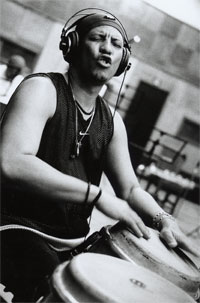
The conga world is stunned by the early death of this master musician. To get an idea of how interesting Angá was besdies being a virtuoso congero, check out his last album.
Cuban Conga Master Miguel ‘Angá’ Díaz Dies at 45
08/10/2006 09:04PM
Contributed by: WMC_News_Dept.
ObituariesUK - British label World Circuit announced today the death of Miguel ‘Angá’ Díaz. "World Circuit are shocked and saddened to announce the death of the great Cuban conga player Miguel ‘Angá’ Díaz who died unexpectedly at his home in Barcelona on 9th August 2006, he was 45."
With his explosive soloing and inventive five conga patterns, Angá’ was widely regarded as one of the world’s great congueros. He was committed to the development of the conga drum, breaking down traditional percussion barriers to perform traditional Latin rhythms, jazz, jungle and hip-hop, whilst retaining his distinctly Cuban roots.
Angá began playing prodigiously early, performing and recording professionally whilst still at college. He made his name as part of the pioneering Latin jazz group Irakere and it was with them he perfected his five drum technique. Emerging in the mid-nineties as an independent musician Angá was free to diversify and pursue a variety of different projects – from the experimental jazz of Steve Coleman and Roy Hargrove, to hip hop with Orishas, to his tours with Omar Sosa, and numerous side projects with musicians from all over the globe, Angá’s musical journey was a personal quest to explore and create new sounds and rhythmic fusions.
More than just a performer, Angá further demonstrated his commitment to the development of his instrument by teaching master classes at various schools and universities across North America and Europe. Angá produced a tuition video in 2000 which explained many of his techniques and his philosophy behind playing, it won Percussion Video of the Year from Drum Magazine. Angá would continue to teach on a regular basis and built up a network of students from his base outside of Barcelona.
Angá’s first project with World Circuit was the hugely influential Afro Cuban All Stars album, A Toda Cuba Le Gusta, recorded in 1996 which showcased the depth and vitality within Cuban music. Angá became an integral part of World Circuit’s extended Buena Vista Social Club family adding his trademark sound to albums from Rubén González, Ibrahim Ferrer, Omara Portuondo, Guajiro Mirabal, and the second Afro Cuban All Stars record. Angá’s own musical vision would emerge with the release of the album ‘Cachaíto’ an inspired union of Afro-Cuban jazz, reggae, hip hop and funk which he recorded with the Cuban bass legend Cachaíto López.
Building from the foundations laid by Cachaíto’s record, and incorporating elements of his own Santeria religion, Angá would finally fulfil his dream in 2005 with the release of his critically acclaimed album Echu Mingua, an exciting fusion of styles blended together the ‘Cuban way’ and is a fitting testament to the career of one of the great musical innovators.
"Angá was an irrepressible character with a larger than life personality, whose beaming grin and booming laugh were matched by a warmth and humility that touched all of those lucky enough to know him. He will be sorely missed," said a World Circuit press release.
Sunday, August 07, 2005
Chicken calypso lawsuit
Chicken Case Goes to Caribbean Court
By PHILIP SPOONER, Associated Press WriterSun Aug 7, 2:44 PM ET
Sixteen years ago, allegations that a farm was supplying questionable chickens to restaurants inspired a flurry of biting calypso songs.
Memories of the "Barbados chicken controversy" still provoke chuckles among locals, but the furor died down and never resonated much off this Caribbean island.
That's about to change.
A libel suit by the farm's owners on Monday will be the unlikely first case to go before a regional appeals court set up to replace the colonial-era Privy Council in faraway London as the final legal arbiter for most former British territories in the Caribbean.
At the same time, the case carries important implications for free speech, and some people worry it could threaten the traditional role of "calypsonians" as the region's political satirists.
The plaintiffs, Ram and Asha Mirchandani, contend the scathing calypso songs forced them to close their farm in 1990 even though allegations by some employees that they were selling sick chickens never were proven.
In 1999, they won a judgment against Barbados Rediffusion, one of the radio stations that played the satirical songs, but the couple has not been awarded damages as the case is appealed.
On Monday, the Trinidad-based Caribbean Court of Justice will decide whether to consider the radio station's final attempt to have the lawsuit dismissed. The nine-judge panel has not disclosed when it will rule.
The hearing will offer the first glimpse at the workings of the court, which opened in April but so far has been formally adopted by only Barbados and Guyana as their final appeals tribunal. Other members of the 16-nation Caribbean Community are wrestling with legal obstacles or resistance from critics, who fear the court could be vulnerable to political pressure.
The push for the court arose when Britain's Privy Council began blocking attempts to impose the death penalty in the 1990s, angering people across the Caribbean fearful about a surge in violent crime as their islands became transit points for drug trafficking.
But while the court grew out of worries about criminals, its first case is a test of free speech.
Afro-Caribbean calypso music evolved in Trinidad as a means of spreading news — and of denouncing corruption and other problems. Calypsonians often were the target of censorship during British colonial rule.
"They function like lampoonists," said Gordon Rohlehr, a literature professor at the University of the West Indies who has written about the role of calypso. "The calypsonians are regarded as the people who sniff out the truth and who tell you what the man on the street thinks."
Attorneys for the Mirchandanis and the radio station declined to discuss the chicken controversy, which erupted in 1989 during carnival, a time when calypsonians traditionally debut their most acidic lyrics.
Several employees of the MacDonald Chicken Farm accused the Mirchandanis of processing and selling chickens that had died of illnesses. An explosion of calypso songs about questionable chicken meat flooded the airwaves, while carnival revelers donned chicken costumes or T-shirts with rude slogans about the couple's farm.
"I was concentrating on highlighting the way people were feeling at the time," said Mighty Gabby, Barbados' most venerated calypsonian. "The issue was to voice the people's opinion, not to hurt."
His song on the controversy, "Chicken and Ram," carried lyrics veiled enough that it was one of the few chicken calypsos that radio stations did not drop when the Mirchandanis filed their lawsuit.
Calypsonians say libel judgments involving their music will have a chilling effect on creativity.
"On 'Saturday Night Live,' in the United States, their performers do some things that we can't even think about doing here in Barbados," said Peter Boyce, a performer with the five-member calypso and comedy troupe MADD, whose "Madd Chicken Song" was among those banned because of the lawsuit.
"We need laws that allow for more freedom of expression."
Rohlehr isn't so sure. He believes the threat of censorship and lawsuits has inspired the veiled imagery and double-entendre that make for the best calypso songs.
A victory for the Mirchandanis might "simply make for better and more clever songs," he said.
___
Associated Press reporters Alexandra Olson in San Juan, Puerto Rico, and Bert Wilkinson in Georgetown, Guyana, contributed to this report.
By PHILIP SPOONER, Associated Press WriterSun Aug 7, 2:44 PM ET
Sixteen years ago, allegations that a farm was supplying questionable chickens to restaurants inspired a flurry of biting calypso songs.
Memories of the "Barbados chicken controversy" still provoke chuckles among locals, but the furor died down and never resonated much off this Caribbean island.
That's about to change.
A libel suit by the farm's owners on Monday will be the unlikely first case to go before a regional appeals court set up to replace the colonial-era Privy Council in faraway London as the final legal arbiter for most former British territories in the Caribbean.
At the same time, the case carries important implications for free speech, and some people worry it could threaten the traditional role of "calypsonians" as the region's political satirists.
The plaintiffs, Ram and Asha Mirchandani, contend the scathing calypso songs forced them to close their farm in 1990 even though allegations by some employees that they were selling sick chickens never were proven.
In 1999, they won a judgment against Barbados Rediffusion, one of the radio stations that played the satirical songs, but the couple has not been awarded damages as the case is appealed.
On Monday, the Trinidad-based Caribbean Court of Justice will decide whether to consider the radio station's final attempt to have the lawsuit dismissed. The nine-judge panel has not disclosed when it will rule.
The hearing will offer the first glimpse at the workings of the court, which opened in April but so far has been formally adopted by only Barbados and Guyana as their final appeals tribunal. Other members of the 16-nation Caribbean Community are wrestling with legal obstacles or resistance from critics, who fear the court could be vulnerable to political pressure.
The push for the court arose when Britain's Privy Council began blocking attempts to impose the death penalty in the 1990s, angering people across the Caribbean fearful about a surge in violent crime as their islands became transit points for drug trafficking.
But while the court grew out of worries about criminals, its first case is a test of free speech.
Afro-Caribbean calypso music evolved in Trinidad as a means of spreading news — and of denouncing corruption and other problems. Calypsonians often were the target of censorship during British colonial rule.
"They function like lampoonists," said Gordon Rohlehr, a literature professor at the University of the West Indies who has written about the role of calypso. "The calypsonians are regarded as the people who sniff out the truth and who tell you what the man on the street thinks."
Attorneys for the Mirchandanis and the radio station declined to discuss the chicken controversy, which erupted in 1989 during carnival, a time when calypsonians traditionally debut their most acidic lyrics.
Several employees of the MacDonald Chicken Farm accused the Mirchandanis of processing and selling chickens that had died of illnesses. An explosion of calypso songs about questionable chicken meat flooded the airwaves, while carnival revelers donned chicken costumes or T-shirts with rude slogans about the couple's farm.
"I was concentrating on highlighting the way people were feeling at the time," said Mighty Gabby, Barbados' most venerated calypsonian. "The issue was to voice the people's opinion, not to hurt."
His song on the controversy, "Chicken and Ram," carried lyrics veiled enough that it was one of the few chicken calypsos that radio stations did not drop when the Mirchandanis filed their lawsuit.
Calypsonians say libel judgments involving their music will have a chilling effect on creativity.
"On 'Saturday Night Live,' in the United States, their performers do some things that we can't even think about doing here in Barbados," said Peter Boyce, a performer with the five-member calypso and comedy troupe MADD, whose "Madd Chicken Song" was among those banned because of the lawsuit.
"We need laws that allow for more freedom of expression."
Rohlehr isn't so sure. He believes the threat of censorship and lawsuits has inspired the veiled imagery and double-entendre that make for the best calypso songs.
A victory for the Mirchandanis might "simply make for better and more clever songs," he said.
___
Associated Press reporters Alexandra Olson in San Juan, Puerto Rico, and Bert Wilkinson in Georgetown, Guyana, contributed to this report.
Ibrahim Ferrer (1927-2005)
Buena Vista Social Club Singer Ferrer Dies
By Anita Snow
The Associated Press
Sunday, August 7, 2005; 12:46 AM
HAVANA -- Ibrahim Ferrer, a leading voice with the hugely popular Buena Vista Social Club of vintage Cuban performers, died Saturday, his representative in Cuba said. He was 78.
The Montuno production company did not give a cause of death, but Ferrer's colleagues said he suffered from emphysema and was feeling ill earlier in the week.
Known for his trademark cap and graying mustache, Ferrer was a wiry, animated figure who clearly enjoyed performing Cuba's traditional "son" music of the 1940s and 1950s for new generations of fans.
Among a group of older Cuban performers recruited by U.S. musician Ry Cooder, Ferrer performed on the "Buena Vista Social Club album" that won a Grammy in 1999, and was among those appearing in the film of the same name.
"I felt like he was my brother," said fellow Buena Vista performer, the guitarist Manuel Galban. "He was a great musician and a great companion."
Also in 1999, Ferrer was featured in one of a string of albums that followed, "Buena Vista Social Club Presents Ibrahim Ferrer," and won a Latin Grammy for best new artist in 2000.
Two other well-known members of the original Buena Vista group, singer Compay Segundo and pianist Ruben Gonzalez, died in 2003.
Originally from Cuba's eastern city of Santiago, Ferrer was born on Feb. 20, 1927, during a dance at a social club after his mother unexpectedly went into labor.
Ferrer was still a boy when he began singing professional with Santiago groups in 1941. By the late 1950s, he was a well-known singer performing regularly with the late, great bandleader Pacho Alonso.
He also made guest appearances with other legendary names, including Benny More and Orquesta de Chepin.
Alonso's group moved to Havana in 1959, and Ferrer came along, remaining with the group for more than two decades. By the early 1980s, Ferrer had left the musical scene, but came out of retirement to perform with the Buena Vista group.
© 2005 The Associated Press
By Anita Snow
The Associated Press
Sunday, August 7, 2005; 12:46 AM
HAVANA -- Ibrahim Ferrer, a leading voice with the hugely popular Buena Vista Social Club of vintage Cuban performers, died Saturday, his representative in Cuba said. He was 78.
The Montuno production company did not give a cause of death, but Ferrer's colleagues said he suffered from emphysema and was feeling ill earlier in the week.
Known for his trademark cap and graying mustache, Ferrer was a wiry, animated figure who clearly enjoyed performing Cuba's traditional "son" music of the 1940s and 1950s for new generations of fans.
Among a group of older Cuban performers recruited by U.S. musician Ry Cooder, Ferrer performed on the "Buena Vista Social Club album" that won a Grammy in 1999, and was among those appearing in the film of the same name.
"I felt like he was my brother," said fellow Buena Vista performer, the guitarist Manuel Galban. "He was a great musician and a great companion."
Also in 1999, Ferrer was featured in one of a string of albums that followed, "Buena Vista Social Club Presents Ibrahim Ferrer," and won a Latin Grammy for best new artist in 2000.
Two other well-known members of the original Buena Vista group, singer Compay Segundo and pianist Ruben Gonzalez, died in 2003.
Originally from Cuba's eastern city of Santiago, Ferrer was born on Feb. 20, 1927, during a dance at a social club after his mother unexpectedly went into labor.
Ferrer was still a boy when he began singing professional with Santiago groups in 1941. By the late 1950s, he was a well-known singer performing regularly with the late, great bandleader Pacho Alonso.
He also made guest appearances with other legendary names, including Benny More and Orquesta de Chepin.
Alonso's group moved to Havana in 1959, and Ferrer came along, remaining with the group for more than two decades. By the early 1980s, Ferrer had left the musical scene, but came out of retirement to perform with the Buena Vista group.
© 2005 The Associated Press
Saturday, May 07, 2005
America Heavy Metal Concert in Cuba
U.S. Band Gives Outdoor Concert in Cuba
By JOHN RICE, Associated Press WriterSat May 7, 4:46 PM ET
The American group Audioslave broke decades-long barriers with a thundering concert before thousands of Cuban fans — who knocked over barriers to get closer to the first U.S. rock band to play an outdoor concert in Cuba.
Chris Cornell's scream — "I won't do what you tell me!" — boomed off the high-rise apartment buildings on south side of the stage Friday night as feedback shrieks from Tom Morello's guitar drifted into the night breeze over the Caribbean to the north.
"This is the best thing that has happened here this year," said 25-year-old rock fan Omar Juanes.
"The best thing in your life," shouted a nearby friend who darted back into a crowd of more than 3,000 people — many with dreadlocks, body piercings and tattoos. A few swooped around the edges of the crowd on roller blades.
It was a distinct difference from the orderly, clean-cut crowds who march in massive anti-U.S. protests along the Malecon waterfront at the same venue: the Jose Marti Anti-Imperialist Tribunal before the U.S. Interests Section, or diplomatic mission.
Even before the concert, hundreds of fans were so eager that they sent metal security barricades clanging to the pavement and rushed forward to fill a 50-yard long area that had been reserved for special guests — mostly workers and teachers with exemplary official records.
Police allowed the fans to stay in the invaded space and several joked with tattooed youths in Metallica T-shirts swigging rum.
U.S. travel restrictions on Cuba and the Cuban government's ambivalence toward rock music have limited visits by U.S. rockers to Cuba.
Officials often cite Billy Joel's 1979 indoor performance as a rock and roll landmark here.
But elemental grunge, thrash and metal are the most popular styles of rock on an island rich in its own complex, polyrhythmic popular music.
Audioslave had the whole crowd screaming and dancing when it went back to its frantic, pounding, grungy roots, but left those in the back merely toe-tapping on some of the newer, less frantic songs.
"We would like to have stronger music — bands like Metallica," said a gaunt man sitting alongside friends on the Malecon seawall who gave his name as Walter Delgado, 32. Even so, he said, "We are happy for the first time in our rock and roll history."
By JOHN RICE, Associated Press WriterSat May 7, 4:46 PM ET
The American group Audioslave broke decades-long barriers with a thundering concert before thousands of Cuban fans — who knocked over barriers to get closer to the first U.S. rock band to play an outdoor concert in Cuba.
Chris Cornell's scream — "I won't do what you tell me!" — boomed off the high-rise apartment buildings on south side of the stage Friday night as feedback shrieks from Tom Morello's guitar drifted into the night breeze over the Caribbean to the north.
"This is the best thing that has happened here this year," said 25-year-old rock fan Omar Juanes.
"The best thing in your life," shouted a nearby friend who darted back into a crowd of more than 3,000 people — many with dreadlocks, body piercings and tattoos. A few swooped around the edges of the crowd on roller blades.
It was a distinct difference from the orderly, clean-cut crowds who march in massive anti-U.S. protests along the Malecon waterfront at the same venue: the Jose Marti Anti-Imperialist Tribunal before the U.S. Interests Section, or diplomatic mission.
Even before the concert, hundreds of fans were so eager that they sent metal security barricades clanging to the pavement and rushed forward to fill a 50-yard long area that had been reserved for special guests — mostly workers and teachers with exemplary official records.
Police allowed the fans to stay in the invaded space and several joked with tattooed youths in Metallica T-shirts swigging rum.
U.S. travel restrictions on Cuba and the Cuban government's ambivalence toward rock music have limited visits by U.S. rockers to Cuba.
Officials often cite Billy Joel's 1979 indoor performance as a rock and roll landmark here.
But elemental grunge, thrash and metal are the most popular styles of rock on an island rich in its own complex, polyrhythmic popular music.
Audioslave had the whole crowd screaming and dancing when it went back to its frantic, pounding, grungy roots, but left those in the back merely toe-tapping on some of the newer, less frantic songs.
"We would like to have stronger music — bands like Metallica," said a gaunt man sitting alongside friends on the Malecon seawall who gave his name as Walter Delgado, 32. Even so, he said, "We are happy for the first time in our rock and roll history."
Sunday, March 13, 2005
Homophobia in Jamaican Dancehall
Village Voice
February 15th, 2005 1:36 PM
Jah Division: Free speech, cultural sovereignty, and human rights clash in reggae dancehall homophobia debate
by Elena Oumano
February 15th, 2005 1:36 PM
Here in New York City, gays in clubs win' up to wildly popular reggae dancehall lyrics like "Fire fi de man dem weh go ride man behind," much as older gays pray in churches that condemn homosexuality. A mere dozen or so protesters picketed the sold-out Hot 97 "On da Reggae Tip Live" at Hammerstein Ballroom last September. Why pay mind to the words when the riddim and the vibe sweet yuh so?
But on Sunday, January 29, JAMPACT, an NYC-based Jamaican American civic group, held a panel at St. Francis College composed of Dr. Gordon Shirley, Jamaica's ambassador to the U.S.; Rebecca Schleifer of Human Rights Watch; Jamaican gay activist Larry Chang; and others. Schleifer was asked to address and defend points in her recent report issued by HRW in which she found that widespread homophobia in Jamaica endangers the welfare not only of those at high risk for HIV/AIDS, but also of HIV/AIDS outreach health care workers. Three days later, Amnesty International's OUTfront! program and New York's Lesbian, Gay, Bisexual & Transgender Community Center hosted a panel discussion at LGBT's Manhattan headquarters with representatives from the Jamaica Forum for Lesbians, All-Sexuals and Gays (J-FLAG), as part of J-FLAG's campaign for support in holding Jamaican authorities accountable for failing to protect the human rights of their LGBT citizens. While dancehall homophobia has been fodder for international headlines lately, "at the Forum, J-FLAG made clear that reggae dancehall's homophobia merely fuels Jamaica's widespread cultural bias against homosexuality and bisexuality," says Alisa Wellek, of the LGBT center.
Following widespread cancellations of dancehall concerts, Sizzla was banned in November from entering the U.K., while he and seven other dancehall artists—Beenie Man, Buju Banton, Elephant Man, Vybz Kartel, T.O.K., Capleton, and Bounty Killer—were investigated by Scotland Yard after gay activists asserted that their homophobic song lyrics constitute incitement to actual murder. In the U.S., where free speech is less restricted, "Stop Murder Music" had shut down only 30 or so Beenie Man and Capleton dates this past summer and fall, mostly on the West Coast. Meanwhile, U.K. gay activist group OutRage! shifted its "Stop Murder Music" campaign higher up reggae's food chain to retail outlets and record labels like NYC-based reggae indie VP Records. After months of negotiations, gay activist groups, the labels, and promoters announced early this month that they'd reached an agreement, and that the "Stop Murder Music" campaign had been suspended.
Reggae may have started out as a poor man's party—a turntable, homemade speakers, and a public light source—but it's grown into Jamaica's survival dream, one shared by politicians, businessmen, and scrawny boys rocking toothbrush microphones. Now that the worldwide debate over what should be a universal right—to love and/or sex the adult of your choice—is focused on that live wire of an island, the dream is threatened, big-time.
New Yorkers—even those who get Jamaican patwah—may dismiss the batty man/chi chi lyrical craze as senseless babble over wicked beats, "but they don't understand what those words mean for us here," says Dr. Nesha Haniff, a volunteer physician with Jamaica AIDS Support (JAS). What those words mean for Jamaica's gays, lesbians, bisexuals, and those trying to help them is detailed in a 79-page report issued November 16 by Human Rights Watch. Titled "Hated to Death: Homophobia, Violence, and Jamaica's HIV/AIDS Epidemic," it roundly condemns Prime Minister P.J. Patterson, a law mandating up to 10 years hard labour for buggery, the national health ministry, the police force, churches, and the average Jamaican on the street for homophobia so endemic that efforts to control Jamaica's HIV/AIDS epidemic are dramatically compromised. Dancehall is not exempted. The report concludes with sample homophobic song lyrics—in patwah and English translation.
Jamaican scholar Carolyn Cooper, author of Sound Clash, describes the JA dancehall as a place of clashes "for sound systems contending for mastery," and "more broadly . . . [as] a trenchant metaphor for the hostile interfacing of warring zones in Jamaican society." This controversy speaks to an even harder three-way clash—between free speech, cultural sovereignty, and human rights. Should an artist's voice ever be censored? And when is it OK to violate a nation's boundaries, literally or culturally?
Immediately following the one-two punch of "Stop Murder Music" and HRW's report, Jamaica's usually fractious society linked arms—churchman with Rastaman, policeman with ruffneck. Together as one, the nation informed the world, at least in its "outside voice," "First yuh must clean up yuh own backyard before yuh come clean up a next man own, and fi dem backyard more dirty than our own."
That outrage is less surprising than how long it took for dancehall's shit to hit the fan . . . again. The early-'90s furor ignited by Buju Banton's "Boom Bye Bye" had fueled reggae's long-standing (and mostly justified) paranoia by adding "gays who control the international entertainment industry" to the enemies list. Big men a foreign telling we what to do? Come, make we wheel and come again!
Jamaica is playing the neo-colonialism, figurative-expression, and religious-belief cards, but they're no match for universal rights—especially since OutRage! launched "Stop Murder Music" only after a plea for help from J-FLAG, an organization with a necessarily secret membership and HQ.
"Homophobic utterances are among the quickest and easiest ways to get a 'forward' [cheers, lighters, and flaming torches]," says dancehall singer Tanya Stephens. "I have seen this industry go through so many phases of stupidity, I no longer even pay attention. It would seem as if it's a moral issue based on our religious heritage, but in the midst of all the 'batty man' burning, many guys handing down 'moral' judgments are openly discussing threesomes they happily partake in with two girls!"
Yet Jamaica can't be dismissed as a bunch of third-world yahoos impeding the march of the Enlightened to higher ground. Jamaicans are a unique people in unique circumstances, and it's in the details of their story that some deeper understanding of the global debate about homosexuality can be drawn.
We're talking about an island of nearly 4,500 square miles, holding 2.7 million descendants of Africans who drifted 4,000 miles from home, tuned into Miami and New Orleans radio as well as to Cuban airwaves, and created a musical culture that's become a central pillar in the world's continuing refusal of the neo-colonial Massa.
From the first days of slavery, communities of Maroons—escaped slaves and free blacks—fought back, first against the Spanish, then the British. From hiding places in mountain bush, Maroon guerrillas rolled on the ground and leaped in the air. One shooter seemed like several to British militia struggling single file up steep trails, terrorized by taunts, beating drums, the abeng horn's eerie call to arms, and the certainty of being picked off, one by one. By the mid 1700s, the colonial government was forced to treat with the Maroons, granting them freedom and a limited sovereignty they retain to this day.
The dancehall DJ is heir to Maroon resistance, making him not only a voice of the people, but also a taunting griot-warrior, and making the Jamaican dancehall more than a "forget your troubles and dance" party, more than even economic survival. Dancehall is a place of national myth, of rituals affirming triumph over the oppressor.
Slavery and colonialism are gone, but Jamaica's 1962 independence masked the economic abandonment of an absentee plantation worked past profitability. The queen gifted her former colony, though, bequeathing Jamaica her church, Bible, and buggery laws. That little-old-lady-in-the-Cotswolds mentality is more recent, and therefore, more vivid in the Jamaican consciousness than any dim genetic recollections of pre-colonial Africa. Even the Rastaman who rejects church as part of the Babylonian West is not immune. Folded into his message of black self-reliance (and for some, separatism) and an African utopia is good old-fashioned King Jamesian fire and brimstone for Babylonian abominations like homosexuality. Yet mounting academic research suggests that the West's legacy to Africa is homophobia, not homosexuality. Yes, Buju, Beenie, and Bounty—gays, lesbians, and bisexuals lived comfortably alongside heteros in many African tribes, long before the white man.
The U.S. hasn't served its neighbor well either. After undermining Jamaica's socialist economic policies in the '70s, then offering International Monetary Fund and World Bank loans with onerous terms that tanked that nation's economy, we unleashed a flood of X-rated images on Jamaica via satellite and cable TV. Suddenly, Jamaicans were witnessing gays revamping straights, Oprah freaking over the "down low," and HBO flinging the window open on all manner of sexual kinkiness. JA's newspapers used to report relatively mild tales of country virgins seduced by parish preachers. Now the tabloids are bursting with sex ads and accounts of bisexual and gay orgies, ghetto boys selling their bodies, unsuspecting women infected with HIV/AIDS by bisexual partners, and Christmas barrels sent home stuffed with foreign porn.
Jamaica's own leaders also have a lot to answer for. In the '70s, the Jamaica Labour Party (JLP) and the People's National Party (PNP) armed their respective voting blocs. One day, kids from Trench Town's First and Eighth streets were shooting marbles together; the next, they were aiming guns at each other across jagged glass-topped concrete walls. When Jamaica became a major stop along cocaine's route from South to North America, gang leaders spun out of the politicians' control and became drug posse dons. Kingston's downtown devolved into a series of bleak, end-of-the-world districts run by dons with loose alliances to ministers of parliament, like Rema, with its four-story "high rises" that allow gunmen to fire on enemies below and its blood-soaked field that ends where a rusted-out car chassis blocks the lane leading into enemy turf. A huge percentage of the young men in Kingston's inner city is unemployed, education is a luxury, and the per capita murder rate has skyrocketed to more than five times that of the U.S. Yet Kingston's ghettos have a raw glamour of their own, mostly from a mother lode of reggae musical talent—"more stars than Hollywood," says Bunny Wailer.
Reggae may be a testament to the transforming powers of a conscious underclass, but the day-to-day ghetto grind testifies to countless ills bred by poverty and post-traumatic slavery and colonialism disorder. Young men unable to make a living and raise families suffer from a fragile sense of masculinity. With no outlet for all that cyclonic energy, what's left but church, territorial warfare, and/or controlling women with your big bamboo? Homosexual sex doesn't fit this picture; it becomes yet another way to rob the black man of his manhood.
Dancehall and its artists come from this place of dispossession and loss, not from the palm-shaded civility of Kingston's gated uptown communities. And young ghetto girls and boys are prey to those uptown top rankings. "A lot of guys come into the ghetto and influence little boys with clothes and shoes and them things, then molest them," says Beenie Man, who claims his lyrics target child abusers only. "I man nah response fi who you want, as long as him a big man. It's all about the youth." Beenie Man was born and raised in Craig Town. Elephant Man and Bounty Killer come from Seaview Gardens, Buju from Barbican, Sizzla from August Town, and so on.
Beenie Man's argument may be disingenuous, but the dancehall fraternity answers to forces far more powerful than record labels, Human Rights Watch, and a gay entertainment lobby combined. That fraternity is so spooked by potential fallout at home that some "out" each other as a preemptive strategy. But onstage homophobic tirades and self-inoculation don't always work. Beenie Man is a prime target both of gay activists and his peers. After a mid-'90s appearance on The RuPaul Show, rumors questioning Beenie Man's sexuality whipped around Planet Reggae and persist to this day. Even PJ the PM is not immune. During the 2002 election, opposition JLP leader Edward Seaga adopted T.O.K.'s "Chi Chi Man" as his campaign theme song and strongly implied in speeches that the prime minister is gay. Like PJ, who felt compelled to state publicly that Jamaica's buggery law will not be repealed, dancehall's eight are stuck between the rock of OutRage! and the much harder place of their constituency.
Some Jamaicans opine that the island's usual tolerance for all manner of outré self-expression was beginning to extend to the island's homosexuals before OutRage! forced its hand. Angelo Ellerbee, an NYC African American publicist who's worked over the decades with Bounty Killer, Shabba Ranks, and others, is openly gay and always states "at the door that this is who I am; you can buy or not." They've always bought. Gays work and party with members of the Dancehall Eight—no problem, mon.
But no one's stepping out of reggae's closet yet. "Jus' 'low one" has yet to extend to open cruising, drag queens and kings parading down Jamaica's streets, or even simple statements of identity. Women who "act like lesbians" risk rape, and gay men risk blackmail, especially by the police. One Kingston attorney says his client roster always includes at least one man faced with that dilemma.
Yet when you consider that England only abolished its buggery laws in 1967 and the American Psychiatric Association deleted homosexuality from its list of psychiatric disorders a mere six years later, it's a wonder this tiny and youthful nation with its own tremendous cultural energy doesn't implode from all the self-righteous outside pressure.
Dancehall's eight will not—cannot—apologize, despite a collective income loss, according to OutRage!, of over $9 million, and the agreement isn't asking them to. In a country that boasts of more churches per capita than any other, few artists can do more than reflect their culture. But biblical citations re homosexuality aren't washing with OutRage!, particularly since dancehall overlooks the Bible's Mosaic law permitting slavery. And it doesn't help to explain that sound bwoys have been threatening to "murder" each other with music at mobile disco clashes ever since Coxsonne Dodd's set first took on Duke Reid's.
Sizzla's arrest under Jamaica's Town and Country Act for "using bad words" during his performance at Jamaica East Fest on Christmas is not the first: Lady Saw and Bounty Killer were arrested under the act several years ago. The government's sudden renewed interest in dancehall could be a sign that it's about to clamp down on any performer whose words threaten to kill off the reggae dancehall cash cow.
"They've won," says VP Records consultant Maxine Stowe, of "Stop Murder Music." Stowe would like to see more summits between gay activists and Jamaicans, especially since the current agreement is fragile. The U.K.'s Guardian wrote on February 5 that the reggae industry has "agreed to ban future material that could be seen as inciting violence against gays and lesbians."
But VP Records CEO Randy Chin says, "This agreement is not about censorship. To interpret it as such distorts the intent and substance of the agreement. It's about consensus, cooperation, and working together on resolving issues as they come up. We've acknowledged there's issues with some songs, but reggae is bigger than that. Neither side has an interest in continuing the 'Stop Murder Music' campaign."
In the U.S. and U.K. at least, "Jus' 'low one" ("just allow a man"—live and let live) got the last word. Dancehall's eight have been handed a way out of this mess. Sizzla once asked if he could "make it in America." Yes, he and the other artists in question can: but only if they leave the "inside voice" at home.
Elena Oumano is working on a book about dancehall culture.
February 15th, 2005 1:36 PM
Jah Division: Free speech, cultural sovereignty, and human rights clash in reggae dancehall homophobia debate
by Elena Oumano
February 15th, 2005 1:36 PM
Here in New York City, gays in clubs win' up to wildly popular reggae dancehall lyrics like "Fire fi de man dem weh go ride man behind," much as older gays pray in churches that condemn homosexuality. A mere dozen or so protesters picketed the sold-out Hot 97 "On da Reggae Tip Live" at Hammerstein Ballroom last September. Why pay mind to the words when the riddim and the vibe sweet yuh so?
But on Sunday, January 29, JAMPACT, an NYC-based Jamaican American civic group, held a panel at St. Francis College composed of Dr. Gordon Shirley, Jamaica's ambassador to the U.S.; Rebecca Schleifer of Human Rights Watch; Jamaican gay activist Larry Chang; and others. Schleifer was asked to address and defend points in her recent report issued by HRW in which she found that widespread homophobia in Jamaica endangers the welfare not only of those at high risk for HIV/AIDS, but also of HIV/AIDS outreach health care workers. Three days later, Amnesty International's OUTfront! program and New York's Lesbian, Gay, Bisexual & Transgender Community Center hosted a panel discussion at LGBT's Manhattan headquarters with representatives from the Jamaica Forum for Lesbians, All-Sexuals and Gays (J-FLAG), as part of J-FLAG's campaign for support in holding Jamaican authorities accountable for failing to protect the human rights of their LGBT citizens. While dancehall homophobia has been fodder for international headlines lately, "at the Forum, J-FLAG made clear that reggae dancehall's homophobia merely fuels Jamaica's widespread cultural bias against homosexuality and bisexuality," says Alisa Wellek, of the LGBT center.
Following widespread cancellations of dancehall concerts, Sizzla was banned in November from entering the U.K., while he and seven other dancehall artists—Beenie Man, Buju Banton, Elephant Man, Vybz Kartel, T.O.K., Capleton, and Bounty Killer—were investigated by Scotland Yard after gay activists asserted that their homophobic song lyrics constitute incitement to actual murder. In the U.S., where free speech is less restricted, "Stop Murder Music" had shut down only 30 or so Beenie Man and Capleton dates this past summer and fall, mostly on the West Coast. Meanwhile, U.K. gay activist group OutRage! shifted its "Stop Murder Music" campaign higher up reggae's food chain to retail outlets and record labels like NYC-based reggae indie VP Records. After months of negotiations, gay activist groups, the labels, and promoters announced early this month that they'd reached an agreement, and that the "Stop Murder Music" campaign had been suspended.
Reggae may have started out as a poor man's party—a turntable, homemade speakers, and a public light source—but it's grown into Jamaica's survival dream, one shared by politicians, businessmen, and scrawny boys rocking toothbrush microphones. Now that the worldwide debate over what should be a universal right—to love and/or sex the adult of your choice—is focused on that live wire of an island, the dream is threatened, big-time.
New Yorkers—even those who get Jamaican patwah—may dismiss the batty man/chi chi lyrical craze as senseless babble over wicked beats, "but they don't understand what those words mean for us here," says Dr. Nesha Haniff, a volunteer physician with Jamaica AIDS Support (JAS). What those words mean for Jamaica's gays, lesbians, bisexuals, and those trying to help them is detailed in a 79-page report issued November 16 by Human Rights Watch. Titled "Hated to Death: Homophobia, Violence, and Jamaica's HIV/AIDS Epidemic," it roundly condemns Prime Minister P.J. Patterson, a law mandating up to 10 years hard labour for buggery, the national health ministry, the police force, churches, and the average Jamaican on the street for homophobia so endemic that efforts to control Jamaica's HIV/AIDS epidemic are dramatically compromised. Dancehall is not exempted. The report concludes with sample homophobic song lyrics—in patwah and English translation.
Jamaican scholar Carolyn Cooper, author of Sound Clash, describes the JA dancehall as a place of clashes "for sound systems contending for mastery," and "more broadly . . . [as] a trenchant metaphor for the hostile interfacing of warring zones in Jamaican society." This controversy speaks to an even harder three-way clash—between free speech, cultural sovereignty, and human rights. Should an artist's voice ever be censored? And when is it OK to violate a nation's boundaries, literally or culturally?
Immediately following the one-two punch of "Stop Murder Music" and HRW's report, Jamaica's usually fractious society linked arms—churchman with Rastaman, policeman with ruffneck. Together as one, the nation informed the world, at least in its "outside voice," "First yuh must clean up yuh own backyard before yuh come clean up a next man own, and fi dem backyard more dirty than our own."
That outrage is less surprising than how long it took for dancehall's shit to hit the fan . . . again. The early-'90s furor ignited by Buju Banton's "Boom Bye Bye" had fueled reggae's long-standing (and mostly justified) paranoia by adding "gays who control the international entertainment industry" to the enemies list. Big men a foreign telling we what to do? Come, make we wheel and come again!
Jamaica is playing the neo-colonialism, figurative-expression, and religious-belief cards, but they're no match for universal rights—especially since OutRage! launched "Stop Murder Music" only after a plea for help from J-FLAG, an organization with a necessarily secret membership and HQ.
"Homophobic utterances are among the quickest and easiest ways to get a 'forward' [cheers, lighters, and flaming torches]," says dancehall singer Tanya Stephens. "I have seen this industry go through so many phases of stupidity, I no longer even pay attention. It would seem as if it's a moral issue based on our religious heritage, but in the midst of all the 'batty man' burning, many guys handing down 'moral' judgments are openly discussing threesomes they happily partake in with two girls!"
Yet Jamaica can't be dismissed as a bunch of third-world yahoos impeding the march of the Enlightened to higher ground. Jamaicans are a unique people in unique circumstances, and it's in the details of their story that some deeper understanding of the global debate about homosexuality can be drawn.
We're talking about an island of nearly 4,500 square miles, holding 2.7 million descendants of Africans who drifted 4,000 miles from home, tuned into Miami and New Orleans radio as well as to Cuban airwaves, and created a musical culture that's become a central pillar in the world's continuing refusal of the neo-colonial Massa.
From the first days of slavery, communities of Maroons—escaped slaves and free blacks—fought back, first against the Spanish, then the British. From hiding places in mountain bush, Maroon guerrillas rolled on the ground and leaped in the air. One shooter seemed like several to British militia struggling single file up steep trails, terrorized by taunts, beating drums, the abeng horn's eerie call to arms, and the certainty of being picked off, one by one. By the mid 1700s, the colonial government was forced to treat with the Maroons, granting them freedom and a limited sovereignty they retain to this day.
The dancehall DJ is heir to Maroon resistance, making him not only a voice of the people, but also a taunting griot-warrior, and making the Jamaican dancehall more than a "forget your troubles and dance" party, more than even economic survival. Dancehall is a place of national myth, of rituals affirming triumph over the oppressor.
Slavery and colonialism are gone, but Jamaica's 1962 independence masked the economic abandonment of an absentee plantation worked past profitability. The queen gifted her former colony, though, bequeathing Jamaica her church, Bible, and buggery laws. That little-old-lady-in-the-Cotswolds mentality is more recent, and therefore, more vivid in the Jamaican consciousness than any dim genetic recollections of pre-colonial Africa. Even the Rastaman who rejects church as part of the Babylonian West is not immune. Folded into his message of black self-reliance (and for some, separatism) and an African utopia is good old-fashioned King Jamesian fire and brimstone for Babylonian abominations like homosexuality. Yet mounting academic research suggests that the West's legacy to Africa is homophobia, not homosexuality. Yes, Buju, Beenie, and Bounty—gays, lesbians, and bisexuals lived comfortably alongside heteros in many African tribes, long before the white man.
The U.S. hasn't served its neighbor well either. After undermining Jamaica's socialist economic policies in the '70s, then offering International Monetary Fund and World Bank loans with onerous terms that tanked that nation's economy, we unleashed a flood of X-rated images on Jamaica via satellite and cable TV. Suddenly, Jamaicans were witnessing gays revamping straights, Oprah freaking over the "down low," and HBO flinging the window open on all manner of sexual kinkiness. JA's newspapers used to report relatively mild tales of country virgins seduced by parish preachers. Now the tabloids are bursting with sex ads and accounts of bisexual and gay orgies, ghetto boys selling their bodies, unsuspecting women infected with HIV/AIDS by bisexual partners, and Christmas barrels sent home stuffed with foreign porn.
Jamaica's own leaders also have a lot to answer for. In the '70s, the Jamaica Labour Party (JLP) and the People's National Party (PNP) armed their respective voting blocs. One day, kids from Trench Town's First and Eighth streets were shooting marbles together; the next, they were aiming guns at each other across jagged glass-topped concrete walls. When Jamaica became a major stop along cocaine's route from South to North America, gang leaders spun out of the politicians' control and became drug posse dons. Kingston's downtown devolved into a series of bleak, end-of-the-world districts run by dons with loose alliances to ministers of parliament, like Rema, with its four-story "high rises" that allow gunmen to fire on enemies below and its blood-soaked field that ends where a rusted-out car chassis blocks the lane leading into enemy turf. A huge percentage of the young men in Kingston's inner city is unemployed, education is a luxury, and the per capita murder rate has skyrocketed to more than five times that of the U.S. Yet Kingston's ghettos have a raw glamour of their own, mostly from a mother lode of reggae musical talent—"more stars than Hollywood," says Bunny Wailer.
Reggae may be a testament to the transforming powers of a conscious underclass, but the day-to-day ghetto grind testifies to countless ills bred by poverty and post-traumatic slavery and colonialism disorder. Young men unable to make a living and raise families suffer from a fragile sense of masculinity. With no outlet for all that cyclonic energy, what's left but church, territorial warfare, and/or controlling women with your big bamboo? Homosexual sex doesn't fit this picture; it becomes yet another way to rob the black man of his manhood.
Dancehall and its artists come from this place of dispossession and loss, not from the palm-shaded civility of Kingston's gated uptown communities. And young ghetto girls and boys are prey to those uptown top rankings. "A lot of guys come into the ghetto and influence little boys with clothes and shoes and them things, then molest them," says Beenie Man, who claims his lyrics target child abusers only. "I man nah response fi who you want, as long as him a big man. It's all about the youth." Beenie Man was born and raised in Craig Town. Elephant Man and Bounty Killer come from Seaview Gardens, Buju from Barbican, Sizzla from August Town, and so on.
Beenie Man's argument may be disingenuous, but the dancehall fraternity answers to forces far more powerful than record labels, Human Rights Watch, and a gay entertainment lobby combined. That fraternity is so spooked by potential fallout at home that some "out" each other as a preemptive strategy. But onstage homophobic tirades and self-inoculation don't always work. Beenie Man is a prime target both of gay activists and his peers. After a mid-'90s appearance on The RuPaul Show, rumors questioning Beenie Man's sexuality whipped around Planet Reggae and persist to this day. Even PJ the PM is not immune. During the 2002 election, opposition JLP leader Edward Seaga adopted T.O.K.'s "Chi Chi Man" as his campaign theme song and strongly implied in speeches that the prime minister is gay. Like PJ, who felt compelled to state publicly that Jamaica's buggery law will not be repealed, dancehall's eight are stuck between the rock of OutRage! and the much harder place of their constituency.
Some Jamaicans opine that the island's usual tolerance for all manner of outré self-expression was beginning to extend to the island's homosexuals before OutRage! forced its hand. Angelo Ellerbee, an NYC African American publicist who's worked over the decades with Bounty Killer, Shabba Ranks, and others, is openly gay and always states "at the door that this is who I am; you can buy or not." They've always bought. Gays work and party with members of the Dancehall Eight—no problem, mon.
But no one's stepping out of reggae's closet yet. "Jus' 'low one" has yet to extend to open cruising, drag queens and kings parading down Jamaica's streets, or even simple statements of identity. Women who "act like lesbians" risk rape, and gay men risk blackmail, especially by the police. One Kingston attorney says his client roster always includes at least one man faced with that dilemma.
Yet when you consider that England only abolished its buggery laws in 1967 and the American Psychiatric Association deleted homosexuality from its list of psychiatric disorders a mere six years later, it's a wonder this tiny and youthful nation with its own tremendous cultural energy doesn't implode from all the self-righteous outside pressure.
Dancehall's eight will not—cannot—apologize, despite a collective income loss, according to OutRage!, of over $9 million, and the agreement isn't asking them to. In a country that boasts of more churches per capita than any other, few artists can do more than reflect their culture. But biblical citations re homosexuality aren't washing with OutRage!, particularly since dancehall overlooks the Bible's Mosaic law permitting slavery. And it doesn't help to explain that sound bwoys have been threatening to "murder" each other with music at mobile disco clashes ever since Coxsonne Dodd's set first took on Duke Reid's.
Sizzla's arrest under Jamaica's Town and Country Act for "using bad words" during his performance at Jamaica East Fest on Christmas is not the first: Lady Saw and Bounty Killer were arrested under the act several years ago. The government's sudden renewed interest in dancehall could be a sign that it's about to clamp down on any performer whose words threaten to kill off the reggae dancehall cash cow.
"They've won," says VP Records consultant Maxine Stowe, of "Stop Murder Music." Stowe would like to see more summits between gay activists and Jamaicans, especially since the current agreement is fragile. The U.K.'s Guardian wrote on February 5 that the reggae industry has "agreed to ban future material that could be seen as inciting violence against gays and lesbians."
But VP Records CEO Randy Chin says, "This agreement is not about censorship. To interpret it as such distorts the intent and substance of the agreement. It's about consensus, cooperation, and working together on resolving issues as they come up. We've acknowledged there's issues with some songs, but reggae is bigger than that. Neither side has an interest in continuing the 'Stop Murder Music' campaign."
In the U.S. and U.K. at least, "Jus' 'low one" ("just allow a man"—live and let live) got the last word. Dancehall's eight have been handed a way out of this mess. Sizzla once asked if he could "make it in America." Yes, he and the other artists in question can: but only if they leave the "inside voice" at home.
Elena Oumano is working on a book about dancehall culture.
Subscribe to:
Posts (Atom)

