Showing posts with label design/architecture. Show all posts

Thursday, July 24, 2008

A 7,500-Square-Foot Ad for Chanel, With an Artistic Mission


NYT
July 24, 2008
A 7,500-Square-Foot Ad for Chanel, With an Artistic Mission
By CAROL VOGEL

A rectangular patch of sand in Central Park may be the last place you’d expect to find a gleaming “Star Trek”-style spacecraft. But an art pavilion that resembles just that will make a temporary landing there this fall.

Called Mobile Art, the structure itself was designed by the renowned London architect Zaha Hadid and will occupy the Rumsey Playfield, midpark at 70th Street, from Oct. 20 to Nov. 9. (It is Ms. Hadid’s first New York building, albeit temporary, and has already made stops in Hong Kong and Tokyo and is headed later for London, Moscow and Paris.)

Yet beyond its artistic mission, the pavilion is a provocative advertisement. Chanel, the fashion brand, commissioned Ms. Hadid to create the traveling structure to house works by about 15 hot contemporary artists. Each was asked to create a work that was at least in part inspired by Chanel’s classic 2.55 quilted-style chain handbag, so named because it was first issued in February 1955.

Maureen Chiquet, Chanel’s global chief executive, declined to give specifics on financial arrangements. But officials familiar with the project, requesting anonymity in deference to Chanel, said that the fashion house was donating a sum “in the low seven figures” to the Central Park Conservancy. Chanel will also pay the city a “use fee” of $400,000.

Artists recruited for the project include Sophie Calle of France, Sylvie Fleury of Switzerland, Subodh Gupta of India and the Russian collective Blue Noses. The resulting works in the show, organized by Fabrice Bousteau, editor in chief of Beaux Arts magazine, include sculpture, photographs, videos and installation pieces.

Many of the artists explored the notion of the handbag as a cultural symbol, often with a dash of irreverence. Mr. Gupta produced “All Things Are Inside,” a video installation that is a meditation on people in transit, like an Indian laborer who returns from Dubai. It also includes clips from Indian films in which the handbag emerges as an element in a human drama.

Blue Noses created “Fifty Years After Our Common Era or Handbags Revolt,” an installation of packing boxes in which videos show satirical moments in the life of a handbag. Ms. Fleury created a giant Pop Art-style quilted handbag lined with pink fur; inside is a makeup compact in which you can view a video of women shooting handbags with guns.

The genesis for the project was the handbag’s 50th anniversary in 2005, when Chanel’s designer, Karl Lagerfeld, issued a new version of the purse, Ms. Chiquet said. The project took several years to come to fruition.

Admission to the exhibition in Central Park will be free, although visitors are advised to book timed tickets at chanel-mobileart.com.

With the weakened dollar New York has become a magnet for European and Asian visitors, and city officials are hoping that the art pavilion will be a draw for tourists. They cited precedents like Christo and Jeanne-Claude’s “Gates,” in which 7,500 gates festooned with saffron-colored fabric panels were positioned along Central Park’s pathways for 16 days in 2005, or the four waterfalls designed by the artist Olafur Eliasson that grace the shores of Brooklyn, Manhattan and Governors Island this summer.

“Right now Central Park is one big international duty-free zone,” said Adrian Benepe, the city’s parks commissioner. “You can’t walk through it without hearing lots of different languages.”

Douglas Blonsky, president of the Central Park Conservancy, said the pavilion would fit perfectly on the 1.5-acre playfield. “It’s low enough so it won’t disturb people,” he said. “We wouldn’t use the Great Lawn or Sheep Meadow. It’s not taking over someone else’s space. It’s a neat little surprise.”

He and Mr. Benepe described Chanel’s donation as a windfall for the park. The money will go toward enhancing its horticulture, particularly in the area from 85th Street to the Harlem Meer.

Asked whether he anticipated criticism for allowing Chanel to advertise one of its products in the park, Mr. Benepe countered, “Everything has a sponsor.”

“Artists in 17th-century Italy wouldn’t have been in business were it not for their patrons,” he added, noting that ING lends its name to the New York City Marathon, which generates millions of dollars in tourist revenue each year.

The convergence of art, architecture and fashion is commonplace these days. A Louis Vuitton bag designed by the artist Richard Prince is constantly spotted on the streets of New York, Basel and London. The Japanese artist Takashi Murakami’s creations for Louis Vuitton were sold in a special shop that formed part of a Murakami retrospective at the Brooklyn Museum and the Los Angeles Museum of Contemporary Art. The architect Rem Koolhaas has helped define the look of Prada shops, and Frank Gehry recently designed a line of jewelry for Tiffany & Company.

“Art is art. Fashion is fashion,” Mr. Lagerfeld said. “However, Andy Warhol proved that they can exist together.”

Noting Ms. Hadid’s star status — she won the architecture profession’s highest honor, the Pritzker Prize, in 2004 — he suggested that “the most important piece of art is the container itself.”

In an interview in her London office, Ms. Hadid said that even though she has not yet designed a permanent building in New York, she liked the idea that the pavilion “lands, creates a buzz and disappears.”

The challenge, she said, was to create a pavilion that was both visually compelling and could be easily transported. Each piece had to fit together like a giant jigsaw puzzle.

Using computer software Ms. Hadid designed a 7,500-square-foot doughnut-shape structure with a central courtyard. Its lightweight panels can be packed in 51 shippable containers; no panel is wider than 7.38 feet.

Skylights admit natural light, and computer-generated lighting casts a rainbow of colors around the base of the exterior that glows day and night.

Visitors entering the pavilion will be given MP3 players. On a track created by the sound artist Stephan Crasneanscki they will hear the French actress Jeanne Moreau discussing everything from sex and love to the secrets at the bottom of a woman’s handbag.

After “Mobile Art” makes its last stop in Paris in 2010, Chanel will have the option to buy all the art. As for Ms. Hadid’s pavilion, Ms. Chiquet said, Chanel owns it but is not yet sure what it will do with it.

Its transitory nature, everyone agreed, will be part of the allure. “It’s like an alien spacecraft that lands in the park and, before you know it, takes off again,” Mr. Benepe said.

Saturday, April 05, 2008

Restaurant Noise: No Appetite for Noise

Washington Post Magazine
The No. 1 complaint of restaurant-goers in the Washington area isn't the service, or even the dinner. It's the din.

By Tom Sietsema
Sunday, April 6, 2008; W16

IT'S A TYPICAL NIGHT AT ZAYTINYA IN PENN QUARTER, which means there's a wait for a table, a mob at the bar, hundreds of mezze flowing from the open kitchen and a flock of hungry vultures waiting to snatch your bar stool at the slightest sign you might be vacating it.

The noise from all this activity is deafening. I can barely hear Eric Stehmer and Amy Wang, my drinking and dining companions for the evening, over the din. The problem is exacerbated by a concrete countertop, bare floor, overhead speakers and the occasional crash of a plate gone astray. A bartender's attempts to share his passion for Greek wines, which he's pouring by the splash for us to try, might as well be in Greek. The three of us have to lean in to hear what he's describing.

"The bar is definitely not a place for an intimate date," I think I catch Stehmer saying.

"It's a strain," agrees Wang, who has to repeat herself twice. "I don't like the feeling I have to raise my voice."

Our restaurant pager goes off. We know this only because the device lights up in bright red and vibrates across the counter toward Wang's pomegranate-flavored cocktail. A host leads us to a table in the dining room, which provides little relief from the aural assault. "This is the loudest restaurant I've ever worked in," our waiter shares after we ask him to repeat the evening's specials.

The scenario might prompt a yawn if it occurred on a weekend or if any of us were AARP members. The reality is, we're meeting on a Tuesday night. Wang is 25. Stehmer is 26. I'm 40-something.

As measured by the sound-level meter I'm carrying, the noise in the restaurant averages about 86 decibels -- the equivalent of truck traffic on a busy street, or a lawn mower.

BON APPETIT!

MORE THAN BAD FOOD, MORE THAN TIPPING QUANDARIES, more than someone wondering if a free meal should follow a rodent sighting in a dining room, the most frequent concern I get from readers involves loud restaurants. The complaints about noise have crescendoed so high in recent years that I've decided to add noise ratings to my dining column in the Magazine, beginning April 20. Henceforth, as I make my restaurant rounds, a discreet sound-level meter will be used to determine the average decibel count. [See this article for how the ratings will work.]

I know readers will welcome the addition of a sound check. When I raised the subject of noise on a recent online food discussion, I got an earful from scores of restaurant mavens. The feedback came from both sexes and a wide range of ages.

"The noise levels don't make me feel lively or youthful," wrote one. "They make me shout and keep asking, 'What?' I'm 34, but recently I have been seeking out 'oldster' restaurants for the noise levels alone. Would much prefer a younger vibe at lower decibels, if such a thing existed!"

"Why do restaurateurs think we want to eat but not to chat with our companions?" another chatter demanded.

"Thank you for bringing up something that's been bothering me for years -- the increased noise in restaurants," someone else chimed in. "I'm not just talking about those ubiquitous chains with their warehouse construction where everything echoes; [noise is] everywhere, it seems. And I hate it! I hate having to shout at the person next to me and not to be able to communicate without everyone at surrounding tables being aware of everything I say. Yet restaurateurs, and in some cases restaurant critics, defend the noise as 'exciting,' 'energetic,' etc., and insist that young people like it. I bet not all of them do. And, even if they do, is that a reason to alienate such a large segment of the dining population?"

The most compelling complaint came from Ron Brown, who told me that restaurant noise had drowned out his attempt to get his girlfriend to say "yes."

Brown, a 35-year-old senior finance manager at a Washington nonprofit, planned to propose to Rebecca Oser at Central Michel Richard downtown just before Valentine's Day. Fueled by a few drinks, Brown says, he pulled out a gift-wrapped box containing a sapphire ring from his jacket pocket before the dessert course. It should have been a memorable moment. Instead, Brown found himself competing for Oser's attention with a bustling open kitchen, CNN anchors on overhead TVs and a conversation at the next table that got louder when another person walked over to say hello.

Despite the distractions, Brown popped the question: Rebecca, will you marry me? He's not sure if he actually heard the reply, but he got the response he was looking for. Oser, a 29-year-old project director, slipped on the ring and came around the table to sit beside him.

Still, neither of them was satisfied with the way the big moment unfolded. "It was the wrong place to propose," says Brown. The next morning, he repeated his invitation "in a more romantic manner."

Oser said yes, again. This time, Brown got the message loud and clear.

While his story is unique, the manner in which loud restaurants affect diners isn't. In ways major and minor, consumers are changing their routines to avoid being subjected to cacophony when they eat out.

Take Emily Wallace, 30, a consultant based in Falls Church. Wallace says she thinks she's becoming a better cook because restaurants are so noisy. She says she can no longer take her hearing-impaired father, a spry 60, to some of his favorite steakhouses. "Unfortunately, there are so many places we can't take him. So I cook more at home." She keeps a mental list of what's quiet (Capital Grille in Penn Quarter, but only after prime time; Charlie Palmer Steak on Capitol Hill, but only in the back area) and what's not (Ray's the Steaks in Arlington).

Eileen Harrington, 55, is a big fan of the food at Rasika, a contemporary Indian destination in Penn Quarter. But the Washington lawyer finds the restaurant so "intensely noisy" that she sits down to eat there only during off hours or if the manager can find a spot for her in an enclosed area off to the side. Other-wise, says the deputy director of consumer protection for the Federal Trade Commission, "I do carryout 90 percent of the time."

ACCORDING TO THE ZAGAT SURVEY, whose familiar burgundy restaurant guides cover 42 markets throughout the United States, noise ranks second, just behind service, as the response to the query: "What irritates you most about dining out?"

"A certain level of noise people consider to be exciting or good energy," says Tim Zagat, the guide's founder. "Once it gets so loud you can't hear yourself chew, it's over the top."

The cause of the clatter is just about everywhere a diner glances these days. In a restaurant's hard floors. On its naked tables. At the high ceilings. In other words, the blame for all the noise comes from the clean, slick and modern look favored by so many restaurant operators and their customers, says Griz Dwight, who has designed 20 or so interiors as an employee of the Washington-based Adamstein & Demetriou Architects and for his five-year-old firm, GrizForm Design.

His trickiest assignment so far was revamping Black's Bar and Kitchen in Bethesda. Only after a glass-wrapped wine room was in place and a room-length, glass-fronted mural was hung, did Dwight discover that their angles and surfaces bounced noise from one to the other, an effect known as slap-back. To catch the excess sound, the architect hung four box-shaped acoustical panels wrapped in fabric. The design, he half-jokes, is "ninety-nine percent functional, one percent decorative." With a sound level registering about 77 decibels on a weeknight, however, patrons still have to raise their voices.

Dwight says the vast majority of his clients want to know, "What can we do to make this quiet?" Or at least quieter. His arsenal of noise busters at Proof, the wine-themed restaurant in Penn Quarter, includes acoustic panels in the ceiling, high leather banquettes and a brick wall that diffuses sound by scattering sound waves. But the restaurant still measures in at 80 decibels on a typically busy weekend. At the nearby PS 7's (70 decibels), the bar is completely separated from the main dining room, which is broken up into smaller areas. To prevent a ruckus in the new tasting room at BlackSalt in Palisades, Dwight installed a floor-to-ceiling padded banquette.

Still, it's not easy for restaurant owners to think about details they can't see, and a lot of noise issues are discovered only after a restaurant opens for business. Regulars of the late, loftlike -- and initially ear-splitting -- Viridian in Logan Circle were amused to find that the undersides of their table were subsequently covered with egg crate-type foam to help absorb the clamor. The padding helped lower Viridian's volume before the restaurant closed for non-noise reasons.

Some restaurants want the volume turned up. One of the few attempts at noise reduction at the new Westend Bistro by Eric Ripert is a glass partition separating the bar from the dining room. General manager Gonzague Muchery says the restaurant's casual concept demands a certain liveliness in the room, which measured an uncomfortable 80 decibels in a recent sound check. Like other restaurants, Westend Bistro has installed a sophisticated sound system and serenades its patrons with music that is programmed to start mellow and get jazzier as the night wears on. The trouble is, once you fill the place with diners, it's hard to tell what's playing.

Even so, Muchery doesn't think the noise at Westend Bistro is a problem. He says he hasn't received a single complaint about it since the restaurant opened.

EXPOSURE TO NOISE MAY BE HARDEST ON RESTAURANT WORKERS, who spend more time in a dining room than do the people they wait on. "Theoretically," says Robert W. Sweetow, director of audiology and professor of otolaryngology at the University of California in San Francisco, "the sound levels over time are loud enough to get impaired hearing." (Otolaryngology is the branch of medicine dealing with ear, nose and throat disorders.)

Noisy restaurants affect more than just the ears. Loud sounds can elevate blood pressure, increase breathing rates, intensify the effects of alcohol and make sleep difficult -- even after the noise ceases. At certain elevated levels, some people can experience dizziness and even nausea.

I never felt lightheaded or sick to my stomach at Zaytinya, one of the loudest restaurants in the city, but I did find myself eating faster than usual, raising my voice to be heard and assuming the posture of the Hunchback of Notre Dame as I bent into the table to hear what my tablemates were saying. Wang and Stehmer are strangers to me and to each other. I invited them to restaurant hop as I measured decibel levels in several popular restaurants because they are young and should theoretically be more tolerant of raucous dining spots. But both find restaurant noise just as annoying as do older participants in my online chats.

Wang is a paralegal with the Justice Department who knows Zaytinya well, having celebrated her 2004 graduation from the University of Maryland there -- and been unable to hear much of what her family said. Stehmer is a temporary office assistant who says he prefers to eat out in July and August, when dining rooms are less busy and thus quieter.

Zaytinya isn't the only place where I find myself almost shouting to be heard. Excess noise is also the unwelcome accompaniment to the meals served at such popular Washington eating establishments as Hook (which registered 84 decibels); Two Amys (86 decibels during a family-packed Saturday afternoon); and Bistro du Coin (90 decibels -- equal to a lawn mower).

According to Sweetow, sounds louder than 80 decibels are potentially hazardous. Which brings up another side effect of loud restaurants. "You have to ask, what is the emotional impact?" he says. The physician, who treats patients with hearing disorders, says many clients don't go to restaurants for fear of embarrassing themselves, because they can't understand what the waiter is saying or have trouble following a table conversation. "It's a big problem."

An estimated 28 million Americans are hearing-impaired, with hearing loss greater in men, according to the National Institute on Deafness and Other Communication Disorders. Wallace, the Falls Church consultant who prefers to cook for her father rather than have him suffer through a noisy restaurant meal, says she wishes waiters would make better eye contact and enunciate their words when they talk to him.

Sweetow has studied the problems of noise in movie theaters and restaurants (his paper on the latter is titled "I'll Have a Side Order of Earplugs, Please"). Ten years ago, he was tapped to examine noise on the Bay Area dining scene by the San Francisco Chronicle, which subsequently introduced noise ratings in its restaurant reviews.

The newspaper's format uses a series of bells and a bomb to illustrate how loud a restaurant is. The more bells, the noisier the venue. One bell (less than 65 decibels) represents a "pleasantly quiet" room; at the opposite end of the scale, the bomb indicates a restaurant that is 80 decibels or higher, or "too noisy for normal conversation."

But the ratings haven't seemed to have much impact. Michael Bauer, the Chronicle's executive food and wine editor, says restaurants have actually grown louder in the decade since he and his staff began recording results. Like critics in other cities, he blames the design penchant for "warehouse," "industrial" and "raw" spaces as well as restaurant budgets. In a pinch, owners tend to cut back on details that diners might not notice, including acoustical treatments. These days in San Francisco, he laments, "you can hardly find any restaurant with fewer than four bells," which is just below 80 decibels on the Chronicle's scale.

To avoid the noisier parts of a restaurant, Sweetow advises his patients to ask for tables on the periphery of the dining room and to avoid seats near the bar or an exhibition kitchen. (The bar at Zay-tinya is a full six decibels louder than the dining room.) No restaurant is going to go out of its way to tell you how loud it is. Still, Sweetow says diners can get a sense of what's in store for them by calling the restaurant during its rush hours, around noon and at night. (The strategy obviously only works when the phone is answered in a public area of the restaurant.)

FOR ALL THE DINERS WHO DON'T LIKE NOISE, there are plenty of people who look forward to some buzz with their Wagyu burger.

Janice Carnevale felt as if she had to whisper when she dined in a snug upstairs room at 1789 in Georgetown. "I don't like it when everyone around me can hear what I'm saying," says the 27-year-old wedding consultant from Falls Church. She much prefers the "dull roar" and "revelry" of a louder restaurant. Plus, "If my husband and I don't have a lot to talk about," she says, a noisy restaurant allows her a little anonymity and the chance to zone out. "I talk to people all day long."

"It's a double-edged sword," says Zagat, the dining guide founder. If a restaurant is hushed, "a lot of people feel it's dead."

Parents often seek out loud restaurants for a different reason. "I can dine out with my infant and never get dirty looks for the occasional squawk or utensil banging," one mom explained during an online chat.

And most restaurateurs don't seem all that worried about the decibel level in their bars and dining rooms. From the moment he opened Rasika three years ago, Ashok Bajaj knew he had a noisy venue on his hands. The floors were wood, and the bar was paved with stone tiles. To soften any blows, he'd had the walls covered in orange fabric, but it wasn't enough to dampen the volume of a full house. Sound experts came in to look at the problem; they recommended more fabric and acoustic tiles.

Ultimately, the restaurateur opted not to change the interior: The vibe, after all, was intentional. "I wanted a place with buzz," Bajaj explains. He also hoped to distinguish it from his more traditional Indian restaurant near the White House, Bombay Club. While some diners at Rasika told him they didn't like the din, Bajaj says he queried upwards of 70 patrons in all age groups, and the message he says he heard was: "Don't change it. If we wanted a quiet restaurant, we'd go to the Bombay Club."

"You have to know why you're going out," says Bajaj. "Different moods call for different restaurants." But even he has his limits. To buffer the sound level a bit, large parties aren't accepted in Rasika's main dining room. "They drink more" and tend to make more noise, says the restaurateur.

Ambience -- the look of a place, the feel of a place, the sound of a place -- is one reason many diners choose one restaurant over another. But what's on the menu remains a significant deciding factor.

"Noise won't turn me off," says Dwight, 34, the restaurant designer. "Bad food will."

Tom Sietsema is The Post's food critic. He can be reached at sietsema@washpost.com.

Saturday, August 11, 2007

Acoustician/Concert Hall Designer Russell Johnson

August 10, 2007
Russell Johnson, Who Transformed the Sound in Concert Halls, Dies at 83
By DOUGLAS MARTIN

Russell Johnson, who combined architectural training, a love of music and acute intuition to revolutionize the quality of sound in hundreds of the world’s concert halls, each of which he regarded as a complex, unique instrument, died on Aug. 7 at his home in Manhattan. He was 83.

Tateo Nakajima, managing director of Artec Consultants, the firm that Mr. Johnson founded in 1970 and at which he worked until he died, confirmed the death.

Mr. Johnson prescribed the acoustic design of concert halls from Dallas to Birmingham, England, to Jazz at Lincoln Center to Lucerne, Switzerland, often working with the world’s leading architects. The concert hall he designed for the small Finnish city of Lahti helped elevate its orchestra and its annual Sibelius Festival to prominence.

After the Scottish Chamber Orchestra visited the Lucerne Concert Hall, completed in 1999, a reviewer for The Glasgow Herald called the sound “so elegant and dreamy it makes the head reel,” saying it testified to “the genius of Russell Johnson.”

Jean Nouvel, the architect who received accolades for designing the Lucerne building, said in an interview with The New York Times in 1998: “I am the guardian of the eye, Russ Johnson is the guardian of the ear.”

Mr. Johnson’s design for Jazz at Lincoln Center was intended to conjure the “golden sound” that Wynton Marsalis, the center’s music director, said he wanted. Mr. Johnson did this by working with architects and others to build a soundproof box inside a bigger box.

At the Morton H. Meyerson Symphony Center in Dallas, his solution included a movable over-the-stage canopy, around-the-room reverberation chambers that can be opened and closed in combinations, and sound-absorptive adjustable curtains.

After decades when few new concert halls were built and old ones were seldom retuned for sound quality, there was a post-war boom in creating and remaking them. But successful outcomes were so spotty that Mr. Johnson found that musicians and concertgoers considered acousticians to be practitioners of a phony art and a failed science.

“I found that as soon as I told musicians I was an acoustician, they wanted to wring my neck,” he said in an interview with The Financial Times in 1997.

Mr. Johnson helped revolutionize the profession with new movable and often automatic technology that can create different environments for different groups. Perhaps most important, he persuaded many owners and architects to return to the basic shape and dimensions of beloved older halls like the Musikverein in Vienna, the Amsterdam Concertgebouw and Symphony Hall in Boston. All are shoebox-shaped and relatively small.

“I believe that you cannot, should not, design opera houses and concert halls for the next century unless you really understand the last three centuries of the design of this type of building,” he said in an interview with The National Post, a Canadian newspaper, in 2002.

Mr. Johnson’s first task was often persuading owners to give him priority over the architect, who was sometimes reluctant to build around Mr. Johnson’s reiteration of the classic concepts he thought necessary to achieve superb sound. The National Post quoted Clint Kuschak, who was general manager of the community auditorium in Thunder Bay, Ontario, and oversaw its building, as saying “We wanted the grand theater, and he wanted something that worked.”

Mr. Johnson strove to achieve four acoustic qualities: loudness, warmth, clarity and reverberation, meaning the after-ring as a sound slowly tapers into silence. The result, he said, “must be air around the music, as if the music is floating.”

Frederick Russell Johnson was born in Berwick, Pa., on Sept. 14, 1923, and was in the children’s choir of his church. He climbed into the pipe organ there to see how it worked, The National Post reported. When he was 12 or 13, he began listening to opera broadcasts on the radio. By 15, he wanted to be a recording engineer and make classical albums.

After Army service, he studied architecture at what is now Carnegie Mellon University and then transferred to Yale, from which he graduated. From 1954 to 1970, he worked for Bolt, Beranek and Newman in Cambridge, Mass., an acoustical consulting firm. In 1970, he started his own company, which has since completed more than 2,000 projects.

Mr. Johnson is survived by his sister, Barbara Johnson Mansfield, of Vienna, Va.

Unlike many acousticians, Mr. Johnson did not believe designing space for sound is susceptible to scientific approaches and preferred to call what he did an art.

“The math today may not help you very much,” he told The New York Times in 2000. “And if you believe some math that’s wrong, you can get into trouble very quickly.”

But he did believe in the overriding importance of silence, telling The Times in 1998 that “you have to work very carefully to get the silence right.”

He added, “The acoustician builds his signature on that silence.”

Thursday, August 09, 2007

Home Design in Second Life


NYT: Home & Garden
August 9, 2007
A House That’s Just Unreal
By SETH KUGEL

FROM the roof deck of Sherman Ochs’s Mexican-style villa atop a breezy bluff, the entire island of Jalisco, population about 20, spreads out below. It is a picturesque place of palm trees, lush lawns and near-cloudless skies. And, of course, there are the perfect sands around the lagoon, where residents grind their perfect bodies together in an N.C.L., or Naked Conga Line. It is not exactly real, of course: Mr. Ochs is Don Ainsworth, a 57-year-old retired music teacher who lives in Ventura, Calif., and Jalisco is a sim (for simulator), a plot of land in Second Life, the virtual world introduced in 2003 by Linden Lab, a San Francisco company.

But it is not entirely fake, either. Life on Jalisco, where neighborly visits are frequent, resembles that in a real-world community. And many of the residents know who their neighbors are in real life, and sometimes converse with them over Internet telephone connections as they operate their avatars.

Second Life’s hundreds of thousands of users can teleport at will, transform into dragons and radically change their appearances with a few clicks. They have built cities, created clothing lines and programmed their avatars — the characters that represent them in the three-dimensional space of Second Life — to ride horses, dance and have sex. But in a land where residents can do nearly anything, many seem to be craving more mundane pursuits. After a few months of dancing the night away in clubs, sowing their virtual seed and role-playing as creatures from “The Lord of the Rings,” they are settling down: building virtual houses, planting gardens, shopping for furniture and electronics and decorating. They are getting serious about creating make-believe homes.

Linden Lab does not keep track of how many houses have been built across the more than 12,000 sims of Second Life, or how many of its regular users own and live in the houses, but the number is certainly in the thousands, according to Catherine Smith, a company spokeswoman. (It’s hard to know exactly how many users there are over all, since they can have multiple accounts, but Linden Lab records show that 8.6 million accounts have been created, of which 1.6 million have been active over the past two months, and that 20,000 to 50,000 users are online at any one time.) “Putting roots down is really important to a lot of people in Second Life,” Ms. Smith said.

For some, these online houses are Architectural Digest-style fantasies. In fact, Second Life (secondlife.com) has its own home design magazine, Prim Perfect, published by a member, which showcases some of the highest-end residences in the virtual world. But for many others, like most of the residents of Jalisco (which is named for the Mexican state), a home is above all a place to relax, entertain friends and experiment with décor.

It was June when Mr. Ainsworth’s affable avatar, who has shaggy blond hair and chest hair popping out of his permanently unbuttoned Hawaiian shirt, decided to buy a “house” after months of hanging out. “I was just gallivanting around Second Life,” he said in an interview on his virtual roof in Jalisco with DonCamilo Rodenberger, this reporter’s avatar, who identified himself in interviews as a writer for The New York Times. “A place to call home didn’t really matter. But after a while, it seemed like a nice idea.”

Second Life offers all kinds of regions from which to chose, including the A’ksha Caves sim, a stark desert area with luxury housing owned by the megadeveloper Anshe Chung (the avatar of Ailin Graef, a Chinese-born businesswoman celebrated for making $1 million in real-life money from Second Life deals) and the Venice sim, based loosely on the real city, where a quick escape to rural Tuscany is just one geographically inaccurate sim away. (Islands like Jalisco comprise more than 9,000 sims, and thousands more sims are on a few mammoth continents.)

But Jalisco was the place for Mr. Ainsworth. He had long been friends with its developer, an often scantily dressed avatar named Rooby Begonia. “The community and the friends were the major selling points to me,” said Mr. Ainsworth, who said in the virtual chat that he spends four hours a night in Second Life instead of watching television. “It is friendly, classy people,” he added. “Most Second Life properties are real stale cookie-cutter. This place has style.”

In part, that’s because of strict zoning laws in the island’s “covenant,” which require that the Mexican theme be maintained in all building designs; in part it’s the personal attention lavished on the sim and its residents by Rooby, or rather her creator, Brenda Beach. Ms. Beach, 46, is an empty-nest homemaker from Issaquah, Wash., who spends four to eight hours a day in Second Life. In addition to developing the island — she paid Linden Lab $1,200 for control of it — she acts as its mayor and cruise director, enforcing the rules and corralling the locals into socializing. In many cases, she helps them build and decorate their houses, at no charge.

“I think the urge to have a home goes hand in hand with the desire for partnership and friendship,” Ms. Beach said. “We informally take turns at different people’s homes.”

It costs about 55,000 Linden dollars, or Lindens, the equivalent of $200, to buy the rights to a piece of land on Jalisco from Ms. Beach, and then the equivalent of something like $25 to $40 a month in Second Life’s version of maintenance fees, which help Ms. Beach pay her dues on the land to Linden Lab. (Lindens can be traded with United States dollars through online exchanges and even ATMs in Second Life; the rate, which fluctuates according to market forces, is currently around 275 Lindens to the dollar.)

In a telephone interview, Ms. Beach attributed part of the island’s pleasant ambience to its high prices. (A lot on another virtual island, Cheops, for example, costs less than $20 to buy and the same amount each month to maintain, and an apartment in Venice rents for the equivalent of about $2 a week.) The cost encourages people to participate in the community they’re paying for, she reasoned, and “keeps out people that don’t want to play the way we play.”


Luke Tchalenko for The New York Times
GARDEN OF DELIGHTS Hannah Hails, left, has a perpetually blooming garden as the avatar Mercedes Georgette, right.


Houses, on the other hand, are cheap, as are furnishings — a table, for example, might cost a real-world dollar or two, a rug a dime or a quarter. Mr. Ainsworth’s house, a prefabricated model that came with the land and was bought by Ms. Beach from Fisher Construction, a Second Life “building company,” cost only about 1,400 Lindens, a bit more than $5, to buy, and about $20 to furnish.

Mr. Ainsworth’s living room is spotless, decorated with Mission-style furniture from Town & Country Furnishings, a store in the largely commercial Doesburg sim; Mr. Ainsworth “built” the adobe fireplace himself, he said, in about an hour. (His real house in Ventura, he said, is decorated with “brass-and-glass stuff from the late ’80s.”)

But the most impressive part of the house is its outdoor space: three terraces, with a hot tub and a dance floor and bar. Like most dance floors in Second Life, Mr. Ainsworth’s has “dance balls,” floating orbs that users can click to make their avatars dance. There are no bad dancers in Second Life.

Some in Second Life choose to build homes and furniture from scratch, but it can be frustrating: users must spend hours practicing, and often take Second Life classes to master the skills needed to manipulate so-called primitive objects, or “prims” — the virtual world’s basic building blocks, which come in shapes like spheres, cones and cubes — into more complicated shapes, which they then combine into useful objects.

Although many people do learn those skills, the growing interest in Second Life has created a market for prefab houses like Mr. Ainsworth’s, built by virtual architects and developers. (There are dozens of groups of Second Life architects, with names like Real Life Architects in Second Life and the Society for Virtual Architecture.)

It has also given rise to a number of philosophical questions: since you don’t eat in Second Life, do you need a kitchen? Is a bathroom really necessary? Since you can teleport, do you need stairs? Since you don’t sleep, do you need a bedroom? Answers vary, but most opt for at least a bedroom (although not for sleeping).

For anyone with a modicum of taste, though, decorating a home is a breeze. Furniture, electronics, art and gardening stores abound, like the Mission Home store in the Tiltir sim, with its Craftsman-style furniture, and Classic Creations by Isabella, a showroom in the Caprera sim that carries rugs and living room sets. And shoppers are spared the inconvenience of driving and parking, since they can teleport to and from any store in a matter of seconds.

Once a resident is home, it’s easy to move furniture around and hang art on the walls. Other advantages of nesting in a virtual world: you can plant both tropical flowers and Arctic vegetation in your garden, and neither will die. And if you’re a hoarder, you can store an unlimited number of virtual beanbags, old movie posters, oak trees and pet ferrets, which take up no visible space when your inventory folder is closed.

Second Life homes do have at least one downside: the number of prims is limited. Every sim has a maximum of 15,000 manipulatable shapes, because of space constraints on the Linden Lab servers, so designing (or buying) furniture with the fewest prims possible — or with the ability to appear when residents enter a room and disappear once they leave, so that only one room is furnished at a time — becomes a priority.

Mr. Ainsworth’s house is still a work in progress — the bedroom walls are bare except for a single wall hanging — but his neighbors Earl Semaphore and Candy Flanagan (the avatars of Richard Lucas, a 54-year-old probation officer from Scotland, and Carmen Clasen, a 22-year-old college student from Blairsville, Ga., who lives in Germany) are well settled in theirs.

The two, who are married to other people in real life, met in a Second Life club, hit it off and were married six weeks later in a Second Life ceremony — a more or less common occurrence (as are Second Life marital spats and Second Life divorce) that often occurs with the knowledge and consent of real-life spouses. Ms. Clasen designed their house in what she calls Old Mexico style; it has a stable for two horses and an orange tree that drops cute-as-a-button fruit that rolls along the ground.

It is striking how often a Second Life process mirrors real life. Case in point: a couple trying to decide which of their old furniture to keep after being married. Mr. Lucas’s avatar, Earl, had lived in a small skybox — a floating house — 50 meters above the ground in the Hyaonmoo sim, and Ms. Clasen’s avatar, Candy, had lived on 5,000 square meters in the Sugulite sim.

“We just emptied our inventories onto the lawn” of the new house, Ms. Clasen said in an instant message. “Then I took all the pieces and put them together here.” Two wedding gifts — gauzy abstract paintings by Second Life artists — hang on either side of the door in the living room. The room is also furnished with stained-glass lamps, a couch programmed to allow the couple to snuggle and a music box that plays their song (“Freebird”).

Their real homes don’t even come close to their Second Life home, Mr. Lucas and Ms. Clasen both said. Mr. Lucas’s “typical Scottish house,” which he shares with his real wife, is “small by U.S. standards,” he said. Ms. Clasen and her husband live in an apartment building. “I like having a house of my own in Second Life,” she said. “My resources are practically unlimited, and I am able to build what I please and redecorate however I like.”

Perhaps because of the ease of redecorating in Second Life, interior designers are much harder to find than home builders or real estate developers.

“Not many people hire someone,” said Pauline Wooley, a part-time administrator at Oxford University, who publishes a Second Life design blog and magazine (both called Prim Perfect and accessible at primperfect.net), under the name of her avatar, Saffia Widdershins. “Most just think bed, chair, and go out and get what they can.”

Still, many Second Life furniture designers also dabble in decorating. A recent issue of Prim Perfect featured the Odaesan House, a grand mansion with an Arts-and-Crafts-style interior attributed to Troy Vogel, the avatar behind the Mission Home store. The issue also showed an elegant Venice apartment with a deep red sofa, zebra cushions and intricate wood paneling by Isabella Lazarno, of Classic Creations by Isabella.

Real-life designers, too, have found their way into Second Life. Thomas Wang, a Hawaii interior designer, began using it in 2004 as a place to build models for real-world projects, but has gone on to design many virtual projects through his avatar, Bill Stirling. His elaborately appointed cruise ship, the Galaxy, takes up three entire sims, and he is now designing the studios for S.L.C.N., the Second Life Cable Network.

Hannah Hails, a 31-year-old sales executive from Guildford, England, who is hoping to make a go of it as a Second Life interior designer, has posted classified advertisements for the decorating services of her avatar, Mercedes Georgette. “It’s something I have been interested in in real life,” she said. “But I’ve never had the opportunity to put it into full practice.”

For now, she’s working on her own 12-sided house, purchased from Creative Excellence, a prefab-house maker, and situated on 16,000 square meters in the Enchanted Paradise sim. A lone bedroom takes up its entire second floor, and most of the third floor is given over to a Moroccan-theme roof deck.

Much of her art — which, like much of her furniture, comes from the Second Life showrooms of Ramos Designs, a company that sells items as varied as houses, jewelry and a bar that doubles as an aquarium — hangs in a broad gallerylike hallway. In the kitchen, a board of cheese and crackers is more or less permanently on display on the center island. “I love cheese,” she said.

Her garden is really the highlight, with black-eyed Susans and foxgloves bought at the Heart Garden Center (which Ms. Hails said has “the best plants in the whole of Second Life”), and two cherry trees in perpetual bloom. There are also a pond with waterlilies, working swings, apple trees that lend themselves to climbing and a campfire area.

Her zeal for virtual home improvement is not matched in the real world. Soon, she and her husband will be painting their apartment. “I like the visualizing of it, but the physical undertaking of it is something I absolutely loathe,” she said. “On Second Life, it can happen in an instant.”

According to Ms. Wooley, the publisher of Prim Perfect, there is often little obvious relation between a person’s real and virtual homes, and the main real-world function of a Second Life house is as a tool for fantasy — albeit, in many cases, fantasy that doesn’t stray too far from reality.

“You have people who go for the castles, palaces, the fantastic,” she said. “But many, many people buy the rather nice suburban house that they can’t afford to live in in real life.”

Others look for other things. Of all the houses in Jalisco, Ms. Beach’s is probably the least fantastic, furnished with just a few chairs and a bed. She calls it “our hovel.”

Although her real-life husband, Prodipto Roy, is a tester of video games, he does not spend much time with her in the virtual realm. He tried out Second Life for a while, she said, but the nesting urge never got to him. “He didn’t enjoy it because there’s nothing to kill,” she said.

Instead, she shares her Jalisco home with Seth Schlegal, the avatar of Richard Siegel, a systems engineer in Auburn, Calif., who is her second Second Life husband. They met while she was still with her first Second Life husband and became fast friends, then married shortly after her “divorce.”

Their house is full of virtual raccoons, arising from a wifely practical joke. One night, when Ms. Beach was talking to Mr. Siegel by Internet phone while they were in Second Life, he complained that there were raccoons outside his real-life door. So later, she found a raccoon design at a popular Second Life business, Textures R Us, and infested the house, from the patio to the bedroom. “When he found them I thought he was going to die laughing,” she said.

For his part, Mr. Roy, like many real-life spouses of virtual bigamists, seems unworried by his wife’s extramarital marriages. “What happens in Vegas stays in Vegas,” he said. “You are a completely fictional person in Second Life.”

Sunday, June 03, 2007

The Best Buildings You’ll Ever Hear

Computer renderings of Elbe Philharmonic Hall, planned to open in Hamburg, Germany, in 2010.

NYT
June 3, 2007
Architecture
The Best Buildings You’ll Ever Hear
By NICOLAI OUROUSSOFF

COULD it be that we’re entering a golden age in concert hall design?

The very idea may sound a little crazy, given how adamantly some people insist that the audience for classical music is slowly dying off.

To those skeptics the current explosion of new concert spaces may seem nothing but a last-ditch attempt to attract younger audiences. And there is some truth in the observation that the global cultural construction boom has more to do with drawing tourists than with satisfying a thirst for classical performances or the arts in general.

But plenty of the partnerships forged recently between orchestras and architects cannot be dismissed as acts of desperation or boosterism. Frank Gehry’s completed Walt Disney Concert Hall in Los Angeles; Herzog & de Meuron’s design for the Elbe Philharmonic Hall in Hamburg, Germany; Jean Nouvel’s new Paris Philharmonie project: these are not only breathtaking architectural forays but a radical rethinking of the concert hall itself. Their exuberant forms and fluid interiors make the great halls of the late 19th century — from Vienna’s Musikverein to Carnegie Hall to Boston’s Symphony Hall — seem fusty by comparison.

The new halls seek to root classical music firmly in the present and forge an intimate bond among orchestra, audience and music. Such experimentation surely has its risks: As architects push the limits of design, acousticians are venturing into uncertain territory. Yet if these projects succeed, they could open the way to the rarest of achievements: a blissful balance between form and sound.

For more than a century the conventional wisdom for creating a great acoustical hall was a narrow, high, rectangular “shoe box” model with a maximum of 2,500 or so seats. The holy grail was Vienna’s 1870 Musikverein, a Greek Revival invention of the Danish-born architect Theophil von Hansen.

But to contemporary architects the gold standard dates from 1963: Hans Scharoun’s 2,440-seat Berlin Philharmonie, an odd-looking cluster of concrete forms clad in yellow metal panels. Scharoun’s masterpiece, erected alongside the barbed-wire and concrete barriers of the Berlin Wall, was an aggressive attempt to tear down the traditional social hierarchies of the classical music world. Gone were the grand stairs, classical colonnades or golden interiors. Instead he planted the concrete bowl of his main performance space on canted columns, so that the underbelly of the hall became an extension of the street life outside. Draped over this interior, the strange yellow, tentlike skin was a joyfully democratic expression of the hall’s public character and a landmark of communal solace in a divided city.

Yet what most intimidates today’s architects is the performance space; 44 years after its completion, it feels even more radical than it did then. Rejecting the classical proscenium stage and uniform rows of seats, Scharoun created a vineyard pattern, a terraced landscape spilling down toward the stage on all sides. A few subtle shifts in the design break the symmetry, charging the room with energy.

In an instant Scharoun’s creation seemed to wipe away a century of bourgeois formality and jolt classical music into the present. If the Musikverein in Vienna remained the model of acoustic perfection to some listeners, his hall offered a more relaxed, egalitarian experience that was in tune with a modern audience.

Acoustically the hall may not have quite the resonance of Vienna. But after a bit of fine-tuning it was soon considered one of the best halls in Europe. What is more, it reinforced the importance of what some experts describe as psycho-acoustics: the idea that a hall’s visual characteristics could affect the way the audience takes in the music.

Yet the real lesson of Berlin, some orchestra managers and conductors say, was that the late-19th-century hall was no longer necessarily the ideal. Given the striking changes in musical programming, there was no longer a single acoustic recipe. That realization has encouraged architects to push creative limits.

“I think even Vienna is a bit of a myth,” said Ernest Fleischmann, the former general manager for the Los Angeles Philharmonic. “The hall is rather small. You can’t put the really big orchestras on that stage. A Mahler symphony there is terribly cramped. The Eighth can hardly be accommodated at all.”

Of the current crop of architects challenging Scharoun’s supremacy, the first out of the gate was Mr. Gehry, with his 2003 Walt Disney Concert Hall in Los Angeles. When he got started in 1987, Mr. Gehry was beginning to work with a sculptural freedom that Scharoun could barely have imagined.

He was captivated by the intimacy of Scharoun’s performance space. “I went to maybe five or six concerts there, and I was knocked out by it,” he told me recently. “The floors were concrete, the handrails were painted metal — all the things that when you’re designing that sort of thing seem antithetical. But there’s this human feeling in it. It engaged you. It encouraged talk. It was the first time I experienced that in a concert hall.”

But if Mr. Gehry was buoyed by the interior’s free-spiritedness, he eventually began to pursue a more compact, symmetrical form for his own. “I was intent on making a beautifully proportioned room,” he said. “I knew my architecture would be difficult for the community already, and I thought of the symmetry as a kind of handrail to help you along.”

And then there was the endless fretting over the acoustics. Mr. Gehry recalls an argument that arose one evening when he was dining in Berlin with the Japanese acoustician Minoru Nagata, an early adviser on Disney Hall, and Lothar Cremer, who had worked with Scharoun in Berlin.

Both were well respected in the music world, but over dinner they could not agree on a preferable acoustical model. As Mr. Gehry remembers it, Mr. Cremer said the hall should be shaped like a coffin, wider at the orchestra. Mr. Nagata firmly favored a wedge.

“It wasn’t quite a food fight,” Mr. Gehry said. “But it was a big argument. So I said innocently, ‘You’re both the best acousticians in the world, and you can’t agree on this?’ There was no answer.

“I realized it was like art,” he said. “You could make it great, but it was intuitive. There wasn’t a formula for it.”

As a result he designed a building that is more voluptuous than Scharoun’s yet also more cautious in some respects.

Unfolding along Grand Avenue in downtown Los Angeles the building’s bold stainless steel ribbons enliven an alienating urban strip. Mr. Gehry lifted the bowl of the hall off the ground, allowing the streetscape to wind its way up through the building.

Inside, Mr. Gehry wraps the 2,265 audience seats around the stage as Scharoun did. But the design’s luxurious wood surfaces seem almost Baroque, a perfectly symmetrical play of convex and concave forms that seem to press in on the stage.

Esa-Pekka Salonen, the Los Angeles Philharmonic’s music director, said the close physical proximity prompted the musicians to reconsider their relationship with the audience. “Everyone is physically close, which means that everyone is mentally very close,” he said. “We didn’t have to overplay. We didn’t have to use excess physical energy.”

“We understood that we couldn’t just continue to play as we used to play things,” he added.

Since then the appreciative response to Disney Hall has emboldened orchestral institutions and architects to experiment far more aggressively, raising the question of when the risks outweigh the dividends.

Acoustically, some of the most respected concert halls built over the past decade are in Japan: Suntory Hall in Tokyo, for example, and Kitara Hall in Sapporo. But neither hall is particularly adventurous. With its kitschy facade Kitara Hall could even be called an architectural dud.

By contrast,the swooping concrete curves of Santiago Calatrava’s recent concert hall in Tenerife, the Canary Islands, are an exercise in self-indulgence, and the acoustics are considered unremarkable.

Such mixed results suggest the daunting challenges architects and their clients must surmount to create a great hall.

“Simply speaking, the hall is the instrument of the orchestra,” said Christoph von Dohnanyi, the chief conductor of Hamburg’s NDR Symphony. “If you mess it up, the orchestra will be a mess. There are some orchestras that don’t sound good because they play all the time in a bad hall.”

Not that the high stakes have dulled the architects’ ambitions. One of the most tantalizing designs to emerge is Jacques Herzog and Pierre de Meuron’s Elbe Philharmonic in Hamburg, scheduled to open in 2010. Its gritty site, a pier at the edge of the industrial harbor on the Elbe River, evokes the city’s long commercial shipping history. In an ingenious stroke these Swiss architects proposed to place the translucent glass hall directly atop an abandoned 1960s-era brick warehouse at the end of the pier rather than demolish it. (The warehouse will serve as a parking garage.) Conceived as an extrusion of the brick base and crowned by a series of crystalline peaks, the hall evokes a ship drifting in the harbor.

The design reaffirms how inventive some architects have become in situating their work in a city’s specific physical and historical context. By placing the hall atop the warehouse, for example, Mr. Herzog and Mr. de Meuron have embraced the tough, heroic landscape of the European industrial age rather than trying to obscure or supplant it. The roof of the warehouse will be transformed into an enormous public terrace just below the gentle contours of the concert hall’s underside, with a panoramic view of the harbor on one side and of the city skyline on the other. The terrace’s vast scale and low height should create an intense sense of compression in the interstices between old and new.

Inside the 2,400-seat hall itself, balancing past and present becomes trickier. Like Mr. Gehry, Mr. Herzog and Mr. de Meuron began by obsessively studying the layout of Scharoun’s Berlin Philharmonie. There are unmistakable similarities. Seats envelop the stage on all sides. Balconies tilt gently toward the stage, and a subtle asymmetry sets the room slightly on edge.

Eventually, however, Mr. Herzog decided to stop pondering Berlin. “It was too perfect,” he said in an interview. “You can only fail. You can never do better.”

Taking a cue from their recent work on stadiums, the architects decided to include more seats for the audience at the back of the stage, so that the feel of the space would be somewhat like that of a bowl. The curving ceiling, designed as a result of acoustic analysis by Yasuhisa Toyota, who also worked on Disney Hall, will add to the enveloping effect. The balconies’ forms undulate back and forth as they rise, setting the entire room in dynamic motion.

If the space succeeds, one imagines, it could be a wondrous experience for concertgoers. But the bolder architects and their acousticians become, the further they move into uncharted territory, leaving us to wonder what the ultimate result will actually be.

Of all the concert halls on the horizon, Mr. Nouvel’s Paris Philharmonie may be taking the biggest risks of all.

Mr. Nouvel established a reputation in Europe as a concert hall designer with his KKL cultural and congress center in Lucerne, Switzerland. Although the exterior is spectacular — its handsome, streamlined form jutting over a magnificent Swiss lake — the hall itself is more or less a sober classical design, with a series of stacked balconies wrapped in a tight U around a rectangular room.

A more daring hall for the Danish Broadcasting Corporation, now under construction in Copenhagen, can be read partly as a homage to Scharoun: The interior is similar to the Berlin Philharmonie’s, although the architect nudges the asymmetry slightly further. The auditorium is encased in a rectangular glass box, suggestive of a space enclosing a precious object. At night video images will stream across the exterior, transforming the enveloping world of the concert into a voyeuristic spectacle.

In his design for the Paris Philharmonie, Mr. Nouvel advances another step, brazenly tossing aside accepted conventions. Paris has never had a great concert hall. (Its resident institution, the Orchestre de Paris, is also viewed as a second-tier orchestra.) And part of his mandate was to generate excitement about the site, a barren strip of land on the edge of La Villette park in working-class northeastern Paris.

Mr. Nouvel first started working on his design while on vacation at a resort in the hills above Cannes, where he spent his evenings playfully moving food around his plate, contemplating potential configurations for the building’s layout.

The result resembles a series of gigantic metal plates stacked loosely atop one another, forming a dreamy mountainous vista at the park’s edge. Broad ramps rising from the park connect the structure to the Cité de la Musique conservatory by Christian de Portzamparc to the south and to the artery that rings the city to the east. In this science-fiction landscape people can ascend the ramps to terraces and restaurants before slipping inside the hall, or continue up to the top of the mound for a sweeping view of the park.

Embedded in the stack is the silvery, amorphous form of the 2,400-seat auditorium, as hypnotic as a pool of mercury. Viewed from above, its interior layout looks vaguely familiar, with part of the audience wrapped around the back of the stage. Yet the rest is an unsettling if exhilarating trip into the unknown. Concertgoers will make their way across narrow bridges to reach balconies suspended like horizontal pods inside the space. Once in their seats they should feel as though they have entered a womb and are floating within the music.

Will it work? We’ll have to wait and see: The hall is not scheduled to open until 2012, and Mr. Nouvel is still working out his design. We have no way of knowing whether his Paris space or Herzog & de Meuron’s Hamburg hall will equal or surpass the wonders of the Berlin Philharmonie or Disney Hall.

Still, the striking range of design approaches here suggests that the classical music world is entering a heady era. Each of these projects, in its own way, celebrates the communal experience, the links between musicians and audiences and the city that envelops them. They are reminders, in the end, that all great architecture is also an exercise in empathy.

M&C note: See original article for image slideshow.

Thursday, May 24, 2007

"Feature Creep": Too much complexity in our technology

THE NEW YORKER
The Financial Page
Feature Presentation
by James Surowiecki May 28, 2007

Technology is supposed to make our lives easier, allowing us to do things more quickly and efficiently. But too often it seems to make things harder, leaving us with fifty-button remote controls, digital cameras with hundreds of mysterious features and book-length manuals, and cars with dashboard systems worthy of the space shuttle. This spiral of complexity, often called “feature creep,” costs consumers time, but it also costs businesses money. Product returns in the U.S. cost a hundred billion dollars a year, and a recent study by Elke den Ouden, of Philips Electronics, found that at least half of returned products have nothing wrong with them. Consumers just couldn’t figure out how to use them. Companies now know a great deal about problems of usability and consumer behavior, so why is it that feature creep proves unstoppable?

In part, feature creep is the product of the so-called internal-audience problem: the people who design and sell products are not the ones who buy and use them, and what engineers and marketers think is important is not necessarily what’s best for consumers. Being technically savvy themselves, engineers love to enhance the capabilities of a product and give users more control and more options, particularly now that, thanks to digitization, lots of added features don’t mean lots of added production costs. The engineers tend not to notice when more options make a product less usable. And marketing and sales departments see each additional feature as a new selling point, and a new way to lure customers. Often, the result is a product like Microsoft Word 2003, which has thirty-one toolbars and more than fifteen hundred commands.

You might think, then, that companies could avoid feature creep by just paying attention to what customers really want. But that’s where the trouble begins, because although consumers find overloaded gadgets unmanageable, they also find them attractive. It turns out that when we look at a new product in a store we tend to think that the more features there are, the better. It’s only once we get the product home and try to use it that we realize the virtues of simplicity. A recent study by a trio of marketing academics—Debora Viana Thompson, Rebecca W. Hamilton, and Roland T. Rust—found that when consumers were given a choice of three models, of varying complexity, of a digital device, more than sixty per cent chose the one with the most features. Then, when the subjects were given the chance to customize their product, choosing from twenty-five features, they behaved like kids in a candy store. (Twenty features was the average.) But, when they were asked to use the digital device, so-called “feature fatigue” set in. They became frustrated with the plethora of options they had created, and ended up happier with a simpler product.

It seems odd that we don’t anticipate feature fatigue and thus avoid it. But, as numerous studies have shown, people are not, in general, good at predicting what will make them happy in the future. As a result, we will pay more for more features because we systematically overestimate how often we’ll use them. We also overestimate our ability to figure out how a complicated product works. A new study by Katherine A. Burson, a marketing professor at the University of Michigan, shows that, when we buy things like golf balls and digital cameras, we generally do a poor job of evaluating our skills, and so get stuck with unsuitable products. We’re also willing to pay for extra options because we feel shortchanged if we don’t have them. But, once we actually have a product, our patience with all those features runs out very quickly. Elke den Ouden found, for instance, that Americans who returned a product that was too complicated for them had spent, on average, just twenty minutes with it before giving up.

The fact that buyers want bells and whistles but users want something clear and simple creates a peculiar problem for companies. A product that doesn’t have enough features may fail to catch our eye in the store. (A cell phone that doesn’t offer a Bluetooth connection, for instance, may be dismissed as underpowered, even though relatively few Americans use Bluetooth headsets.) But a product with too many features is likely to annoy consumers and generate bad word of mouth, as BMW’s original iDrive system did. Intended to give drivers unprecedented control over navigation, temperature, and entertainment through a single device, it was so hard to use that it has been described as “arguably the biggest corporate disaster” since New Coke.

There is no easy solution to this. You can try to make simplicity into a selling point, as Philips has done with its Sense and Simplicity campaign, or as Apple has done with the iPod. You can stratify the market, creating different products for different skill levels (as in the market for computer printers), although that may leave consumers bewildered at the sheer number of choices. In theory, the best strategy would be to make the complex simple, packaging all the power and the options consumers think they want into a design that they’ll find easy to use. This is clearly what Apple believes it will be offering with the iPhone: a device with a remarkable range of features, coupled with an uncluttered touch-screen interface. It won’t be surprising if the iPhone succeeds, but it would be understandable if it failed. The strange truth about feature creep is that even when you give consumers what they want they can still end up hating you for it. ♦

Monday, September 04, 2006

It's Raining Concert Halls

The Renée and Henry Segerstrom Concert Hall.

Top, the Schermerhorn Symphony Center in Nashville, and the view from a balcony inside. This season, its orchestra has more than doubled its ticket revenue.

New York Times
September 3, 2006
In Cities Across the United States, It’s Raining Concert Halls
By DANIEL J. WAKIN

Correction Appended

Costa Mesa, Calif.

TALL and silver-haired, wearing a pin-striped suit and the prosperous air of Orange County, Calif., Henry Segerstrom made his way recently to the conductor’s podium of the concert hall that bears his and his wife’s name. Before he could speak, the musicians of the Pacific Symphony Orchestra, who were there for the hall’s baptismal rehearsal, applauded and cheered. Mr. Segerstrom, a prominent real estate developer, bowed and addressed them in a soft but steady voice.

“You have been an inspiration from the start,” he said. “We’re in complete control of our artistic destiny. This hall can do anything you guys can do.”

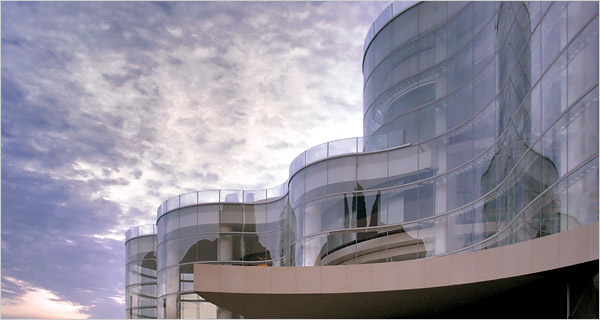
Designed by Cesar Pelli, it has already done something: it has made a splash, with its undulating glass walls, curvaceous tiers, silver-leafed foyer ceiling, chandelier of 300 individual hanging crystal lights and well-coifed public plaza.

But such architecture does not come cheap. The new Renée and Henry Segerstrom Concert Hall cost $200 million. Mr. Segerstrom led the drive to have it built and provided about a quarter of the money; other donations came from the county’s wealthy business class. Several of the donors were there with him at the rehearsal that evening, joined by orchestra administrators, builders, designers and the elated music director of the Pacific Symphony, Carl St. Clair.

All in all, it was a scene in an increasingly familiar American civic drama: the building of a new concert hall, a lavish statement of civic pride and cultural ambition.

The new hall (not to be confused with the existing Segerstrom Hall, across a plaza at the Orange County Performing Arts Center) opens on Sept. 14, in the beginning of what will be a banner season for major new performance spaces. Five are opening in North America this fall, at a total cost of nearly $1 billion. They include the Schermerhorn Symphony Center in Nashville, the new home of the Nashville Symphony, which opens next Saturday; the Four Seasons Center for the Performing Arts in Toronto, the new house of the Canadian Opera Company, which had special inaugural concerts in June and opens its first season with a Wagner “Ring” cycle later this month; and the Carnival Center for the Performing Arts in Miami, which comprises both a house for opera and ballet and a concert hall and opens officially on Oct. 5.

The stories behind these buildings show the wide array of hopes that a community invests in a new performing space, even at a time when many fret that classical music is becoming less relevant.

As concert halls have evolved into multipurpose destinations — complete with chic restaurants, bars and the inevitable education centers — local officials and business leaders have come to view them as a chance to revive a downtown or add luster to their city. Orchestra administrators see a draw for new audiences and a means of raising their group’s profile. Music directors envision a platform to artistic greatness. Orchestra members hear wonderful new acoustics. The music-loving public looks forward to more and better concerts.

“There’s a sense that a concert hall can truly enrich a community,” said Deborah Borda, the president of the Los Angeles Philharmonic. “People have seen successful examples of that, and they aspire to it.” She should know: the orchestra’s Walt Disney Concert Hall, which opened in 2003 and was designed by Frank Gehry, has quickly become a cultural touchstone, attracting full houses and plenty of buzz.

Visually arresting concert halls with sophisticated acoustical setups have also opened in Philadelphia; North Bethesda, Md.; Fort Worth; and Omaha in the last eight years. Atlanta is raising funds to build a hall designed by Santiago Calatrava.

“It’s a great expression of optimism in the art form,” said Gary Hanson, the executive director of the Cleveland Orchestra. For any orchestra that aspires to greatness, he added, a hall to match is a prerequisite.

Yet for all the boosterism behind new halls and the hoopla surrounding their openings, some observers call for tempered expectations.

“A new theater is not automatically simply great news,” said Marc Scorca, the president of Opera America, an organization serving opera companies nationwide. When a hall is added, he said, it may just divert audiences and their dollars from other performance and cultural institutions.

“This is all redistributing people’s expenditures from one activity to another,” said David Galenson, an economist at the University of Chicago who focuses on the arts.

Tyler Cowen, a professor of economics at George Mason University and the author of “Good and Plenty: The Creative Successes of American Arts Funding,” said there was little solid research measuring the economic impact of arts centers on a city, although there was for sports stadiums. Such research shows no benefit for a city’s growth, he said, adding that he was skeptical about economic claims for new concert halls.

“The glorious tales are typically exaggerations,” said Mr. Cowen, who also contributes a monthly economics column to The New York Times.

A look at how the new halls came into being reveals a pattern.

An orchestra outgrows its old multipurpose hall. A powerful person steps up with drive and money. The planners woo local officials and donors. A celebrity architect is engaged. A large public relations firm begins an expensive campaign trumpeting the architectural and acoustic glories of the new hall.

Nashville followed much of this script. In the spring of 2000 the Nashville Chamber of Commerce arranged for city leaders to visit Seattle in search of ideas about civic improvement. The last stop was a visit to Benaroya Hall, the home of the Seattle Symphony since 1998. The visitors heard a rehearsal of a Beethoven symphony, said Alan D. Valentine, the president of the 60-year-old Nashville Symphony and a member of the touring group.

“They were just blown away by the quality of the building,” he said. The visitors were then polled on the top five ideas they could take back to Nashville. A dedicated concert hall was No. 2, behind public transportation. “I said, ‘Oh my God, they got it,’ ” Mr. Valentine recounted.

That September he took the orchestra, which used to play in the acoustically and architecturally drab Tennessee Performing Arts Center, to Carnegie Hall, and 1,100 Nashville citizens and orchestra supporters went along. “It was the Carnegie Hall concert which really helped the board and leaders of the community to understand how a good orchestra can sound in a good space,” Mr. Valentine said.

Board members, administrators and designers toured Europe’s best halls. Martha Ingram, a wealthy orchestra supporter who was the companion of Kenneth Schermerhorn, the orchestra’s music director for 22 years, provided $30 million to the project. Mr. Schermerhorn, who died last year, was instrumental in building the orchestra’s quality and reputation.

“What really matters is doing this project in a way that will benefit Nashvillians and make things better here,” Mr. Valentine said. “That’s ultimately what we are, community servants.”

The neo-Classical limestone-clad hall is in keeping with the character of Nashville’s other civic buildings. It has the natural light of the Musikvereinsaal in Vienna and the alcoves and intimate lobby seating of the Concertgebouw in Amsterdam.

“They were looking for a building that would appear timeless and not be dated 10 years after opening,” said Craig P. Williams, the project manager for the architectural firm, David M. Schwarz.

Then the Nashville Symphony, like the Orange County Performing Arts Center, hired an outside public relations firm, Ruder Finn, to promote the hall, arranging meetings with reporters in New York well in advance.

Mayor Bill Purcell of Nashville said the city’s investment of $16 million so far and the private money spent on the hall were worth it. “For me, this is really the last essential part for our being the Music City,” he said. Along with the Grand Ole Opry and other bluegrass and country music sites, “this particular symphony hall frankly finishes out that range of venues, of special places, that we had to have,” he said. “We needed this, and we needed it now.”

Mr. Valentine added: “The hall itself is a great reflection of what Nashville feels about its orchestra. That’s good for our long-term well-being, financially and otherwise.” This season the orchestra has more than doubled its ticket revenue, a development that Mr. Valentine attributes to excitement over the hall. The orchestra will present about 100 concerts a season, instead of the previous 65.

But the hall will cost more to run: about $2.5 million in the orchestra’s budget. The orchestra hopes to make up the difference with rentals, more ticket and endowment income and annual giving increases, Mr. Valentine said.

BEFORE construction of the Carnival Center for the Performing Arts could begin in Miami, backers commissioned at least three economic impact statements to convince public officials that it would improve depressed downtown Miami streets the way Lincoln Center did for part of the Upper West Side of Manhattan.

“That’s been a strong argument here,” said Michael Hardy, the Carnival Center’s president and chief executive. “We’ve used it a lot.”

A study by Michael Connolly, an economics professor at the University of Miami, said the center would generate $122 million annually for businesses in the area and $6 million in taxes, and add 1,059 jobs. Professor Connolly said it had stimulated development in the depressed area around it and had helped push up property values at a faster rate than in the rest of Miami. Already 35,000 condominium units have been built within a 15-block radius of the center, Mr. Hardy said. But Professor Connolly’s estimate of $491 million in new building investment fell below the expectations of its backers.

The Carnival Center also came with huge cost overruns. It was budgeted at $255 million but rose to $461 million. “It was a much harder building to build than people realized,” Mr. Hardy said. Most of that money came from the proceeds of a local hotel tax, along with $85 million in private, corporate and foundation money.

The Miami center is an anomaly. There is no resident orchestra, although the Cleveland Orchestra will have a yearly three-week residency, and the New World Orchestra, a training group, will also play there regularly. Barely two-dozen classical concerts will be presented this season. The rest is mostly jazz, world music, Broadway shows and popular entertainers. The resident Florida Grand Opera and the Miami City Ballet will benefit the most.

Some arts groups in Miami have argued that some of the vast amount of money raised for the center could have gone to pay musicians, dancers and singers.

“Concert halls are needed, but when concert halls are sucking up all the money of a community, I don’t believe they are really serving the community,” said Luciano Magnanini, the former principal bassoonist of the Florida Philharmonic Orchestra, which declared bankruptcy in 2003. “Great civilizations are known for their culture. They’re not known for the money. I don’t know anybody who goes to Florence because the Medicis were great bankers.”

One important motivation in Orange County was to free up space in the existing Segerstrom Hall, which plays host to touring Broadway shows, a concert series and the Pacific Symphony: more than 350 performances a year. Since the old hall was built in 1986, the county’s population has increased 50 percent, to three million, creating more demand for seats.

The orchestra was chafing. The hall was so overscheduled that musicians had to rehearse in a former church. And it was so big that it did not fit smaller works, like Mozart and Haydn symphonies, putting a damper on the orchestra’s development, said Mr. St. Clair, the longtime music director. Founded only in 1978, the Pacific Symphony lacks a major national profile and pays by the service, meaning that the members, many of them crack Los Angeles studio musicians, do not receive fixed salaries like players in major orchestras. But it has big ambitions and has come up with innovative programming.

“We had reached our plateau,” said John Forsyte, the orchestra’s executive director. “We’re just trying to catch up to where an orchestra like the Boston Symphony is.”

Mr. St. Clair holds a yearly American composers festival and has released several recordings and produced important commissions. The orchestra’s patrons raised money to send it on a European tour this summer, a calculated maneuver to attract attention, lift orchestra morale by letting it play in first-rate halls and give it experience in adjusting to new spaces.

“We have a golden opportunity to take our young history and mold ourselves,” Mr. St. Clair said. “This is much more than a building. I really hope this will be the breath and soul of Orange County.”

But the orchestra’s situation is not ideal. It holds a year-to-year lease with the center, which has ultimate say in programming.

The hall was built on former lima bean fields owned by the Segerstrom family, which transformed farmland into the sleek office buildings, malls and arts hub of Costa Mesa’s downtown. Mr. Segerstrom, 83, a competitive man beneath his patrician exterior, says the performing arts center is part of his vision for Orange County. He calls it the “symbol of Orange County’s pride and self-esteem.”

He and other backers also hope that it will give a focus to the county, an agglomeration of nearly three dozen towns flung south and east of Los Angeles, and help lift it out of that city’s shadow. Mr. Segerstrom said the new hall was mainly a source of cultural distinction but acknowledged that well-heeled concertgoers would be welcome in his company’s luxury South Coast Plaza shopping mall next door.

All told, he put up $50 million for the new hall. But later fund-raising lagged, forcing backers to scrape up donations to meet interest payments on construction bonds. Still, few expect Orange County’s wealthy pillars to let the campaign fail.

During the first rehearsal, of Holst’s “Planets” and “Shooting Stars” by Frank Ticheli, the orchestra came out full of smiles. Backstage, wine bottles with yellow caution-tape bows stood in rows.

Mr. St. Clair, began the rehearsal with a carefully considered passage, the lush, regal theme from the “Jupiter” movement of “The Planets.” The musicians were impressed by the sound, some saying they could hear one another for the first time and play softly with ease.

Mindy Ball, a harpist, teared up. “It’s a musical jewel,” she said. “It’s for the 21st century, and it’s all ours.”

Correction: September 3, 2006

Because of an editing error, an article today on the cover of Arts & Leisure about new performance spaces opening this season misstates the date of the debut of the Renée and Henry Segerstrom Concert Hall in Costa Mesa, Calif. It is Friday, Sept. 15, not Sept. 14.