From the Los Angeles Times
OBITUARIES
Cheikha Rimitti, 83; Algerian Singer, `Mother of Rai'
By Jocelyn Y. Stewart
Times Staff Writer
June 4, 2006
In the 1930s no respectable Algerian woman dared to make music about sexual pleasure, alcohol consumption, poverty, oppression.
Cheikha Rimitti sang anyway.
The artist, whose pioneering recordings inspired younger generations in her homeland and around the world and earned her the title of "mother of rai," the Algerian music of dissent, died of a heart attack May 15 in Paris. She was 83.
"I don't know that the world has anyone ready to step into those shoes," said Leigh Ann Hahn, director of programming for Grand Performances and a longtime fan, who helped bring Rimitti to Los Angeles for a historic performance. "It's a huge, huge loss."
Just last month Rimitti, who was still performing concerts in Europe, released a new recording, N'ta Goudami ("Face Me").
Rimitti began singing as a means of surviving. Born Saadia Bediaf near Sidi Bel Abbes in Algeria on May 8, 1923, Rimitti was orphaned at an early age and struggled for daily existence. When she sang at weddings and parties as a youth, "people gave me food to eat."
"Misery was like a school for me," Rimitti said in a 2001 interview with Afropop Worldwide, a radio program and website dedicated to African pop music. "It taught me my trade."
At 20, Rimitti joined a group of musicians who sang at religious festivals, weddings, births and other rites. Her predecessors included early rai singer Cheikha Tetma.
Cheikha is a title given to female rai singers, who in the early days of rai were regarded as outcasts and often took on nicknames or stage names.
In Arabic the word rai means "opinion" or "way of seeing." In its early form, the music was rooted in the concerns of everyday people — the joys, the pains, the unspeakable. It was dance music, sung in the language of the streets.
Nourredine Gafaiti, Rimitti's most recent producer, called the music "as happy as funk" and "as deep as the blues." It is both hopeful and melancholy, Gafaiti said in a biography of Rimitti posted on the singer's official website.
Algeria was a colony of France when Rimitti began singing. Her first recorded hit, "Charrak Gatta" ("Tear, Lacerate"), was released in 1954, the year the Algerian War of Independence began.
The song has been described as an attack on the virtue of virginity and an invitation for women in the Muslim nation to rethink their views on morality. Her signature husky voice led later observers to describe her music as earthy, raw and bold.
"It's a matter of observing and reflecting," Rimitti said in a 2001 interview with Afropop Worldwide.
"Rai music has always been a music of rebellion, a music that looks ahead. At that time, it was even more so, with just the flute and the tam-tam," a type of gong.
But in the new Algeria there was little tolerance for the bold or the brash. The religious considered her immoral. The revolutionaries considered her anti-revolutionary and apolitical. In the 1960s the new government banned Rimitti and other rai artists from performing on the radio, relegating the music to private parties and black-market cassette tapes.
In 1978, she moved to France, but her heart — and her musical legacy — remained in Algeria. Years later, rai would experience renewed popularity and Rimitti complained that younger artists took her songs and "exploited them without giving me my due."
In 1994 Rimitti collaborated with Flea, bassist from the Red Hot Chili Peppers, and Robert Fripp on the album "Sidi Mansour." The musicians recorded in Los Angeles, while Rimitti recorded vocals in Paris. The collaboration, she later said, opened the door to realizing her long-held dream of performing in the United States.
By the time Rimitti performed in the U.S. in 2001, she was 78, but she was still vibrant and innovating. The next year she performed at California Plaza in downtown Los Angeles as part of a Grand Performances lineup of world music artists.
Many who attended the performance were local fans who had never had an opportunity to see Rimitti perform live. Others there were open to exploring Arabic "cultural tradition in order to be able to take a different look or perspective on the global community" in the aftermath of 9/11, Hahn said.
Times writer Lynell George described Rimitti striding out "in a dress as white and elaborate as a wedding cake. A sparkling tiara rests atop her long blue-black tresses."
"Suddenly turning, arms close to body, gold-slippered feet shuffling like a moving hieroglyph, she makes two passes across the stage before a ragged voice curls out from somewhere way, way low — a map, a road, a history unscrolling," George wrote.
Over the years, even as the times changed, the bold, raw flavor of her lyrics remained.
"I sang the life I had seen, my own history," Rimitti said.
Showing posts with label algeria. Show all posts
Showing posts with label algeria. Show all posts
Sunday, June 04, 2006


Tuesday, May 30, 2006
Cheikha Rimitti, Pioneer of Algerian Raï Music (1923-2006)

New York Times
May 28, 2006
Cheikha Rimitti, 83, Rebel of Algerian Music, Is Dead
By JON PARELES
Cheikha Rimitti, a pioneer of the rebellious Algerian pop called ra-2006), died on May 15 in Paris, where she had lived since 1978. She was 83.
The cause was a heart attack, her Web site said.
Cheikha Rimitti was considered the queen of raï (RYE or rah-AY), which means opinion in Arabic. She sang daringly and forthrightly about sexuality, poverty, drinking, oppression and independence. "Misfortune is my teacher," she often said.
Her brash lyrics and deep, rough-hewn voice made her an international star. She defied taboos, and her music was often banned.
"Raï music has always been a music of rebellion, a music that looks ahead," she said in a 2001 interview with Afropop Worldwide, a syndicated radio program and Web site. Two nights before her death, she performed at the Zénith concert hall in Paris.
She was born in 1923 in the village of Tessala near Sidi Bel-Abbés in Western Algeria. Her parents named her Saadia, which means joyful. But she was orphaned as a young girl and grew up poor, often homeless.
To support herself, she began singing at weddings. She arrived in the town of Relizane and joined a troupe of traveling musicians when she was 20, performing at festivals as a singer, a dancer and an equestrienne, riding with a rifle in each hand.
Her stage name, Rimitti, was derived from the French word remettez (put it back, or slang for another). Various stories link the name to her buying rounds of drinks for fans or calling for refills herself. Later, the honorific Cheikha was added.
North Africa has a tradition of bawdy wedding songs, performed by and for women. Cheikha Rimitti began to sing them for mixed audiences in public. She also wrote songs about social conditions, including, in the 1940's, the harshness of French colonial rule and the epidemics that ravaged Algeria. She wrote about rough lives and about the temporary diversions of sex and alcohol.
"I sang all the subjects back then," she told Afropop Worldwide. "I sang about misery. I sang about love. I sang about the condition of women. I sang about ordinary life, concrete things. I sang the life I had seen, my own history."
Although she composed hundreds of songs, Cheikha Rimitti was illiterate. "Words sing silent in my head until I sing them loud," she once said. "No need to take either a pencil or a notebook."
A well-known Algerian musician, Mohammed Ould Ennems, helped arrange her first radio broadcasts in the 1940's. She made her first recording in 1952, and in 1954 she caused a controversy with a song called "Charrag Gataa" ("Tear, Lacerate"), which was taken as an attack on the virtue of female virginity. "He crushes, whips and beats me," she sang. "I say that I'm going away, but I still spend the night."
When Algeria became independent of France in 1962, the new conservative Islamic government banned her songs from radio and television. She continued to perform at private gatherings, as raï music circulated on underground cassettes.
In 1976, she made a pilgrimage to Mecca and gave up drinking and smoking. She emigrated to Paris in 1978, but continued to visit Algeria, which eventually removed the ban on her music.
According to her manager, Nourredine Gafaaiti, she is survived by her 3 children and 18 grandchildren, all of whom live in Algeria.
By the 1980's, her songs had been taken up by a younger generation of raï musicians, though they often did not credit her. She was rediscovered by the world-music audience in the 1990's and modernized her music. Her 1994 album "Sidi Mansour" included the guitarist Robert Fripp from King Crimson, and Flea, the bassist from the Red Hot Chili Peppers, although she never met the musicians; she was recorded in Paris and the backup tracks were recorded in Los Angeles.
She continued to make albums, and one, "N'ta Goudami" (Because Music), was released this month. It was recorded in Oran, Algeria, the birthplace of raï.
In 2001 she made her United States debut with a triumphant concert at Central Park SummerStage.
"When I'm on stage, I don't cheat," she told Afropop Worldwide afterward. "I give everything I have in my soul and my spirit."
Monday, October 10, 2005
A Slain Berber Singer's Voice Rouses His Hometown

New York Times
October 10, 2005
A Slain Berber Singer's Voice Rouses His Hometown
By MICHAEL SLACKMAN
TIZI OUZOU, Algeria - High in the jagged mountains covered with olive and fig trees, his voice booms from a minivan as it twists along narrow winding roads to drop off students after a day of school.
Head down into this city and there he is again, this time larger than life, in a poster mounted on a cafe wall while, of course, his voice booms from the stereo behind the counter. In shops, offices, restaurants - everywhere in this region, it seems - is the voice of Lounès Matoub.
"Never surrender, never surrender," he sings, strong and folksy. "Of course times change, but you should never forget."
Someone tried to silence Mr. Matoub on June 25, 1998; his car was sprayed with 79 bullets. Instead, he became in death a powerful symbol of defiance for an ethnic minority that has challenged the government's decision to define Algeria as an Arab nation.
This is Kabylia, one of Algeria's most restive regions - home to a stubborn and proud ethnic minority of Berbers who since independence four decades ago have fought to preserve their cultural identity and independence. While politicians and village elders have helped lead the fight, the soul of this struggle is captured in music, especially the music of Mr. Matoub.
"Music is much more a symbol of our identity than it is about entertainment," said Ousmail Abderrahmane, owner of a music shop in this city, the Kabylia region's capital.
Considered by many the original inhabitants of northern Africa, the Berbers had their own language, music and culture until the region was effectively Arabized as Islam spread a thousand years ago.
While many people in Algeria have Berber ancestors, those in the Kabylia region cling to their language and customs, even while adopting Islam as a faith. The women wear bright-colored traditional dress, and the men participate in elder councils, which govern affairs in their mountain villages. The Berbers were also known as fierce fighters, and Kabylia contributed many forces during the eight-year war of independence from France.
But after more than a century under French rule, Algeria's new government decided to forge an Arab identity, and the Berbers felt betrayed. They had believed that independence would give them greater autonomy over their affairs, not less. Over time, the Berbers of Kabylia began to organize, politically and socially, staging boycotts and acts of civil disobedience to force the government into talks. There have been violent confrontations as well.
In battles of identity, language often becomes the front line, and so while the issues for the Berbers are many, the flash point is the government's insistence that Arabic serve as the only official language. People from this region want their language, Tamazight, to have equal status, but the president refuses to budge.
"Algeria above all," read a recent headline in El Moudjahid, the government-controlled daily newspaper. "The head of state has chaired a rally on Thursday in Constantine, and he has stated Arabic will remain the sole official language."
Through brutal force and careful political calculation, the government has managed to secure the country. But the people of Kabylia are still fighting: boycotting elections, refusing to pay utility bills, insisting on greater democracy and some degree of self-rule. Music has helped pass the struggle from generation to generation, to unite political factions behind common ideas and to help keep the fires of resistance burning.
The region's four most popular musicians sing about the struggle for identity. Indeed, one of them, Idir, has an album titled "Identity." But Mr. Matoub remains the biggest seller, said Mr. Abderrahmane, the music shop owner. His lyrics tell of daily life in Kabylia, of oppression and of contemporary events, like the day in 2001 when the military opened fire on citizens protesting and rioting after a local boy was killed while in custody.
"O my life, o my life, the mountains are my life, Kabylia is my whole life." The words are Mr. Matoub's, but they are being sung softly by three young women standing side by side on the edge of a mountain road. Dahbir Ouidir is 19 years old. Sabina Wahan and Yasmine Lasmi are 16. They are a year behind in their studies because they joined thousands of other young people in a one-year school boycott as a sign of defiance.
They came home from school in a minivan, as the driver played a Matoub album. Stepping out, they said they would be happy to sing their favorite Matoub song, and soon the three , eyes closed, drew a crowd.
"People identify with his poetry," Ms. Ouidir said, her face flushed after singing.
Samir Rehane, a tall, slender 18-year-old with a book bag under his arm, overheard the conversation and walked over. "Matoub is a son of my village," he said. "He is a teacher for us. He is a symbol of freedom."
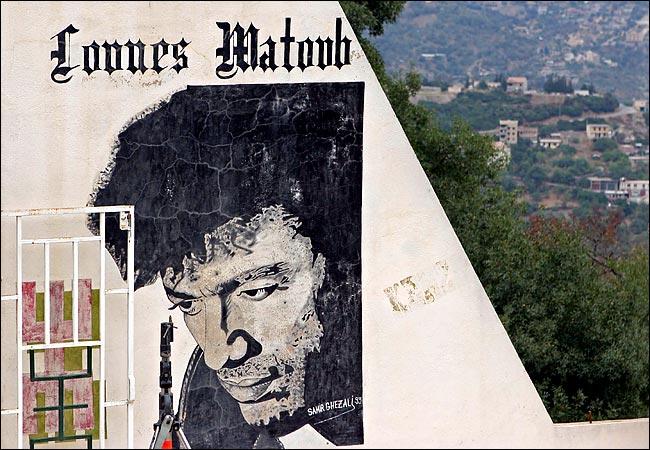
Down the road, in the village of Taourirt Moussa, a red marble tomb is decorated with dozens of tiny Algerian flags. It is where Mr. Matoub is buried, and it has become a pilgrimage site. The tomb is in front of Mr. Matoub's childhood home, which has been transformed into a shrine. The bullet-riddled Mercedes sedan he was driving when he was killed is parked in the garage, with a piece of tape on the driver's seat that marks a hole from the fatal bullet.
"We are not only interested in his music," said Ali Yashir, 21, who visited the grave one recent day. "We are interested in what he stands for. His struggle and his ideas will go on forever."
There is another shrine for Mr. Matoub at the mountainside scene of the ambush. A large metal sculpture, it depicts the Berber symbol of freedom, a crude stick figure of a person with raised hands. Mounted between the hands is a drawing by a popular Algerian political cartoonist, Ali Dilem, which was used as one of Mr. Matoub's album covers.
There is also a carved stone plaque nearby with a phrase that might well have been a chorus in one of Mr. Matoub's own songs: "Even if you are dead, you are still alive. A History. A Struggle. A Hope."
Subscribe to:
Posts (Atom)

