Showing posts with label museum. Show all posts

Saturday, March 23, 2013

Actress Tilda Swinton on Display at MOMA


As part of a performance art display at MOMA, actress Tilda Swinton is periodically appearing in a glass case, sleeping. Story HERE.

Monday, December 28, 2009

Chile's New Museum of Memory and Human Rights


LAT has a story on Chile's new Museum of Memory and Human Rights:

By Chris Kraul
December 28, 2009

Reporting from Santiago, Chile - What they'll leave in and what they'll leave out -- that question haunts Margarita Iglesias as she considers next month's opening of the Museum of Memory and Human Rights.

That Chile is recognizing victims of its military dictatorship in a striking new "monument to memories" is positive, said Iglesias, both a victim and a historian of Augusto Pinochet's bloody 17-year rule. As a high school student activist in Santiago in 1975, she was tortured before fleeing with her family to France.

"It can't be just a horror show. The political movements and conditions that led to the coup and its aftermath must be explained. If not, how can you understand how state terrorism came about?" said Iglesias, 51, now a University of Chile professor.

The $19-million museum that opens in downtown Santiago on Jan. 11 is dedicated to the 31,000 murder, torture and kidnapping victims of the 1973-90 military dictatorship of Gen. Pinochet.

Museum directors are keeping a tight lid on the specific exhibits, hoping for maximum effect.

read the rest HERE

Monday, March 12, 2007

Patti Smith on her Induction to Rock & Roll Hall of Fame

March 12, 2007
Op-Ed Contributor
Ain’t It Strange?
By PATTI SMITH

ON a cold morning in 1955, walking to Sunday school, I was drawn to the voice of Little Richard wailing “Tutti Frutti” from the interior of a local boy’s makeshift clubhouse. So powerful was the connection that I let go of my mother’s hand.

Rock ’n’ roll. It drew me from my path to a sea of possibilities. It sheltered and shattered me, from the end of childhood through a painful adolescence. I had my first altercation with my father when the Rolling Stones made their debut on “The Ed Sullivan Show.” Rock ’n’ roll was mine to defend. It strengthened my hand and gave me a sense of tribe as I boarded a bus from South Jersey to freedom in 1967.

Rock ’n’ roll, at that time, was a fusion of intimacies. Repression bloomed into rapture like raging weeds shooting through cracks in the cement. Our music provided a sense of communal activism. Our artists provoked our ascension into awareness as we ran amok in a frenzied state of grace.

My late husband, Fred Sonic Smith, then of Detroit’s MC5, was a part of the brotherhood instrumental in forging a revolution: seeking to save the world with love and the electric guitar. He created aural autonomy yet did not have the constitution to survive all the complexities of existence.

Before he died, in the winter of 1994, he counseled me to continue working. He believed that one day I would be recognized for my efforts and though I protested, he quietly asked me to accept what was bestowed — gracefully — in his name.

Today I will join R.E.M., the Ronettes, Van Halen and Grandmaster Flash and the Furious Five to be inducted into the Rock and Roll Hall of Fame. On the eve of this event I asked myself many questions. Should an artist working within the revolutionary landscape of rock accept laurels from an institution? Should laurels be offered? Am I a worthy recipient?

I have wrestled with these questions and my conscience leads me back to Fred and those like him — the maverick souls who may never be afforded such honors. Thus in his name I will accept with gratitude. Fred Sonic Smith was of the people, and I am none but him: one who has loved rock ’n’ roll and crawled from the ranks to the stage, to salute history and plant seeds for the erratic magic landscape of the new guard.

Because its members will be the guardians of our cultural voice. The Internet is their CBGB. Their territory is global. They will dictate how they want to create and disseminate their work. They will, in time, make breathless changes in our political process. They have the technology to unite and create a new party, to be vigilant in their choice of candidates, unfettered by corporate pressure. Their potential power to form and reform is unprecedented.

Human history abounds with idealistic movements that rise, then fall in disarray. The children of light. The journey to the East. The summer of love. The season of grunge. But just as we seem to repeat our follies, we also abide.

Rock ’n’ roll drew me from my mother’s hand and led me to experience. In the end it was my neighbors who put everything in perspective. An approving nod from the old Italian woman who sells me pasta. A high five from the postman. An embrace from the notary and his wife. And a shout from the sanitation man driving down my street: “Hey, Patti, Hall of Fame. One for us.”

I just smiled, and I noticed I was proud. One for the neighborhood. My parents. My band. One for Fred. And anybody else who wants to come along.

Patti Smith is a poet and performer.

Tuesday, March 06, 2007

Rock Hall of Fame to Induct Rappers

Rockers making room for rappers in Hall
Grandmaster Flash induction signals the time of hip hop is upon us
The Associated Press
Updated: 10:37 a.m. PT March 6, 2007

NEW YORK - Ask Grandmaster Flash about hip-hop stars deserving of the Rock and Roll Hall of Fame, and he’s quick with a list of rap icons.

“Afrika Bambaataa. Run-DMC. KRS-One,” he says, barely pausing for a breath. “Big Daddy Kane. LL Cool J. Eric B and Rakim. Tribe Called Quest. The list goes on and on.”

Flash left himself out, with good reason: The DJ and partners the Furious Five enter the Hall on March 12 as its initial rap inductees. The Bronx hip-hop pioneers are part of an otherwise traditional class: R.E.M., Van Halen and a pair of fellow New York City performers, Patti Smith and the Ronettes.

As the first citizens of hip-hop nation in the Rock Hall, the arrival of Grandmaster Flash and the Furious Five signals a new age at the Cleveland attraction: Smith likely marks the end of the ’70s punk inductees, and the time of hip-hop is upon us.

“This announces the beginning of the rap era for the Hall,” said Bill Adler, a hip-hop historian — currently editing the “Eyejammie Encyclopedia of Hip-Hop” — and member of the Hall’s nominating committee. “Flash and the Furious Five are going to open the floodgates.”

Adler, a publicist for the hugely influential Def Jam Records in the mid-1980s, offered his own list of rappers destined for induction: “The Beastie Boys, very quickly. Run-DMC and LL Cool J will get in pretty quickly. Slick Rick.”

‘The Message’ was heard
Grandmaster Flash and the Furious Five enter 25 years after their groundbreaking single, “The Message,” about hard times in their native borough during the Reagan Administration. It was the first popular rap song with a social theme — “It’s like a jungle sometimes, it makes me wonder how I keep from going under,” went the hypnotic chorus.

“One of the pivotal points in hip-hop history,” said Furious Five rapper Melle Mel, who acknowledged his group initially wanted to pass on the song.

The group, which also featured Kid Creole, Cowboy, Mr. Ness and Raheim before an acrimonious 1983 split between Flash and Mel, had missed induction on two previous occasions. So when word arrived of the honor this year, Flash said he was initially skeptical.

“When it sank in that we were in, it was a good feeling for hip-hop,” Flash said. “I think it’s bigger than Grandmaster Flash and the Furious Five. To get that kind of respect is good for hip-hop.”

Melle Mel recalled lying in bed — “I usually sleep with the TV on” — when he heard the news that R.E.M. and Van Halen were in. Before he could roll over, the announcer added the name of Grandmaster Flash and the Furious Five.

“The fact that we’re in the Hall of Fame speaks volumes,” said Melle Mel. “People try to separate hip-hop music like it stands alone, but it really doesn’t. We’re in with all the great groups in the history of music. It further legitimizes hip-hop.”

The Hall gets with it
Admitting a hip-hop group to the home of rockers from Chuck Berry through U2 is a bigger step for the Hall of Fame than it is for many rap aficionados, said Erik Parker, director of content at the hip-hop web site SOHH.com.

“The average hip-hop fan long ago learned to live without validation,” said Parker. “They realized it was already accepted as part of the mainstream culture.” (VH1 started honoring rap’s pioneers three years ago in a Rock Hall-like ceremony, and two years ago honored Grandmaster Flash and the Furious Five).

The Hall is undeniably an equal opportunity inductor: its first class included James Brown and the Everly Brothers, while last year’s group featured Miles Davis and the Sex Pistols.

But its requirement that candidates can’t get inducted until 25 years after their first release kept many of rap’s founding fathers from a shot at stepping inside the Hall until recent years. Unlike rock, which dates back more than a half-century, rap is a relatively young genre — about 30 years old.

Parker said the timing for Grandmaster Flash and the Furious Five’s induction was impeccable.

“This is what’s really key: their ‘Message’ is still relevant today, 25 years later,” he said. “The words in that song couldn’t ring truer.”
© 2007 The Associated Press. All rights reserved. This material may not be published, broadcast, rewritten or redistributed.

URL: http://www.msnbc.msn.com/id/17484676/

Wednesday, April 12, 2006

Displaying Native American Culture

Displaying Native American Culture

New York Times
December 21, 2004
CRITIC'S NOTEBOOK
Who Should Tell History: The Tribes or the Museums?
By EDWARD ROTHSTEIN

CHICAGO - Museums always make use of the past for the sake of the present. They collect it, shape it, insist on its significance. When that past is also prehistoric, when its objects come to the present without written history and with jumbled oral traditions, a museum can even become the past's primary voice.

But what if that prehistoric past is also claimed by some as a living heritage? Then disagreements about interpretation develop into battles over the museum's very function.

That was the result, for example, at the Smithsonian Institution's $219 million National Museum of the American Indian, which opened in September in Washington and calls itself a "museum different." George Gustav Heye's extraordinary collection of 800,000 tribal American objects is put in service of contemporary Indian cultures with tribal guest curators determining how their heritage is to be presented. The result is homogenized pap in which the collection is used not to reveal the past's complexities, but to serve the present's simplicities.

There are, however, other ways in which the prehistoric past can be revealed, as two exhibitions in Chicago suggest. At the Field Museum, "Machu Picchu: Unveiling the Mystery of the Incas," is remarkable not just for its careful exploration of the famed archeological site high in the Peruvian Andes, but also for demonstrating an almost devotional care to exhuming a lost past. At the Art Institute of Chicago, "Hero, Hawk and Open Hand: American Indian Art of the Ancient Midwest and South" is no less remarkable in its display of objects created by ancient American cultures, but it is subject to many of the same forces that molded the National Museum of the American Indian. Here though, rather than overturning the museum's enterprise, they merely distract from it.

First, the Machu Picchu exhibition. Created by the Peabody Museum at Yale, it offers the largest collection of Incan artifacts ever shown in the United States, including robust three-foot-high jugs for corn beer (which was fermented by the saliva of women who chewed the maize before brewing it); samples of bright, geometrically ornamented 500-year-old fabrics; and a corded "quipu," a linked collection of knotted strings used to record events and numerical accounts. The curators are Richard L. Burger, a Yale anthropologist, and Lucy C. Salazar, a Peruvian archaeologist.

The major question about Machu Picchu has not been who speaks for its past, but what that past actually was. The site, with its terraced, mountainous landscape and stone structures, was known to only a few local inhabitants when it was discovered by Hiram Bingham III, who led Yale's Peruvian Expedition in 1911. As Mr. Berger and Ms. Salazar explain various hypotheses by Bingham, including one that the site was a sacred nunnery for Incan "Virgins of the Sun," have been conclusively disproved. The curators established, instead, that it was a summer retreat for a ruling Incan family, built between 1450 and 1470 and used only for about 80 years before being abandoned in the face of the Incas' defeat by Pizarro's Spanish armies.

The exhibition also makes it clear what an extraordinary site Machu Picchu is. Nestled in the cloud-decked mountains of the Andes, its architecture serves as a kind of cosmic clock, the sun and constellations appearing in certain stone windows at specific times of the year. The exhibition shows how scientists have used bone fragments to analyze the Incan diet (60 percent maize), and demonstrates how Incan skulls were deliberately elongated by molds placed on infants' heads, presumably for aesthetic effect. One emerges astonished by this lost world.

Still, there are subtle traces of contemporary claims evident in the portrayal of this prehistoric culture. After all, Machu Picchu is now a national symbol in Peru; in 2001, it was used for the inauguration of the president, Alejandro Toledo. It is also the object of almost mystical devotion. Hundreds of thousands of tourists climb its ruins every year.

In response, perhaps, there are hints of overly tactful delicacy in the exhibition's descriptions of Incan society. Incan aesthetic and cosmological preoccupations become clear, but other aspects do not, including a rigid social structure that involved forms of slavery, a religious culture that incorporated human sacrifice, and a military organization powerful enough to conquer 2,500 miles of the South American coastline and build 25,000 miles of roads. Mr. Berger, in an e-mail message, said that for the Peruvians, the Incans looked good compared to the Spaniards. The exhibition wants us to admire, and we do. But we know less about what we might admire less.

At the Art Institute of Chicago more explicit pressures are at work, and they nearly derail the considerable achievements of "Hero, Hawk and Open Hand." The exhibition is devoted to products of societies that thrived along the Ohio, Tennessee and Mississippi Rivers as early as 5,000 B.C. Their remnants can still be seen in landscapes near Newark, Ohio, or St. Clair County, Ill., in enormous earthen mounds and geometric shapes outlined by raised ground.

These structures testify to a highly organized society barely glimpsed by European settlers. Some sites had already been abandoned by the time the Europeans arrived. Others were devastated by diseases brought by the settlers, which wiped out as much as 90 percent of their Indian populations.

But as Richard F. Townsend, the curator of the department of African and Amerindian art at the Art Institute, shows, these cultures' mastery can be sensed in the objects produced: a haunting 2,000-year-old elongated face smoothed out of stone found in Kentucky; a graceful, elegant hand cut out of mica from about the same era in Ohio; a 500-year-old wooden figure - half human, half feline - found in Florida.

Such a display, along with historical commentary, would once have been sufficient. But contemporary Indian tribes, supported by some scholars, have argued that they have an ancestral connection to these cultures. And since museums have not traditionally displayed much sensitivity toward living cultures, the Native American Graves Protection and Repatriation Act now obliges them to consult with tribes about their holdings. In preparation for the exhibition, four years were spent consulting with tribal leaders. But to what end?

Joyce Bear, the cultural preservation officer of the Muscogee Nation, has the exhibition's first word, declaring on the wall leading to the galleries, that it will "make our tribal people realize that we are descendants of a wonderful and great culture." In the catalog, she proudly announces that the exhibition proves that "I come from kings and queens." The exhibition ends with a statement about a "new, sweeping movement of cultural preservation" among Indians, including a film showing their renewal of traditions.

But all this has little to do with the objects on display and makes it seem as if the exhibition's purpose were to boost tribal pride. Also, while there may indeed be ancient traditions that have found their way into contemporary practices, the nature of these connections, at the very least, demands closer scrutiny.

One anthropologist's assertion that contemporary Indian beliefs are "analogous" to those of these ancient cultures is challenged by others in the catalog. Mr. Townsend writes that these earthworks were "built by peoples whose achievements and ancestral connections to present day tribes are at best only vaguely surmised." Robert L. Hall, an anthropologist, points out that Cahokia, an imposing culture on the Mississippi that was already in decline in the 14th century, "left no written records and no native peoples possess oral traditions that specifically identify Cahokia or even recognize its existence." In the 18th century, another writer says, Indians encountered by settlers "did not construct mounds, nor did any of them have oral traditions relating to these earthworks."

Even the exhibition's explanations of these societies' workings seem idealized, skewed by contemporary sensitivities. In the catalog, for example, an anthropologist, David H. Dye, explores warfare among the Mississippi Indians, but it is barely alluded to in the exhibition, despite the presence of objects like a pipe (1200-1500 A.D.) sculpted as a bound captive and a vase whose decorations are "trophy scalps stretched in a starlike pattern." The exhibition gives so refined a picture of these societies that there is no way of knowing how important such images were, or where historical evidence of slavery and human sacrifice fits in.

This is also, of course, what happened in the Smithsonian's Indian museum. Since almost no tribes had a written culture and oral traditions were disrupted by disease, massacre, government policy and assimilation, the tribal curators often seem to know less about their history than do scholars. Yet scholars' assessments are ignored in favor of self-promotional platitudes.

All this is a form of guilty overcompensation for past museum sins that themselves need re-examination and assessment. In the meantime, exhibitions like the one on Machu Picchu serve as reminders of what is possible. And the objects at the Art Institute can still be heard straining to speak for themselves, despite the layers of promotional and political gauze in which they are wrapped.

Wednesday, March 01, 2006

Hip-hop at the Smithsonian

New York Times
March 1, 2006
Smithsonian's Doors Open to a Hip-Hop Beat
By BEN SISARIO


Grandmaster Flash gave his prized Technics turntable. Ice-T offered vintage tour T-shirts and rare CD's. Afrika Bambaataa gave a trove of jackets, caps and jewelry in his trademark Afrocentric style.

All will go to the Smithsonian Institution's National Museum of American History in Washington, where they will reside alongside the flag that inspired "The Star-Spangled Banner" and the Woolworth's lunch counter from Greensboro, N.C., where four black students sat for civil rights in 1960.

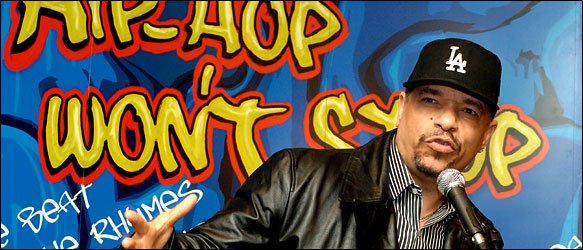
At an emotional and at times rowdy news conference yesterday at the Hilton New York, a group of hip-hop pioneers gathered beside the dark-suited, white-gloved Smithsonian staff to announce a plan for a major new collection devoted to the music. Called "Hip-Hop Won't Stop: The Beat, the Rhymes, the Life," it is to be a broad sampling of memorabilia, from boomboxes and vinyl albums to handwritten lyrics and painted jeans jackets, as well as multimedia exhibits and oral histories.

"Now whenever anybody asks me about my music," Ice-T said, he would direct him — with a torrent of blunt epithets — "to the museum."

Brent D. Glass, the director of the museum, said the project was begun in recent months with seed money from Universal Records and was still in its earliest stages of planning. But he said that he and his curators believed the time had come to recognize hip-hop, with its straight-from-the-gut raps and minimalist funk, as a significant cultural force that had spread all over the United States and, increasingly, the world.

"American music is the soundtrack to American history," Mr. Glass said. "Hip-hop has been a part of American music for more than 30 years."

With help from the music industry, the museum has been soliciting donations, and most of the initial contributors were present: in addition to Ice-T, Afrika Bambaataa and Grandmaster Flash, Russell Simmons, DJ Kool Herc and the dancer Crazy Legs have opened their archives, and were clearly proud of the recognition.

"Nobody expected this thing 35 years ago to be mentioned in the Smithsonian conversation," said Kool Herc, one of the prime technological innovators in the early days of hip-hop in the Bronx, who was still trying to decide what to donate.

The National Museum of American History is not the first major institution to collect hip-hop materials. The Experience Music Project in Seattle has also built a sizable collection, and in 1999 the Rock and Roll Hall of Fame in Cleveland organized an exhibition of hip-hop memorabilia that traveled to the Brooklyn Museum.

Mr. Simmons, the impresario who was a founder of the Def Jam label, said that at first he had feared that hip-hop's inclusion in a major museum would mean it had lost its power and novelty. His initial thought when contacted by the Smithsonian, he said, was "It must be over."

But in an opinion echoed by nearly every speaker, Mr. Simmons suggested that as hip-hop aged it was in danger of losing its connection to its roots and that younger fans and performers would profit from direct experience of the music's history. Hip-hop, he said, is "the only real description of the suffering of our people."

Museum officials say that the collection may take three to five years to develop and that they are still approaching musicians about donations. When complete, they say, the collection will be used for a long-term exhibition. The museum also plans scholarly symposiums to discuss the content, as well as a traveling show.

Afrika Bambaataa, who helped integrate hip-hop with electronic music in the early 1980's on recordings that remain influential, praised the museum in his familiar declamatory tone for its attention to "factology" in representing the music's history.

"Brothers and sisters," he said, "this is beautiful that the Smithsonian Institution is recognizing hip-hop culture for what it is."