
Showing posts with label food/cooking/eating. Show all posts
Showing posts with label food/cooking/eating. Show all posts
Sunday, July 22, 2012


Monday, June 07, 2010
Dogfish Head Brewery has a Bitches Brew Beer in honor of Miles Davis' 1970 Bitches Brew album

In honor of the 40th anniversary of Miles Davis' historic Bitches Brew album, the Dogfish Head Brewery has unveiled a Bitches Brew...well, brew. Check it out.
Tuesday, October 21, 2008
Tijuana's Caesar's Restaurant: Home of the Caesar Salad
NYT
October 22, 2008
Tijuana Journal
Wary Tourists Toss Aside a Chance to Taste History
By MARC LACEY
TIJUANA, Mexico — Eating salad in Mexico is discouraged by most guide books, citing the potential threat to the digestive tract.
It is true that the water can be problematic south of the border, if it is consumed directly from the tap or used to wash one’s salad fixings. At the same time, fine dining abounds throughout Mexico, white tablecloth affairs with celebrity chefs, mouthwatering menus and fancy water that comes from elegantly shaped bottles.
Although not in that lofty league, there is one eatery with a particularly distinguished history that is relevant to the question of whether one should consume salads in Mexico. Called Caesar’s Restaurant, it sits in the seediest of spots, along Tijuana’s Avenida Revolución, and specializes in salad — Caesar salad, to be exact, which it says was invented in its kitchen in 1924.
Jorge Chávez is the manager of Caesar’s and the keeper of the historical flame. After a waiter whipped up a salad tableside the other day in an elaborate ceremony, Mr. Chávez plunked down to defend his lettuce.
A table full of customers had recently left the premises after taking advantage of Caesar’s two-for-one beer special but not daring to eat the food. One of them had scoffed when a waiter offered her a salad. She made a crack about that being a sure-fire vacation spoiler.
“She has bad information,” Mr. Chávez said when the group was gone. “We’re not using dirty water on our salad. I’d put our salad up against anyone, anywhere.”
He then veered into a bit of history. One day back in 1924, Caesar Cardini, an Italian immigrant who ran a restaurant in what was then an upscale tourist zone in Tijuana, found himself low on provisions but with some hungry friends to feed. As the story goes, he threw what he had — some lettuce, garlic and pieces of bread, among other ingredients — into a bowl and came up with a creation that has lived on ever since.
There are some disagreements over the details of the story. Was it a cook who really came up with it? Did Caesar’s brother, Alex, first throw anchovies into the mix? But there appears to be some support that the Caesar salad was born in Tijuana, or at the very least earned its worldwide reputation here.
None other than Julia Child wrote in one of her cookbooks, “One of my early remembrances of restaurant life was going to Tijuana in 1925 or 1926 with my parents, who were wildly excited that they should finally lunch at Caesar’s Restaurant.”
She recalled Mr. Cardini himself rolling a big cart to her family’s table and throwing some raw eggs into the mix.
Raw egg yolks are still part of the recipe here. Also tossed into the large wooden bowl, which is big enough to bathe a newborn child, are olive oil, ground anchovies, garlic, a dash of mustard and Worcestershire sauce, Parmesan cheese, pepper and white wine mixed with vinegar.
Large romaine lettuce leaves are dunked in the mixture and then laid out on a plate.
Mr. Chávez took pains to point out that each leaf is carefully cut into a diamond shape and then purified with a chemical additive to kill any microbes. The resulting salad, he contends, is not only safe to eat and delicious to eat but, in his view, quintessentially Mexican.
“Some of the ingredients are foreign but the hands that make it are Mexican,” he said. Another key addition are Mexican limes, which are squeezed into the salad dressing to neutralize the strong flavors of the anchovies, garlic and egg yolks. “No flavor dominates,” he said.
The biggest problem these days is that not enough people are digging in. Tourism is in the doldrums in Tijuana, a result of a variety of factors, including too much crime, police harassment and the economic woes up north.
The restaurant has struggled through hard times before. It closed for more than five years in the 1990s, and after it reopened, it installed a topless dance club in the back, which operates in the evening and supplements the paltry restaurant income.
There were only six people eating salads on a recent afternoon. Four of them were local university students who were on a research trip and were eating on the house. The other two were reporting on and photographing the salads for this article.
“You hear so much that’s bad about Tijuana,” Mr. Chávez said. “I want people to know that we have something to be proud of.”
And how is the salad? Well, the guy taking pictures let out a long “mmmmm” as he sampled the sauce. The guy with the pen thought the croutons, which soak up the zesty dressing, were among the best he had sampled anywhere.
Both of them lingered at the table, their stomachs feeling fine.
October 22, 2008
Tijuana Journal
Wary Tourists Toss Aside a Chance to Taste History
By MARC LACEY
TIJUANA, Mexico — Eating salad in Mexico is discouraged by most guide books, citing the potential threat to the digestive tract.
It is true that the water can be problematic south of the border, if it is consumed directly from the tap or used to wash one’s salad fixings. At the same time, fine dining abounds throughout Mexico, white tablecloth affairs with celebrity chefs, mouthwatering menus and fancy water that comes from elegantly shaped bottles.
Although not in that lofty league, there is one eatery with a particularly distinguished history that is relevant to the question of whether one should consume salads in Mexico. Called Caesar’s Restaurant, it sits in the seediest of spots, along Tijuana’s Avenida Revolución, and specializes in salad — Caesar salad, to be exact, which it says was invented in its kitchen in 1924.
Jorge Chávez is the manager of Caesar’s and the keeper of the historical flame. After a waiter whipped up a salad tableside the other day in an elaborate ceremony, Mr. Chávez plunked down to defend his lettuce.
A table full of customers had recently left the premises after taking advantage of Caesar’s two-for-one beer special but not daring to eat the food. One of them had scoffed when a waiter offered her a salad. She made a crack about that being a sure-fire vacation spoiler.
“She has bad information,” Mr. Chávez said when the group was gone. “We’re not using dirty water on our salad. I’d put our salad up against anyone, anywhere.”
He then veered into a bit of history. One day back in 1924, Caesar Cardini, an Italian immigrant who ran a restaurant in what was then an upscale tourist zone in Tijuana, found himself low on provisions but with some hungry friends to feed. As the story goes, he threw what he had — some lettuce, garlic and pieces of bread, among other ingredients — into a bowl and came up with a creation that has lived on ever since.
There are some disagreements over the details of the story. Was it a cook who really came up with it? Did Caesar’s brother, Alex, first throw anchovies into the mix? But there appears to be some support that the Caesar salad was born in Tijuana, or at the very least earned its worldwide reputation here.
None other than Julia Child wrote in one of her cookbooks, “One of my early remembrances of restaurant life was going to Tijuana in 1925 or 1926 with my parents, who were wildly excited that they should finally lunch at Caesar’s Restaurant.”
She recalled Mr. Cardini himself rolling a big cart to her family’s table and throwing some raw eggs into the mix.
Raw egg yolks are still part of the recipe here. Also tossed into the large wooden bowl, which is big enough to bathe a newborn child, are olive oil, ground anchovies, garlic, a dash of mustard and Worcestershire sauce, Parmesan cheese, pepper and white wine mixed with vinegar.
Large romaine lettuce leaves are dunked in the mixture and then laid out on a plate.
Mr. Chávez took pains to point out that each leaf is carefully cut into a diamond shape and then purified with a chemical additive to kill any microbes. The resulting salad, he contends, is not only safe to eat and delicious to eat but, in his view, quintessentially Mexican.
“Some of the ingredients are foreign but the hands that make it are Mexican,” he said. Another key addition are Mexican limes, which are squeezed into the salad dressing to neutralize the strong flavors of the anchovies, garlic and egg yolks. “No flavor dominates,” he said.
The biggest problem these days is that not enough people are digging in. Tourism is in the doldrums in Tijuana, a result of a variety of factors, including too much crime, police harassment and the economic woes up north.
The restaurant has struggled through hard times before. It closed for more than five years in the 1990s, and after it reopened, it installed a topless dance club in the back, which operates in the evening and supplements the paltry restaurant income.
There were only six people eating salads on a recent afternoon. Four of them were local university students who were on a research trip and were eating on the house. The other two were reporting on and photographing the salads for this article.
“You hear so much that’s bad about Tijuana,” Mr. Chávez said. “I want people to know that we have something to be proud of.”
And how is the salad? Well, the guy taking pictures let out a long “mmmmm” as he sampled the sauce. The guy with the pen thought the croutons, which soak up the zesty dressing, were among the best he had sampled anywhere.
Both of them lingered at the table, their stomachs feeling fine.
Wednesday, October 08, 2008
Falafel Wars (Lebanon: Israel stole our falafel)
Ynetnews
Country's Industrialists Association says Jewish state trying to claim ownership of traditional Lebanese delicacies like tabouleh and hummus, plans international food-related suit
Roee Nahmias
Lebanon is planning on filing an international law suit against Israel for violating a food copyright, Fadi Abboud, president of the Lebanese Industrialists Association, told the al-Arabiya network.
The Lebanese claim is that Israel markets original Lebanese food like tabouleh, kubbeh, hummus, falafel and fattoush which the Lebanese considered their trademarks prior to the establishment of the Jewish state.
Abboud explained that the fact that Israel has been marketing Lebanese delicacies under the same names and ingredients around the world has caused great losses to Lebanon, and that while, “the full extent is unknown, it is estimated at tens of millions of dollars annually.”
Abboud, who prepared a memo on the subject, based his case on the, ”feta cheese precedent” that occurred six years ago.
At that time, France, Denmark and Germany asserted that Greece cannot have a monopoly over the production of this type of cheese. Greece managed to prove in international institutions that it is the cheese’s “originator” and won the case.
Until that point, the three prosecuting countries produced 12,000 tons of cheese a year.
The court ruled that from then on, other countries could not use the name “feta”, as this cheese is “largely associated with Greece’s history and has been produced under this name for 6,000 years.”
Thus, the European Parliament’s Committee on Economic and Monetary Affairs decided to grant Greece the sole right to produce and market the cheese under that name.
The Lebanese official claims that not only does Israel use the names of Lebanese foods but it also markets them in ready-to-eat plastic boxes for European and US consumers as if these were traditional Israeli foods.
According to Abboud, while Lebanon never registered the names and ingredients of these delicacies, “it can refer to the Greece precedent since these foods are historically known as traditional Lebanese foods.”
He also said that the Lebanese Industrialists Association is working on registering all the foods and ingredients and submitting a report to the Lebanese government since only it can appeal to the international courts against Israel and “prevent it from stealing the foods that others produce."
Country's Industrialists Association says Jewish state trying to claim ownership of traditional Lebanese delicacies like tabouleh and hummus, plans international food-related suit
Roee Nahmias
Lebanon is planning on filing an international law suit against Israel for violating a food copyright, Fadi Abboud, president of the Lebanese Industrialists Association, told the al-Arabiya network.
The Lebanese claim is that Israel markets original Lebanese food like tabouleh, kubbeh, hummus, falafel and fattoush which the Lebanese considered their trademarks prior to the establishment of the Jewish state.
Abboud explained that the fact that Israel has been marketing Lebanese delicacies under the same names and ingredients around the world has caused great losses to Lebanon, and that while, “the full extent is unknown, it is estimated at tens of millions of dollars annually.”
Abboud, who prepared a memo on the subject, based his case on the, ”feta cheese precedent” that occurred six years ago.
At that time, France, Denmark and Germany asserted that Greece cannot have a monopoly over the production of this type of cheese. Greece managed to prove in international institutions that it is the cheese’s “originator” and won the case.
Until that point, the three prosecuting countries produced 12,000 tons of cheese a year.
The court ruled that from then on, other countries could not use the name “feta”, as this cheese is “largely associated with Greece’s history and has been produced under this name for 6,000 years.”
Thus, the European Parliament’s Committee on Economic and Monetary Affairs decided to grant Greece the sole right to produce and market the cheese under that name.
The Lebanese official claims that not only does Israel use the names of Lebanese foods but it also markets them in ready-to-eat plastic boxes for European and US consumers as if these were traditional Israeli foods.
According to Abboud, while Lebanon never registered the names and ingredients of these delicacies, “it can refer to the Greece precedent since these foods are historically known as traditional Lebanese foods.”
He also said that the Lebanese Industrialists Association is working on registering all the foods and ingredients and submitting a report to the Lebanese government since only it can appeal to the international courts against Israel and “prevent it from stealing the foods that others produce."
Saturday, April 05, 2008
Restaurant Noise: No Appetite for Noise
Washington Post Magazine
The No. 1 complaint of restaurant-goers in the Washington area isn't the service, or even the dinner. It's the din.
By Tom Sietsema
Sunday, April 6, 2008; W16
IT'S A TYPICAL NIGHT AT ZAYTINYA IN PENN QUARTER, which means there's a wait for a table, a mob at the bar, hundreds of mezze flowing from the open kitchen and a flock of hungry vultures waiting to snatch your bar stool at the slightest sign you might be vacating it.
The noise from all this activity is deafening. I can barely hear Eric Stehmer and Amy Wang, my drinking and dining companions for the evening, over the din. The problem is exacerbated by a concrete countertop, bare floor, overhead speakers and the occasional crash of a plate gone astray. A bartender's attempts to share his passion for Greek wines, which he's pouring by the splash for us to try, might as well be in Greek. The three of us have to lean in to hear what he's describing.
"The bar is definitely not a place for an intimate date," I think I catch Stehmer saying.
"It's a strain," agrees Wang, who has to repeat herself twice. "I don't like the feeling I have to raise my voice."
Our restaurant pager goes off. We know this only because the device lights up in bright red and vibrates across the counter toward Wang's pomegranate-flavored cocktail. A host leads us to a table in the dining room, which provides little relief from the aural assault. "This is the loudest restaurant I've ever worked in," our waiter shares after we ask him to repeat the evening's specials.
The scenario might prompt a yawn if it occurred on a weekend or if any of us were AARP members. The reality is, we're meeting on a Tuesday night. Wang is 25. Stehmer is 26. I'm 40-something.
As measured by the sound-level meter I'm carrying, the noise in the restaurant averages about 86 decibels -- the equivalent of truck traffic on a busy street, or a lawn mower.
BON APPETIT!
MORE THAN BAD FOOD, MORE THAN TIPPING QUANDARIES, more than someone wondering if a free meal should follow a rodent sighting in a dining room, the most frequent concern I get from readers involves loud restaurants. The complaints about noise have crescendoed so high in recent years that I've decided to add noise ratings to my dining column in the Magazine, beginning April 20. Henceforth, as I make my restaurant rounds, a discreet sound-level meter will be used to determine the average decibel count. [See this article for how the ratings will work.]
I know readers will welcome the addition of a sound check. When I raised the subject of noise on a recent online food discussion, I got an earful from scores of restaurant mavens. The feedback came from both sexes and a wide range of ages.
"The noise levels don't make me feel lively or youthful," wrote one. "They make me shout and keep asking, 'What?' I'm 34, but recently I have been seeking out 'oldster' restaurants for the noise levels alone. Would much prefer a younger vibe at lower decibels, if such a thing existed!"
"Why do restaurateurs think we want to eat but not to chat with our companions?" another chatter demanded.
"Thank you for bringing up something that's been bothering me for years -- the increased noise in restaurants," someone else chimed in. "I'm not just talking about those ubiquitous chains with their warehouse construction where everything echoes; [noise is] everywhere, it seems. And I hate it! I hate having to shout at the person next to me and not to be able to communicate without everyone at surrounding tables being aware of everything I say. Yet restaurateurs, and in some cases restaurant critics, defend the noise as 'exciting,' 'energetic,' etc., and insist that young people like it. I bet not all of them do. And, even if they do, is that a reason to alienate such a large segment of the dining population?"
The most compelling complaint came from Ron Brown, who told me that restaurant noise had drowned out his attempt to get his girlfriend to say "yes."
Brown, a 35-year-old senior finance manager at a Washington nonprofit, planned to propose to Rebecca Oser at Central Michel Richard downtown just before Valentine's Day. Fueled by a few drinks, Brown says, he pulled out a gift-wrapped box containing a sapphire ring from his jacket pocket before the dessert course. It should have been a memorable moment. Instead, Brown found himself competing for Oser's attention with a bustling open kitchen, CNN anchors on overhead TVs and a conversation at the next table that got louder when another person walked over to say hello.
Despite the distractions, Brown popped the question: Rebecca, will you marry me? He's not sure if he actually heard the reply, but he got the response he was looking for. Oser, a 29-year-old project director, slipped on the ring and came around the table to sit beside him.
Still, neither of them was satisfied with the way the big moment unfolded. "It was the wrong place to propose," says Brown. The next morning, he repeated his invitation "in a more romantic manner."
Oser said yes, again. This time, Brown got the message loud and clear.
While his story is unique, the manner in which loud restaurants affect diners isn't. In ways major and minor, consumers are changing their routines to avoid being subjected to cacophony when they eat out.
Take Emily Wallace, 30, a consultant based in Falls Church. Wallace says she thinks she's becoming a better cook because restaurants are so noisy. She says she can no longer take her hearing-impaired father, a spry 60, to some of his favorite steakhouses. "Unfortunately, there are so many places we can't take him. So I cook more at home." She keeps a mental list of what's quiet (Capital Grille in Penn Quarter, but only after prime time; Charlie Palmer Steak on Capitol Hill, but only in the back area) and what's not (Ray's the Steaks in Arlington).
Eileen Harrington, 55, is a big fan of the food at Rasika, a contemporary Indian destination in Penn Quarter. But the Washington lawyer finds the restaurant so "intensely noisy" that she sits down to eat there only during off hours or if the manager can find a spot for her in an enclosed area off to the side. Other-wise, says the deputy director of consumer protection for the Federal Trade Commission, "I do carryout 90 percent of the time."
ACCORDING TO THE ZAGAT SURVEY, whose familiar burgundy restaurant guides cover 42 markets throughout the United States, noise ranks second, just behind service, as the response to the query: "What irritates you most about dining out?"
"A certain level of noise people consider to be exciting or good energy," says Tim Zagat, the guide's founder. "Once it gets so loud you can't hear yourself chew, it's over the top."
The cause of the clatter is just about everywhere a diner glances these days. In a restaurant's hard floors. On its naked tables. At the high ceilings. In other words, the blame for all the noise comes from the clean, slick and modern look favored by so many restaurant operators and their customers, says Griz Dwight, who has designed 20 or so interiors as an employee of the Washington-based Adamstein & Demetriou Architects and for his five-year-old firm, GrizForm Design.
His trickiest assignment so far was revamping Black's Bar and Kitchen in Bethesda. Only after a glass-wrapped wine room was in place and a room-length, glass-fronted mural was hung, did Dwight discover that their angles and surfaces bounced noise from one to the other, an effect known as slap-back. To catch the excess sound, the architect hung four box-shaped acoustical panels wrapped in fabric. The design, he half-jokes, is "ninety-nine percent functional, one percent decorative." With a sound level registering about 77 decibels on a weeknight, however, patrons still have to raise their voices.
Dwight says the vast majority of his clients want to know, "What can we do to make this quiet?" Or at least quieter. His arsenal of noise busters at Proof, the wine-themed restaurant in Penn Quarter, includes acoustic panels in the ceiling, high leather banquettes and a brick wall that diffuses sound by scattering sound waves. But the restaurant still measures in at 80 decibels on a typically busy weekend. At the nearby PS 7's (70 decibels), the bar is completely separated from the main dining room, which is broken up into smaller areas. To prevent a ruckus in the new tasting room at BlackSalt in Palisades, Dwight installed a floor-to-ceiling padded banquette.
Still, it's not easy for restaurant owners to think about details they can't see, and a lot of noise issues are discovered only after a restaurant opens for business. Regulars of the late, loftlike -- and initially ear-splitting -- Viridian in Logan Circle were amused to find that the undersides of their table were subsequently covered with egg crate-type foam to help absorb the clamor. The padding helped lower Viridian's volume before the restaurant closed for non-noise reasons.
Some restaurants want the volume turned up. One of the few attempts at noise reduction at the new Westend Bistro by Eric Ripert is a glass partition separating the bar from the dining room. General manager Gonzague Muchery says the restaurant's casual concept demands a certain liveliness in the room, which measured an uncomfortable 80 decibels in a recent sound check. Like other restaurants, Westend Bistro has installed a sophisticated sound system and serenades its patrons with music that is programmed to start mellow and get jazzier as the night wears on. The trouble is, once you fill the place with diners, it's hard to tell what's playing.
Even so, Muchery doesn't think the noise at Westend Bistro is a problem. He says he hasn't received a single complaint about it since the restaurant opened.
EXPOSURE TO NOISE MAY BE HARDEST ON RESTAURANT WORKERS, who spend more time in a dining room than do the people they wait on. "Theoretically," says Robert W. Sweetow, director of audiology and professor of otolaryngology at the University of California in San Francisco, "the sound levels over time are loud enough to get impaired hearing." (Otolaryngology is the branch of medicine dealing with ear, nose and throat disorders.)
Noisy restaurants affect more than just the ears. Loud sounds can elevate blood pressure, increase breathing rates, intensify the effects of alcohol and make sleep difficult -- even after the noise ceases. At certain elevated levels, some people can experience dizziness and even nausea.
I never felt lightheaded or sick to my stomach at Zaytinya, one of the loudest restaurants in the city, but I did find myself eating faster than usual, raising my voice to be heard and assuming the posture of the Hunchback of Notre Dame as I bent into the table to hear what my tablemates were saying. Wang and Stehmer are strangers to me and to each other. I invited them to restaurant hop as I measured decibel levels in several popular restaurants because they are young and should theoretically be more tolerant of raucous dining spots. But both find restaurant noise just as annoying as do older participants in my online chats.
Wang is a paralegal with the Justice Department who knows Zaytinya well, having celebrated her 2004 graduation from the University of Maryland there -- and been unable to hear much of what her family said. Stehmer is a temporary office assistant who says he prefers to eat out in July and August, when dining rooms are less busy and thus quieter.
Zaytinya isn't the only place where I find myself almost shouting to be heard. Excess noise is also the unwelcome accompaniment to the meals served at such popular Washington eating establishments as Hook (which registered 84 decibels); Two Amys (86 decibels during a family-packed Saturday afternoon); and Bistro du Coin (90 decibels -- equal to a lawn mower).
According to Sweetow, sounds louder than 80 decibels are potentially hazardous. Which brings up another side effect of loud restaurants. "You have to ask, what is the emotional impact?" he says. The physician, who treats patients with hearing disorders, says many clients don't go to restaurants for fear of embarrassing themselves, because they can't understand what the waiter is saying or have trouble following a table conversation. "It's a big problem."
An estimated 28 million Americans are hearing-impaired, with hearing loss greater in men, according to the National Institute on Deafness and Other Communication Disorders. Wallace, the Falls Church consultant who prefers to cook for her father rather than have him suffer through a noisy restaurant meal, says she wishes waiters would make better eye contact and enunciate their words when they talk to him.
Sweetow has studied the problems of noise in movie theaters and restaurants (his paper on the latter is titled "I'll Have a Side Order of Earplugs, Please"). Ten years ago, he was tapped to examine noise on the Bay Area dining scene by the San Francisco Chronicle, which subsequently introduced noise ratings in its restaurant reviews.
The newspaper's format uses a series of bells and a bomb to illustrate how loud a restaurant is. The more bells, the noisier the venue. One bell (less than 65 decibels) represents a "pleasantly quiet" room; at the opposite end of the scale, the bomb indicates a restaurant that is 80 decibels or higher, or "too noisy for normal conversation."
But the ratings haven't seemed to have much impact. Michael Bauer, the Chronicle's executive food and wine editor, says restaurants have actually grown louder in the decade since he and his staff began recording results. Like critics in other cities, he blames the design penchant for "warehouse," "industrial" and "raw" spaces as well as restaurant budgets. In a pinch, owners tend to cut back on details that diners might not notice, including acoustical treatments. These days in San Francisco, he laments, "you can hardly find any restaurant with fewer than four bells," which is just below 80 decibels on the Chronicle's scale.
To avoid the noisier parts of a restaurant, Sweetow advises his patients to ask for tables on the periphery of the dining room and to avoid seats near the bar or an exhibition kitchen. (The bar at Zay-tinya is a full six decibels louder than the dining room.) No restaurant is going to go out of its way to tell you how loud it is. Still, Sweetow says diners can get a sense of what's in store for them by calling the restaurant during its rush hours, around noon and at night. (The strategy obviously only works when the phone is answered in a public area of the restaurant.)
FOR ALL THE DINERS WHO DON'T LIKE NOISE, there are plenty of people who look forward to some buzz with their Wagyu burger.
Janice Carnevale felt as if she had to whisper when she dined in a snug upstairs room at 1789 in Georgetown. "I don't like it when everyone around me can hear what I'm saying," says the 27-year-old wedding consultant from Falls Church. She much prefers the "dull roar" and "revelry" of a louder restaurant. Plus, "If my husband and I don't have a lot to talk about," she says, a noisy restaurant allows her a little anonymity and the chance to zone out. "I talk to people all day long."
"It's a double-edged sword," says Zagat, the dining guide founder. If a restaurant is hushed, "a lot of people feel it's dead."
Parents often seek out loud restaurants for a different reason. "I can dine out with my infant and never get dirty looks for the occasional squawk or utensil banging," one mom explained during an online chat.
And most restaurateurs don't seem all that worried about the decibel level in their bars and dining rooms. From the moment he opened Rasika three years ago, Ashok Bajaj knew he had a noisy venue on his hands. The floors were wood, and the bar was paved with stone tiles. To soften any blows, he'd had the walls covered in orange fabric, but it wasn't enough to dampen the volume of a full house. Sound experts came in to look at the problem; they recommended more fabric and acoustic tiles.
Ultimately, the restaurateur opted not to change the interior: The vibe, after all, was intentional. "I wanted a place with buzz," Bajaj explains. He also hoped to distinguish it from his more traditional Indian restaurant near the White House, Bombay Club. While some diners at Rasika told him they didn't like the din, Bajaj says he queried upwards of 70 patrons in all age groups, and the message he says he heard was: "Don't change it. If we wanted a quiet restaurant, we'd go to the Bombay Club."
"You have to know why you're going out," says Bajaj. "Different moods call for different restaurants." But even he has his limits. To buffer the sound level a bit, large parties aren't accepted in Rasika's main dining room. "They drink more" and tend to make more noise, says the restaurateur.
Ambience -- the look of a place, the feel of a place, the sound of a place -- is one reason many diners choose one restaurant over another. But what's on the menu remains a significant deciding factor.
"Noise won't turn me off," says Dwight, 34, the restaurant designer. "Bad food will."
Tom Sietsema is The Post's food critic. He can be reached at sietsema@washpost.com.
The No. 1 complaint of restaurant-goers in the Washington area isn't the service, or even the dinner. It's the din.
By Tom Sietsema
Sunday, April 6, 2008; W16
IT'S A TYPICAL NIGHT AT ZAYTINYA IN PENN QUARTER, which means there's a wait for a table, a mob at the bar, hundreds of mezze flowing from the open kitchen and a flock of hungry vultures waiting to snatch your bar stool at the slightest sign you might be vacating it.
The noise from all this activity is deafening. I can barely hear Eric Stehmer and Amy Wang, my drinking and dining companions for the evening, over the din. The problem is exacerbated by a concrete countertop, bare floor, overhead speakers and the occasional crash of a plate gone astray. A bartender's attempts to share his passion for Greek wines, which he's pouring by the splash for us to try, might as well be in Greek. The three of us have to lean in to hear what he's describing.
"The bar is definitely not a place for an intimate date," I think I catch Stehmer saying.
"It's a strain," agrees Wang, who has to repeat herself twice. "I don't like the feeling I have to raise my voice."
Our restaurant pager goes off. We know this only because the device lights up in bright red and vibrates across the counter toward Wang's pomegranate-flavored cocktail. A host leads us to a table in the dining room, which provides little relief from the aural assault. "This is the loudest restaurant I've ever worked in," our waiter shares after we ask him to repeat the evening's specials.
The scenario might prompt a yawn if it occurred on a weekend or if any of us were AARP members. The reality is, we're meeting on a Tuesday night. Wang is 25. Stehmer is 26. I'm 40-something.
As measured by the sound-level meter I'm carrying, the noise in the restaurant averages about 86 decibels -- the equivalent of truck traffic on a busy street, or a lawn mower.
BON APPETIT!
MORE THAN BAD FOOD, MORE THAN TIPPING QUANDARIES, more than someone wondering if a free meal should follow a rodent sighting in a dining room, the most frequent concern I get from readers involves loud restaurants. The complaints about noise have crescendoed so high in recent years that I've decided to add noise ratings to my dining column in the Magazine, beginning April 20. Henceforth, as I make my restaurant rounds, a discreet sound-level meter will be used to determine the average decibel count. [See this article for how the ratings will work.]
I know readers will welcome the addition of a sound check. When I raised the subject of noise on a recent online food discussion, I got an earful from scores of restaurant mavens. The feedback came from both sexes and a wide range of ages.
"The noise levels don't make me feel lively or youthful," wrote one. "They make me shout and keep asking, 'What?' I'm 34, but recently I have been seeking out 'oldster' restaurants for the noise levels alone. Would much prefer a younger vibe at lower decibels, if such a thing existed!"
"Why do restaurateurs think we want to eat but not to chat with our companions?" another chatter demanded.
"Thank you for bringing up something that's been bothering me for years -- the increased noise in restaurants," someone else chimed in. "I'm not just talking about those ubiquitous chains with their warehouse construction where everything echoes; [noise is] everywhere, it seems. And I hate it! I hate having to shout at the person next to me and not to be able to communicate without everyone at surrounding tables being aware of everything I say. Yet restaurateurs, and in some cases restaurant critics, defend the noise as 'exciting,' 'energetic,' etc., and insist that young people like it. I bet not all of them do. And, even if they do, is that a reason to alienate such a large segment of the dining population?"
The most compelling complaint came from Ron Brown, who told me that restaurant noise had drowned out his attempt to get his girlfriend to say "yes."
Brown, a 35-year-old senior finance manager at a Washington nonprofit, planned to propose to Rebecca Oser at Central Michel Richard downtown just before Valentine's Day. Fueled by a few drinks, Brown says, he pulled out a gift-wrapped box containing a sapphire ring from his jacket pocket before the dessert course. It should have been a memorable moment. Instead, Brown found himself competing for Oser's attention with a bustling open kitchen, CNN anchors on overhead TVs and a conversation at the next table that got louder when another person walked over to say hello.
Despite the distractions, Brown popped the question: Rebecca, will you marry me? He's not sure if he actually heard the reply, but he got the response he was looking for. Oser, a 29-year-old project director, slipped on the ring and came around the table to sit beside him.
Still, neither of them was satisfied with the way the big moment unfolded. "It was the wrong place to propose," says Brown. The next morning, he repeated his invitation "in a more romantic manner."
Oser said yes, again. This time, Brown got the message loud and clear.
While his story is unique, the manner in which loud restaurants affect diners isn't. In ways major and minor, consumers are changing their routines to avoid being subjected to cacophony when they eat out.
Take Emily Wallace, 30, a consultant based in Falls Church. Wallace says she thinks she's becoming a better cook because restaurants are so noisy. She says she can no longer take her hearing-impaired father, a spry 60, to some of his favorite steakhouses. "Unfortunately, there are so many places we can't take him. So I cook more at home." She keeps a mental list of what's quiet (Capital Grille in Penn Quarter, but only after prime time; Charlie Palmer Steak on Capitol Hill, but only in the back area) and what's not (Ray's the Steaks in Arlington).
Eileen Harrington, 55, is a big fan of the food at Rasika, a contemporary Indian destination in Penn Quarter. But the Washington lawyer finds the restaurant so "intensely noisy" that she sits down to eat there only during off hours or if the manager can find a spot for her in an enclosed area off to the side. Other-wise, says the deputy director of consumer protection for the Federal Trade Commission, "I do carryout 90 percent of the time."
ACCORDING TO THE ZAGAT SURVEY, whose familiar burgundy restaurant guides cover 42 markets throughout the United States, noise ranks second, just behind service, as the response to the query: "What irritates you most about dining out?"
"A certain level of noise people consider to be exciting or good energy," says Tim Zagat, the guide's founder. "Once it gets so loud you can't hear yourself chew, it's over the top."
The cause of the clatter is just about everywhere a diner glances these days. In a restaurant's hard floors. On its naked tables. At the high ceilings. In other words, the blame for all the noise comes from the clean, slick and modern look favored by so many restaurant operators and their customers, says Griz Dwight, who has designed 20 or so interiors as an employee of the Washington-based Adamstein & Demetriou Architects and for his five-year-old firm, GrizForm Design.
His trickiest assignment so far was revamping Black's Bar and Kitchen in Bethesda. Only after a glass-wrapped wine room was in place and a room-length, glass-fronted mural was hung, did Dwight discover that their angles and surfaces bounced noise from one to the other, an effect known as slap-back. To catch the excess sound, the architect hung four box-shaped acoustical panels wrapped in fabric. The design, he half-jokes, is "ninety-nine percent functional, one percent decorative." With a sound level registering about 77 decibels on a weeknight, however, patrons still have to raise their voices.
Dwight says the vast majority of his clients want to know, "What can we do to make this quiet?" Or at least quieter. His arsenal of noise busters at Proof, the wine-themed restaurant in Penn Quarter, includes acoustic panels in the ceiling, high leather banquettes and a brick wall that diffuses sound by scattering sound waves. But the restaurant still measures in at 80 decibels on a typically busy weekend. At the nearby PS 7's (70 decibels), the bar is completely separated from the main dining room, which is broken up into smaller areas. To prevent a ruckus in the new tasting room at BlackSalt in Palisades, Dwight installed a floor-to-ceiling padded banquette.
Still, it's not easy for restaurant owners to think about details they can't see, and a lot of noise issues are discovered only after a restaurant opens for business. Regulars of the late, loftlike -- and initially ear-splitting -- Viridian in Logan Circle were amused to find that the undersides of their table were subsequently covered with egg crate-type foam to help absorb the clamor. The padding helped lower Viridian's volume before the restaurant closed for non-noise reasons.
Some restaurants want the volume turned up. One of the few attempts at noise reduction at the new Westend Bistro by Eric Ripert is a glass partition separating the bar from the dining room. General manager Gonzague Muchery says the restaurant's casual concept demands a certain liveliness in the room, which measured an uncomfortable 80 decibels in a recent sound check. Like other restaurants, Westend Bistro has installed a sophisticated sound system and serenades its patrons with music that is programmed to start mellow and get jazzier as the night wears on. The trouble is, once you fill the place with diners, it's hard to tell what's playing.
Even so, Muchery doesn't think the noise at Westend Bistro is a problem. He says he hasn't received a single complaint about it since the restaurant opened.
EXPOSURE TO NOISE MAY BE HARDEST ON RESTAURANT WORKERS, who spend more time in a dining room than do the people they wait on. "Theoretically," says Robert W. Sweetow, director of audiology and professor of otolaryngology at the University of California in San Francisco, "the sound levels over time are loud enough to get impaired hearing." (Otolaryngology is the branch of medicine dealing with ear, nose and throat disorders.)
Noisy restaurants affect more than just the ears. Loud sounds can elevate blood pressure, increase breathing rates, intensify the effects of alcohol and make sleep difficult -- even after the noise ceases. At certain elevated levels, some people can experience dizziness and even nausea.
I never felt lightheaded or sick to my stomach at Zaytinya, one of the loudest restaurants in the city, but I did find myself eating faster than usual, raising my voice to be heard and assuming the posture of the Hunchback of Notre Dame as I bent into the table to hear what my tablemates were saying. Wang and Stehmer are strangers to me and to each other. I invited them to restaurant hop as I measured decibel levels in several popular restaurants because they are young and should theoretically be more tolerant of raucous dining spots. But both find restaurant noise just as annoying as do older participants in my online chats.
Wang is a paralegal with the Justice Department who knows Zaytinya well, having celebrated her 2004 graduation from the University of Maryland there -- and been unable to hear much of what her family said. Stehmer is a temporary office assistant who says he prefers to eat out in July and August, when dining rooms are less busy and thus quieter.
Zaytinya isn't the only place where I find myself almost shouting to be heard. Excess noise is also the unwelcome accompaniment to the meals served at such popular Washington eating establishments as Hook (which registered 84 decibels); Two Amys (86 decibels during a family-packed Saturday afternoon); and Bistro du Coin (90 decibels -- equal to a lawn mower).
According to Sweetow, sounds louder than 80 decibels are potentially hazardous. Which brings up another side effect of loud restaurants. "You have to ask, what is the emotional impact?" he says. The physician, who treats patients with hearing disorders, says many clients don't go to restaurants for fear of embarrassing themselves, because they can't understand what the waiter is saying or have trouble following a table conversation. "It's a big problem."
An estimated 28 million Americans are hearing-impaired, with hearing loss greater in men, according to the National Institute on Deafness and Other Communication Disorders. Wallace, the Falls Church consultant who prefers to cook for her father rather than have him suffer through a noisy restaurant meal, says she wishes waiters would make better eye contact and enunciate their words when they talk to him.
Sweetow has studied the problems of noise in movie theaters and restaurants (his paper on the latter is titled "I'll Have a Side Order of Earplugs, Please"). Ten years ago, he was tapped to examine noise on the Bay Area dining scene by the San Francisco Chronicle, which subsequently introduced noise ratings in its restaurant reviews.
The newspaper's format uses a series of bells and a bomb to illustrate how loud a restaurant is. The more bells, the noisier the venue. One bell (less than 65 decibels) represents a "pleasantly quiet" room; at the opposite end of the scale, the bomb indicates a restaurant that is 80 decibels or higher, or "too noisy for normal conversation."
But the ratings haven't seemed to have much impact. Michael Bauer, the Chronicle's executive food and wine editor, says restaurants have actually grown louder in the decade since he and his staff began recording results. Like critics in other cities, he blames the design penchant for "warehouse," "industrial" and "raw" spaces as well as restaurant budgets. In a pinch, owners tend to cut back on details that diners might not notice, including acoustical treatments. These days in San Francisco, he laments, "you can hardly find any restaurant with fewer than four bells," which is just below 80 decibels on the Chronicle's scale.
To avoid the noisier parts of a restaurant, Sweetow advises his patients to ask for tables on the periphery of the dining room and to avoid seats near the bar or an exhibition kitchen. (The bar at Zay-tinya is a full six decibels louder than the dining room.) No restaurant is going to go out of its way to tell you how loud it is. Still, Sweetow says diners can get a sense of what's in store for them by calling the restaurant during its rush hours, around noon and at night. (The strategy obviously only works when the phone is answered in a public area of the restaurant.)
FOR ALL THE DINERS WHO DON'T LIKE NOISE, there are plenty of people who look forward to some buzz with their Wagyu burger.
Janice Carnevale felt as if she had to whisper when she dined in a snug upstairs room at 1789 in Georgetown. "I don't like it when everyone around me can hear what I'm saying," says the 27-year-old wedding consultant from Falls Church. She much prefers the "dull roar" and "revelry" of a louder restaurant. Plus, "If my husband and I don't have a lot to talk about," she says, a noisy restaurant allows her a little anonymity and the chance to zone out. "I talk to people all day long."
"It's a double-edged sword," says Zagat, the dining guide founder. If a restaurant is hushed, "a lot of people feel it's dead."
Parents often seek out loud restaurants for a different reason. "I can dine out with my infant and never get dirty looks for the occasional squawk or utensil banging," one mom explained during an online chat.
And most restaurateurs don't seem all that worried about the decibel level in their bars and dining rooms. From the moment he opened Rasika three years ago, Ashok Bajaj knew he had a noisy venue on his hands. The floors were wood, and the bar was paved with stone tiles. To soften any blows, he'd had the walls covered in orange fabric, but it wasn't enough to dampen the volume of a full house. Sound experts came in to look at the problem; they recommended more fabric and acoustic tiles.
Ultimately, the restaurateur opted not to change the interior: The vibe, after all, was intentional. "I wanted a place with buzz," Bajaj explains. He also hoped to distinguish it from his more traditional Indian restaurant near the White House, Bombay Club. While some diners at Rasika told him they didn't like the din, Bajaj says he queried upwards of 70 patrons in all age groups, and the message he says he heard was: "Don't change it. If we wanted a quiet restaurant, we'd go to the Bombay Club."
"You have to know why you're going out," says Bajaj. "Different moods call for different restaurants." But even he has his limits. To buffer the sound level a bit, large parties aren't accepted in Rasika's main dining room. "They drink more" and tend to make more noise, says the restaurateur.
Ambience -- the look of a place, the feel of a place, the sound of a place -- is one reason many diners choose one restaurant over another. But what's on the menu remains a significant deciding factor.
"Noise won't turn me off," says Dwight, 34, the restaurant designer. "Bad food will."
Tom Sietsema is The Post's food critic. He can be reached at sietsema@washpost.com.
Sunday, May 28, 2006
Hey Man, Pimp My Grill!
New York Times
May 28, 2006
Pimp My Grill
By ALLEN SALKIN
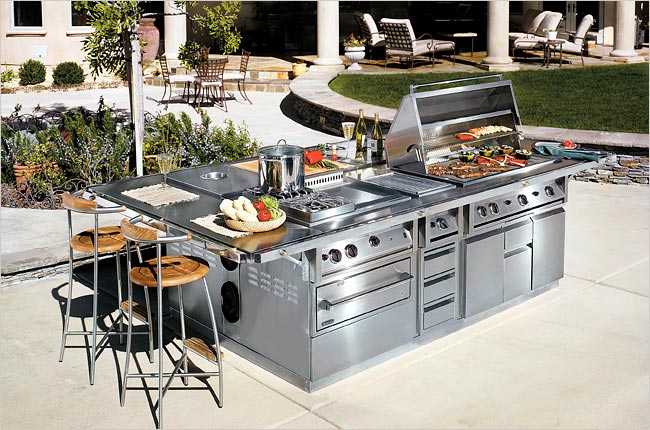 The reigning heavyweight is the Talos Outdoor Cooking Suite, for $35,000.
A KALAMAZOO grill can suck a standard tank of propane dry in two and a half hours. Not that backyard grill-users would want to crank every burner simultaneously and reach the full 154,000 B.T.U. capacity of this $11,290, six-and-a-half-foot-wide brute. But, as with a Porsche that can go 175 miles an hour on the autobahn, some owners find it sweet to know they've got that kind of juice under the hood.
"Our gas line had to be doubled in capacity from the house," said Connie Dove of York, Me. She and her husband, Mo Houde, took delivery last year of a Kalamazoo Bread Breaker Two Dual-Fuel grill with an infrared rotisserie cradle system and a side burner.
They hooked the 600-pound stainless steel hulk into their home's main propane supply, choosing not to mess with standard tanks, which each hold only four gallons of fuel. That's enough to allow a typical backyard grill to run at maximum for 15 hours, according to the Propane Education and Research Council in Washington.
"It is very, very powerful," Ms. Dove said. "A turkey you can have in an hour and a half."
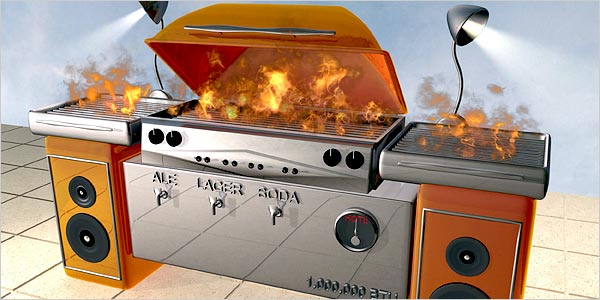
The Bread Breaker, which has a temperature gauge that reaches 1,000 degrees, is one of an increasingly popular breed of supergrills that are becoming backyard status symbols, as Americans, mostly of the male variety, peacock with an object that harks back to the earliest days of human existence.
As Memorial Day marks the official beginning of grilling season, many men will find themselves almost genetically drawn to throwing hunks of raw meat onto a fire and poking them with tongs. It's a pull that some will spend almost any amount of money to satisfy, said Pantelis A. Georgiadis, the owner of Kalamazoo Outdoor Gourmet, the grill manufacturer based in Michigan. "There is a market segment we call the 'man cook with fire' types," he said.
When Daniel Conrad, a lawyer, moved to Dallas four years ago from Pittsburgh to join the woman who would become his wife, his parents bought him a small Weber grill. "It wasn't big enough for my ego," Mr. Conrad, 34, said. "So I got this giant enormous Weber grill."
Now, he rushes home to his wife — and to his baby, a Weber Summit Gold D6, to slow-cook ribs or experiment with smoking turkeys. "Grilling has become my creative outlet," Mr. Conrad said. "The only two extravagances I have in my life are my car and my grill." He drives a Mercedes.
And like luxury car owners, many people who splurge on a grill that can simmer, bake and fry are looking to impress.
Last fall, Dave and Allison Petrullo of Commack, N.Y., installed a custom-built Cal Spas grill on their patio with an outdoor refrigerator. They spent more than $100,000 renovating their backyard with a new synthetic deck, masonry, a whirlpool and a pool waterfall, so $6,500 more for Mr. Petrullo to have a brick sanctuary with a Cal Spas grill as its central altar seemed like nothing. "I told him to just go for it," Ms. Petrullo said. "And get your dream barbecue."
Though they have actually cooked on the grill only three times since they installed it, it has been a hit with Mr. Petrullo's friends, who congregate around it at parties and give it a going-over like a pack of high school boys around a Corvette, Ms. Petrullo said. "They like to lift up the hood and play with the knobs," she said. "They open the doors underneath, and they open the fridge next to it to check it out."
The high-end grill market, which generally refers to any grill that costs more than $1,000, started quietly in 1990 when Dynamic Cooking Systems, a company based in California, introduced the DCS Professional Grill. The 48-inch-wide $5,000 appliance, which included H-shaped cast-iron commercial-quality burners, a heavy-duty side-burner and more B.T.U.'s per square inch than any other grill then on the market, was adopted by a few deep-pocketed souls on the grilling vanguard.
But those in the grill industry say the market did not begin to take off until the last half-decade, when homeowners in the West and the South began building increasingly elaborate outdoor areas with brick kitchen islands and ornate all-weather furniture.
"You had the ultrarich people who were buying high-end grills," said Dan Darche, sales manager for Masda Corporation, an outdoor home furnishings distributor based in Whippany, N.J. "But for the more normal families, the concept started to take off abut five or six years ago, and it's been increasing ever since."
Now the high-end grill market accounts for 3 to 4 percent of the 14.5 million grills sold last year, said Don Johnson, the director of market research for the Hearth, Patio and Barbecue Association, the grill industry trade group. It includes about a dozen players.
Viking has its Ultra-Premium line of grills starting around $2,500, which, among other doodads, have adjustable chrome-plated warming racks and stainless steel "flavor-generator plates" that, according to product literature, "catch drippings, generate smoke, minimize flare-ups and allow for better heat control."
Weber, the grill maker founded in Mount Prospect, Ill., in 1952, is refining its most expensive grill, the $2,200 Summit Platinum D6, in response to buyers who want more bells and whistles, said Brooke Jones, a Weber product manager. "They are looking for stainless steel grills and more accessories like rotisseries, warmer drawers, side burners and hand lights," she said.
Lynx, another high-end maker, sells a model with a 54-inch-wide cooking surface (one inch longer than Viking's biggest) for $6,500; it is equipped with dual halogen grill surface lights and red brass burners. The Twin Eagles Pinnacle Grill Series features dual-ring sealed burners and black-stripes across the starkly modern stainless steel silhouette of its base for a "museum-style look," a sales brochure effuses.
But the Queen Mary 2 of outdoor cooking is the $35,000 Talos Outdoor Cooking Suite sold by Frontgate, a luxury goods catalog retailer. The sprawling stainless steel temple features a searing station with a restaurant-style griddle, a hardwood cutting board, two side burners to heat sauces, a warming drawer, 3/8-inch-thick cooking grates, a 16,000-B.T.U. ceramic infrared rotisserie, a bartender module with a sink and a nine-volt electronic ignition system. The company doesn't release specific sales data, but a spokeswoman, Amy Crowley, said that fewer than 50 have been sold.
Some of the new top-of-the-line grills are hybrids, with interchangeable heating drawers that allow cooks to use gas, charcoal or wood for barbecuing. (Barbecuing, which usually involves indirect heat, long cooking times and wood smoke, is different from grilling, which simply means cooking on a grill.)
Many of these grills can reach temperatures of 2,000 degrees — hot enough to melt brass — if used improperly, but grill manufacturers say temperatures should stay under a safe 1,000 degrees (which can melt lead).
"If you load it up with charcoal and light 100,000 B.T.U.'s of propane under it, you're going to have a 2,000-degree fire going," said Russ Faulk, director of marketing for Kalamazoo. "It's not going to lead to cooking success." In addition to the owner's manual, Kalamazoo tries to give in-person training to new grill owners, as do most of the other high-end manufacturers.
But for those who want to stay on top of cooking technology, there is no such thing as too much power; grills have become an extension of their constantly updated kitchens. Describing the family's indoor appliances, Ms. Dove in Maine said: "Our stove is a Frigidaire Profile series with five burners, and we have a Miele wok burner and a Thermador downdraft system. The grill is something that has the glamour of the indoor kitchen."
During summer months her family uses the grill, which they have named Bertha, three to four times a week, but even in winter the short path from the house to the grill is kept shoveled and the grill is fired up at least twice a week. "When you look outside and she's covered up with a grill cover," Ms. Dove said, "she looks like a monster."
Devotees of expensive grills speak of being able to cook multiple dishes at once for large crowds and rave about exacting temperature control. "Because it's so big, you can do things you wouldn't do on a normal grill," Mr. Conrad of Dallas said. "You can cook ribs slowly by putting them on the side of the grill away from the heat. Practically speaking it's fantastic."
Those in the grill business also want to sell buyers on the idea that these grills can do more than just grill. Fireplace Patio Shoppe in Eastchester, N.Y., regularly brings in a chef for cooking demonstrations on a $6,600 Fire Magic Monarch Magnum, which, with the hood down, can flawlessly maintain a temperature of 350 degrees. "He actually cooks a pie," the owner, Darin Del Gardo, said. "Usually apple crumb."
A new breed of grill cuisine is rising along with grill prices. A new book, "Weeknight Grilling With the BBQ Queens" (Harvard Common Press), includes recipes for Blistered Whole Squash, Peppers, and Scallions with Goat Cheese, and Stir-Grilled Spaghetti with Meat Sauce and a Kiss of Smoke.
Still, according to research by the Hearth, Patio and Barbecue Association, hot dogs, burgers, steaks, and chicken are by far the most commonly prepared foods on outdoor grills. As A. Cort Sinnes, author of "The Grilling Book" (Aris Books, 1985), put it, "The way most grills get used, even the expensive ones, is you turn it on, you cook some chicken breasts, and you turn it off."
But does anyone really need to spend thousands of dollars to do that? No, said Chris Schlesinger, chef and owner of the East Coast Grill in Cambridge, Mass., and the author of books about grilling. "Give me two bricks and an oven rack and some wood, and I'll cook you a better steak than any expensive gas grill, hands down," he said. "It might look good in your garden, it might be more convenient, it might impress your friends, but it's not going to cook you a better steak."
Subscribe to:
Posts (Atom)

