New York Times
June 25, 2008
Albanian Custom Fades: Woman as Family Man
By DAN BILEFSKY
KRUJE, Albania — Pashe Keqi recalled the day nearly 60 years ago when she decided to become a man. She chopped off her long black curls, traded in her dress for her father’s baggy trousers, armed herself with a hunting rifle and vowed to forsake marriage, children and sex.
For centuries, in the closed-off and conservative society of rural northern Albania, swapping genders was considered a practical solution for a family with a shortage of men. Her father was killed in a blood feud, and there was no male heir. By custom, Ms. Keqi, now 78, took a vow of lifetime virginity. She lived as a man, the new patriarch, with all the swagger and trappings of male authority — including the obligation to avenge her father’s death.
She says she would not do it today, now that sexual equality and modernity have come even to Albania, with Internet dating and MTV invading after the fall of the Berlin Wall. Girls here do not want to be boys anymore. With only Ms. Keqi and some 40 others remaining, the sworn virgin is dying off.
“Back then, it was better to be a man because before a woman and an animal were considered the same thing,” said Ms. Keqi, who has a bellowing baritone voice, sits with her legs open wide like a man and relishes downing shots of raki. “Now, Albanian women have equal rights with men, and are even more powerful. I think today it would be fun to be a woman.”
The tradition of the sworn virgin can be traced to the Kanun of Leke Dukagjini, a code of conduct passed on orally among the clans of northern Albania for more than 500 years. Under the Kanun, the role of a woman is severely circumscribed: take care of children and maintain the home. While a woman’s life is worth half that of a man, a virgin’s value is the same: 12 oxen.
The sworn virgin was born of social necessity in an agrarian region plagued by war and death. If the family patriarch died with no male heirs, unmarried women in the family could find themselves alone and powerless. By taking an oath of virginity, women could take on the role of men as head of the family, carry a weapon, own property and move freely.
They dressed like men and spent their lives in the company of other men, even though most kept their female given names. They were not ridiculed, but accepted in public life, even adulated. For some the choice was a way for a woman to assert her autonomy or to avoid an arranged marriage.
“Stripping off their sexuality by pledging to remain virgins was a way for these women in a male-dominated, segregated society to engage in public life,” said Linda Gusia, a professor of gender studies at the University of Pristina, in Kosovo. “It was about surviving in a world where men rule.”
Taking an oath to become a sworn virgin should not, sociologists say, be equated with homosexuality, long taboo in rural Albania. Nor do the women have sex-change operations.
Known in her household as the “pasha,” Ms. Keqi said she decided to become the man of the house at age 20 when her father was murdered. Her four brothers opposed the Communist government of Enver Hoxha, the ruler for 40 years until his death in 1985, and they were either imprisoned or killed. Becoming a man, she said, was the only way to support her mother, her four sisters-in-law and their five children.
Ms. Keqi lorded over her large family in her modest house in Tirana, where her nieces served her brandy while she barked out orders. She said living as a man had allowed her freedom denied other women. She worked construction jobs and prayed at the mosque with men. Even today, her nephews and nieces said, they would not dare marry without their “uncle’s” permission.
When she stepped outside the village, she enjoyed being taken for a man. “I was totally free as a man because no one knew I was a woman,” Ms. Keqi said. “I could go wherever I wanted to and no one would dare swear at me because I could beat them up. I was only with men. I don’t know how to do women’s talk. I am never scared.”
When she was recently hospitalized for surgery, the other woman in her room was horrified to be sharing close quarters with someone she assumed was male.
Being the man of the house also made her responsible for avenging her father’s death, she said. When her father’s killer, by then 80, was released from prison five years ago, Ms. Keqi said, her 15-year-old nephew shot him dead. Then the man’s family took revenge and killed her nephew. “I always dreamed of avenging my father’s death,” she said. “Of course, I have regrets; my nephew was killed. But if you kill me, I have to kill you.”
In Albania, a majority Muslim country in the western Balkans, the Kanun is adhered to by Muslims and Christians. Albanian cultural historians said the adherence to medieval customs long discarded elsewhere was a byproduct of the country’s previous isolation. But they stressed that the traditional role of the Albanian woman was changing.
“The Albanian woman today is a sort of minister of economics, a minister of affection and a minister of interior who controls who does what,” said Ilir Yzeiri, who writes about Albanian folklore. “Today, women in Albania are behind everything.”
Some sworn virgins bemoan the changes. Diana Rakipi, 54, a security guard in the seaside city of Durres, in west Albania, who became a sworn virgin to take care of her nine sisters, said she looked back with nostalgia on the Hoxha era. During Communist times, she was a senior army officer, training women as combat soldiers. Now, she lamented, women do not know their place.
“Today women go out half naked to the disco,” said Ms. Rakipi, who wears a military beret. “I was always treated my whole life as a man, always with respect. I can’t clean, I can’t iron, I can’t cook. That is a woman’s work.”
But even in the remote mountains of Kruje, about 30 miles north of Tirana, residents say the Kanun’s influence on gender roles is disappearing. They said erosion of the traditional family, in which everyone once lived under the same roof, had altered women’s position in society.
“Women and men are now almost the same,” said Caca Fiqiri, whose aunt Qamile Stema, 88, is his village’s last sworn virgin. “We respect sworn virgins very much and consider them as men because of their great sacrifice. But there is no longer a stigma not to have a man of the house.”
Yet there is no doubt who wears the trousers in Ms. Stema’s one-room stone house in Barganesh, the family’s ancestral village. There, on a recent day, “Uncle” Qamile was surrounded by her clan, dressed in a qeleshe, the traditional white cap of an Albanian man. Pink flip-flops were her only concession to femininity.
After becoming a man at the age of 20, Ms. Stema said, she carried a gun. At wedding parties, she sat with the men. When she talked to women, she recalled, they recoiled in shyness.
She said becoming a sworn virgin was a necessity and a sacrifice. “I feel lonely sometime, all my sisters have died, and I live alone,” she said. “But I never wanted to marry. Some in my family tried to get me to change my clothes and wear dresses, but when they saw I had become a man, they left me alone.”
Ms. Stema said she would die a virgin. Had she married, she joked, it would have been to a traditional Albanian woman. “I guess you could say I was partly a woman and partly a man,” she said. “I liked my life as a man. I have no regrets.”
Showing posts with label Balkans. Show all posts
Showing posts with label Balkans. Show all posts
Wednesday, June 25, 2008


Monday, May 26, 2008
Turbo-folk music is the sound of Serbia feeling sorry for itself

Diva of nationalism: Svetlana Raznatovic – ‘Ceca’ – is Serbia’s most famous star of turbo-folk. As much aesthetic as sound, the genre drips with the emotional martyrdom of a wounded nation and the commercialism of sex.
Srdjan Ilic/ap
Christian Science Monitor
Turbo-folk music is the sound of Serbia feeling sorry for itself
A product of the criminal Milosevic era, its odd nostalgia is the soundtrack to a new wave of nationalism.
By Nicole Itano | Correspondent of The Christian Science Monitor
from the May 5, 2008 edition
BELGRADE, Serbia - The women parade across the stage, stiletto heels clacking as they croon songs of love and loss – ballads of village girls and heroic battles, of unrequited love and faithless men.
"Wherever I go, I always end up in the same place," goes the final medley, sung by a squadron of buxom, scantily-clad women to the accompaniment of accordions and brass. "Who can tear Kosovo away from my soul?"
The crowd cheers, waves heart-shaped balloons, and joins in. "Serbia, Serbia!" they chant.
This is the beat of nationalism in Serbia, the mournful, pumped-up tunes of turbo-folk, a genre born in the dark days of Yugoslavia's disintegration. And as Serbia confronts a resurgent nationalism – fueled by economic troubles and anger over Kosovo's declaration of independence – the rhythms of the Milosevic era are again playing on the political stage.
Turbo-folk is a flippant – oxymoronic – term that stuck to a genre of traditionally inspired folk songs set to a techno-pop beat. Associated with the brutal nationalism of the 1990s when Serbia was under the sway of the late Slobodan Milosevic, it is as much an aesthetic as a sound, one that is aggressive, brazenly sexual, and dripping with patriotic pride and victimhood.
"Turbo-folk," explains Milos Trninic, a local singer who plays in turbo-folk clubs, "sells emotion."
At the Amsterdam, a popular boat-cafe on the Danube River, young women in six-inch heels totter in, with ever-so-short skirts over fishnet stockings. Plunging necklines are de rigueur and platinum-dyed hair glints in the blinking lights. The men are less flashily dressed; in this world of new-money ostentatiousness, it's the thickness of their wallets that matters most.
Turbo-folk, according to Serbian academic Ivana Kronja, who has written a book on the music, glorified a newly emergent criminal class in Serbia – tied to Mr. Milosevic – that rose to power and prominence in the 1990s. Svetlana Raznatovic – the most famous turbo-folk singer, nicknamed Ceca – is the widow of the notorious Serbian paramilitary leader "Arkan," who was indicted on genocide charges by The Hague tribunal for Bosnian war crimes. She herself was arrested on suspicion of involvement in the assassination of Serbian Prime Minister Zoran Djindjic in 2003.
Once again, these are troubled times for Serbia, which is awash with rage over the Feb. 17 declaration of independence by Kosovo. After the traumatic 1990s – when Serbia lost four wars, was bombed by NATO, and faced international condemnation and isolation – the chastened country seemed to be slowly creeping toward a Western orbit.
But western support for Kosovo's independence has strained ties between Serbia and Western Europe and reopened old wounds.The fragile governing coalition collapsed in the wake of Kosovo's independence declaration.
Now, as the country heads into yet another round of elections on May 11, there's a strong possibility that Serbia's next government will be a coalition with a strongly nationalistic flavor, between the center-right Democratic Party of Serbia and the ultranationalist Serbian Radical Party, which wants closer ties to Russia.
So, licking its wounds again, Serbia is feeling the resurgence of the turbo-folk beat.
Modern politics here has always had a soundtrack. There was the '80s rock embraced by a generation shrugging off the shackles of communism. The turbo-folk of Serbian aggression in the 1990s gave way to more alternative pop fare – hip hop, electronica, indie rock – tied to the revolt against Milosevic, who was toppled by street protests in 2000.
But turbo-folk's popularity never completely waned, even during the years when Milosevic was on trial for crimes against humanity. The genre's younger generation of fans, who can sing along with the turbo-folk anthems of the 1990s, say the music has shed its nationalistic undertones and now worships only commercial success.
"When it appeared in the 1990s, maybe it was political," says Milos Vuksanovic, the handsome guitarist of a band that plays weekly at the Amsterdam. "Now it's more a way of dressing. The girls, especially, they want to be stylish and to dress and be seen in a certain way."
After a decade of cultural isolation, in the years since Milosevic's fall, new musical styles have flooded in, many associated with the youth revolt. There are now Serbian rappers, like Beogradski Sindikat (Belgrade Syndicate) – who have taken on corruption – and punk bands and rockers. The Exit Festival, an annual concert in the Serbian city of Novi Sad, has become one of the great alternative-music festivals in Europe, attracting people from across the continent.
But turbo-folk still outsells them all in Serbia. The most popular clubs in Belgrade play the music on their busiest nights. Street stalls sell bootleg CDs of popular turbo-folk (and little else).
Local media broadcast their political philosophies through music, too. You won't hear turbo-folk on B92, which started as an anti-Milosevic youth radio station with alternative music and independent news and now broadcasts nationally on radio and TV. Pink TV – a shamelessly commercial TV station – plays endless videos of scantily clad singers belting out the folk-inspired tunes. Its most popular show, "Grand Parade," is an American Idol-like program on which viewers vote for their favorite songs, mostly turbo-folk.
But despite turbo-folk's wide popularity, many Serbs are hesitant to admit they like it, perhaps because the taint of nationalism lingers.
"People try to distance themselves from folk," says Mr. Vuksanovic, who confesses he doesn't particularly like the turbo-folk he sings. (He prefers Phil Collins.) "They put on an act and say that they only listen to turbo-folk when they go out. They are ashamed of it."
For Serbia's politicians, though, in these deeply divided times, music remains a powerful way of channeling ideology. Rallies for nationalist political parties play to nostalgic ballads, and, in the presidential election in February, the differences between the two candidates could be heard as much as seen.
Western-oriented liberal Boris Tadic, who was narrowly reelected as president, campaigned to the tunes of 1980s Belgrade rock, associated with the dying days of communism and the country's opening to the West. But his ultranationalist opponent, Tomislav Nikolic, known as "Toma" to his supporters, was backed at rallies by provocatively dressed turbo-folk crooners who sang nationalistic anthems and love songs with his name inserted as the romantic hero: "This life is not worth living if Toma does not win."
For many liberal-leaning Serbs, the right's embrace of turbo-folk is enough to send them running.
"Those of us who are political and socially aware, we would never go listen to that type of music," insisted Maia Todorovic, a beautiful, dreadlocked 19-year-old at a get-out-the-vote concert before the February election.
"It's not even music," scoffed her friend Tamara Antonijevic.
"Besides," laughed Ms. Todorovic, assessing the crowd, among which there was not a stiletto heel in sight. "We don't have the right clothes."
Saturday, August 11, 2007
Traditional Changing of Gender Identity in Albania

The Sacrifices of Albania's 'Sworn Virgins'
A Rockville Filmmaker Tells Of an Old Custom That Both Liberates and Limits Women
By Joshua Zumbrun
Washington Post Staff Writer
Saturday, August 11, 2007; C01
When the Albanian journalist and author Elvira Dones was traveling in the mountains of northern Albania, she asked for directions from someone she thought was a man walking his mule through a village, rifle on shoulder.
After the exchange, her guide whispered, "That is one of them."
Dones, who lives in Rockville, had just met an adherent of an ancient northern Albanian tradition in which women take an oath of lifelong virginity in exchange for the right to live as men. The process is not surgical -- in these mountains there is little knowledge that sex-change surgery is even possible. Rather, sworn virgins cut their hair and wear baggy men's clothes and take up manly livelihoods as shepherds or truck drivers or even political leaders. And those around them -- despite knowing the sworn virgins are women -- treat them as men.
The idea that a woman would need to forsake love and live as a man to control her own fate seems primitive to modern eyes. But perhaps, in the context of a once-upon-a-time culture, a culture before feminism, it can be seen as progressive. The existence of sworn virgins reveals a cultural belief, however inchoate, that a biological woman can do all the work of a man.
"Why live like a man?" one virgin, Lule Ivanaj, asks herself rhetorically in an English-subtitled documentary that Dones (pronounced DOH-nez) made on the women for Swiss television called "Sworn Virgins." Ivanaj looks like a man in his 50s, with short hair, thick arms and a wide metal watchband on one wrist. "Because I value my freedom. I suppose I was ahead of my time."
Dones, 47, learned about sworn virgins 25 years ago from her university classmates in Albania's capital, Tirana. The practice has existed at least since the 15th century, when the traditions of the region were first codified, according to Dones. The sworn virgins came into being for emergencies: If the patriarch of the family died and there was no other man to carry on, a provision was needed so that a woman could run her family.
When Dones was in college, the country was under the control of communist dictator Enver Hoxha, who ruled for more than 40 years until his death in 1985. Dones had the itch to tell the story of the sworn virgins, but the communist regime tightly controlled the media and travel to the north was not allowed.
In 1988, Dones -- then a journalist for state-run television -- defected, in part because of frustration with her country's government. She moved to the Italian-language region of Switzerland, where she worked for Swiss television and wrote novels.
Three years ago, she moved to Rockville, where she continues to write and make documentaries for Swiss television. She is now a popular novelist in Italy and Albania, having written eight books of fiction; her most recent novel, published this year in Italian and Albanian, is about a 34-year-old woman named Hana, who comes to regret her decision to live as a sworn virgin. For her book, Dones read up on the tradition, which has been documented by historians and sociologists. But until recently she had never met a sworn virgin, except for that brief, unwitting encounter with the rifle-toting virgin while filming a documentary on another topic.
"I was happy with the novel, but I wanted to see them," Dones says, "I was obsessed by them."
So last year Dones traveled to meet with them. There are only about 30 to 40 sworn virgins remaining in Albania, Dones says, with perhaps a few in the neighboring mountains of Kosovo and Serbia and Montenegro. Dones interviewed 12, from elderly women to 20-somethings. The documentary debuted on Swiss television this year and has been accepted into the Baltimore Women's Film Festival, which takes place in October. It also is available through Dones Media, the U.S.-based production company Dones co-owns with Swiss television.
In the mountains of northern Albania, throughout modern history, women have had very few rights. They cannot vote in their local elections, they cannot buy land, there are many jobs they are not permitted to hold; they cannot even enter many establishments. An ancient set of laws called the Kanun still helps govern the region. The Kanun says, "A woman is a sack made to endure."
Other traditional practices of the north were repressed by the communists, but leaders in Tirana simply never cared if a woman in the impoverished and remote mountains wanted to dress and labor as a man.
Over the years, women became sworn virgins for different reasons. Some swore the oath if the patriarch of the family died. Others swore the oath out of a fierce streak of independence, and others because it was the only way to avoid an arranged marriage without disgracing the family of the selected groom. The oath is traditionally sworn in front of a town's elders, though some women take the oath privately.
One virgin that Dones interviews in the documentary, Shkurtan Hasanpapaj, once served as the local secretary of the Communist Party, the top office in her region. She was in charge of all the men, and though they knew the reality of her anatomy, her authority was unquestioned.
Asked if she would have felt restricted in a marriage, the virgin Ivanaj responds, "Absolutely! More like squashed than restricted. . . . Even when there's love and harmony, only men have the right to decide. I want total equity or nothing."
"I wanted to tell their stories and respect the way they told their stories," Dones says. "I found an extreme sense of beauty in them. They are not bitter. They carry the stories with such dignity. . . . They are so comfortable with their role."
But the virgins in Dones's documentary acknowledge there are many sacrifices with this lifestyle. The women may enjoy the rights of men, but they are denied their womanhood. They will never experience the pleasures of having a lifelong partner or bearing children.
Sanie Vatoci, a 50-year-old who took the oath as a teenager when her father died, speaks of how she has slowly come to regret the life she now leads as a solitary truck driver.
"While looking at other couples, reading books, watching movies -- I began to wonder: Why don't I have a partner? Why am I acting like a man?" Vatoci says. "There must have been a man out there for me."
But it may be too late for her. Even as movies and television creep into northern Albania, even as traditions slowly die, Vatoci could never go back on her oath, she says. Breaking the oath was once punishable by death, and though Dones doubts such punishment would be enforced today, a deflowered sworn virgin would nevertheless be shunned, she says. She would certainly never be accepted as a woman.
It's easy now for people to come down from the mountains. Travel is no longer restricted. The city beckons. And just as many members of the new generation leave their ancestral homelands for a modern life, modern life slowly trickles back into the mountains. The choice between being a woman and having the rights of men is no longer absolute.
"I asked the young girls of the region what they think of the sworn virgins," Dones says. "They said they respect them, but they would never follow their path. Not now."
Vatoci, the truck driver, has applied to immigrate to the United States, where her sister has lived for seven years, and maybe here, Vatoci figures, she could have a fresh start.
"She deeply feels that she needs to give love to someone else," Dones says. "And of course, she's not delusional. She knows that perhaps she will never find a man. And perhaps she could never start a life as a woman at 50."
Though Vatoci speaks no English, she has the "skills of a man," and Dones thinks she could make it in America: "She went to school for being a truck mechanic. She's a tough guy."
Tuesday, April 11, 2006
Global Brass Bands
New York Times
April 9, 2006
Music
They're With the Band, Speaking That Global Language: Brass
By JOSH KUN
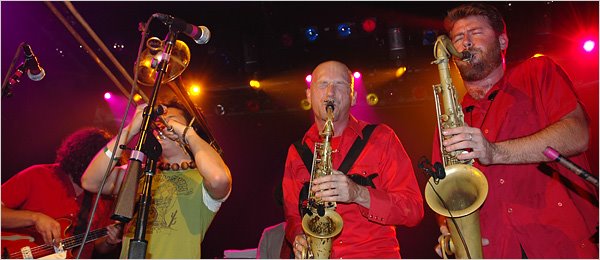
LAST December, the veteran Mexican-American rock band Los Lobos dusted off its 1992 album "Kiko" and performed it live, start to finish, at the House of Blues in West Hollywood. For most of the night it was a standard rock setup, but when it came time for the album closer, a woozy Mexican folk swoon called "Rio de Tenampa," Los Lobos brought out Los Cenzontles, a Northern California banda troupe. While Mexican bandas (brass bands) can have as many as 20 members, Los Cenzontles didn't need much more than a tuba, a trumpet, a thudding bass drum and a pair of clarinets to turn the club into a raucous cantina.
Brass band music can have this effect. The stammering pepper-spray of horns, the crisp snaps of snare rolls: it's precise and excessive at once, a joyous emotional tornado awash in spit, sweat and celebration. No wonder it's one of the world's most-spoken musical languages — from Serbian villages to Manhattan's bustling "gypsy punk scene" to this year's Grammy Awards, where Kanye West reinvented "Gold Digger" by having a marching band play, running through the aisles. Awareness of international brass styles has blossomed in recent years in the United States, thanks in large part to an increase in domestic album distribution deals and more frequent international concert tours.
"You would think that a brass band, which has no strings at all, would be limited in its sound," said Tamir Muskat, the Israeli-born co-founder of Balkan Beat Box, a new-school crew in New York known for wild live shows that mix Balkan horn blasts with electronic beats. "But it's unbelievable what people manage to do with it. There is a whole world of brass out there."
Listen to enough brass band music — whether a slice of Mexican banda or the Romanian group Fanfare Ciocarlia pulling the trigger on a dizzying blast of high-velocity trumpets — and you start to hear the history of the world handed back to you in a horn section. Suddenly, Serbia and Romania could be the alternative birthplace of Brazilian frevo; brass flurries from Gypsy bands in Macedonia and Bulgaria could be lost cousins of the Jaipur Kawa Brass Band from India, the Gangbe Brass Band from Benin or any New Orleans jazz troupe.
The connections are more than theoretical. In the 1860's, thousands of former Gypsy slaves fled Romania for the American South, landing in mostly black neighborhoods. The brass music they brought with them, like that of all Balkan countries, can be traced to the Turks, the original band geeks. Last year's "Blowers From the Balkans" compilation (Topic), which unearthed a trove of early 20th-century Balkan brass recordings, spelled it out loud and clear: it was the Ottoman Empire's janissary bands that turned brass into the lingua franca of Serbia, Macedonia, Romania and Bulgaria.
"The Ottoman empire used brass bands to impress the enemy, walking and playing in front of the first line of soldiers," explained Oprica Ivancea, the lead clarinetist for Fanfare Ciocarlia, a 12-piece band of Romany Gypsies who work out of the remote mountain town of Zece Prajini (population 400) in eastern Romania. "But in the early 19th century, brass got popular in Germany and Austria and because Romanians always want to be like the Germans we began to adapt to their sound as well."
Long before Kelly Clarkson and Jay-Z (and for that matter, long before rock 'n' roll), European military and church bands were the world's top global musical exports. Locals throughout Asia, Africa and the Americas were trained in the ways of the marching band as part of colonialism. As empires dissolved, official bands soon became voluntary village bands, and by the turn of the 20th century most of the world shared an ingrained knowledge of all things brass.
"All brass bands have a link somewhere," Mr. Muskat said. "Ninety percent of all brass bands are based on the same elements. It's all rhythm and horns."
Mr. Muskat's Balkan Beat Box partner Ori Kaplan grew up in Jaffa, Israel, where he watched Egyptian orchestras on television and learned to play Eastern European klezmer clarinet from a Bulgarian trained by Gypsy brass musicians. When Mr. Kaplan moved to New York 15 years ago, though, he wanted nothing of his klezmer past, choosing instead to play in industrial punk bands. That all changed when he heard a CD from Macedonia's top brass band, Kocani Orkestar, and learned about the Gypsy-Turkish fusions of the Bulgarian horn stalwart Yuri Yunakov, another New York City transplant). "I started to listen to Balkan music constantly," Mr. Kaplan said, "I became a brass band freak."
Of brass band enthusiasts in the United States, however, few can top the trumpeter Frank London, whose Klezmer Brass All-Stars have just released their third raucous manifesto of brass globalization, "Carnival Conspiracy." While firmly grounded in both Balkan and klezmer traditions (Mr. London's main gig is with the tradition-bending Klezmatics), "Carnival" makes cross-cultural brass connection its guiding impulse, riffing on the beer hall oompah of Mexican banda and the funk marches of Brazilian frevo and batucada. If the batucada seems like a stretch, it shouldn't: the first Jews in North America were Eastern European immigrants from Recife, Brazil — the capital of Brazilian big band.
"The idea of brass repertoires crossing genres and being assimilated into different traditions has been going on in all of these brass band musics forever," said Mr. London, who in the 1980's also fronted Les Misérables Brass Band, playing music from Pakistan, Serbia and South America (as well as the occasional Jimi Hendrix cover). "For many years, the most popular song for Indian brass bands was 'Tequila.' When you play an Italian feast, you don't just do Italian parade music. At the end you sit down and play opera overtures, then you can do covers of popular music, dance music, jazz music. Most brass bands just have this breadth of repertoire and styles at their fingertips."
Fanfare Ciocarlia have made a career out of this kind of stylistic juggling. They play everything from Russian-influenced Romanian doinas (slow improvised melodies) to Gypsy maneas (melancholy love songs) born in India, and on their latest CD, "Gili Garabdi," tackle an Afro-Cuban rumba alongside versions of the James Bond theme and Duke Ellington and Juan Tizol's "Caravan."
"We play music and dances we learned from our fathers," said Mr. Ivancea, who considers Gili Garabdi a tribute to the shared heritage of Gypsy brass and African-American jazz. "But we also play any tune requested during a wedding or baptism. We provide a service — we have to play what people want to hear."
In 2003, Mr. London decided to test these theories of a single brass family tree on an actual collaboration. So on the Klezmer Brass All-Stars' sophomore outing, "Brotherhood of Brass," he sought out the Hasaballa Brass Band from Cairo and Boban Markovic, a Serbian trumpet king, for a series of reeling geography mashups that imagined Eastern European shtetls and Egyptian markets sprouting up in Serbian villages.
"Over the last few years, I've noticed that my music has become part of a larger global conversation," said Mr. Markovic, who has been known to start his live sets with a version of the theme from "Titanic." "Knowing someone's music is so much easier these days. But I am still mostly trying to communicate with local people, especially communities in the south of Serbia and in the Balkans."
In that spirit, Mr. Markovic's newest album, "The Promise," features his typically kaleidoscopic takes on standard coceks (stomping Gypsy dance tunes), but also dips into the Latin American brass band tradition with "Latino" and "Voz," songs that wouldn't sound out of place on the set list of a Mexican banda. Which makes perfect sense considering that the Mexican brass style — one of the most commercially dominant genres in that country's music industry — was initially inspired by the Franco-Austrian military bands that reached Mexico through the coastal hub of Mazatlán in the 1800's.
"Our brass music is very similar to German music," said Poncho Lizárraga of Banda el Recodo, Mexico's longest-running brass ensemble, founded by Mr. Lizárraga's father, Don Cruz, in 1938. "We just interpreted it differently, turned the polkas into our own rancheras. My father wanted something different from all that music coming from Europe. It was music just for our town, and in the beginning, mostly for people who liked to spend too much time in the cantinas."
More than six decades and 180 albums later (their latest, "Hay Amor," has just been released), Recodo's 17 members are international banda ambassadors who wear matching jewel-studded suits made of black velvet, and their music has become a favorite sample source for hip-hop and electronic acts like Akwid from Los Angeles, Wakal from Mexico City and Nortec Collective from Tijuana. Similarly, the growing popularity of Balkan brass with sample-hunting D.J.'s in the United States and Europe — led by Shantel of Germany, whose "Bucovina Club" nights in Frankfurt ignited an electro-Balkan avalanche — which has been a key factor in introducing the centuries-old music to first-time listeners.
On Shantel's new "Bucovina Club Vol. 2" mix CD, Balkan Beat Box makes an appearance, and he throws a few house beats under cuts from Fanfare Ciocarlia and Mahala Rai Banda, another Romanian band, but mostly he lets the old-school originals speak for themselves: the traditional as the new cutting-edge.
"People are tired of corporate-friendly rock 'n' roll and the cold nihilism of the electronic music scene," said Mr. Kaplan of Balkan Beat Box. "They're hungry for this really sweaty, personal, alcohol-driven, familiar, ceremony-like music. There's something very healthy about all of this interest in brass music. People just want to get back in touch with their feelings."
Subscribe to:
Posts (Atom)


