
Showing posts with label sax/flute/woodwinds. Show all posts
Showing posts with label sax/flute/woodwinds. Show all posts
Thursday, January 26, 2012


Thursday, January 05, 2012
Harold Land (1928-2001)

Been doing a little reading on jazz saxophonist Harold Land, who passed away in 2001. Here's the NYT obituary:
Harold Land, 73, Saxophonist Who Made a Splash in the Bop Era
By BEN RATLIFF
Published: July 30, 2001
Harold Land, a West Coast tenor saxophonist who had a brush with the jazz pantheon through a brief tenure with the Clifford Brown-Max Roach Quintet in the mid-1950's, died on Friday in Los Angeles. He was 73 and lived in Los Angeles.
The cause was a stroke, said his wife, Lydia.
Mr. Land was performing with great strength even until last year as part of the Harold Land-Billy Higgins Quintet, a group that had come to the Jazz Standard in Manhattan three times in recent years. His dire, brooding sound began somewhere between rhythm and blues and Coleman Hawkins, and after the early 1960's owed more and more to John Coltrane's harmonies, phrasing and experiments with modalism.
Born in Houston, Mr. Land moved with his family to San Diego when he was 5. He began playing saxophone at 16 after hearing Hawkins's recording of ''Body and Soul.'' After high school Mr. Land worked in a band led by a local bass player, Ralph Houston, who also helped him join the musicians' union. Then he was in the trumpeter Froebel Brigham's band at the Creole Palace, a jazz club. He made his first recording at 21 as part of Brigham's band. He toured briefly with the rhythm-and-blues bandleaders (and brothers) Jimmy and Joe Liggins and then in 1954 moved to Los Angeles.
The trumpeter Clifford Brown heard Mr. Land in a jam session at the home music studio of the saxophonist Eric Dolphy, and Mr. Land was abruptly hired into the Brown-Roach band, which already had a wide reputation, replacing the saxophonist Teddy Edwards. For almost two years, based in Philadelphia, far from his wife and young son, he contributed to some of the finest records of the hard-bop era, including ''Study in Brown.'' He was becoming famous in jazz circles.
But in late 1955, when he learned that his grandmother was dying in Los Angeles, he quit and moved back there to be with his family. He was an archetypal example of a musician whose career might have taken off if he had stayed in the New York area.
Back on the West Coast, he joined the bassist Curtis Counce's group, recording with Counce and making his own records for Contemporary, including ''The Fox,'' from 1959, a lesser-known classic with a number of tunes written by the pianist Elmo Hope and Mr. Land's own tricky, blisteringly fast title number.
He recorded for Concord in the 1970's, and in the 80's he joined the Timeless All-Stars sextet. He returned to performing on his own more frequently and widely in the late 1990's. He had taught jazz at the University of California at Los Angeles for the past three and a half years. His final record, from last year, was ''The Promised Land,'' on Audiophonic.
In addition to his wife, he is survived by a son, the jazz pianist Harold Land Jr. of Los Angeles, and a grandson.
Tuesday, January 03, 2012
Jazz Great Charles McPherson Interview
Sound is bad in places, but McPherson is a great player with a lot of experience and wisdom.
Saturday, December 10, 2011

Monday, May 23, 2011
SLATE: Is Pop Bringing Back the Sax for Nostalgia's Sake?
Bringing Saxy Back
The sax solo returns to pop music.
By Jonah WeinerUpdated Monday, May 23, 2011, at 6:50 AM ET
For 36 years, Saturday Night Live has provided sanctuary to a species of musical wildlife that today sits on the endangered list: the saxophone solo. In 1975, jazz whiz David Sanborn's note-gobbling, register-vaulting altissimo ushered in the show's premiere episode, setting the brassy tone for every SNL opening sequence that followed. Since 1985, the SNL house band's lead saxophonist has been Lenny Pickett, who made his name in the venerable horn band Tower of Power. Over the course of Pickett's tenure on the show, the sax, once a pop-music staple, has fallen precipitously out of vogue—everywhere, that is, except SNL.
Last October, though, the show allowed some hunting in the preserve. In a digital short titled "The Curse," Andy Samberg, playing an arrogant businessman, is tormented by Jon Hamm, who—ponytailed, shirtless, and with biceps oiled to the point they're reflective—bursts through walls at inopportune moments and, sax in hand, lays into lustful torrents of lite-jazz honking. When the solos are done, Hamm whips his face toward the camera and, fiery-eyed with passion, intones his character's name: "Sergio!" You'd be tempted to call the joke one-note if it didn't involve such a preposterous number of notes: The sketch wrings four sublimely absurd minutes from the simple idea that blistering saxophone solos have come to sound not merely dated but ridiculous, and not merely ridiculous but hilarious.
I can't help but picture Sergio when I listen to Katy Perry's "Last Friday Night (T.G.I.F.)," a song from her 2010 album Teenage Dream. For the most part, the song chugs along pleasantly and, in the context of state-of-the-art pop-rock, unremarkably: crisp beat; summery guitars; big chorus about remembering, and hoping to re-create, a fun night of skinny dipping and table dancing. But just before the 3-minute mark, a saxophone bursts unexpectedly into the mix, Sergio-style, for a flurry of ecstatic screeches. The first time I heard the song, the sax took me entirely by surprise. It was ingenious. Perry's lyrics celebrate a goofy blast from the past, so what better musical corollary to that theme than a sax solo, as goofy as blasts from the past get? The "T.G.I.F." sax part, it turns out, was performed by Lenny Pickett. The caretaker had emerged from the sanctuary to release one of his beasts back into the wild.
With the release of Lady Gaga's new album, Born This Way, what was an anomaly officially becomes a pop trend: The saxophone is repopulating. Two of Born This Way's songs, "Hair" and "Edge of Glory," feature sax playing courtesy of the E Street Band's own Clarence Clemons. "It was wild. I was so excited," Clemons told Rolling Stone in a detailed report on the collaboration. "I'm a Gaga-ite." What unites Gaga's sax songs with Perry's is that both use the instrument as a nostalgia button. Gaga has said she wanted to give the song a "Bruce Springsteen vibe," adding, of "Hair," "it's really interesting, because it's putting saxophone on this really huge electronic record." (In this respect, Perry's and Gaga's sax solos are of a piece with the Black Eyed Peas' hit "The Time," a another bittersweet song that drops a chunk of undigested '80s cheese—an interpolation of Dirty Dancing's "The Time of My Life"—into an otherwise contemporary-sounding track.)
.....
The the full story in SLATE.
The sax solo returns to pop music.
By Jonah WeinerUpdated Monday, May 23, 2011, at 6:50 AM ET
For 36 years, Saturday Night Live has provided sanctuary to a species of musical wildlife that today sits on the endangered list: the saxophone solo. In 1975, jazz whiz David Sanborn's note-gobbling, register-vaulting altissimo ushered in the show's premiere episode, setting the brassy tone for every SNL opening sequence that followed. Since 1985, the SNL house band's lead saxophonist has been Lenny Pickett, who made his name in the venerable horn band Tower of Power. Over the course of Pickett's tenure on the show, the sax, once a pop-music staple, has fallen precipitously out of vogue—everywhere, that is, except SNL.
Last October, though, the show allowed some hunting in the preserve. In a digital short titled "The Curse," Andy Samberg, playing an arrogant businessman, is tormented by Jon Hamm, who—ponytailed, shirtless, and with biceps oiled to the point they're reflective—bursts through walls at inopportune moments and, sax in hand, lays into lustful torrents of lite-jazz honking. When the solos are done, Hamm whips his face toward the camera and, fiery-eyed with passion, intones his character's name: "Sergio!" You'd be tempted to call the joke one-note if it didn't involve such a preposterous number of notes: The sketch wrings four sublimely absurd minutes from the simple idea that blistering saxophone solos have come to sound not merely dated but ridiculous, and not merely ridiculous but hilarious.
I can't help but picture Sergio when I listen to Katy Perry's "Last Friday Night (T.G.I.F.)," a song from her 2010 album Teenage Dream. For the most part, the song chugs along pleasantly and, in the context of state-of-the-art pop-rock, unremarkably: crisp beat; summery guitars; big chorus about remembering, and hoping to re-create, a fun night of skinny dipping and table dancing. But just before the 3-minute mark, a saxophone bursts unexpectedly into the mix, Sergio-style, for a flurry of ecstatic screeches. The first time I heard the song, the sax took me entirely by surprise. It was ingenious. Perry's lyrics celebrate a goofy blast from the past, so what better musical corollary to that theme than a sax solo, as goofy as blasts from the past get? The "T.G.I.F." sax part, it turns out, was performed by Lenny Pickett. The caretaker had emerged from the sanctuary to release one of his beasts back into the wild.
With the release of Lady Gaga's new album, Born This Way, what was an anomaly officially becomes a pop trend: The saxophone is repopulating. Two of Born This Way's songs, "Hair" and "Edge of Glory," feature sax playing courtesy of the E Street Band's own Clarence Clemons. "It was wild. I was so excited," Clemons told Rolling Stone in a detailed report on the collaboration. "I'm a Gaga-ite." What unites Gaga's sax songs with Perry's is that both use the instrument as a nostalgia button. Gaga has said she wanted to give the song a "Bruce Springsteen vibe," adding, of "Hair," "it's really interesting, because it's putting saxophone on this really huge electronic record." (In this respect, Perry's and Gaga's sax solos are of a piece with the Black Eyed Peas' hit "The Time," a another bittersweet song that drops a chunk of undigested '80s cheese—an interpolation of Dirty Dancing's "The Time of My Life"—into an otherwise contemporary-sounding track.)
.....
The the full story in SLATE.
Wednesday, April 06, 2011
Tuesday, February 02, 2010
Wednesday, April 01, 2009
Groundbreaking Female Flutist Frances Blaisdell dies at 97

NYT
March 31, 2009
Frances Blaisdell, ‘Girl Flutist’ Who Opened Doors, Dies at 97
By DOUGLAS MARTIN
Frances Blaisdell, a flutist who played her way into what was then the male world of orchestral music, becoming one of the early women to play a woodwind instrument with the New York Philharmonic, died on March 11 in Portola Valley, Calif. She was 97.
Her son, John, announced her death.
In addition to playing with the Philharmonic, Ms. Blaisdell performed with prominent chamber ensembles, on Broadway, at Radio City Music Hall, in vaudeville, and with Phil Spitalny and His All-Girl Orchestra on the “Hour of Charm” on CBS and NBC radio. She also taught generations of leading flutists.
“I had lots of opportunities because I was sort of a freak, and people couldn’t imagine a girl flutist,” she said in an interview printed in The Flutist Quarterly in 2005.
Chamber Music magazine suggested in 1992 that she was considerably more than that, saying, “Every woman flute player in every major American orchestra, every little girl who pays the flute in a school band, has Frances Blaisdell to thank. She was first.”
Ms. Blaisdell had to overcome the mixed feelings of her father to become a professional; proud of her talent, he feared that as a woman, she would not survive as a player. He was in the lumber business, but his own love was the flute, and he started teaching her to play when she was 5. He wished she were a boy and called her Jim, she said in The Flutist Quarterly interview, which first appeared in the New York Flute Club newsletter. Ms. Blaisdell wrote to Ernest Wagner, a flutist with the New York Philharmonic, to ask if he would teach “Jim.”
When she appeared for her lesson, she said, Mr. Wagner refused to teach her, saying there was no future for a woman trying to play the flute in orchestras. But he finally agreed to six lessons, and then more.
Ms. Blaisdell’s father wanted her to pursue a career, but saw no future for her in music. He gave her the choice of being a teacher, nurse or secretary. She persuaded him that since she was graduating at 16, two years early, she should spend the two years pursuing her dream.
“Two years, but not another day,” he said.
So in 1928 she wrote Georges Barrère, the great French flutist, who taught at what is now Juilliard. She was given an appointment, perhaps because her name had been taken down as “Francis.” She was admitted with a scholarship.
Ms. Blaisdell later studied with two other giants of the flute, Marcel Moyse and William Kincaid. In 1941, after Barrère had a stroke, she took his place in the Barrère Trio.
In 1930, she became first flute of the National Orchestral Association and soon joined Barrère to play Bach’s Brandenburg Concerto No. 4 under the baton of Walter Damrosch at Madison Square Garden. She was first flute in the New Opera Company and in the New Friends of Music.
On Nov. 26, 1932, she was the soloist with the Philharmonic at a children’s concert, playing Mozart’s Flute Concerto No. 2 in D major. Josh Marcum, a spokesman for the Philharmonic, confirmed the appearance.
But in 1937, she was refused an audition for an opening as assistant first flute of the Philharmonic because she was a woman. In 1962, she said, she became one of the first women to play a woodwind with the Philharmonic, when a piece demanded extra flutes. Mr. Marcum said this was possible, but not provable.
In 1937, Ms. Blaisdell married Alexander Williams, first clarinetist for the Philharmonic. They and three other Philharmonic players formed the Blaisdell Woodwind Quintet, which had a radio series. Mr. Williams died in 2003.
In addition to her son, Frances Louise Blaisdell is survived by her daughter, Alexandra Hawley; three grandchildren; and three great-grandchildren.
Ms. Blaisdell played several concerts with the soprano Lily Pons, providing the requisite flute trills that accompany many showpieces for a coloratura soprano, and taught at the Manhattan School of Music, among other places. In 1973, she moved to California, where she taught at Stanford for 35 years.
Ms. Blaisdell adapted to the show business side of classical music. She said she wore a beautiful gold lamé dress at Radio City Music Hall for five shows a day in 1934 or 1935. She had two Rockettes on each side of her. Still, she was deathly frightened the first time she gazed into the immense black space, which looked, she said, like the “caverns of hell.”
A Rockette nudged her and said, “Get going, kid, and smile.”
Ms. Blaisdell did. After a couple of shows, it was easy."
Tuesday, June 10, 2008
Remembering pre-Katrina New Orleans Jazz Funerals

A wonderful article by Dr. Michael White.
Excerpt:
"I met disappointment searching for musical direction in pop music, modern jazz, and the commercialized jazz of Bourbon Street. Things changed when I started going to the New Orleans Jazz and Heritage Festival in 1973 and heard real traditional jazz bands for the first time. It was there I met the brass band leader and legend Ernest “Doc” Paulin. Though the elderly trumpet player seemed skeptical about hiring “young fellas,” a few weeks later I answered the phone to hear his thick Creole accent offer me a job: “Be at my house at nine o’clock sharp next Sunday. You need to wear black pants, a clean white shirt, a solid black tie, black shoes and a white band cap. You won’t mess up will you? You know you young fellas ain’t no good.” That Sunday, after a brief military-like inspection and reprimand of those not properly attired, Doc led a caravan of ten musicians just across the Mississippi River to Marrero and parked in front of the small Morning Star Baptist Church—the place where the baptism into my jazz life began. I was sure it would be my first and last musical engagement. I was very wrong. Over the next four years I was a regular member of the band and played over 200 jobs.
Most of Doc’s work was in the African American community: social club and church parades, jazz funerals, and dances. Doc employed several older musicians who, like himself, had been playing jazz since the 1920s. It was during that time that I really got to know various New Orleans neighborhoods and became immersed in the subculture whence jazz originated. Doc and the older band members taught me that, at least in the neighborhoods, jazz was not the same as tourist music. It was a musical accompaniment to a way of life, an expression of community spirit that permeated dancing, speech, cooking, mannerisms, dress, walking, wit, and humor. And over the years of many memorable engagements I came to appreciate the strong spiritual and cultural ties between the local African American community, West African customs, and European traditions. The band often played for seasonal benevolent society, and social aid and pleasure club parades—very different in look, sound, nature, and purpose from the better-known, more Eurocentric Mardi Gras parades. New Orleans African American social club parades consist of colorfully attired dancing club divisions, uniformed brass bands, and a “second line.” The second line is a crowd of anonymous followers, sometimes numbering in the thousands, who dance and cheer throughout social club parades and jazz funerals. The term also refers to the participants’ free-form, West African–influenced dance that has endless variations and symbolic gestures, and often involves the use of umbrellas and handkerchiefs.
Eventually, I began to see beneath the collective hysteria an important social significance. Like the jazz music that accompanied them, the community parades since the early 1900s not only celebrated ancestral traditions, they gave scope for pride and free expression; they promoted visibility, unity, respect, and strength.
The first nonmusician’s jazz funeral Doc Paulin’s brass band played after I joined was for a member of an old benevolent society across the river from New Orleans in Hahnville. I will never forget the look, sound, and feel of that very spiritual day. Society members wore navy blue nineteenth-century French military-style uniforms trimmed in gold—complete with shiny swords and plumed admirals’ hats. There was an air of beauty, majesty, and seriousness throughout the procession. The band’s sad dirges, played en route to the cemetery, were marked by the slow, orderly steps of the somber, sunken-faced, elderly society members and attendees. Our instruments seemed to sing and cry out the melodies of “The Old Rugged Cross” and “Nearer My God to Thee” with all the passion and somber emotion heard in the sobbing and screams of the deceased’s closest family members. After the burial the traditional joyous second line dancing—to upbeat songs such as “Just Over in the Gloryland” and “Oh, Didn’t He Ramble”—was almost comic in its combination of graceful reserve and soulful expression. It was one of the last of the traditional jazz funerals conducted with the sound, look, and ceremonial dignity originally intended for New Orleans’s unique dualistic celebration of death. There was no way of knowing at the time, but those years marked the end of an era. No longer would the traditional jazz sound and style of brass bands dominate community street processions—as they had for over three-quarters of a century."
Read "Reflections of an Authentic Jazz Life in Pre-Katrina New Orleans" here in the Journal of American History.
Tuesday, April 29, 2008
Video of the Week: Weather Report 1978 "Black Market/Scarlet Woman"
Zawinul, Shorter, Pastorius, Erskine play "Black Market" and "Scarlet Woman." The usual Youtube sync problems are there, but check out Zawinul's "inverted keybord" set-up (part of the performance), a burning Shorter/Erskine duo, and Zawinul doing one of his ripping ballads. Amazing.
Wednesday, December 05, 2007
The hidden gem: A walk through San Diego jazz history with tenor saxophone legend Daniel Jackson
San Diego City Beat
The hidden gem
A walk through San Diego jazz history with tenor saxophone legend Daniel Jackson
By D.A. Kolodenko 11/27/2007
Daniel Jackson is reading a small bronze plaque affixed to the side of the Starbucks at Fourth Avenue and Market Street. It says that the building once housed The Crossroads, “San Diego’s first live jazz nightclub.” Not only is it a shame that the ubiquitous coffee mega-chain replaced the venerable club—which, after about 15 years, closed its doors in 1984 due to noise complaints (prior to the Gaslamp revitalization that made the question of noise superfluous)—but the plaque, Jackson assures me, is inaccurate.
“Downtown had jazz before that. The Creole Palace in the Douglas Hotel at Third and Market had live shows going back to the ’20s. They called it the ‘Harlem of the West.’ Those were shows with dancers and comedians. But the first real jazz club in San Diego was the Black and Tan up on Imperial.” Jackson points a long index finger toward the Southeast.
He knows what he’s talking about. A San Diego native and acclaimed tenor saxophonist, the 70-year-old is a legend among West Coast jazz musicians. Alto superstar Charles MacPherson considers Daniel “an excellent, very knowledgeable musician… who has his own way of doing things, his own style.” And tenor giant James Moody “can’t say enough about Daniel” and calls him “a wonderful saxophonist” who “if he was in L.A. or New York would be a much, much bigger name.”
But Jackson, with his reputation as private and maybe even eccentric—who has been known to pack up his horn and walk right off a gig if the audience is unruly—is not well-known outside of his hometown.
We’ve left downtown now, driven east, parked and started to stroll up Imperial Avenue, Logan Heights’ busy commercial heart. It’s a warm but breezy day and Jackson—exceptionally cool in a white rayon dress shirt, black vest, black slacks, dress shoes, shades and a black beret—takes long but measured strides, greeting everybody we pass, including kids.
Now a predominantly Latino neighborhood, from the 1930s to the 1970s, Logan Heights was home to much of San Diego’s African-American community, and Imperial Avenue was the musical Mecca of San Diego’s black nightlife.
That avenue of jazz history, however, has largely been ignored, as San Diego’s black musical legacy has often been subordinated to that of the well-documented Central Avenue jazz scene of Los Angeles, memorably depicted in the Walter Mosley novel Devil with a Blue Dress and the popular Denzel Washington film based on it.
Case in point: In published mentions of the late Harold Land, tenor star of the brilliant Max Roach/Clifford Brown Quintet, Land is usually referred to as a Los Angeles player, while the years he spent mastering his instrument in the juke joints, hotels and dance halls of San Diego remain overlooked.
In West Coast Jazz: Modern Jazz in California 1945-1960, Ted Gioia does quote Land’s point that “there was a strong jazz scene in San Diego,” which attracted top players from L.A. like Sonny Criss, Hampton Hawes and Teddy Edwards. Gioia also acknowledges that Land honed his skills in the band of San Diego’s famed trumpeter Fro Brigham, who had turned down offers from the likes of Duke Ellington and Billy Eckstine to remain the “King” of San Diego’s club scene. Gioia points out that by the 1940s “some twenty clubs flourished on the black side of town—none of which has survived to the present day.”
But one gets the sense that without Land’s success in Los Angeles, San Diego might not have made it into the book at all: Gioia’s primary concern is documenting the professional lives of the stars of jazz and not its overlooked regional scenes and players; the discussion of San Diego takes up less than two of the book’s 400 pages.
As San Diego jazz languished in the shadow of its flashier sister to the north, local musicians who wanted to make it big knew they’d have to leave. In the mid-’50s, Land moved to L.A. Jackson’s stubbornness in staying put, like Brigham’s, is responsible to a large extent for his obscurity.
And now, some 40 years later, walking past the decrepit shells of those “twenty clubs that flourished on the black side of town,” Jackson pauses and gazes through the weathered facades into that past where, after a hard working week, sharply dressed African-American men and women came to escape, dance, laugh, drink, flirt and listen to the musicians wail.
“Now, you see that right there?” Jackson points across the street at the one-story building that currently houses the Western Service Worker’s Association, the social-justice organization founded by San Diego’s beloved Episcopalian priest and activist, the late Art Elcombe. “That was the first jazz club—the Black and Tan,” Jackson says. “It was a nightclub chain like The Cotton Club. It was the one club down here where white people would come.” The only evidence of the building’s former life are the faded glass brick windows and heavy art deco doors. No plaque.
Further down the block, he points out a large, refurbished two-story building that houses a Muslim Mosque. “There was a black doctor, Doctor Jackson—no relation—and he decided the black neighborhood needed a real ballroom. And this is it: The Ebony Ballroom. I saw Big Jay MacNeeley play here one night, and he came out onto the sidewalk playing his horn and the police arrested him.”
Jackson recalls the incident with an impassioned, searching expression on his face—a look you’ll see each time he confronts the memory of an event ripe with implications of social injustice.
You’ll see the look a lot if you hang out with Jackson.
“With the military buildup of World War II,” he recalls, “a lot of people came out here from the South. And they brought their prejudice with them.” He cites an example—but one not culled from the African-American experience: “I remember the Japanese families in Logan Heights being shipped off to internment camps, man.” He pauses and lets that probing look of his stand as commentary.
We keep walking. Jackson lingers in front of storefronts along the way, pointing out the former sites of The Two-Five Club (now Gabriel’s Mercadito), The Silver Slipper (now Imperial Electronics) and the still-standing Elks Lodge just off Imperial on Hensley Street, where Jackson would attend teenage dances and hear the likes of Bobby “Blue” Bland and local blues shouter Big Daddy Rucker.
At the clubs that served alcohol, young Jackson would stand outside and listen to his older brother, Fred, play piano inside with Fro Brigham’s band.
“Fred and Harold [Land] played in Fro’s band—Fro ran all the gigs in San Diego—and I was just a kid, but when I heard Harold play tenor, I said, ‘Man, I want to play that!’”
Prior, Jackson had been “more interested in marbles than music,” as he puts it, but with Land as his inspiration—literally rehearsing in the Jacksons’ living room—he began taking saxophone lessons from local teacher Max Dalby.
The lessons were paid for by his mother, the late Mrs. Johnnie B. Jackson, a native of Waco, Texas, who, widowed since 1946, raised Daniel, Fred and their sister. Mrs. Jackson could hardly afford the lessons, supporting her family as a single mother on the pay she earned performing domestic work. After graduating from San Diego High School in 1955, Jackson joined the Air Force, securing a spot in the marching band, which he says helped him develop a disciplined approach as a performer.
The Air Force took Jackson to Illinois, where he played in regular jam sessions with guitarist Wes Montgomery and organist Jimmie Smith, honing his chops, learning on the fly.
When he returned to California a more seasoned improviser, Jackson heard Charlie Parker play at a boxing ring downtown. Legend has it that hearing Bird play in person made some players put down their horns forever. But not Jackson. “You knew you could never reach that. It was on a different level. But it made you want to try,” he says.
Within a few years of leaving San Diego, Harold Land had risen to star status in Los Angeles. “I went and heard him at The Flame in Hillcrest, after he had joined Clifford Brown and Max Roach. It was amazing.”
“One of Max Roach’s students,” Jackson recalls, “was one of the greatest drummers in jazz at the time, this cat named Lenny McBrowne.” In 1959, McBrowne asked Jackson to take Land’s place as a member of McBrowne’s Four Souls, which Land had left to join the Roach/Brown Quintet. Jackson took the gig and performed on McBrowne’s two highly regarded and collectable LPs recorded in 1960 and 1961 for the Pacific Jazz label, which feature Jackson’s compositions and arrangements. These classics of the hard bop idiom have been re-released by EMI.
By mid-decade, Jackson had landed a gig with Ray Charles and toured Europe with the legendary genius. He likes to tell stories about those days. Charles was a tough taskmaster with a wicked sense of humor. “One time the weather was so bad that the pilot was reluctant to take off and some guys in the band were afraid, but we had this gig in another city. So Ray says, ‘We’re gonna take off in this motherfucker if I have to fly it myself.’”
He loved being in the band and listening to Charles play piano and alto sax, but by that time, Jackson had already developed the heroin addiction—a habit he shared with Charles—that he believes held him back.
Although he composed music for the likes of Cannonball Adderly, and went on to perform with jazz greats from Freddie Hubbard to Willie Bobo, Jackson says he “didn’t have any sense of self-worth.”
At one point, his addiction became so bad that Jackson pawned his horn; he played only piccolo flute for many years and became accomplished on the instrument. In the ’70s, Jackson spent some time living in Veracruz, Mexico, where he says that for the first time, he felt what it was like to be accepted and not judged by the color of his skin. “It was something to get a sense of that, of what it was like to live without prejudice.”
In the ’80s, back in San Diego, Jackson entered a methadone clinic. He kicked heroin and started picking up teaching and performing gigs, one of which was as the first performer at Croce’s jazz bar, on Fifth Avenue and F Street. Ingrid Croce helped him pay for the Selmer he plays now, and the legendary tenor player James Moody gave him the mouthpiece he performs with to this day. “I saw him once a few years back, and he asked me how that mouthpiece is working out, and I said, ‘Man, I still haven’t found out all the things it can do.’”
Before the end of the ’90s, Jackson found himself paid to play piano nearly as much as saxophone and took a gig as the house pianist at the upscale Prince of Wales Room at the Hotel Del Coronado, which he wryly refers to as “Ice Cube Island” for the chilly atmosphere he endured for six years. With a recent remodel, the bar was demolished and Jackson’s stint ended.
It was, he says, “the only regular paying gig I ever had in San Diego.” Is he bitter that they let him go? “No, man, that’s just the free market system at work. I’m happy to have time to focus on the horn. There’s some things I want to do, to figure out. I’d like to record an album with strings,” as his heroes Parker and Land did before him. “And I’m organizing a foundation to get artists, musicians and other creative people in need the training or equipment they need to help shine some light in the world.”
Not long after our afternoon on Imperial, I travel with Jackson by car up the coast—avoiding the freeway almost the entire way, since he prefers surface streets, “where you can see something”—to attend a jam session in South Central Los Angeles, where Jackson is admired as a visiting sage. Young musicians seek him out after the session for advice and encouragement, which Jackson gives generously, as he has off and on for decades in university seminars on jazz improvisation and occasionally as a private saxophone teacher.
Appearances at such jam sessions have been high points of the 2000s, during which Jackson has recorded several independently produced CDs, written dozens of compositions, performed at a concert in his honor at Sushi Gallery, a sold-out 69th birthday tribute at Dizzy’s and an all-star show he organized at San Diego City College.
But infrequent concerts don’t pay the bills.
The town to which Jackson has remained loyal hasn’t entirely reciprocated. Resurgent interest in the recordings of jazz icons like John Coltrane (who once advised Jackson not to imitate others but to “do what you do”), along with a burgeoning young local jazz scene led by trumpeter Gilbert Castellanos, who cites Jackson as a mentor, has yet to lead to regular work for the elder statesman. There are only a few clubs in town that feature jazz as more than background music, and Jackson’s only current steady gig is playing piano for Sunday brunch at Croce’s.
Last week, Jackson called me, discouraged, and said, “I’m thinking about maybe selling my horn.”
If he did, the dominant living voice of the post-war Imperial Avenue scene, of San Diego jazz history, would be silenced. And what a shame that would be when Jackson at 70 plays with remarkable dexterity, passion and tone, perhaps better than ever.
As James Moody says, “San Diego doesn’t know how lucky it is to have Daniel Jackson.”
Daniel Jackson is on the web at Danieljacksonmusic.com.
The hidden gem
A walk through San Diego jazz history with tenor saxophone legend Daniel Jackson
By D.A. Kolodenko 11/27/2007
Daniel Jackson is reading a small bronze plaque affixed to the side of the Starbucks at Fourth Avenue and Market Street. It says that the building once housed The Crossroads, “San Diego’s first live jazz nightclub.” Not only is it a shame that the ubiquitous coffee mega-chain replaced the venerable club—which, after about 15 years, closed its doors in 1984 due to noise complaints (prior to the Gaslamp revitalization that made the question of noise superfluous)—but the plaque, Jackson assures me, is inaccurate.
“Downtown had jazz before that. The Creole Palace in the Douglas Hotel at Third and Market had live shows going back to the ’20s. They called it the ‘Harlem of the West.’ Those were shows with dancers and comedians. But the first real jazz club in San Diego was the Black and Tan up on Imperial.” Jackson points a long index finger toward the Southeast.
He knows what he’s talking about. A San Diego native and acclaimed tenor saxophonist, the 70-year-old is a legend among West Coast jazz musicians. Alto superstar Charles MacPherson considers Daniel “an excellent, very knowledgeable musician… who has his own way of doing things, his own style.” And tenor giant James Moody “can’t say enough about Daniel” and calls him “a wonderful saxophonist” who “if he was in L.A. or New York would be a much, much bigger name.”
But Jackson, with his reputation as private and maybe even eccentric—who has been known to pack up his horn and walk right off a gig if the audience is unruly—is not well-known outside of his hometown.
We’ve left downtown now, driven east, parked and started to stroll up Imperial Avenue, Logan Heights’ busy commercial heart. It’s a warm but breezy day and Jackson—exceptionally cool in a white rayon dress shirt, black vest, black slacks, dress shoes, shades and a black beret—takes long but measured strides, greeting everybody we pass, including kids.
Now a predominantly Latino neighborhood, from the 1930s to the 1970s, Logan Heights was home to much of San Diego’s African-American community, and Imperial Avenue was the musical Mecca of San Diego’s black nightlife.
That avenue of jazz history, however, has largely been ignored, as San Diego’s black musical legacy has often been subordinated to that of the well-documented Central Avenue jazz scene of Los Angeles, memorably depicted in the Walter Mosley novel Devil with a Blue Dress and the popular Denzel Washington film based on it.
Case in point: In published mentions of the late Harold Land, tenor star of the brilliant Max Roach/Clifford Brown Quintet, Land is usually referred to as a Los Angeles player, while the years he spent mastering his instrument in the juke joints, hotels and dance halls of San Diego remain overlooked.
In West Coast Jazz: Modern Jazz in California 1945-1960, Ted Gioia does quote Land’s point that “there was a strong jazz scene in San Diego,” which attracted top players from L.A. like Sonny Criss, Hampton Hawes and Teddy Edwards. Gioia also acknowledges that Land honed his skills in the band of San Diego’s famed trumpeter Fro Brigham, who had turned down offers from the likes of Duke Ellington and Billy Eckstine to remain the “King” of San Diego’s club scene. Gioia points out that by the 1940s “some twenty clubs flourished on the black side of town—none of which has survived to the present day.”
But one gets the sense that without Land’s success in Los Angeles, San Diego might not have made it into the book at all: Gioia’s primary concern is documenting the professional lives of the stars of jazz and not its overlooked regional scenes and players; the discussion of San Diego takes up less than two of the book’s 400 pages.
As San Diego jazz languished in the shadow of its flashier sister to the north, local musicians who wanted to make it big knew they’d have to leave. In the mid-’50s, Land moved to L.A. Jackson’s stubbornness in staying put, like Brigham’s, is responsible to a large extent for his obscurity.
And now, some 40 years later, walking past the decrepit shells of those “twenty clubs that flourished on the black side of town,” Jackson pauses and gazes through the weathered facades into that past where, after a hard working week, sharply dressed African-American men and women came to escape, dance, laugh, drink, flirt and listen to the musicians wail.
“Now, you see that right there?” Jackson points across the street at the one-story building that currently houses the Western Service Worker’s Association, the social-justice organization founded by San Diego’s beloved Episcopalian priest and activist, the late Art Elcombe. “That was the first jazz club—the Black and Tan,” Jackson says. “It was a nightclub chain like The Cotton Club. It was the one club down here where white people would come.” The only evidence of the building’s former life are the faded glass brick windows and heavy art deco doors. No plaque.
Further down the block, he points out a large, refurbished two-story building that houses a Muslim Mosque. “There was a black doctor, Doctor Jackson—no relation—and he decided the black neighborhood needed a real ballroom. And this is it: The Ebony Ballroom. I saw Big Jay MacNeeley play here one night, and he came out onto the sidewalk playing his horn and the police arrested him.”
Jackson recalls the incident with an impassioned, searching expression on his face—a look you’ll see each time he confronts the memory of an event ripe with implications of social injustice.
You’ll see the look a lot if you hang out with Jackson.
“With the military buildup of World War II,” he recalls, “a lot of people came out here from the South. And they brought their prejudice with them.” He cites an example—but one not culled from the African-American experience: “I remember the Japanese families in Logan Heights being shipped off to internment camps, man.” He pauses and lets that probing look of his stand as commentary.
We keep walking. Jackson lingers in front of storefronts along the way, pointing out the former sites of The Two-Five Club (now Gabriel’s Mercadito), The Silver Slipper (now Imperial Electronics) and the still-standing Elks Lodge just off Imperial on Hensley Street, where Jackson would attend teenage dances and hear the likes of Bobby “Blue” Bland and local blues shouter Big Daddy Rucker.
At the clubs that served alcohol, young Jackson would stand outside and listen to his older brother, Fred, play piano inside with Fro Brigham’s band.
“Fred and Harold [Land] played in Fro’s band—Fro ran all the gigs in San Diego—and I was just a kid, but when I heard Harold play tenor, I said, ‘Man, I want to play that!’”
Prior, Jackson had been “more interested in marbles than music,” as he puts it, but with Land as his inspiration—literally rehearsing in the Jacksons’ living room—he began taking saxophone lessons from local teacher Max Dalby.
The lessons were paid for by his mother, the late Mrs. Johnnie B. Jackson, a native of Waco, Texas, who, widowed since 1946, raised Daniel, Fred and their sister. Mrs. Jackson could hardly afford the lessons, supporting her family as a single mother on the pay she earned performing domestic work. After graduating from San Diego High School in 1955, Jackson joined the Air Force, securing a spot in the marching band, which he says helped him develop a disciplined approach as a performer.
The Air Force took Jackson to Illinois, where he played in regular jam sessions with guitarist Wes Montgomery and organist Jimmie Smith, honing his chops, learning on the fly.
When he returned to California a more seasoned improviser, Jackson heard Charlie Parker play at a boxing ring downtown. Legend has it that hearing Bird play in person made some players put down their horns forever. But not Jackson. “You knew you could never reach that. It was on a different level. But it made you want to try,” he says.
Within a few years of leaving San Diego, Harold Land had risen to star status in Los Angeles. “I went and heard him at The Flame in Hillcrest, after he had joined Clifford Brown and Max Roach. It was amazing.”
“One of Max Roach’s students,” Jackson recalls, “was one of the greatest drummers in jazz at the time, this cat named Lenny McBrowne.” In 1959, McBrowne asked Jackson to take Land’s place as a member of McBrowne’s Four Souls, which Land had left to join the Roach/Brown Quintet. Jackson took the gig and performed on McBrowne’s two highly regarded and collectable LPs recorded in 1960 and 1961 for the Pacific Jazz label, which feature Jackson’s compositions and arrangements. These classics of the hard bop idiom have been re-released by EMI.
By mid-decade, Jackson had landed a gig with Ray Charles and toured Europe with the legendary genius. He likes to tell stories about those days. Charles was a tough taskmaster with a wicked sense of humor. “One time the weather was so bad that the pilot was reluctant to take off and some guys in the band were afraid, but we had this gig in another city. So Ray says, ‘We’re gonna take off in this motherfucker if I have to fly it myself.’”
He loved being in the band and listening to Charles play piano and alto sax, but by that time, Jackson had already developed the heroin addiction—a habit he shared with Charles—that he believes held him back.
Although he composed music for the likes of Cannonball Adderly, and went on to perform with jazz greats from Freddie Hubbard to Willie Bobo, Jackson says he “didn’t have any sense of self-worth.”
At one point, his addiction became so bad that Jackson pawned his horn; he played only piccolo flute for many years and became accomplished on the instrument. In the ’70s, Jackson spent some time living in Veracruz, Mexico, where he says that for the first time, he felt what it was like to be accepted and not judged by the color of his skin. “It was something to get a sense of that, of what it was like to live without prejudice.”
In the ’80s, back in San Diego, Jackson entered a methadone clinic. He kicked heroin and started picking up teaching and performing gigs, one of which was as the first performer at Croce’s jazz bar, on Fifth Avenue and F Street. Ingrid Croce helped him pay for the Selmer he plays now, and the legendary tenor player James Moody gave him the mouthpiece he performs with to this day. “I saw him once a few years back, and he asked me how that mouthpiece is working out, and I said, ‘Man, I still haven’t found out all the things it can do.’”
Before the end of the ’90s, Jackson found himself paid to play piano nearly as much as saxophone and took a gig as the house pianist at the upscale Prince of Wales Room at the Hotel Del Coronado, which he wryly refers to as “Ice Cube Island” for the chilly atmosphere he endured for six years. With a recent remodel, the bar was demolished and Jackson’s stint ended.
It was, he says, “the only regular paying gig I ever had in San Diego.” Is he bitter that they let him go? “No, man, that’s just the free market system at work. I’m happy to have time to focus on the horn. There’s some things I want to do, to figure out. I’d like to record an album with strings,” as his heroes Parker and Land did before him. “And I’m organizing a foundation to get artists, musicians and other creative people in need the training or equipment they need to help shine some light in the world.”
Not long after our afternoon on Imperial, I travel with Jackson by car up the coast—avoiding the freeway almost the entire way, since he prefers surface streets, “where you can see something”—to attend a jam session in South Central Los Angeles, where Jackson is admired as a visiting sage. Young musicians seek him out after the session for advice and encouragement, which Jackson gives generously, as he has off and on for decades in university seminars on jazz improvisation and occasionally as a private saxophone teacher.
Appearances at such jam sessions have been high points of the 2000s, during which Jackson has recorded several independently produced CDs, written dozens of compositions, performed at a concert in his honor at Sushi Gallery, a sold-out 69th birthday tribute at Dizzy’s and an all-star show he organized at San Diego City College.
But infrequent concerts don’t pay the bills.
The town to which Jackson has remained loyal hasn’t entirely reciprocated. Resurgent interest in the recordings of jazz icons like John Coltrane (who once advised Jackson not to imitate others but to “do what you do”), along with a burgeoning young local jazz scene led by trumpeter Gilbert Castellanos, who cites Jackson as a mentor, has yet to lead to regular work for the elder statesman. There are only a few clubs in town that feature jazz as more than background music, and Jackson’s only current steady gig is playing piano for Sunday brunch at Croce’s.
Last week, Jackson called me, discouraged, and said, “I’m thinking about maybe selling my horn.”
If he did, the dominant living voice of the post-war Imperial Avenue scene, of San Diego jazz history, would be silenced. And what a shame that would be when Jackson at 70 plays with remarkable dexterity, passion and tone, perhaps better than ever.
As James Moody says, “San Diego doesn’t know how lucky it is to have Daniel Jackson.”
Daniel Jackson is on the web at Danieljacksonmusic.com.
Thursday, August 23, 2007
Mario Rivera obituary
Miami Herald
Posted on Tue, Aug. 14, 2007
Mario Rivera, favorite sideman of music legends, dies
BY ENRIQUE FERNANDEZ
Mario Rivera's apartment on the Upper West Side of Manhattan was filled with musical instruments. Every room. Wall to wall.
When he hosted friends, at the ungodly hours when musicians go home from playing gigs, he'd encourage them, regardless of musical skills, to beat on drums, bang soft hammers on a xylophone, finger keyboards, pluck bass guitars, strum regular ones, blow on all manner of wind instruments, knock claves, rasp gourds, shake maracas and chekeres, jam.
''Go ahead!'', he'd say, ''¡cúrate!'', roughly translated, ``get your ya-yas out.''
If Rivera, who died in New York on Friday after a two-year battle with bone cancer, had not made a name for himself as one of the most sought-after sidemen in jazz and Latin jazz, he could have had a successful career as a music therapist.
Rivera, 68, had played with a who's who of jazz and Latin masters: Tito Puente, Machito, Eddie Palmieri, George Coleman, Dizzy Gillespie, Slide Hampton, Chico O'Farrill. He was in Miami in October, backing veteran Cuban piano master Bebo Valdés, with whom he also recorded a big-band CD.
Sidemen are the unsung heroes of music; they back legends but seldom become superstars. But Rivera was a legend on his own right.
His main ax was the saxophone and his riffs and solos are as good as any big name saxman's in any genre. For, yes, Rivera dominated all the musical languages. He could be an orquesta de salsa workhorse. Or an intense jazz combo artist. Or a big-band soulman. Or, his natural habitat, the linchpin of a Latin jazz group -- most notably, he was a mainstay of Tito Puente's Latin jazz ensembles.
''Mario was such a vital individual that death is nothing short of incongruous,'' says Latin jazz historian and producer Nat Chediak, who worked with Rivera on recordings as well as the music documentary Calle 54. As for his artistry, Chediak believes that ``there are few Latino musicians in jazz who can touch him.''
In 1993, Rivera made his own wonderful CD, El Comandante, a playful and infectious fusion of Dominican merengue and jazz.
Rivera was Dominican. Before the diaspora of the '80s, which transformed Washington Heights, north of Rivera's home, into Quisqueya Heights, the gifted musician was, along with Fania Records founder Johnny Pacheco, a prominent Dominican figure in a Latin scene dominated by Puerto Ricans and Cubans.
When merengue nudged salsa aside in the '80s and early '90s, major artists from the Dominican Republic doing New York concerts would go to Rivera's home to pay their respects to their countryman.
Artists of all backgrounds respected Rivera, for he was a musician's musician. And in the music world, as in all arts, crafts and professions, there is no greater honor than to have colleagues think you're great. In Mario Rivera's case, the greatest.
Posted on Tue, Aug. 14, 2007
Mario Rivera, favorite sideman of music legends, dies
BY ENRIQUE FERNANDEZ
Mario Rivera's apartment on the Upper West Side of Manhattan was filled with musical instruments. Every room. Wall to wall.
When he hosted friends, at the ungodly hours when musicians go home from playing gigs, he'd encourage them, regardless of musical skills, to beat on drums, bang soft hammers on a xylophone, finger keyboards, pluck bass guitars, strum regular ones, blow on all manner of wind instruments, knock claves, rasp gourds, shake maracas and chekeres, jam.
''Go ahead!'', he'd say, ''¡cúrate!'', roughly translated, ``get your ya-yas out.''
If Rivera, who died in New York on Friday after a two-year battle with bone cancer, had not made a name for himself as one of the most sought-after sidemen in jazz and Latin jazz, he could have had a successful career as a music therapist.
Rivera, 68, had played with a who's who of jazz and Latin masters: Tito Puente, Machito, Eddie Palmieri, George Coleman, Dizzy Gillespie, Slide Hampton, Chico O'Farrill. He was in Miami in October, backing veteran Cuban piano master Bebo Valdés, with whom he also recorded a big-band CD.
Sidemen are the unsung heroes of music; they back legends but seldom become superstars. But Rivera was a legend on his own right.
His main ax was the saxophone and his riffs and solos are as good as any big name saxman's in any genre. For, yes, Rivera dominated all the musical languages. He could be an orquesta de salsa workhorse. Or an intense jazz combo artist. Or a big-band soulman. Or, his natural habitat, the linchpin of a Latin jazz group -- most notably, he was a mainstay of Tito Puente's Latin jazz ensembles.
''Mario was such a vital individual that death is nothing short of incongruous,'' says Latin jazz historian and producer Nat Chediak, who worked with Rivera on recordings as well as the music documentary Calle 54. As for his artistry, Chediak believes that ``there are few Latino musicians in jazz who can touch him.''
In 1993, Rivera made his own wonderful CD, El Comandante, a playful and infectious fusion of Dominican merengue and jazz.
Rivera was Dominican. Before the diaspora of the '80s, which transformed Washington Heights, north of Rivera's home, into Quisqueya Heights, the gifted musician was, along with Fania Records founder Johnny Pacheco, a prominent Dominican figure in a Latin scene dominated by Puerto Ricans and Cubans.
When merengue nudged salsa aside in the '80s and early '90s, major artists from the Dominican Republic doing New York concerts would go to Rivera's home to pay their respects to their countryman.
Artists of all backgrounds respected Rivera, for he was a musician's musician. And in the music world, as in all arts, crafts and professions, there is no greater honor than to have colleagues think you're great. In Mario Rivera's case, the greatest.
Monday, May 07, 2007
Clarinetist Alvin Batiste (1932-2007)
NYT
May 7, 2007
Alvin Batiste, Clarinetist of New Orleans, Dies at 74
By THE ASSOCIATED PRESS
NEW ORLEANS, May 6 (AP) — Alvin Batiste, a clarinetist who toured with Ray Charles, recorded with Branford Marsalis and taught the pianist Henry Butler, died here on Sunday only hours before he was to perform with Harry Connick Jr. and Mr. Marsalis at the New Orleans Jazz & Heritage Festival. He was 74.
The cause was apparently a heart attack, festival officials said.
Mr. Marsalis’s record label, Marsalis Music, released the CD “Marsalis Music Honors Alvin Batiste” just a few weeks ago; Mr. Marsalis played on the album.
Mr. Batiste was born in New Orleans in 1932. He was considered one of the founders of the city’s modern jazz scene and wrote for and toured with Billy Cobham and Cannonball Adderley.
He was a longtime teacher at Southern University in Baton Rouge, La., where he created his own jazz institute, one of the first of its kind in the country; he also taught jazz at the New Orleans Center for Creative Arts. His students included Mr. Marsalis, Donald Harrison, Kent Jordan, Michael Ward, Herlin Riley, Charlie Singleton and Woodie Douglas.
“He was not only a teacher, he was my father away from home,” Mr. Butler said. “He taught us about music, the history of music and the business of music.”
Mr. Batiste toured with Charles in 1958, but remained largely unknown to the public until he recorded with the group Clarinet Summit in the 1980s; it included John Carter, David Murray and Jimmy Hamilton.
Mr. Batiste’s albums included “Bayou Magic” (1988), “Late” (1993) and “Songs, Words and Messages, Connections” (1999).
Sunday’s event, in the jazz tent of festival, was called “Marsalis Music Honors Alvin Batiste & Bob French.”
“The show will go on,” Matthew Goldman, a festival spokesman, announced. “Branford will play the entire show.”
May 7, 2007
Alvin Batiste, Clarinetist of New Orleans, Dies at 74
By THE ASSOCIATED PRESS
NEW ORLEANS, May 6 (AP) — Alvin Batiste, a clarinetist who toured with Ray Charles, recorded with Branford Marsalis and taught the pianist Henry Butler, died here on Sunday only hours before he was to perform with Harry Connick Jr. and Mr. Marsalis at the New Orleans Jazz & Heritage Festival. He was 74.
The cause was apparently a heart attack, festival officials said.
Mr. Marsalis’s record label, Marsalis Music, released the CD “Marsalis Music Honors Alvin Batiste” just a few weeks ago; Mr. Marsalis played on the album.
Mr. Batiste was born in New Orleans in 1932. He was considered one of the founders of the city’s modern jazz scene and wrote for and toured with Billy Cobham and Cannonball Adderley.
He was a longtime teacher at Southern University in Baton Rouge, La., where he created his own jazz institute, one of the first of its kind in the country; he also taught jazz at the New Orleans Center for Creative Arts. His students included Mr. Marsalis, Donald Harrison, Kent Jordan, Michael Ward, Herlin Riley, Charlie Singleton and Woodie Douglas.
“He was not only a teacher, he was my father away from home,” Mr. Butler said. “He taught us about music, the history of music and the business of music.”
Mr. Batiste toured with Charles in 1958, but remained largely unknown to the public until he recorded with the group Clarinet Summit in the 1980s; it included John Carter, David Murray and Jimmy Hamilton.
Mr. Batiste’s albums included “Bayou Magic” (1988), “Late” (1993) and “Songs, Words and Messages, Connections” (1999).
Sunday’s event, in the jazz tent of festival, was called “Marsalis Music Honors Alvin Batiste & Bob French.”
“The show will go on,” Matthew Goldman, a festival spokesman, announced. “Branford will play the entire show.”
Sunday, April 08, 2007
Pilgrim With an Oboe, Citizen of the World
NYT
April 8, 2007
Pilgrim With an Oboe, Citizen of the World
By DANIEL J. WAKIN
DRESSED in black, his oval face adorned with sideburns and an upturned lock of hair, the slender oboist looked like a New Wave Tintin as he took his seat on stage for an orchestra rehearsal.
He turned and chatted with the bassoonist behind him, waved shyly to a violinist across the stage and exchanged words with the neighboring principal flutist, who threw his head back in laughter.
The man in black, Liang Wang, all of 26, was only a few months into his first season as principal oboist of the New York Philharmonic. It is an enormous job: giver of the tuning pitch A, de facto leader of the woodwinds, a major solo voice. Around him were some of the toughest, most expert orchestra players in the world, several of whom had joined the orchestra long before Mr. Wang was born.
By all accounts the players — most important, the woodwind section — have embraced him. For his part Mr. Wang said in an interview, he feels at home.
“People are just so supportive of me, and allow me to express myself as an artist,” said Mr. Wang, who conveys a mix of self-assurance, unfeigned humility and amazement at where he has arrived. “They really welcome people who are trying to make something musical.”
Although he does not want to sound cocky, Mr. Wang said, he has an inner security about his abilities. “If you don’t have the goods,” he added, “people aren’t going to put up with you.”
It is an extraordinary place to be for a young man who just a little more than a decade ago was playing his oboe in a practice room in Beijing. But Mr. Wang’s hiring was also a clarion example of the strides musicians from China have made in the realm of Western classical music. They have become a powerful presence as soloists, orchestra members and conservatory students.
Immigrants — Russians, Japanese and Koreans — have long filled out orchestral string sections and excelled as pianists. But Chinese musicians have to a large extent broken out of those areas, lending their talents to woodwinds, brass and percussion instruments as well, despite the generally lower quality of teaching of those instruments in China.
Two of the finest students now in the Juilliard School’s precollege division, teachers there say, are a Chinese clarinetist and a Chinese marimba player.
Mr. Wang’s rise has been meteoric.
Orchestra auditions are grueling competitions to win coveted lifetime jobs. Hundreds of musicians often vie for a position. Winning a first chair in a major orchestra is like winning tenure at an Ivy League university.
Mr. Wang’s touch on the audition circuit was golden from the start, so successful that he won jobs faster than he could take them, although it is also true that he came up at a time when an unusually large number of top jobs were open.
He was appointed principal oboist at the Richmond Symphony in Virginia in 2003 but never showed up, having won an audition for the principal position at the San Francisco Ballet. Then came an appointment to the San Francisco Symphony Orchestra as associate principal oboist. He lasted two weeks before grabbing the principal job at the Cincinnati Symphony Orchestra.
While there he was a finalist at the Chicago Symphony Orchestra and the Cleveland Orchestra. He won an audition for the Grant Park Orchestra in Chicago, a summer job, which was rendered moot by an appointment at the Santa Fe Opera.
“There’s an incredible combination of talent and personality,” said Paavo Jarvi, the music director of the Cincinnati Symphony. “Liang is a good example of what’s right with musical education here at the highest level.” The veterans of the Cincinnati woodwind section, some old enough to be Mr. Wang’s grandparents, immediately accepted him as a colleague, Mr. Jarvi said.
After a season in Cincinnati, Mr. Wang won the equivalent of full professorships at Harvard and Yale, simultaneously. He received offers as principal oboist from both the New York Philharmonic and the Metropolitan Opera orchestra.
He used the Met offer to negotiate a better package from the Philharmonic, where he could play for a favorite conductor, the music director Lorin Maazel. The job would also be less grueling than the Met’s and more high-profile, offering a heavy weekly dose of oboe solos.
“I enjoy being put on the spot,” Mr. Wang said. “I like the pressure.”
He took some ribbing from his new colleagues for his flighty job history. “I became the ‘two-weeks guy,’ ” he said.
Despite his extraordinary ability and success, Mr. Wang, like many Asian-born musicians, has had to confront preconceptions about his ability to connect with Western classical music. At the Curtis Institute of Music in Philadelphia, where he studied with Richard Woodhams of the Philadelphia Orchestra, a German conductor said he would be happy to show Mr. Wang how to play Brahms, since it was not in his culture, he recounted.
“You don’t have to be German to play Brahms,” Mr. Wang said. “I was very hurt. People think that way? It never occurred to me.”
Mr. Woodhams counseled him to work extra hard because some critics would blame stylistic failings on his nationality, Mr. Wang said. “I had to go the extra mile,” he added. “It may seem like I won a lot of auditions. But I worked harder.”
Sometimes, Mr. Wang said, he gets naïve questions like, “Did you listen to classical music when you were growing up?”
“There are things called CD players,” he said with some sarcasm. He pointed out that he probably grew up listening to far more classical music than most American youngsters. “The thing I don’t understand is why it should make a difference,” he said. “I am a Chinese guy when I look in the mirror, but I’m a world citizen of music.”
At the Philharmonic players in the woodwind section praise Mr. Wang as having a tone easy to blend with, rock-solid intonation and great sensitivity and musicality.
“He’s a very mature player, beyond his years,” said Judith LeClair, the principal bassoonist. “He’s a wonderful colleague. It’s just all music. He’s just very humble and wants to do his job.” Mr. Wang said he feels that acceptance when he senses the other members of the wind section following his lead when he makes subtle changes of character or color.
Michael Tilson Thomas, the music director of the San Francisco Symphony, said he was frustrated that Mr. Wang did not take the job there after an extensive search but did not begrudge him the choice. Mr. Wang impressed him, he said, during a tryout concert performance that included Schoenberg’s Violin Concerto. The oboe part is notoriously extensive and difficult.
“It was remarkable how quickly he grasped it,” Mr. Thomas said. “It became real music very, very quickly.”
Mr. Wang auditioned for the New York Philharmonic in May 2005, having practiced for a month in his closet, where the dead acoustic laid bare the tiniest flaws. (“Trust me,” he said, “it doesn’t sound good at all.”) He played for two trial periods, including a concert with no rehearsals. Mr. Maazel wanted to see if he could handle the pressure, it seemed to Mr. Wang. “I like excitement like that,” he said.
For the Met audition, he learned 34 excerpts from 18 operas, then listened through the operas to understand the contexts of the excerpts.
He was offered the Philharmonic job last June and now occupies the Alice Tully Chair as principal oboist. “The hard work paid off,” he said.
MR. WANG is from Tsingtao, which is in the province of Shandong, the home of Lao-tzu and Confucius. As a former German and Japanese colony, Tsingtao is the cradle of many fine Chinese musicians. His mother was a singer but could not pursue a career because of the Cultural Revolution; his father was a government official overseeing business interests. His family is well off now, but Mr. Wang said he grew up middle class, living in a one-bedroom apartment and sleeping on the living-room couch for seven years.
He was introduced to the oboe at 7 by his uncle, an oboist with the Tsingtao orchestra and now a woodwind instrument dealer in Beijing. “I heard him play ‘Swan Lake,’ the oboe solo,” Mr. Wang said. “I fell in love with the sound of the oboe.” He was drawn, he added, by the instrument’s personal, vocal timbre. He began studying with his uncle.
At 13 he won a rare oboe scholarship at the Central Conservatory in Beijing and left home for good, moving there to share a dormitory room with six other young musicians. He also shared practice room No. 256 with Lang Lang, now a superstar pianist.
Two years later Mr. Wang was visiting an exhibit put on by Lorée, the French oboe maker. A man there heard him play and invited him to his hotel — the Olympic, Mr. Wang still remembers — for an audition. “He said, ‘Do you want to come to the United States?’ ” Mr. Wang recounted. “For a Chinese kid this is impossible. It was too good to be true.”
The man turned out to be a Taiwanese Lorée dealer with ties to the Idyllwild Arts Academy in California, a high school program. Within months Mr. Wang was there. “It was a Cinderella story, really,” he said.
By 2003 he had graduated from Curtis in Philadelphia, where he said he attended every Philadelphia Orchestra program for four years. Mr. Woodhams was a major influence. “He taught us how to be musicians rather than audition takers,” Mr. Wang said.
After three years of constant moving Mr. Wang now lives in a sparsely furnished one-bedroom apartment on West End Avenue and 63rd Street, where, like most other oboists, he spends endless hours painstakingly carving reeds from cane. He has bonded with other young members of the Philharmonic, including the Spanish Pascual Martinez Forteza, the second-clarinetist since 2001, and the German Markus Rhoten, the principal timpanist, who also joined the orchestra this season.
Mr. Wang has a proud streak. While at Curtis, he applied for an audition to the Los Angeles Philharmonic but was turned down because he was too inexperienced. He pressed, was given permission and won through to the finals but did not get the job — again, he was told, because he was not ready.
When the orchestra reconsidered and asked him back for a tryout last year, he declined. Esa-Pekka Salonen, the music director of the Los Angeles Philharmonic, said he could not recall the matter. “Auditioning for an orchestra and hiring is not an exact science,” he said. “It really is as much about the kind of fit.”
In February, Mr. Salonen appeared as guest conductor with the New York Philharmonic in a program that included Ravel’s “Tombeau de Couperin,” which has a prominent and difficult oboe part.
Mr. Wang said he felt awkward greeting Mr. Salonen but felt a measure of satisfaction as well. And as the audience applauded after the performance, Mr. Salonen gave him a solo bow.
Thomas Stacy, the veteran English horn player, also noticed. He sent Mr. Wang a bottle of sparkling wine afterward and a note praising the “myriad colorings and spontaneous subtlety” of his performance, closing with, “Damn, what a talent!”
April 8, 2007
Pilgrim With an Oboe, Citizen of the World
By DANIEL J. WAKIN
DRESSED in black, his oval face adorned with sideburns and an upturned lock of hair, the slender oboist looked like a New Wave Tintin as he took his seat on stage for an orchestra rehearsal.
He turned and chatted with the bassoonist behind him, waved shyly to a violinist across the stage and exchanged words with the neighboring principal flutist, who threw his head back in laughter.
The man in black, Liang Wang, all of 26, was only a few months into his first season as principal oboist of the New York Philharmonic. It is an enormous job: giver of the tuning pitch A, de facto leader of the woodwinds, a major solo voice. Around him were some of the toughest, most expert orchestra players in the world, several of whom had joined the orchestra long before Mr. Wang was born.
By all accounts the players — most important, the woodwind section — have embraced him. For his part Mr. Wang said in an interview, he feels at home.
“People are just so supportive of me, and allow me to express myself as an artist,” said Mr. Wang, who conveys a mix of self-assurance, unfeigned humility and amazement at where he has arrived. “They really welcome people who are trying to make something musical.”
Although he does not want to sound cocky, Mr. Wang said, he has an inner security about his abilities. “If you don’t have the goods,” he added, “people aren’t going to put up with you.”
It is an extraordinary place to be for a young man who just a little more than a decade ago was playing his oboe in a practice room in Beijing. But Mr. Wang’s hiring was also a clarion example of the strides musicians from China have made in the realm of Western classical music. They have become a powerful presence as soloists, orchestra members and conservatory students.
Immigrants — Russians, Japanese and Koreans — have long filled out orchestral string sections and excelled as pianists. But Chinese musicians have to a large extent broken out of those areas, lending their talents to woodwinds, brass and percussion instruments as well, despite the generally lower quality of teaching of those instruments in China.
Two of the finest students now in the Juilliard School’s precollege division, teachers there say, are a Chinese clarinetist and a Chinese marimba player.
Mr. Wang’s rise has been meteoric.
Orchestra auditions are grueling competitions to win coveted lifetime jobs. Hundreds of musicians often vie for a position. Winning a first chair in a major orchestra is like winning tenure at an Ivy League university.
Mr. Wang’s touch on the audition circuit was golden from the start, so successful that he won jobs faster than he could take them, although it is also true that he came up at a time when an unusually large number of top jobs were open.
He was appointed principal oboist at the Richmond Symphony in Virginia in 2003 but never showed up, having won an audition for the principal position at the San Francisco Ballet. Then came an appointment to the San Francisco Symphony Orchestra as associate principal oboist. He lasted two weeks before grabbing the principal job at the Cincinnati Symphony Orchestra.
While there he was a finalist at the Chicago Symphony Orchestra and the Cleveland Orchestra. He won an audition for the Grant Park Orchestra in Chicago, a summer job, which was rendered moot by an appointment at the Santa Fe Opera.
“There’s an incredible combination of talent and personality,” said Paavo Jarvi, the music director of the Cincinnati Symphony. “Liang is a good example of what’s right with musical education here at the highest level.” The veterans of the Cincinnati woodwind section, some old enough to be Mr. Wang’s grandparents, immediately accepted him as a colleague, Mr. Jarvi said.
After a season in Cincinnati, Mr. Wang won the equivalent of full professorships at Harvard and Yale, simultaneously. He received offers as principal oboist from both the New York Philharmonic and the Metropolitan Opera orchestra.
He used the Met offer to negotiate a better package from the Philharmonic, where he could play for a favorite conductor, the music director Lorin Maazel. The job would also be less grueling than the Met’s and more high-profile, offering a heavy weekly dose of oboe solos.
“I enjoy being put on the spot,” Mr. Wang said. “I like the pressure.”
He took some ribbing from his new colleagues for his flighty job history. “I became the ‘two-weeks guy,’ ” he said.
Despite his extraordinary ability and success, Mr. Wang, like many Asian-born musicians, has had to confront preconceptions about his ability to connect with Western classical music. At the Curtis Institute of Music in Philadelphia, where he studied with Richard Woodhams of the Philadelphia Orchestra, a German conductor said he would be happy to show Mr. Wang how to play Brahms, since it was not in his culture, he recounted.
“You don’t have to be German to play Brahms,” Mr. Wang said. “I was very hurt. People think that way? It never occurred to me.”
Mr. Woodhams counseled him to work extra hard because some critics would blame stylistic failings on his nationality, Mr. Wang said. “I had to go the extra mile,” he added. “It may seem like I won a lot of auditions. But I worked harder.”
Sometimes, Mr. Wang said, he gets naïve questions like, “Did you listen to classical music when you were growing up?”
“There are things called CD players,” he said with some sarcasm. He pointed out that he probably grew up listening to far more classical music than most American youngsters. “The thing I don’t understand is why it should make a difference,” he said. “I am a Chinese guy when I look in the mirror, but I’m a world citizen of music.”
At the Philharmonic players in the woodwind section praise Mr. Wang as having a tone easy to blend with, rock-solid intonation and great sensitivity and musicality.
“He’s a very mature player, beyond his years,” said Judith LeClair, the principal bassoonist. “He’s a wonderful colleague. It’s just all music. He’s just very humble and wants to do his job.” Mr. Wang said he feels that acceptance when he senses the other members of the wind section following his lead when he makes subtle changes of character or color.
Michael Tilson Thomas, the music director of the San Francisco Symphony, said he was frustrated that Mr. Wang did not take the job there after an extensive search but did not begrudge him the choice. Mr. Wang impressed him, he said, during a tryout concert performance that included Schoenberg’s Violin Concerto. The oboe part is notoriously extensive and difficult.
“It was remarkable how quickly he grasped it,” Mr. Thomas said. “It became real music very, very quickly.”
Mr. Wang auditioned for the New York Philharmonic in May 2005, having practiced for a month in his closet, where the dead acoustic laid bare the tiniest flaws. (“Trust me,” he said, “it doesn’t sound good at all.”) He played for two trial periods, including a concert with no rehearsals. Mr. Maazel wanted to see if he could handle the pressure, it seemed to Mr. Wang. “I like excitement like that,” he said.
For the Met audition, he learned 34 excerpts from 18 operas, then listened through the operas to understand the contexts of the excerpts.
He was offered the Philharmonic job last June and now occupies the Alice Tully Chair as principal oboist. “The hard work paid off,” he said.
MR. WANG is from Tsingtao, which is in the province of Shandong, the home of Lao-tzu and Confucius. As a former German and Japanese colony, Tsingtao is the cradle of many fine Chinese musicians. His mother was a singer but could not pursue a career because of the Cultural Revolution; his father was a government official overseeing business interests. His family is well off now, but Mr. Wang said he grew up middle class, living in a one-bedroom apartment and sleeping on the living-room couch for seven years.
He was introduced to the oboe at 7 by his uncle, an oboist with the Tsingtao orchestra and now a woodwind instrument dealer in Beijing. “I heard him play ‘Swan Lake,’ the oboe solo,” Mr. Wang said. “I fell in love with the sound of the oboe.” He was drawn, he added, by the instrument’s personal, vocal timbre. He began studying with his uncle.
At 13 he won a rare oboe scholarship at the Central Conservatory in Beijing and left home for good, moving there to share a dormitory room with six other young musicians. He also shared practice room No. 256 with Lang Lang, now a superstar pianist.
Two years later Mr. Wang was visiting an exhibit put on by Lorée, the French oboe maker. A man there heard him play and invited him to his hotel — the Olympic, Mr. Wang still remembers — for an audition. “He said, ‘Do you want to come to the United States?’ ” Mr. Wang recounted. “For a Chinese kid this is impossible. It was too good to be true.”
The man turned out to be a Taiwanese Lorée dealer with ties to the Idyllwild Arts Academy in California, a high school program. Within months Mr. Wang was there. “It was a Cinderella story, really,” he said.
By 2003 he had graduated from Curtis in Philadelphia, where he said he attended every Philadelphia Orchestra program for four years. Mr. Woodhams was a major influence. “He taught us how to be musicians rather than audition takers,” Mr. Wang said.
After three years of constant moving Mr. Wang now lives in a sparsely furnished one-bedroom apartment on West End Avenue and 63rd Street, where, like most other oboists, he spends endless hours painstakingly carving reeds from cane. He has bonded with other young members of the Philharmonic, including the Spanish Pascual Martinez Forteza, the second-clarinetist since 2001, and the German Markus Rhoten, the principal timpanist, who also joined the orchestra this season.
Mr. Wang has a proud streak. While at Curtis, he applied for an audition to the Los Angeles Philharmonic but was turned down because he was too inexperienced. He pressed, was given permission and won through to the finals but did not get the job — again, he was told, because he was not ready.
When the orchestra reconsidered and asked him back for a tryout last year, he declined. Esa-Pekka Salonen, the music director of the Los Angeles Philharmonic, said he could not recall the matter. “Auditioning for an orchestra and hiring is not an exact science,” he said. “It really is as much about the kind of fit.”
In February, Mr. Salonen appeared as guest conductor with the New York Philharmonic in a program that included Ravel’s “Tombeau de Couperin,” which has a prominent and difficult oboe part.
Mr. Wang said he felt awkward greeting Mr. Salonen but felt a measure of satisfaction as well. And as the audience applauded after the performance, Mr. Salonen gave him a solo bow.
Thomas Stacy, the veteran English horn player, also noticed. He sent Mr. Wang a bottle of sparkling wine afterward and a note praising the “myriad colorings and spontaneous subtlety” of his performance, closing with, “Damn, what a talent!”
Saturday, January 13, 2007
Saxophonist Michael Brecker dead at 57
Tenor saxophonist Michael Brecker dead at age 57 in New York City
1 hour, 58 minutes ago
By Nahal Toosi
NEW YORK (AP) - Michael Brecker, a versatile and highly influential tenor saxophonist who won 11 Grammys over a career that spanned more than three decades, died Saturday at age 57.
Brecker died in a hospital in New York City of leukemia, said his longtime friend and manager, Darryl Pitt.
In recent years, the saxophonist had struggled with myelodysplastic syndrome, a cancer in which the bone marrow stops producing enough healthy blood cells. The disease, known as MDS, often progresses to leukemia.
Throughout his career, Brecker recorded and performed with numerous jazz and pop music leaders, including Herbie Hancock, James Taylor, Paul Simon and Joni Mitchell, his website said. His most recently released recording, Wide Angles, appeared on many top jazz lists and won two Grammys in 2004.
His technique on the saxophone was widely emulated and his style was much-studied in music schools throughout the world. Jazziz magazine recently called him "inarguably the most influential tenor stylist of the last 25 years," said a news release from his family.
Though very sick, Brecker managed to record a final album, as yet untitled, that was completed just two weeks ago. Pitt said the musician was very enthusiastic about the final work.
"In addition to the love of his family and friends, his work on this project helped keep him alive and will be another jewel in his legacy," Pitt said.
Brecker, who had a home in Hastings-on-Hudson, N.Y., was born in 1949 in Philadelphia to a musically inclined family. His father would take his sons to performances of jazz legends such as Miles Davis, Thelonious Monk and Duke Ellington.
Brecker, who first studied clarinet and alto saxophone, decided to pursue the tenor saxophone in high school after being inspired by the work of John Coltrane, his website said. He followed his brother, Randy, a trumpet player, to Indiana University, but he left after a year for New York.
In 1970, he helped found the jazz-rock group Dreams. He later joined his brother in pianist and composer Horace Silver's quintet. Michael and Randy also started the successful jazz-rock fusion group the Brecker Brothers. The two also owned the now-defunct New York City downtown jazz club Seventh Avenue South.
His solo career began in 1987, when his self-titled debut was voted "Jazz Album of the Year" in both Down Beat and Jazziz magazines.
His struggle with the blood disease led him and his family to publicly encourage people to enrol in bone marrow donor programs. His own search for a donor led to an experimental blood stem cell transplant that "did not work as hoped," said a May 2006 entry on his website.
His illness silenced his music at times but raising awareness of bone marrow drives gave him a new focus.
"It's something that doesn't come naturally...I obviously miss playing and writing music," Brecker said in 2005.
"On the other hand, this whole experience has allowed me to be a conduit to attract attention for a cause that's much larger than me...for people to go get tested (for the marrow donor program) because I know a lot of lives will be saved."
1 hour, 58 minutes ago
By Nahal Toosi
NEW YORK (AP) - Michael Brecker, a versatile and highly influential tenor saxophonist who won 11 Grammys over a career that spanned more than three decades, died Saturday at age 57.
Brecker died in a hospital in New York City of leukemia, said his longtime friend and manager, Darryl Pitt.
In recent years, the saxophonist had struggled with myelodysplastic syndrome, a cancer in which the bone marrow stops producing enough healthy blood cells. The disease, known as MDS, often progresses to leukemia.
Throughout his career, Brecker recorded and performed with numerous jazz and pop music leaders, including Herbie Hancock, James Taylor, Paul Simon and Joni Mitchell, his website said. His most recently released recording, Wide Angles, appeared on many top jazz lists and won two Grammys in 2004.
His technique on the saxophone was widely emulated and his style was much-studied in music schools throughout the world. Jazziz magazine recently called him "inarguably the most influential tenor stylist of the last 25 years," said a news release from his family.
Though very sick, Brecker managed to record a final album, as yet untitled, that was completed just two weeks ago. Pitt said the musician was very enthusiastic about the final work.
"In addition to the love of his family and friends, his work on this project helped keep him alive and will be another jewel in his legacy," Pitt said.
Brecker, who had a home in Hastings-on-Hudson, N.Y., was born in 1949 in Philadelphia to a musically inclined family. His father would take his sons to performances of jazz legends such as Miles Davis, Thelonious Monk and Duke Ellington.
Brecker, who first studied clarinet and alto saxophone, decided to pursue the tenor saxophone in high school after being inspired by the work of John Coltrane, his website said. He followed his brother, Randy, a trumpet player, to Indiana University, but he left after a year for New York.
In 1970, he helped found the jazz-rock group Dreams. He later joined his brother in pianist and composer Horace Silver's quintet. Michael and Randy also started the successful jazz-rock fusion group the Brecker Brothers. The two also owned the now-defunct New York City downtown jazz club Seventh Avenue South.
His solo career began in 1987, when his self-titled debut was voted "Jazz Album of the Year" in both Down Beat and Jazziz magazines.
His struggle with the blood disease led him and his family to publicly encourage people to enrol in bone marrow donor programs. His own search for a donor led to an experimental blood stem cell transplant that "did not work as hoped," said a May 2006 entry on his website.
His illness silenced his music at times but raising awareness of bone marrow drives gave him a new focus.
"It's something that doesn't come naturally...I obviously miss playing and writing music," Brecker said in 2005.
"On the other hand, this whole experience has allowed me to be a conduit to attract attention for a cause that's much larger than me...for people to go get tested (for the marrow donor program) because I know a lot of lives will be saved."
Sunday, December 31, 2006
Richard Egües (1924-2006)
A great obituary from Descarga.com
Richard Egües (1924-2006)
Richard Egües passed away this past September 1st. Richard was, in my opinion, Cuba's greatest charanga flutist of all time. His greatest career accomplishment was his long tenure with Orquesta Aragón from the spring of 1955 through the fall of 1984.
Eduardo Richard Egües was born in the town of Cruces, in the central Cuban province of Las Villas. As a child he also lived in the Las Villas town of Sancti Spiritus and then moved with his parents to the Las Villas Province capital city of Santa Clara (now known as Villa Clara). In Santa Clara Richard learned how to read music and soon became skilled in several musical instruments, such as the piano, clarinet and saxophone. He was also somewhat of a percussionist since versatility was a must in the world of music and the other arts at the time. At Santa Clara he joined his dad as a cymbal player in that city's Municipal Band and later also joined him in Orquesta "Monterrey." These musical experiences and his skills led him to choose the semi-glossy 5 key wooden flute. The flute became his favorite instrument and flute players were in demand at the time, due to the popularity of successful charanga groups such as Arcaño, Melodias del 40 and others.
Around the late 40's Richard Egües was recommended to Orquesta Aragón of Cienfuegos' founder, director and bass player Orestes Aragón Cantero. Aragón needed someone to fill in for the orchestra's co-founder and flute player Efrain Loyola, who was taking some time off for personal reasons. Richard filled in for Professor Loyola with success. In 1949 Orestes Aragón became ill, decided to retire and leave Orquesta Aragón under the direction of its first violinist, Rafael Lay, Sr. About a year later, in 1950, Professor Loyola decided to leave the orchestra to form his own group under the name of Orquesta "Loyola." Rafael Lay sought Richard Egües and offered him the vacant position left by Loyola, but for reasons best known to him, Richard refused. Rafael Lay then offered the vacancy to his longtime friend and childhood buddy Rolando Lozano who was also a greatly skilled flute player. However, five years later Rolando Lozano accepted an offer from Orquesta America's director and chorus singer, Ninon Mondejar, to join America in Mexico City. Lozano left for Mexico accompanied by his brother Clemente who was also a skilled flute player. Rafael Lay then sought Richard Egües to replace Lozano and, this time, Richard accepted and joined Aragón.
The acquisition of Richard Egües proved to be the key to an even greater success by Orquesta Aragón and soon it occupied the number #1 spot in popularity in Cuba. It was a perfect union. Around July of 1955, Lay, by popular demand of audiences in Havana, decided to move Orquesta Aragón from their native Cienfuegos in Las Villas to Havana. And there shortly afterwards Cuba's outstanding radio station Radio Progreso contracted Orquesta Aragón. The orchestra continues to play there to this day. Since both Richard Egües and Rafael Lay were proficient, to say the least, in playing their instruments and both had a natural love for classical music, together they made musical history, creating a unique style in playing Enrique Jorrin's Cha Cha Cha rhythm, earning Aragón the surname, "Estilistas de Cha Cha Cha" or "The Stylists of the Cha Cha Cha." Their unique style included injecting classical music passages into their special arrangements giving Orquesta Aragón a unique seal of identification which greatly pleased not only connoisseurs but the demanding and unforgiving Cuban public in general, elevating Orquesta Aragón to international fame status in a short period of time.
However, Richard Egües still had other sources of income as he fine-tuned pianos as a part time activity and often a then increasingly popular radio announcement could be heard on Radio Progreso as star program host and radio announcer Pimentel Molina said, "Richard Egües fine tunes pianos, please contact Richard at such and such phone number or go directly to his home at Desague St. in Havana and make sure to tell Richard, Pimentel Molina sent you." It was business creating not just more business but also new friendships and connections. Soon Richard was fine tuning virtually every piano in Havana. How he managed to squeeze so much in one day never ceased to amaze. Richard never stopped free-lancing and participated in various All-Star recordings such as Gema's Lp "Los Mejores Musicos de Cuba" which included fellow luminaries like Bebo Valdés, El Negro Vivar, Tojo Jimenez, Tata Guines and many others as well as the famous and successful all star Panart Cuban Jam Sessions.
To fathom the deep influence classical music had on both Egües and Lay, just one example of many I'd like to mention is the clever, matching and timely injection of "Rondo Capriccioso," a classical music piece composed specially for violin solos, authored by French classical music maestro "Saint-Saens" in the musical intermission of Osvaldo Alburquerque's successful bolero-cha cha cha, "No Puedo Vivir." Other similar additions in their extensive recorded and non-recorded repertoire preceded and followed keeping Orquesta Aragón at the top. The late Mongo Santamaria was once quoted as saying that the difference between the two most prominent of Orquesta Aragón's flute players, Rolando Lozano and Richard Egües, was that Lozano was the "street flute player," much like Arcaño and Fajardo to name just a couple and Egües was the "classical flute player." It was a most accurate assessment.
During the fall of 1957, when Orquesta Aragón reigned supreme in Cuba and in most of the world of Latin music, an incident almost cut short or at least greatly hindered Richard Egües' career. A jealous woman nearly succeeded in blinding him by pouring a liquid acid cleanser on his eyes as he was waking up one morning. Every newspaper, tabloid and magazine in Cuba carried the scandalous story. Richard was fortunate that he was immediately taken to the nearby "Hospital de Emergencia," the "Emergency Hospital" in Carlos III Ave. (near my house) and there, thanks to the timely and quick intervention of eye specialists, they were able to save his eyesight. There was still some minimal damage for which his eyeglass prescription had to be changed to a stronger one. In about 2 months he recovered and Richard was back with Orquesta Aragón. This scary experience compelled Richard to compose and record for RCA with Aragón the bolero-cha "Asi Es Mejor" featuring a beautiful solo vocal by Aragón's then lead singer Jose "Chino" Olmo. Unfortunately only its flip side, "Cha Cha Cha El Satelite" has been found and re-issued in recent years, but "Asi Es Mejor" is still shelved in the RCA vaults or has vanished. During his two months absence due to the acid incident, Richard was replaced with Efrain Loyola's son Jose "Loyolita" Loyola, also a highly skilled flute player, who had experience with Aragón as he had previously replaced Richard during the winter of 1956-57, during a brief absence by Richard in which he had oral surgery and then made a trip to visit his family in his native Santa Clara. At the time another RCA recording was scheduled and "Loyolita" can be heard on that recording playing with Aragón in Felix Molina's cha cha cha, "Eso No Lo Aguanto Yo" and on its flip side was the beautiful "Cha Cha Cha Navideño," or "Christmas Cha Cha Cha" also, unfortunately, never released on either LP or CD.
Some of the Richard Egües' compositions he recorded with Orquesta Aragón, were "Desconsiderada," "Picando de Vicio," "El Trago," "La Muela"(inspired by his oral surgery), "Por Que Me Tienes Asi," "Cero Penas," "Sabrosona or Tan Sabrosona" jointly with Rafael Lay, the great danzon-cha "Gladys" and of course his milestone hit and composition "El Bodeguero" recorded by virtually every artist and group in the world, definitely his biggest money making super hit song. It is virtually impossible to keep track of all the awards both national and international won by Richard with "El Bodeguero" (the Grocer) not to mention the royalties, which kept pouring in decades after he composed it and first recorded it with Aragón during the winter of 1955-56. It was astonishing to see at the time in Havana, original 45 rpm RCA Camden, New Jersey, editions of "El Bodeguero" and its flip side "Señor Juez" delivered to record stores everywhere in the morning disappear from the shelves that same day by noon time or at least early afternoon. Record shops clerks would hide a few remaining copies for friends and customers and do exactly the same thing again and again with subsequent editions. Camden just couldn't keep up with the demands, until it finally subsided somewhat about 9-10 months later! I've never seen anything like it in my entire life. "El Bodeguero" was and perhaps still is unprecedented in both national and international popularity.
Richard Egües and the Orquesta Aragón became inseparable like bread and butter, etc. But in life all good things must come to an end. On August of 1982, Rafael Lay, Sr. was killed in an automobile accident on his way to his native Cienfuegos, Las Villas. Richard Egües was named interim director of Orquesta Aragón, until November 1984 when he decided to leave "for health reasons" and was replaced as director by violinist Rafael Lay Bravo, Rafael Lay's son. It must be said that in 1976 Richard stopped playing the five key wooden flute and substituted it for the least stressful "Bohemme" metal flute due to a kidney ailment. The five key wooden flute requires more pressure and stress to play than the metal ones. After he left Orquesta Aragón, Richard founded the "Orquesta Richard Egües" and recorded an LP album for Egrem, however the new group was not very successful and disbanded, an unusual happening for his brilliant career. Richard returned to free-lancing and played and recorded with other groups, some of which were the new and reorganized Orquesta America, also Felix Reyna's then new and re-organized Orquesta Estrellas Cubanas and around 2000 a successful all-star CD for the Lideres label entitled Richard Egües & Friends- Cuban Sessions. It should be also mentioned that the Richard Egües lineage continued in the world of Cuban music as his son Rembert Egües, a superbly talented musician, has directed various musical groups and orchestras in Cuba, starting his musical career with Orquesta Sensacion in which he substituted for its director and founder Rolando Valdés.
Last month I read in Descarga about the death of Richard Egües and I am honored to write this article as a hearfelt memorial to one of Cuba's most brilliant musicians and composers of all time. Cuba and Latin music lovers everywhere will never forget our dearly departed longtime friend Richard Egües.
May God embrace him as he enters his kingdom and may he give him eternal rest and peace.
Luis de Quesada, NYC
Richard Egües (1924-2006)
Richard Egües passed away this past September 1st. Richard was, in my opinion, Cuba's greatest charanga flutist of all time. His greatest career accomplishment was his long tenure with Orquesta Aragón from the spring of 1955 through the fall of 1984.
Eduardo Richard Egües was born in the town of Cruces, in the central Cuban province of Las Villas. As a child he also lived in the Las Villas town of Sancti Spiritus and then moved with his parents to the Las Villas Province capital city of Santa Clara (now known as Villa Clara). In Santa Clara Richard learned how to read music and soon became skilled in several musical instruments, such as the piano, clarinet and saxophone. He was also somewhat of a percussionist since versatility was a must in the world of music and the other arts at the time. At Santa Clara he joined his dad as a cymbal player in that city's Municipal Band and later also joined him in Orquesta "Monterrey." These musical experiences and his skills led him to choose the semi-glossy 5 key wooden flute. The flute became his favorite instrument and flute players were in demand at the time, due to the popularity of successful charanga groups such as Arcaño, Melodias del 40 and others.
Around the late 40's Richard Egües was recommended to Orquesta Aragón of Cienfuegos' founder, director and bass player Orestes Aragón Cantero. Aragón needed someone to fill in for the orchestra's co-founder and flute player Efrain Loyola, who was taking some time off for personal reasons. Richard filled in for Professor Loyola with success. In 1949 Orestes Aragón became ill, decided to retire and leave Orquesta Aragón under the direction of its first violinist, Rafael Lay, Sr. About a year later, in 1950, Professor Loyola decided to leave the orchestra to form his own group under the name of Orquesta "Loyola." Rafael Lay sought Richard Egües and offered him the vacant position left by Loyola, but for reasons best known to him, Richard refused. Rafael Lay then offered the vacancy to his longtime friend and childhood buddy Rolando Lozano who was also a greatly skilled flute player. However, five years later Rolando Lozano accepted an offer from Orquesta America's director and chorus singer, Ninon Mondejar, to join America in Mexico City. Lozano left for Mexico accompanied by his brother Clemente who was also a skilled flute player. Rafael Lay then sought Richard Egües to replace Lozano and, this time, Richard accepted and joined Aragón.
The acquisition of Richard Egües proved to be the key to an even greater success by Orquesta Aragón and soon it occupied the number #1 spot in popularity in Cuba. It was a perfect union. Around July of 1955, Lay, by popular demand of audiences in Havana, decided to move Orquesta Aragón from their native Cienfuegos in Las Villas to Havana. And there shortly afterwards Cuba's outstanding radio station Radio Progreso contracted Orquesta Aragón. The orchestra continues to play there to this day. Since both Richard Egües and Rafael Lay were proficient, to say the least, in playing their instruments and both had a natural love for classical music, together they made musical history, creating a unique style in playing Enrique Jorrin's Cha Cha Cha rhythm, earning Aragón the surname, "Estilistas de Cha Cha Cha" or "The Stylists of the Cha Cha Cha." Their unique style included injecting classical music passages into their special arrangements giving Orquesta Aragón a unique seal of identification which greatly pleased not only connoisseurs but the demanding and unforgiving Cuban public in general, elevating Orquesta Aragón to international fame status in a short period of time.
However, Richard Egües still had other sources of income as he fine-tuned pianos as a part time activity and often a then increasingly popular radio announcement could be heard on Radio Progreso as star program host and radio announcer Pimentel Molina said, "Richard Egües fine tunes pianos, please contact Richard at such and such phone number or go directly to his home at Desague St. in Havana and make sure to tell Richard, Pimentel Molina sent you." It was business creating not just more business but also new friendships and connections. Soon Richard was fine tuning virtually every piano in Havana. How he managed to squeeze so much in one day never ceased to amaze. Richard never stopped free-lancing and participated in various All-Star recordings such as Gema's Lp "Los Mejores Musicos de Cuba" which included fellow luminaries like Bebo Valdés, El Negro Vivar, Tojo Jimenez, Tata Guines and many others as well as the famous and successful all star Panart Cuban Jam Sessions.
To fathom the deep influence classical music had on both Egües and Lay, just one example of many I'd like to mention is the clever, matching and timely injection of "Rondo Capriccioso," a classical music piece composed specially for violin solos, authored by French classical music maestro "Saint-Saens" in the musical intermission of Osvaldo Alburquerque's successful bolero-cha cha cha, "No Puedo Vivir." Other similar additions in their extensive recorded and non-recorded repertoire preceded and followed keeping Orquesta Aragón at the top. The late Mongo Santamaria was once quoted as saying that the difference between the two most prominent of Orquesta Aragón's flute players, Rolando Lozano and Richard Egües, was that Lozano was the "street flute player," much like Arcaño and Fajardo to name just a couple and Egües was the "classical flute player." It was a most accurate assessment.
During the fall of 1957, when Orquesta Aragón reigned supreme in Cuba and in most of the world of Latin music, an incident almost cut short or at least greatly hindered Richard Egües' career. A jealous woman nearly succeeded in blinding him by pouring a liquid acid cleanser on his eyes as he was waking up one morning. Every newspaper, tabloid and magazine in Cuba carried the scandalous story. Richard was fortunate that he was immediately taken to the nearby "Hospital de Emergencia," the "Emergency Hospital" in Carlos III Ave. (near my house) and there, thanks to the timely and quick intervention of eye specialists, they were able to save his eyesight. There was still some minimal damage for which his eyeglass prescription had to be changed to a stronger one. In about 2 months he recovered and Richard was back with Orquesta Aragón. This scary experience compelled Richard to compose and record for RCA with Aragón the bolero-cha "Asi Es Mejor" featuring a beautiful solo vocal by Aragón's then lead singer Jose "Chino" Olmo. Unfortunately only its flip side, "Cha Cha Cha El Satelite" has been found and re-issued in recent years, but "Asi Es Mejor" is still shelved in the RCA vaults or has vanished. During his two months absence due to the acid incident, Richard was replaced with Efrain Loyola's son Jose "Loyolita" Loyola, also a highly skilled flute player, who had experience with Aragón as he had previously replaced Richard during the winter of 1956-57, during a brief absence by Richard in which he had oral surgery and then made a trip to visit his family in his native Santa Clara. At the time another RCA recording was scheduled and "Loyolita" can be heard on that recording playing with Aragón in Felix Molina's cha cha cha, "Eso No Lo Aguanto Yo" and on its flip side was the beautiful "Cha Cha Cha Navideño," or "Christmas Cha Cha Cha" also, unfortunately, never released on either LP or CD.
Some of the Richard Egües' compositions he recorded with Orquesta Aragón, were "Desconsiderada," "Picando de Vicio," "El Trago," "La Muela"(inspired by his oral surgery), "Por Que Me Tienes Asi," "Cero Penas," "Sabrosona or Tan Sabrosona" jointly with Rafael Lay, the great danzon-cha "Gladys" and of course his milestone hit and composition "El Bodeguero" recorded by virtually every artist and group in the world, definitely his biggest money making super hit song. It is virtually impossible to keep track of all the awards both national and international won by Richard with "El Bodeguero" (the Grocer) not to mention the royalties, which kept pouring in decades after he composed it and first recorded it with Aragón during the winter of 1955-56. It was astonishing to see at the time in Havana, original 45 rpm RCA Camden, New Jersey, editions of "El Bodeguero" and its flip side "Señor Juez" delivered to record stores everywhere in the morning disappear from the shelves that same day by noon time or at least early afternoon. Record shops clerks would hide a few remaining copies for friends and customers and do exactly the same thing again and again with subsequent editions. Camden just couldn't keep up with the demands, until it finally subsided somewhat about 9-10 months later! I've never seen anything like it in my entire life. "El Bodeguero" was and perhaps still is unprecedented in both national and international popularity.
Richard Egües and the Orquesta Aragón became inseparable like bread and butter, etc. But in life all good things must come to an end. On August of 1982, Rafael Lay, Sr. was killed in an automobile accident on his way to his native Cienfuegos, Las Villas. Richard Egües was named interim director of Orquesta Aragón, until November 1984 when he decided to leave "for health reasons" and was replaced as director by violinist Rafael Lay Bravo, Rafael Lay's son. It must be said that in 1976 Richard stopped playing the five key wooden flute and substituted it for the least stressful "Bohemme" metal flute due to a kidney ailment. The five key wooden flute requires more pressure and stress to play than the metal ones. After he left Orquesta Aragón, Richard founded the "Orquesta Richard Egües" and recorded an LP album for Egrem, however the new group was not very successful and disbanded, an unusual happening for his brilliant career. Richard returned to free-lancing and played and recorded with other groups, some of which were the new and reorganized Orquesta America, also Felix Reyna's then new and re-organized Orquesta Estrellas Cubanas and around 2000 a successful all-star CD for the Lideres label entitled Richard Egües & Friends- Cuban Sessions. It should be also mentioned that the Richard Egües lineage continued in the world of Cuban music as his son Rembert Egües, a superbly talented musician, has directed various musical groups and orchestras in Cuba, starting his musical career with Orquesta Sensacion in which he substituted for its director and founder Rolando Valdés.
Last month I read in Descarga about the death of Richard Egües and I am honored to write this article as a hearfelt memorial to one of Cuba's most brilliant musicians and composers of all time. Cuba and Latin music lovers everywhere will never forget our dearly departed longtime friend Richard Egües.
May God embrace him as he enters his kingdom and may he give him eternal rest and peace.
Luis de Quesada, NYC
Tuesday, September 05, 2006
Saxophonist Dewey Redman dies at 75
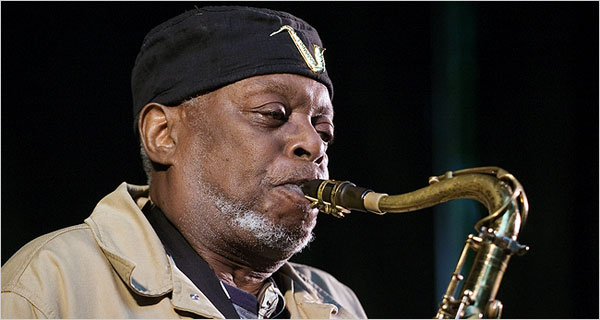
NYT
September 4, 2006
Dewey Redman, 75, Jazz Saxophonist, Dies
By BEN RATLIFF
Dewey Redman, an expansive and poetic tenor saxophonist and bandleader who had been at the aesthetic frontiers of jazz since the 1960’s, died on Saturday in Brooklyn. He was 75 and lived in Brooklyn.
The cause was liver failure, said Velibor Pedevski, his brother-in-law.
Walter Redman was born and grew up in Fort Worth. He started off on clarinet at 13, playing in a church band. Not long after, he met Ornette Coleman when they both played in the high school marching band. Their friendship would become one of the crucial links in his life.
Typical of late-1950’s jazz tenor saxophone players, Mr. Redman was informed by the sound and style of Dexter Gordon, John Coltrane and Sonny Rollins. But he didn’t immerse himself in technique and harmonic theory, as those musicians did, or lead a band until his mid-30’s. Until then, he said, he was largely playing by ear.
Consequently his playing always kept a rawness, a willingness to play outside tonality, a closeness to the blues and above all a powerful sound: an expressive, dark-toned, vocalized expression that he could apply in any situation. (This power could also come through his second instrument — he played a double-reed instrument he called a musette.) He has often been called a free-jazz musician, and he could indeed put a logic and personality into music that had no chord changes. But that designation doesn’t acknowledge how authoritatively Mr. Redman could play a traditional ballad like “The Very Thought of You,” or how his solos could become dramatic diversions in someone else’s written music, as in parts of Tom Harrell’s 1998 album “The Art of Rhythm.”
After attending Prairie View A&M University in Texas, where he played alto and tenor saxophone in the college band, and then a stint in the Army, Mr. Redman taught fifth grade in Bastrop, Tex., near Austin. In 1959 he moved to Los Angeles and then San Francisco, playing with Pharoah Sanders, Donald Rafael Garrett and others.
Mr. Redman missed the ascension of his old friend Ornette Coleman, moving to New York to join the band only in 1967. His performances with Mr. Coleman over the next seven years, on albums like “New York Is Now!,” “Love Call” and “Science Fiction,” on which his tenor saxophone meshes with Mr. Coleman’s alto, are good ways to understand some of the great jazz of the period, intuitively finding a third way between general conceptions of the jazz tradition and the avant-garde.
Mr. Redman also recorded with Charlie Haden’s Liberation Music Orchestra in 1969 and then, beginning in 1971, spent five years off and on with a band known to historians as Keith Jarrett’s American quartet, which included Mr. Jarrett, Mr. Haden and the drummer Paul Motian. Underrated by the public and ever important to musicians, it played a music that was more determined by harmonic structure than Mr. Coleman’s, but equally challenging and prescient in its drive to make organic sense of various schisms in jazz since post-bop.
Mr. Coleman then provided the impetus for the next phase of Mr. Redman’s work, but in absentia. Old and New Dreams was a quartet of mainstays from different Coleman bands: Mr. Redman, Mr. Haden, Don Cherry and Ed Blackwell. They recorded and toured from 1976 to 1984, relying mostly on Mr. Coleman’s repertory. Though he had stopped playing with Mr. Coleman’s bands, he never stopped proclaiming his admiration for his old friend’s work and performed brilliantly during Jazz at Lincoln Center’s 2004 concert of Coleman music, with Mr. Coleman in the audience.
From the mid-60’s on, Mr. Redman often led his own bands, usually quartets with piano, bass and drums; he recorded twice with his son Joshua Redman, the popular jazz saxophonist. Most recently his band included the pianist Frank Kimbrough, the bassist John Menegon and the drummer Matt Wilson. He played his final concert on Aug. 27 at the Charlie Parker Jazz Festival in Tompkins Square Park on the Lower East Side of Manhattan.
He is survived by his wife, Lidija Pedevska-Redman, and two sons Joshua, of Berkeley, Calif., and Tarik.
Saturday, June 24, 2006
Saxophonist Donald Myrick's 1993 Obit
Someone asked me about him today. If you remember the sweet alto sax solo from the live version of Earth Wind & Fire's "Reasons," you've heard Myrick. Bad end to a wonderful career. It's a dated story, but indulge me.
The Los Angeles Times (August 15th 1993) ~ By Mathis Chazanov, Staff Writer
Saxophonist Donald Myrick, shot by a police officer when he answered his door with a butane lighter in his hand, was laid to rest at Bethany Baptist Church in West Los Angeles last weekend.
Percussionists tapped out a rhythm on congas and the tambourine. Eight horn men played a swinging fugue. Earth, Wind & Fire vocalist Philip Bailey brought a church full of people to their feet when he unleashed his high-soaring rendition of the hymn "Precious Lord."
It was a jazzman's funeral. But troubling questions about Myrick's life and death hung in the air like the grating notes of an unresolved chord.
"We'll get to the bottom of it," said singer-songwriter Oscar Brown Jr., who let Myrick and his friends rehearse in his Chicago basement more than 30 years ago.
"We'll find out what happened and we'll rectify it," said Brown at the funeral. "But that don't bother Don, because he's gone to join a bigger band."
Myrick, 53 at his death on July 30, had a career that many musicians would envy. He had recorded and toured with English pop star Phil Collins. His solo was featured in Collins' hit song and video "One More Night."
Earlier, he had been with Earth, Wind & Fire, a group that mixed doo-wop vocals, big-band horns, Afro-Latin rhythms and outlandish showmanship and sold millions of records in the 1970s and early '80s.
As his body lay in a casket beneath floral arrangements decorated with black quarter notes and a white dove, mourners spoke of the pure tone and quick musical ear, the generosity and gentleness of the man who was known as Hippmo.
The nickname goes back to childhood days, said Louis Satterfield, a bassist and trombonist who was Myrick's musical partner from college years until the end.
Overweight as a child, the youngster was called "Hippmo-potamus," but as Myrick matured into a master of blues, jazz and pop music, the name came to mean that he was "mo' hip," Satterfield said.
After playing with a college group called The Jazzmen, Myrick started his professional career with the Pharaohs, the house band at the old Regal Theater in Chicago. There he backed entertainers from Louis Armstrong to Smokey Robinson.
Fueled by the revolutionary spirit of the 1960s, the Pharaohs and their families followed a clean-living regimen of vegetarianism and black consciousness, but they did not shrink from the good things of life.
"We all were driving Mercedes-Benzes, and most people didn't know what kind of car it was in those days," Satterfield said.
Heeding the call of Maurice White, who played with them in The Jazzmen, the two moved to Southern California to form the core of Earth, Wind & Fire's horn section.
Later, they toured the world with Collins as the Phenix Horns. Myrick also played with Anita Baker, Bobby Blue Bland, Stanley Turrentine, Grover Washington Jr., Carlos Santana, Nancy Wilson, Diana Ross and others.
A picture on display at the funeral showed him shaking hands with Princess Diana.
"He was getting ready to do an album," Satterfield said. "He was going through some changes but he was coming out of all that. His music was more powerful than all of that. The only weapon he ever had was a weapon of peace -- the saxophone."
Separated from his wife of 26 years, diagnosed with leukemia and at loose ends professionally, Myrick was fatally shot by Santa Monica police when they served a search warrant at his small apartment in the Palms area of Los Angeles.
The search team was on the trail of a dial-for-drugs ring that operated out of two addresses on the Westside, Sgt. Gary Gallinot said. Alerted by informants, they put both places under surveillance.
A friend who was with Myrick in his final days said that the musician was not involved in the drug trade. But Gallinot said that detectives identified his apartment as a place where couriers would pick up rock cocaine for delivery to customers who placed their orders by telephone.
With two officers posted at a sliding-glass back door leading to a patio, four officers were at the front when Officer Gary Barbaro knocked and demanded entry at 6:10 a.m.
Opening the door with a key supplied by the management of the Oakwood apartment complex, Barbaro caught sight of Myrick, who authorities say was holding a black metal object that turned out to be a butane lighter.
"We're just as perplexed as to why he'd come to the door with something like that," Gallinot said.
Gallinot said Barbaro feared for his life and fired a bullet that hit Myrick in the chest. The musician died at a hospital a short time later.
A woman who was in the apartment was arrested on drug charges. Also arrested was a man police say headed the alleged cocaine operation, and two alleged drug couriers.
According to court documents, the search of Myrick's apartment turned up what was described as cocaine paraphernalia -- a Brillo pad, a metal plate, a heavy-duty razor blade, a fingernail tool, a cotton ball and part of a cigarette -- in a night stand.
There was also an electronic scale, a stack of plastic sandwich bags and a vial of inositol, a sugar-like vitamin. Inositol is often used to cut cocaine for retail sale, Gallinot said.
The seven-inch butane lighter, also known as a pencil torch, is the type commonly used to heat cocaine, he said.
Gallinot said it resembles a firearm known as a pencil gun, which was recently featured on television and in police training bulletins.
Police said they found crack pipes, a bag of marijuana and two pieces of crack cocaine at the apartment on Santa Monica Boulevard.
The operation relied on phone pagers and rental cars obtained by bribing a car rental clerk with cocaine, court documents said. The dealer would frequently change addresses but stay in touch with his customers by using the telephone company's call-forwarding service, according to the documents.
But Myrick's friends who attended his funeral were still at a loss over his death and questioned the officer's action.
"To be shot down like a common criminal, it's ridiculous," said Larry Dunn, the former keyboard player and musical director for Earth, Wind & Fire. "Most of the people here are still in shock."
Myrick's survivors include his wife, Barbara; three daughters, Shirika, Shani and Lauren; his mother, Antoinette Myrick; a sister, Shirley Wade, and a brother, Vernon Myrick. If you're reading this, you've probably already heard Myrick's work, but in the event you stumbled onto this page and can't remember Myrick's solos, here's the live versions of "Reasons" by Earth Wind and Fire from their Gratitude album. Skip the ad, and listen to Philip Bailey's amazing voice, or if you are pressed for time jump to the 4:00 mark and soon Myrick will come in and kill a vamp with soul:
The Los Angeles Times (August 15th 1993) ~ By Mathis Chazanov, Staff Writer
Saxophonist Donald Myrick, shot by a police officer when he answered his door with a butane lighter in his hand, was laid to rest at Bethany Baptist Church in West Los Angeles last weekend.
Percussionists tapped out a rhythm on congas and the tambourine. Eight horn men played a swinging fugue. Earth, Wind & Fire vocalist Philip Bailey brought a church full of people to their feet when he unleashed his high-soaring rendition of the hymn "Precious Lord."
It was a jazzman's funeral. But troubling questions about Myrick's life and death hung in the air like the grating notes of an unresolved chord.
"We'll get to the bottom of it," said singer-songwriter Oscar Brown Jr., who let Myrick and his friends rehearse in his Chicago basement more than 30 years ago.
"We'll find out what happened and we'll rectify it," said Brown at the funeral. "But that don't bother Don, because he's gone to join a bigger band."
Myrick, 53 at his death on July 30, had a career that many musicians would envy. He had recorded and toured with English pop star Phil Collins. His solo was featured in Collins' hit song and video "One More Night."
Earlier, he had been with Earth, Wind & Fire, a group that mixed doo-wop vocals, big-band horns, Afro-Latin rhythms and outlandish showmanship and sold millions of records in the 1970s and early '80s.
As his body lay in a casket beneath floral arrangements decorated with black quarter notes and a white dove, mourners spoke of the pure tone and quick musical ear, the generosity and gentleness of the man who was known as Hippmo.
The nickname goes back to childhood days, said Louis Satterfield, a bassist and trombonist who was Myrick's musical partner from college years until the end.
Overweight as a child, the youngster was called "Hippmo-potamus," but as Myrick matured into a master of blues, jazz and pop music, the name came to mean that he was "mo' hip," Satterfield said.
After playing with a college group called The Jazzmen, Myrick started his professional career with the Pharaohs, the house band at the old Regal Theater in Chicago. There he backed entertainers from Louis Armstrong to Smokey Robinson.
Fueled by the revolutionary spirit of the 1960s, the Pharaohs and their families followed a clean-living regimen of vegetarianism and black consciousness, but they did not shrink from the good things of life.
"We all were driving Mercedes-Benzes, and most people didn't know what kind of car it was in those days," Satterfield said.
Heeding the call of Maurice White, who played with them in The Jazzmen, the two moved to Southern California to form the core of Earth, Wind & Fire's horn section.
Later, they toured the world with Collins as the Phenix Horns. Myrick also played with Anita Baker, Bobby Blue Bland, Stanley Turrentine, Grover Washington Jr., Carlos Santana, Nancy Wilson, Diana Ross and others.
A picture on display at the funeral showed him shaking hands with Princess Diana.
"He was getting ready to do an album," Satterfield said. "He was going through some changes but he was coming out of all that. His music was more powerful than all of that. The only weapon he ever had was a weapon of peace -- the saxophone."
Separated from his wife of 26 years, diagnosed with leukemia and at loose ends professionally, Myrick was fatally shot by Santa Monica police when they served a search warrant at his small apartment in the Palms area of Los Angeles.
The search team was on the trail of a dial-for-drugs ring that operated out of two addresses on the Westside, Sgt. Gary Gallinot said. Alerted by informants, they put both places under surveillance.
A friend who was with Myrick in his final days said that the musician was not involved in the drug trade. But Gallinot said that detectives identified his apartment as a place where couriers would pick up rock cocaine for delivery to customers who placed their orders by telephone.
With two officers posted at a sliding-glass back door leading to a patio, four officers were at the front when Officer Gary Barbaro knocked and demanded entry at 6:10 a.m.
Opening the door with a key supplied by the management of the Oakwood apartment complex, Barbaro caught sight of Myrick, who authorities say was holding a black metal object that turned out to be a butane lighter.
"We're just as perplexed as to why he'd come to the door with something like that," Gallinot said.
Gallinot said Barbaro feared for his life and fired a bullet that hit Myrick in the chest. The musician died at a hospital a short time later.
A woman who was in the apartment was arrested on drug charges. Also arrested was a man police say headed the alleged cocaine operation, and two alleged drug couriers.
According to court documents, the search of Myrick's apartment turned up what was described as cocaine paraphernalia -- a Brillo pad, a metal plate, a heavy-duty razor blade, a fingernail tool, a cotton ball and part of a cigarette -- in a night stand.
There was also an electronic scale, a stack of plastic sandwich bags and a vial of inositol, a sugar-like vitamin. Inositol is often used to cut cocaine for retail sale, Gallinot said.
The seven-inch butane lighter, also known as a pencil torch, is the type commonly used to heat cocaine, he said.
Gallinot said it resembles a firearm known as a pencil gun, which was recently featured on television and in police training bulletins.
Police said they found crack pipes, a bag of marijuana and two pieces of crack cocaine at the apartment on Santa Monica Boulevard.
The operation relied on phone pagers and rental cars obtained by bribing a car rental clerk with cocaine, court documents said. The dealer would frequently change addresses but stay in touch with his customers by using the telephone company's call-forwarding service, according to the documents.
But Myrick's friends who attended his funeral were still at a loss over his death and questioned the officer's action.
"To be shot down like a common criminal, it's ridiculous," said Larry Dunn, the former keyboard player and musical director for Earth, Wind & Fire. "Most of the people here are still in shock."
Myrick's survivors include his wife, Barbara; three daughters, Shirika, Shani and Lauren; his mother, Antoinette Myrick; a sister, Shirley Wade, and a brother, Vernon Myrick. If you're reading this, you've probably already heard Myrick's work, but in the event you stumbled onto this page and can't remember Myrick's solos, here's the live versions of "Reasons" by Earth Wind and Fire from their Gratitude album. Skip the ad, and listen to Philip Bailey's amazing voice, or if you are pressed for time jump to the 4:00 mark and soon Myrick will come in and kill a vamp with soul:
Subscribe to:
Posts (Atom)


