
Showing posts with label clothing/fashion. Show all posts
Showing posts with label clothing/fashion. Show all posts
Monday, February 03, 2014


Saturday, June 15, 2013

Tuesday, October 25, 2011
Friday, June 10, 2011
Mexico's Narco Polo Shirt Fashion Craze

AP/MSNBC
By MARK STEVENSON
updated 54 minutes ago
MEXICO CITY — "Narco Polo" is the new fashion trend sweeping lower-class neighborhoods in Mexico, inspired by seven high-ranking drug traffickers who were arrested over a three-month stretch wearing open-neck, short-sleeved jerseys with the familiar horseman-with-a-stick emblem.
The polo shirts are becoming ubiquitous in street vendors' stalls from the drug-war-ravaged state of Tamaulipas to the cradle of Mexican drug trafficking, Sinaloa.
Demand is so high that a Mexico City street vendor named Felipe stocks several colors, and names them after the drug lord who was wearing that color at the time of his arrest.
"This is the 'J.J'," he says, pointing to a blue one, "and this is 'La Barbie,'" indicating a green number. That was a reference to Jose Jorge ("J.J.") Balderas, who allegedly dealt drugs and shot soccer star Salvador Cabanas in the head, and to U.S.-born Edgar Valdez Villarreal, "La Barbie."
Despite their Ralph Lauren labels, the shirts on sale on Mexico City streets for 160 pesos ($13.50) are clearly pirated goods, sold by unlicensed vendors like Felipe who don't want their full names used for fear of attracting police attention.
read the full post HERE.
Wednesday, March 09, 2011
NYT on Commercialism and Conflict in the Carnival of Trinidad
NYT
March 9, 2011
Carnival’s Louder Commercial Beat Adds Dissonance
By JOHN ELIGON
PORT-OF-SPAIN, Trinidad and Tobago — To some people here, Dean Ackin, 38, with his boyish face, is an inspiration of entrepreneurship, a bearer of this country’s evolving culture. To others, he is a threat to this nation’s most beloved social and cultural treasure: Carnival.
Mr. Ackin runs one of the country’s most popular Carnival bands, the groups of people who don costumes and masquerade — or play Mas, as locals call it — in the raucous annual two-day street parade. The roughly 5,000 spots available in Mr. Ackin’s band, Tribe, sell out every year almost as fast as they go on sale. Demand has been so high since he started Tribe in 2005 that Mr. Ackin just started a second band.
But some say Mr. Ackin and others like him, who have in recent years spun profitable, year-round businesses out of organizing these bands, threaten the existence of Carnival as Trinidadians know it.
By shunning the conservative, traditional costumes for cheaper, skimpier outfits that are sometimes produced outside of Trinidad, these new bands, critics say, are distorting their forebears’ creation and sending work elsewhere at a time when the government and others are trying to turn Trinidadian-style Carnival into a more profitable and exportable industry.
“We call it two-piece and fries, the bikini and the bras,” said Stephen Derek, a traditional costume maker, referring to the skimpy costumes that have become a staple of the new bands. “The costume comes like a fast food. To them, the bottom line is profit. It has nothing to do about country or culture anymore.”
The entrepreneurial bandleaders counter that they are part of a natural evolution, merely offering what people want.
“If you really look at those people who play Mas with the younger bands, or if you talk to a visitor abroad and say: ‘Hey, have you ever heard of Trinidad Carnival? What band would you play with?’ they would call Tribe or they would call one of the younger bands,” Mr. Ackin said. “That says we are reaching out further than the traditional bands. We are reaching out to the international market.”
With few exceptions, the 1.3 million people living on these twin West Indian islands believe that they do Carnival better than anyone in the world. But the generational clash has raised questions over how today’s Carnival is shaping the country.
Is the reliance on mass-produced bikinis — a far cry from the elaborate, hand-crafted costumes Trinidadians had grown accustomed to — stifling the creative works that have been the hallmark of traditional Carnival, which the government of Prime Minister Kamla Persad-Bissessar has been pressing to revive since she took office last year?
Or does it reflect the country’s new energy, representative of a push beyond Trinidad’s reputation for complacency in developing revenue streams beyond oil production?
Read the full post, including photos and video, HERE.
March 9, 2011
Carnival’s Louder Commercial Beat Adds Dissonance
By JOHN ELIGON
PORT-OF-SPAIN, Trinidad and Tobago — To some people here, Dean Ackin, 38, with his boyish face, is an inspiration of entrepreneurship, a bearer of this country’s evolving culture. To others, he is a threat to this nation’s most beloved social and cultural treasure: Carnival.
Mr. Ackin runs one of the country’s most popular Carnival bands, the groups of people who don costumes and masquerade — or play Mas, as locals call it — in the raucous annual two-day street parade. The roughly 5,000 spots available in Mr. Ackin’s band, Tribe, sell out every year almost as fast as they go on sale. Demand has been so high since he started Tribe in 2005 that Mr. Ackin just started a second band.
But some say Mr. Ackin and others like him, who have in recent years spun profitable, year-round businesses out of organizing these bands, threaten the existence of Carnival as Trinidadians know it.
By shunning the conservative, traditional costumes for cheaper, skimpier outfits that are sometimes produced outside of Trinidad, these new bands, critics say, are distorting their forebears’ creation and sending work elsewhere at a time when the government and others are trying to turn Trinidadian-style Carnival into a more profitable and exportable industry.
“We call it two-piece and fries, the bikini and the bras,” said Stephen Derek, a traditional costume maker, referring to the skimpy costumes that have become a staple of the new bands. “The costume comes like a fast food. To them, the bottom line is profit. It has nothing to do about country or culture anymore.”
The entrepreneurial bandleaders counter that they are part of a natural evolution, merely offering what people want.
“If you really look at those people who play Mas with the younger bands, or if you talk to a visitor abroad and say: ‘Hey, have you ever heard of Trinidad Carnival? What band would you play with?’ they would call Tribe or they would call one of the younger bands,” Mr. Ackin said. “That says we are reaching out further than the traditional bands. We are reaching out to the international market.”
With few exceptions, the 1.3 million people living on these twin West Indian islands believe that they do Carnival better than anyone in the world. But the generational clash has raised questions over how today’s Carnival is shaping the country.
Is the reliance on mass-produced bikinis — a far cry from the elaborate, hand-crafted costumes Trinidadians had grown accustomed to — stifling the creative works that have been the hallmark of traditional Carnival, which the government of Prime Minister Kamla Persad-Bissessar has been pressing to revive since she took office last year?
Or does it reflect the country’s new energy, representative of a push beyond Trinidad’s reputation for complacency in developing revenue streams beyond oil production?
Read the full post, including photos and video, HERE.
Saturday, February 26, 2011
Behold the horror of the 1973 Sears Catalog

Ever hear a nice tune from the early 70s and imagine or feel nostalgia for that era? Well, this will cure you of that nonsense. Behold the horror that was the 1973 Sears catalog. Browse if you dare: 1973 catalog courtesy of the wonderful Lileks Site.
Thursday, July 08, 2010
Beautiful Steampunk
Most of these examples come from the British steampunk blog Brass Goggles.
Check out this functional Steampunk Wheelchair.

How about this beautiful steampunk guitar?

Here's a massive functional steampunk computer that was offered as a contest prize:

And an insane VTR controller:

And better yet, my favorite, the steampunk laptop by Mr. Datamancer (who gets a shout out from the NYT):

Some of the stuff there is lovingly hilarious, completely useless and 100% style, like this steampunk iPad and steampunk Segway:


Check out these goggles, which i found here at Wired:

Check out this functional Steampunk Wheelchair.

How about this beautiful steampunk guitar?

Here's a massive functional steampunk computer that was offered as a contest prize:

And an insane VTR controller:

And better yet, my favorite, the steampunk laptop by Mr. Datamancer (who gets a shout out from the NYT):

Some of the stuff there is lovingly hilarious, completely useless and 100% style, like this steampunk iPad and steampunk Segway:


Check out these goggles, which i found here at Wired:

Monday, May 17, 2010
Shanghai's public pajama tradition runs afoul the world Expo
NYT
May 14, 2010
The Pajama Game Closes in Shanghai
By GAO YUBING
Hong Kong
ONE hundred thousand fireworks lighted the sky over Shanghai on April 30, marking the grand opening of the 2010 World Expo. For the city’s many pajama wearers, it also signified the start of a nightmare.
After pumping $58 billion into staging this mega-event, which is expected to attract more than 70 million visitors over the next six months, city authorities started a campaign to suppress one of Shanghai’s most distinctive customs: wearing pajamas in public. Just as Beijing discouraged men from going shirtless during the Olympics, Shanghai wants everyone to wear “proper attire” for the Expo.
Catchy red signs reading “Pajamas don’t go out of the door; be a civilized resident for the Expo” are posted throughout the city. Volunteer “pajama policemen” patrol the neighborhoods, telling pajama wearers to go home and change. Celebrities and socialites appear on TV to promote the idea that sleepwear in public is “backward” and “uncivilized.”
But many residents disagree. Pajamas — not the sexy sleepwear you find at Victoria’s Secret, but loose-fitting, non-revealing PJs made of cotton or polyester — have been popular in Shanghai since the late 1970s, when Deng Xiaoping, then China’s leader, sought to modernize the economy and society by “opening up” to the outside world. The Chinese adopted Western pajamas without fully understanding their context. Most of us had never had any dedicated sleepwear other than old T-shirts and pants. And we thought pajamas were a symbol of wealth and coolness.
Shanghainese began wearing them to bed — but kept them on to walk around the neighborhood, mainly out of convenience. At that time in Shanghai, people lived in crammed, communal-style quarters in shikumen — low-rise townhouses in which families shared toilets and kitchens. Through the 1980s and ’90s, the average person had less than 10 square meters of living area. To change out of one’s pajamas just to walk across the road to the market would be too troublesome and unnecessary.
Besides, as a retiree told a news reporter: “Pajamas are also a type of clothes. It’s comfortable, and it’s no big deal since everyone wears them outside.”
Read the whole op-ed HERE.
May 14, 2010
The Pajama Game Closes in Shanghai
By GAO YUBING
Hong Kong
ONE hundred thousand fireworks lighted the sky over Shanghai on April 30, marking the grand opening of the 2010 World Expo. For the city’s many pajama wearers, it also signified the start of a nightmare.
After pumping $58 billion into staging this mega-event, which is expected to attract more than 70 million visitors over the next six months, city authorities started a campaign to suppress one of Shanghai’s most distinctive customs: wearing pajamas in public. Just as Beijing discouraged men from going shirtless during the Olympics, Shanghai wants everyone to wear “proper attire” for the Expo.
Catchy red signs reading “Pajamas don’t go out of the door; be a civilized resident for the Expo” are posted throughout the city. Volunteer “pajama policemen” patrol the neighborhoods, telling pajama wearers to go home and change. Celebrities and socialites appear on TV to promote the idea that sleepwear in public is “backward” and “uncivilized.”
But many residents disagree. Pajamas — not the sexy sleepwear you find at Victoria’s Secret, but loose-fitting, non-revealing PJs made of cotton or polyester — have been popular in Shanghai since the late 1970s, when Deng Xiaoping, then China’s leader, sought to modernize the economy and society by “opening up” to the outside world. The Chinese adopted Western pajamas without fully understanding their context. Most of us had never had any dedicated sleepwear other than old T-shirts and pants. And we thought pajamas were a symbol of wealth and coolness.
Shanghainese began wearing them to bed — but kept them on to walk around the neighborhood, mainly out of convenience. At that time in Shanghai, people lived in crammed, communal-style quarters in shikumen — low-rise townhouses in which families shared toilets and kitchens. Through the 1980s and ’90s, the average person had less than 10 square meters of living area. To change out of one’s pajamas just to walk across the road to the market would be too troublesome and unnecessary.
Besides, as a retiree told a news reporter: “Pajamas are also a type of clothes. It’s comfortable, and it’s no big deal since everyone wears them outside.”
Read the whole op-ed HERE.
Thursday, May 13, 2010
Outlawing the Burqa?
A bunch of discussion and feedback at Sullivan's Daily Dish blog.
The Hitchens quote that kicked it off is HERE.
and MORE on his thread.
The Hitchens quote that kicked it off is HERE.
and MORE on his thread.
Saturday, October 03, 2009
Congolese Sapeur Fashion photographed by Hector Mediavilla

I'm going full Congo for the moment. Check out this posting of Congolese fashionistas known as sapeurs, with wonderful photographs by Hector Mediavilla HERE.
Saturday, December 20, 2008
Shoe Model Hurled at Bush in Iraq Flies Off Turkish Maker’s Shelves
Bloomberg
Shoe Hurled at Bush Flies Off Turkish Maker’s Shelves (Update1)
By Mark Bentley
Dec. 19 (Bloomberg) -- The shoe hurled at President George W. Bush has sent sales soaring at the Turkish maker as orders pour in from Iraq, the U.S. and Iran.
The brown, thick-soled “Model 271” may soon be renamed “The Bush Shoe” or “Bye-Bye Bush,” Ramazan Baydan, who owns the Istanbul-based producer Baydan Ayakkabicilik San. & Tic., said in a telephone interview today.
“We’ve been selling these shoes for years but, thanks to Bush, orders are flying in like crazy,” he said. “We’ve even hired an agency to look at television advertising.”
Iraqi journalist Muntadar al-Zeidi hurled a pair at Bush at a news conference in Baghdad on Dec. 14. Both shoes missed the president after he ducked. The journalist was jailed and is seeking a pardon from Prime Minister Nuri al-Maliki.
Baydan has received orders for 300,000 pairs of the shoes since the attack, more than four times the number his company sold each year since the model was introduced in 1999. The company plans to employ 100 more staff to meet demand, he said.
“Model 271” is exported to markets including Iraq, Iran, Syria and Egypt. Customers in Iraq ordered 120,000 pairs this week and some Iraqis offered to set up distribution companies for the shoe, Baydan said.
Baydan has received a request for 4,000 pairs from a company called Davidson, based in Maryland. He declined to provide further details.
To contact the reporter on this story: Mark Bentley at mbentley3@bloomberg.net
Last Updated: December 19, 2008 11:53 EST
Shoe Hurled at Bush Flies Off Turkish Maker’s Shelves (Update1)
By Mark Bentley
Dec. 19 (Bloomberg) -- The shoe hurled at President George W. Bush has sent sales soaring at the Turkish maker as orders pour in from Iraq, the U.S. and Iran.
The brown, thick-soled “Model 271” may soon be renamed “The Bush Shoe” or “Bye-Bye Bush,” Ramazan Baydan, who owns the Istanbul-based producer Baydan Ayakkabicilik San. & Tic., said in a telephone interview today.
“We’ve been selling these shoes for years but, thanks to Bush, orders are flying in like crazy,” he said. “We’ve even hired an agency to look at television advertising.”
Iraqi journalist Muntadar al-Zeidi hurled a pair at Bush at a news conference in Baghdad on Dec. 14. Both shoes missed the president after he ducked. The journalist was jailed and is seeking a pardon from Prime Minister Nuri al-Maliki.
Baydan has received orders for 300,000 pairs of the shoes since the attack, more than four times the number his company sold each year since the model was introduced in 1999. The company plans to employ 100 more staff to meet demand, he said.
“Model 271” is exported to markets including Iraq, Iran, Syria and Egypt. Customers in Iraq ordered 120,000 pairs this week and some Iraqis offered to set up distribution companies for the shoe, Baydan said.
Baydan has received a request for 4,000 pairs from a company called Davidson, based in Maryland. He declined to provide further details.
To contact the reporter on this story: Mark Bentley at mbentley3@bloomberg.net
Last Updated: December 19, 2008 11:53 EST
Saturday, December 15, 2007
Japanese Monks Stage Fashion Show

Japanese Monks Stage Fashion Show
Japanese Buddhists trying to spread religion to younger generations
The Associated Press
updated 1:15 p.m. PT, Sat., Dec. 15, 2007
TOKYO - Japanese monks and nuns hit the catwalk in Tokyo on Saturday in a bid to spread Buddhism among younger people in this rapidly aging society.
The fashion show opened with a Buddhist prayer set to a hip-hop beat at the centuries-old Tsukiji Honganji temple, where nearly 40 monks and nuns from eight major Buddhist sects showed off elaborate robes in an effort to win back believers.
Five monks from each school walked on the runway, then chanted prayers and wrapped up in a grand finale with confetti resembling lotus petals.
Buddhist monks traditionally wear simple black robes. But to appeal to more fashion-conscious youth, the monks wore green and yellow clothes, some with gold embroidery. Others wore elaborate, multilayered robes.
"Their robes were gorgeous," said Sayaka Anma, one of the audience in her 20s, after the monks' show. "I was a bit surprised in the beginning, but it was very moving."
Buddhism in crisis?
More than 1,200 years after it first arrived from mainland Asia, Buddhism in Japan is in crisis, priests say.
Almost three-quarters of Japan's population of 120 million are registered as Buddhist, but for many, the only time they enter a temple is to attend a funeral. That has sent many of the country's 75,000 temples into financial trouble.
Japan's aging population has meant more funerals, but the declining population and birth rate means fewer young people to share the bill to keep temples afloat.
"We wanted to show the young people that Buddhism is cool, and temples are not a place just for funerals," said Koji Matsubara, a chief monk at Tsukiji.
The Tsukiji Honganji offers theological seminars in English for foreign visitors, and has fitted its main hall with a pipe organ for Western-style weddings to attract young couples. Some other temples have also introduced cafes, art galleries and other innovations to reach out to young people who are interested in a different lifestyle.
"Many of us priests share the sense of crisis, and a need to do something to reach out to people," said priest Kosuke Kikkawa, 37, one of the organizers of Saturday's event. "We won't change Buddha's teachings, but perhaps we need a different presentation that can touch the feelings of the people today."
Copyright 2007 The Associated Press. All rights reserved. This material may not be published, broadcast, rewritten or redistributed.
URL: http://www.msnbc.msn.com/id/22273859/
Monday, July 02, 2007
Fascist Overtones From Blithely Oblivious Rock Fans

NYT
July 2, 2007
Zagreb Journal
Fascist Overtones From Blithely Oblivious Rock Fans
By NICHOLAS WOOD
ZAGREB, Croatia, June 30 — On a hot Sunday evening in June, thousands of fans in a packed stadium here in the Croatian capital gave a Nazi salute as the rock star Marko Perkovic shouted a well-known slogan from World War II.
Some of the fans were wearing the black caps of Croatia’s infamous Nazi puppet Ustashe government, which was responsible for sending tens of thousands of Serbs, Gypsies and Jews to their deaths in concentration camps.
The exchange with the audience is a routine part of Mr. Perkovic’s act, and the gesture seemed to lack any conscious political overtones. The audience — most of whom appeared to be in their teens and early 20s — just seemed to be having a good time. But Mr. Perkovic’s recent success among a new generation — many of them apparently oblivious to the history of the Holocaust — has prompted concern and condemnation from Jewish groups abroad and minority groups in Croatia.
[Despite those objections, the concert — his biggest ever, with an estimated 40,000 fans in the soccer stadium — was shown in prime time on Sunday night on state-owned television, prompting further protests from Jewish and Serbian groups.]
“We don’t want to pay for something that strikes fear into my children, or distances them from their friends or neighbors,” said Milorad Pupovac, leader of the largest Serbian political party in Croatia, referring to the plan for the broadcast.
What has shocked those groups more, though, is that in the ensuing debate, many senior politicians and journalists have said that they see no problem with the imagery or salutes.
“They just don’t seem to get it,” said Efraim Zuroff, the Jerusalem director of the Simon Wiesenthal Center, who has urged President Stipe Mesic to ban future concerts and help outlaw the use of extremist symbols and slogans.
The Croatian government has been trying to improve its image so it can join the European Union, and it did issue a statement after the concert criticizing the open display of Ustashe memorabilia and slogans. But much of Croatia’s political establishment cannot understand what all the fuss is about.
“You can’t see any anti-Semitism here,” Dragan Primorac, Croatia’s education minister, said in an interview. He said he had planned to attend the concert, before rain caused it to be postponed by a day. Others who did get there, though, included a former foreign minister and two Croatian basketball stars.
“At most, you could blame four to five people,” Dr. Primorac said, for wearing Ustashe regalia, or giving the Nazi salute during the concert. He emphasized, too, that Croatia was a good friend of Israel and pointed to a photograph on his mantelpiece of himself with the Israeli elder statesman Shimon Peres as evidence.
Over the last three years the conservative prime minister, Ivo Sanader, has to some extent managed to shed the country’s image as a nationalist state that once harbored war criminals. The effort has been successful enough that Croatia is a favorite to join the European Union. What was seen for much of 1990s as a war-torn nation is now widely perceived as a prime tourist destination, with 10 million tourists a year and visitors flocking to its Adriatic coast.
Photographs and memorabilia from the Ustashe period are no longer sold openly in Zagreb’s city center. Restaurants no longer display photographs of Ustashe units on their wall. But souvenir shops do still sell key rings and baseball caps with the Ustashe U, as well as the slogan used in Mr. Perkovic’s concerts, “Za Dom: Spremni!” or, “For the Homeland: Ready!”
And many Croats still display an insensitivity to Holocaust issues. Mr. Perkovic’s public affairs manager, Albino Ursic, has a large poster that he designed in 1994 on the wall of his office with the words “final solution.” The poster shows a package of cigarettes marked with a large Swastika and labeled “Adolf Filters,” poking out of a black leather jacket. “It’s an antismoking picture,” he said.
“It won an award in Lisbon,” he added, emphasizing that he viewed himself as left of center. As for Mr. Perkovic’s performance, Mr. Ursic said, the fascist salute is made by soccer hooligans across Europe who have little understanding of it. “It is just teenage rebellion,” he said.
Mr. Perkovic’s patriotic — and sometimes violently nationalistic — songs first became popular here during the Balkan wars, when he fought in the Croatian Army. Most Croats know him better by his stage name, Thompson, given to him during the war, when he carried the British-made submachine gun of the same name. He, too, has recently sought to distance himself from the Ustashe association. In an interview, the soft-spoken singer said he had never raised his own arm to make a fascist salute. Nor, he said, did he encourage people to wear Ustashe uniforms. As for the Ustashe slogan he uses, he claims it is a traditional Croatian salute that predates World War II.
Others are unapologetic. Vedran Rudan, a columnist with the Croatian center-right daily Nacional, accused Mr. Zuroff of “extreme arrogance” for writing a letter to the president of Croatia asking the government to bar future Thompson concerts.
She also accused him of branding Croatian youths fascists while ignoring the activities of a well-known ultranationalist member of Parliament, who has close ties with Israel.
“Why do Jews forgive him everything, and the beardless youth and Thompson do not have right to mercy?” Ms. Rudan wrote.
But rights groups here say there is a fundamental problem. While Croatia is now seeking to move away from the nationalist period of the 1990s, the current generation of young people has largely been schooled to believe that the Ustashe government’s actions were no worse than those of Communist leaders in Yugoslavia during the same period.
“They want to put them on an equal footing,” said Danijel Ivin, the president of the Croatian Helsinki Committee for Human Rights. “The education about the recent history of Croatia is not adequate.”
Dr. Primorac said that was slowly beginning to change and pointed out that since 2004, Croatian schools had dedicated a day each year to studying the Holocaust.
Others do not think it is changing quickly enough. “It is an issue,” said Tomislav Jakic, an adviser to President Mesic. “It is far from Ustashe nostalgia that was 15 years ago, when the ghost was first let out of the bottle. But the ghost is still here and it will be for years to come.”
Monday, June 18, 2007
80,000-year-old bling
Even the very first modern humans may have spruced themselves up with beaded bling.
Twelve shell beads discovered in a cave in eastern Morocco have been dated at more than 80,000 years old, making them one of the earliest examples of human culture. The beads are colored with red ochre and show signs of being strung together.
Similar beads have been found in other parts of Africa and the Middle East, suggesting the first Homo sapiens literally carried their penchant for baubles with them as they populated the world.
"If you draw a triangle covering the three furthest known locations of Homo sapiens between 75,000–120,000 years ago, that triangle stretches from South Africa to Morocco to Israel," said study co-author Chris Stringer of London's Natural History Museum.
"Shell beads are now known at all three points of that triangle," Stringer added. "So such behavior had probably spread right across the early human range by this time, and would have been carried by modern humans as they dispersed from Africa in the last 100,000 years."
The findings are detailed in a recent issue of the Proceedings of the National Academy of Sciences. Oxford University's Institute of Archaeology and Morocco's National Institute for Archaeological Sciences led the project.
The beads found in Morocco aren't the oldest in existence. That title belongs to two tiny shells discovered in Israel in the 1930s and dated at 100,000 years old. The shells are pierced with holes and were probably also hung as pendants or necklaces, archaeologists say.
Combined, the finds hint at the extent of the culture and symbolism being practiced by the earliest modern humans. Art and decoration like the beads are considered good indicators of how human behavior evolved from Africa to other parts of the globe.
"A major question in evolutionary studies today is 'how early did humans begin to think and behave in ways we would see as fundamentally modern?'," said co-author Nick Barton of Oxford University. "The appearance of ornaments such as these may be linked to a growing sense of self-awareness and identity among humans."
Some researchers have suggested that humans didn't become culturally modern until they reached Europe about 35,000 years ago. But Europe, which doesn't show evidence of similar jewelry or customs until much later, actually lagged behind in cultural development, Stringer said.
"This research shows that a long lasting and widespread bead-working tradition associated with early modern humans extended through Africa to the Middle East well before comparable evidence appears in Europe," Stringer said in a 2006 prepared statement, commenting on the just-released, very ancient dates for the Israeli beads.
"Modern human anatomy and behavior have deep roots in Africa and were widespread by 75,000 years ago, even though they may not have appeared in Europe for another 35,000 years," he said.
Twelve shell beads discovered in a cave in eastern Morocco have been dated at more than 80,000 years old, making them one of the earliest examples of human culture. The beads are colored with red ochre and show signs of being strung together.
Similar beads have been found in other parts of Africa and the Middle East, suggesting the first Homo sapiens literally carried their penchant for baubles with them as they populated the world.
"If you draw a triangle covering the three furthest known locations of Homo sapiens between 75,000–120,000 years ago, that triangle stretches from South Africa to Morocco to Israel," said study co-author Chris Stringer of London's Natural History Museum.
"Shell beads are now known at all three points of that triangle," Stringer added. "So such behavior had probably spread right across the early human range by this time, and would have been carried by modern humans as they dispersed from Africa in the last 100,000 years."
The findings are detailed in a recent issue of the Proceedings of the National Academy of Sciences. Oxford University's Institute of Archaeology and Morocco's National Institute for Archaeological Sciences led the project.
The beads found in Morocco aren't the oldest in existence. That title belongs to two tiny shells discovered in Israel in the 1930s and dated at 100,000 years old. The shells are pierced with holes and were probably also hung as pendants or necklaces, archaeologists say.
Combined, the finds hint at the extent of the culture and symbolism being practiced by the earliest modern humans. Art and decoration like the beads are considered good indicators of how human behavior evolved from Africa to other parts of the globe.
"A major question in evolutionary studies today is 'how early did humans begin to think and behave in ways we would see as fundamentally modern?'," said co-author Nick Barton of Oxford University. "The appearance of ornaments such as these may be linked to a growing sense of self-awareness and identity among humans."
Some researchers have suggested that humans didn't become culturally modern until they reached Europe about 35,000 years ago. But Europe, which doesn't show evidence of similar jewelry or customs until much later, actually lagged behind in cultural development, Stringer said.
"This research shows that a long lasting and widespread bead-working tradition associated with early modern humans extended through Africa to the Middle East well before comparable evidence appears in Europe," Stringer said in a 2006 prepared statement, commenting on the just-released, very ancient dates for the Israeli beads.
"Modern human anatomy and behavior have deep roots in Africa and were widespread by 75,000 years ago, even though they may not have appeared in Europe for another 35,000 years," he said.
Friday, July 28, 2006
The Heyday of the Dead
NYT
July 27, 2006
The Heyday of the Dead
By DAVID COLMAN


YES, it’s July. The sun’s shining. People are heading to the beach or just out, to catch some UV, drink some Mountain Dew and indulge in some good clean summer fun.
But what is that little black cloud drifting across the sun? Will it ruin our picnic, like ants or a motorcycle gang? Heaven protect us ... a skull? Not one, but a sea of them! Ah, but ere it comes near, it is clear: it will barely cast a pall.
If it was not clear a year or two ago, when the skull motif cropped up on battered Herman-Melville-meets-Edgar-Allan-Poe T-shirts made by Rogues Gallery, on costly cashmere sweaters by Lucien Pellat-Finet, on the perforated uppers of the wingtips made by the men’s wear line Barker Black, it is now. What only recently seemed clever and stylish — I’m wearing a skull! I’m baaaaad! — has shifted into overdrive, if not overkill.
Beyond the sea of skull wear — belts, T-shirts, ties — there are umbrellas, sneakers, swimsuits, packing tape, party lights, even a skull-branded line of hand tools. One company has made a skull toilet brush and caddy (with a molded-plastic femur bone for a handle). This summer Damien Hirst announced that he will make a life-size skull, cast in platinum and adorned with 8,000 diamonds.
If it seems harmless, well, there you have it. With the full force of the American consumer marketing establishment behind it, the skull has lost virtually all of its fearsome outsider meaning. It has become the Happy Face of the 2000’s. When the mid-1980’s proto-Goth group the Ministry sang “Every Day Is Halloween,” this was not quite what they had in mind.
“This is such a huge gripe of mine,” said Voltaire, a musician in New York and the author of “What is Goth?” (Weiser Books, 2004), a kind of “Preppy Handbook” for the living dead. “Throughout hundreds of years of history, what the skull has communicated is, ‘I am dangerous.’ That’s where the irony is. You can buy dangerous for $11.99 at Kmart.”
For years Voltaire was the happy owner of several skull-motif sweaters hand-knit by an eccentric Englishwoman. He recounted that a woman stopped him the other day on an East Village street to admire the one he was wearing. “She said: ‘I love your sweater. Is it Ralph Lauren?’ Then I found out that Ralph Lauren has a whole store that sells skull stuff.”
Well, not for long he doesn’t. At Rugby, the chain of collegiate-style stores Mr. Lauren rolled out only last year, the shirts are embroidered not with a polo player but a skull. However, the logo is already being scaled back (though not dropped entirely), a spokesman said.
“It’s a pity it’s so commercial now,” Mr. Pellat-Finet said. For more than five years, he has splashed oversize skull graphics — sporting, say, Mickey Mouse ears — on his sweaters. “Maybe Wal-Mart will replace their smiley-face with a tête de mort,” he added, using the French term for skull. “It’s lost its meaning.”
Well, it still has one meaning for Mr. Pellat-Finet, whose latest skull sweaters are embellished with Afros and top hats, among other images. Asked if he will stop using the motif, he responded with a chuckle: “No, no, no. It’s my best seller!”
Other designers appear to have similarly mixed feelings: on one hand, they are confronted with skull saturation; on the other, skulls are ringing the dinner bell louder than ever. Alexander McQueen’s fall men’s wear show did not play up skull imagery on the runway — surely the critics would be bored — but there are plenty back in the showroom, on sports coats, polo shirts and trousers. His $210 skull-print silk scarf is one of the best-selling items on the men’s designer floor at Barneys New York.
“We’ve sold 400 since May,” said Timothy Elliott, a Barneys spokesman. “We sell them as fast as they come in.”
Many people point to the “Pirates of the Caribbean” franchise as fuel for skullmania. But the skull’s ascent to the logo throne has more to it and behind it than a Disney marketing campaign. Reminiscent of the vogue for angels a decade or more ago — remember how the little winged creatures were everywhere? — the skull neatly encapsulates a cultural moment in terms both precise and vague.
It is also the product of potent economic forces. The proliferation of skulls has paralleled the rise of the Hot Topic clothing chain. Begun 17 years ago in Southern California, Hot Topic is a 680-stores-in-50-states phenomenon based on the simple idea of selling music-related clothing and accessories — punk studded wristbands, heavy-metal T-shirts and lately, lots and lots of skulls — to suburban teenagers who would otherwise have to visit an urban clothing boutique for such goodies.
“Have we brought skulls to the mall?” said Cindy Levitt, the vice president for marketing at Hot Topic. “Absolutely. But skulls are a rock icon. We’ve always had them. We see this as more of a fashion trend.”
Still, Ms. Levitt agreed that the skull is not what it used to be. “It’s no longer threatening,” she said. “Anyone will wear a skull now.”
The inventory at Hot Topic, which caters to music fans of all stripes, points up another facet of the skull’s allure, its vagueness. Cherished as an icon by several rock genres, it communicates many potential meanings without specifying any single one: the skull as style hedge.
“The skull is all-purpose,” said Sasha Frere-Jones, a music critic at The New Yorker. “It simultaneously refers to horror movies, to the Misfits and, by extension, all punk rock, and to a generalized culture of blackness and spookiness and the larger, mall-Goth culture.” So, he said, “if you’re really at heart a Goth, but you have friends who are into metal and punk, you can rock the skulls and be friends with all of them.”
Or in fashionspeak: skulls — fun, flexible, easy, breezy!
It is a different way of thinking of one of history’s most formidable images, seen in thousands of years of art and a symbol integral to Mexican culture. Robert Rosenblum, a professor of fine arts at New York University, explained that the skull is central to the vanitas, a genre of still-life painting in which temporal pleasures are juxtaposed with a skull. “The vanitas includes the skull as a reminder that death is everywhere,” he said, “as a cutting edge to too much contentment with the here and now.”
Perhaps the Manhattan hostess who bought a $4,140 set of 12 sterling-silver skull place-card holders by the jeweler Douglas Little wanted to convey that message to her guests. (Supercute touch: the place cards are clenched between the hinged jaws.) Or maybe not; she declined to be interviewed.
The skull as memento mori is important to Philip Crangi, a fashionable jeweler in Manhattan known for a pared-down modernized take on 19th-century morbidity. “I use it in a Victorian or Latin sense,” he said, “where it meant that life is short and death is the great equalizer, so stop your whining and get on with it.”
In his view skulls are not less threatening because a chic jeweler is casting them in precious metal but because, in an age when slasher films are top grossers, death itself has become less threatening. “In the 19th century, when people died, they were laid out in the living room,” he said. “I think we’ve lost that connection to death.”
For others, the skull is about youth, not death, losing its sting. Banks Violette, an artist whose fascination with heavy metal imagery won him a show at the Whitney Museum last summer, is never happy to see cherished symbols of teen angst treated blithely.
“It’s always an inward flinch,” he said. “People create this little world where they try to negotiate their own sense of alienation, then it gets pulled apart.” He added that because such symbols are associated with youth culture, they are often viewed as superficial and treated cynically by companies that market to young people.
Yet as consumers young and old tire of being marketed to, the skull appears to offer a kind of antidote: the ultimate unbrand, one that belongs to no one. Curiously, then, what began as an outlaw anti-logo may as well be viewed as the death rattle of an underground aesthetic.
“The skull was one of the last frontiers,” said Rick Owens, the designer known for his glamorized Goth style. “There’s no way to make yourself edgy anymore.”
Even so, he is planning on selling skulls — real ones — in “natural and black” in his new Paris boutique. “Skulls are kind of timeless,” he said, deadpan as it gets.
Ah, well. Eat, drink and be trendy. Tomorrow we die.
July 27, 2006
The Heyday of the Dead
By DAVID COLMAN

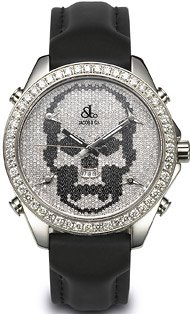
YES, it’s July. The sun’s shining. People are heading to the beach or just out, to catch some UV, drink some Mountain Dew and indulge in some good clean summer fun.
But what is that little black cloud drifting across the sun? Will it ruin our picnic, like ants or a motorcycle gang? Heaven protect us ... a skull? Not one, but a sea of them! Ah, but ere it comes near, it is clear: it will barely cast a pall.
If it was not clear a year or two ago, when the skull motif cropped up on battered Herman-Melville-meets-Edgar-Allan-Poe T-shirts made by Rogues Gallery, on costly cashmere sweaters by Lucien Pellat-Finet, on the perforated uppers of the wingtips made by the men’s wear line Barker Black, it is now. What only recently seemed clever and stylish — I’m wearing a skull! I’m baaaaad! — has shifted into overdrive, if not overkill.
Beyond the sea of skull wear — belts, T-shirts, ties — there are umbrellas, sneakers, swimsuits, packing tape, party lights, even a skull-branded line of hand tools. One company has made a skull toilet brush and caddy (with a molded-plastic femur bone for a handle). This summer Damien Hirst announced that he will make a life-size skull, cast in platinum and adorned with 8,000 diamonds.
If it seems harmless, well, there you have it. With the full force of the American consumer marketing establishment behind it, the skull has lost virtually all of its fearsome outsider meaning. It has become the Happy Face of the 2000’s. When the mid-1980’s proto-Goth group the Ministry sang “Every Day Is Halloween,” this was not quite what they had in mind.
“This is such a huge gripe of mine,” said Voltaire, a musician in New York and the author of “What is Goth?” (Weiser Books, 2004), a kind of “Preppy Handbook” for the living dead. “Throughout hundreds of years of history, what the skull has communicated is, ‘I am dangerous.’ That’s where the irony is. You can buy dangerous for $11.99 at Kmart.”
For years Voltaire was the happy owner of several skull-motif sweaters hand-knit by an eccentric Englishwoman. He recounted that a woman stopped him the other day on an East Village street to admire the one he was wearing. “She said: ‘I love your sweater. Is it Ralph Lauren?’ Then I found out that Ralph Lauren has a whole store that sells skull stuff.”
Well, not for long he doesn’t. At Rugby, the chain of collegiate-style stores Mr. Lauren rolled out only last year, the shirts are embroidered not with a polo player but a skull. However, the logo is already being scaled back (though not dropped entirely), a spokesman said.
“It’s a pity it’s so commercial now,” Mr. Pellat-Finet said. For more than five years, he has splashed oversize skull graphics — sporting, say, Mickey Mouse ears — on his sweaters. “Maybe Wal-Mart will replace their smiley-face with a tête de mort,” he added, using the French term for skull. “It’s lost its meaning.”
Well, it still has one meaning for Mr. Pellat-Finet, whose latest skull sweaters are embellished with Afros and top hats, among other images. Asked if he will stop using the motif, he responded with a chuckle: “No, no, no. It’s my best seller!”
Other designers appear to have similarly mixed feelings: on one hand, they are confronted with skull saturation; on the other, skulls are ringing the dinner bell louder than ever. Alexander McQueen’s fall men’s wear show did not play up skull imagery on the runway — surely the critics would be bored — but there are plenty back in the showroom, on sports coats, polo shirts and trousers. His $210 skull-print silk scarf is one of the best-selling items on the men’s designer floor at Barneys New York.
“We’ve sold 400 since May,” said Timothy Elliott, a Barneys spokesman. “We sell them as fast as they come in.”
Many people point to the “Pirates of the Caribbean” franchise as fuel for skullmania. But the skull’s ascent to the logo throne has more to it and behind it than a Disney marketing campaign. Reminiscent of the vogue for angels a decade or more ago — remember how the little winged creatures were everywhere? — the skull neatly encapsulates a cultural moment in terms both precise and vague.
It is also the product of potent economic forces. The proliferation of skulls has paralleled the rise of the Hot Topic clothing chain. Begun 17 years ago in Southern California, Hot Topic is a 680-stores-in-50-states phenomenon based on the simple idea of selling music-related clothing and accessories — punk studded wristbands, heavy-metal T-shirts and lately, lots and lots of skulls — to suburban teenagers who would otherwise have to visit an urban clothing boutique for such goodies.
“Have we brought skulls to the mall?” said Cindy Levitt, the vice president for marketing at Hot Topic. “Absolutely. But skulls are a rock icon. We’ve always had them. We see this as more of a fashion trend.”
Still, Ms. Levitt agreed that the skull is not what it used to be. “It’s no longer threatening,” she said. “Anyone will wear a skull now.”
The inventory at Hot Topic, which caters to music fans of all stripes, points up another facet of the skull’s allure, its vagueness. Cherished as an icon by several rock genres, it communicates many potential meanings without specifying any single one: the skull as style hedge.
“The skull is all-purpose,” said Sasha Frere-Jones, a music critic at The New Yorker. “It simultaneously refers to horror movies, to the Misfits and, by extension, all punk rock, and to a generalized culture of blackness and spookiness and the larger, mall-Goth culture.” So, he said, “if you’re really at heart a Goth, but you have friends who are into metal and punk, you can rock the skulls and be friends with all of them.”
Or in fashionspeak: skulls — fun, flexible, easy, breezy!
It is a different way of thinking of one of history’s most formidable images, seen in thousands of years of art and a symbol integral to Mexican culture. Robert Rosenblum, a professor of fine arts at New York University, explained that the skull is central to the vanitas, a genre of still-life painting in which temporal pleasures are juxtaposed with a skull. “The vanitas includes the skull as a reminder that death is everywhere,” he said, “as a cutting edge to too much contentment with the here and now.”
Perhaps the Manhattan hostess who bought a $4,140 set of 12 sterling-silver skull place-card holders by the jeweler Douglas Little wanted to convey that message to her guests. (Supercute touch: the place cards are clenched between the hinged jaws.) Or maybe not; she declined to be interviewed.
The skull as memento mori is important to Philip Crangi, a fashionable jeweler in Manhattan known for a pared-down modernized take on 19th-century morbidity. “I use it in a Victorian or Latin sense,” he said, “where it meant that life is short and death is the great equalizer, so stop your whining and get on with it.”
In his view skulls are not less threatening because a chic jeweler is casting them in precious metal but because, in an age when slasher films are top grossers, death itself has become less threatening. “In the 19th century, when people died, they were laid out in the living room,” he said. “I think we’ve lost that connection to death.”
For others, the skull is about youth, not death, losing its sting. Banks Violette, an artist whose fascination with heavy metal imagery won him a show at the Whitney Museum last summer, is never happy to see cherished symbols of teen angst treated blithely.
“It’s always an inward flinch,” he said. “People create this little world where they try to negotiate their own sense of alienation, then it gets pulled apart.” He added that because such symbols are associated with youth culture, they are often viewed as superficial and treated cynically by companies that market to young people.
Yet as consumers young and old tire of being marketed to, the skull appears to offer a kind of antidote: the ultimate unbrand, one that belongs to no one. Curiously, then, what began as an outlaw anti-logo may as well be viewed as the death rattle of an underground aesthetic.
“The skull was one of the last frontiers,” said Rick Owens, the designer known for his glamorized Goth style. “There’s no way to make yourself edgy anymore.”
Even so, he is planning on selling skulls — real ones — in “natural and black” in his new Paris boutique. “Skulls are kind of timeless,” he said, deadpan as it gets.
Ah, well. Eat, drink and be trendy. Tomorrow we die.
Friday, June 23, 2006
Stone Age Bling
New York Times
June 23, 2006
Old Shells Suggest Early Human Adornment
By JOHN NOBLE WILFORD
Archaeologists say they have found evidence that in one respect people were behaving like thoroughly modern humans as early as 100,000 years ago: they were apparently decorating themselves with a kind of status-defining jewelry — the earliest known shell necklaces.
If this interpretation is correct, it means that human self-adornment, considered a manifestation of symbolic thinking, was practiced at least 25,000 years earlier than previously thought.
An international team of archaeologists, writing today in the journal Science, reported its analysis of small shells with distinctive perforations that appeared to have been strung together as ornamental beads. Chemical study showed that the two shells from the Skhul rock shelter in Israel were more than 100,000 years old, and the single shell from Oued Djebbana, in Algeria, was about 90,000 years old.
Three shells may not be much to go on, the archaeologists conceded. But they emphasized that the shells were from the same genus of marine snail and were worked in the same manner as those from the Blombos Cave, near Cape Town in South Africa, which were reported two years ago as the earliest jewelry, dated at 75,000 years ago.
The Blombos find was hotly contested because of a lack of corroborating evidence from other sites.
The archaeologists also pointed out that the Israeli and Algerian sites were so far from the seashore that the shells were most likely brought there intentionally for beadworking. A study of modern shells of similar snails, they noted, determined that the chances that the holes occurred naturally were extremely small.
In the journal report, the research team led by Marian Vanhaeren of University College London and Francesco d'Errico of the National Center for Scientific Research in Talence, France, concluded, "These beads support the hypothesis that a long-lasting and widespread beadworking tradition existed in Africa and the Levant well before the arrival of anatomically modern humans in Europe."
The hypothesis challenges the traditional view that modern Homo sapiens underwent a significant behavioral change about 50,000 years ago, possibly the result of some genetic modification that afforded a greater capability for symbolic thinking and creativity in arts and crafts. The change might have prompted human migrations into Europe from Africa. In Europe it underlay the burst of creativity that began about 40,000 years ago and has been glimpsed in human figurines, musical instruments and cave paintings.
Jewelry was probably one of the earliest ways people conveyed aspects of their social and cultural identities, Dr. Vanhaeren said.
Alison S. Brooks, an anthropologist at George Washington University who was not involved in the research, called the findings exciting.
"It shows that human behavior emerges slowly over a long period of time," Dr. Brooks said. "Not that there was no creative revolution 40,000 years ago, but it was a florescence that stems from much earlier developments in Africa."
In a separate journal article, Richard G. Klein, a paleoanthropologist at Stanford who backs the late, abrupt creative-explosion school, was quoted as saying the shell evidence "seems weak" and the interpretation remained "debatable."
June 23, 2006
Old Shells Suggest Early Human Adornment
By JOHN NOBLE WILFORD
Archaeologists say they have found evidence that in one respect people were behaving like thoroughly modern humans as early as 100,000 years ago: they were apparently decorating themselves with a kind of status-defining jewelry — the earliest known shell necklaces.
If this interpretation is correct, it means that human self-adornment, considered a manifestation of symbolic thinking, was practiced at least 25,000 years earlier than previously thought.
An international team of archaeologists, writing today in the journal Science, reported its analysis of small shells with distinctive perforations that appeared to have been strung together as ornamental beads. Chemical study showed that the two shells from the Skhul rock shelter in Israel were more than 100,000 years old, and the single shell from Oued Djebbana, in Algeria, was about 90,000 years old.
Three shells may not be much to go on, the archaeologists conceded. But they emphasized that the shells were from the same genus of marine snail and were worked in the same manner as those from the Blombos Cave, near Cape Town in South Africa, which were reported two years ago as the earliest jewelry, dated at 75,000 years ago.
The Blombos find was hotly contested because of a lack of corroborating evidence from other sites.
The archaeologists also pointed out that the Israeli and Algerian sites were so far from the seashore that the shells were most likely brought there intentionally for beadworking. A study of modern shells of similar snails, they noted, determined that the chances that the holes occurred naturally were extremely small.
In the journal report, the research team led by Marian Vanhaeren of University College London and Francesco d'Errico of the National Center for Scientific Research in Talence, France, concluded, "These beads support the hypothesis that a long-lasting and widespread beadworking tradition existed in Africa and the Levant well before the arrival of anatomically modern humans in Europe."
The hypothesis challenges the traditional view that modern Homo sapiens underwent a significant behavioral change about 50,000 years ago, possibly the result of some genetic modification that afforded a greater capability for symbolic thinking and creativity in arts and crafts. The change might have prompted human migrations into Europe from Africa. In Europe it underlay the burst of creativity that began about 40,000 years ago and has been glimpsed in human figurines, musical instruments and cave paintings.
Jewelry was probably one of the earliest ways people conveyed aspects of their social and cultural identities, Dr. Vanhaeren said.
Alison S. Brooks, an anthropologist at George Washington University who was not involved in the research, called the findings exciting.
"It shows that human behavior emerges slowly over a long period of time," Dr. Brooks said. "Not that there was no creative revolution 40,000 years ago, but it was a florescence that stems from much earlier developments in Africa."
In a separate journal article, Richard G. Klein, a paleoanthropologist at Stanford who backs the late, abrupt creative-explosion school, was quoted as saying the shell evidence "seems weak" and the interpretation remained "debatable."
Subscribe to:
Posts (Atom)


