Reuters
updated 9/12/2011 4:38:55 PM ET
TOKYO — Across from a noodle shop in a Yokohama suburb, Hisayoshi Teramura's inn looks much like any other small lodging that dots the port city. Occasionally, it's even mistaken for a love hotel by couples hankering for some time beneath the sheets.
But Teramura's place is neither a love nest nor a pit stop for tired travelers. The white and grey tiled building is a corpse hotel, its 18 deceased guests tucked up in refrigerated coffins.
"We tell them we only have cold rooms," Teramura quips when asked how his staff respond to unwary lovers looking for a room.
The daily rate at Lastel, as it is known, is 12,000 yen ($157). For that fee, bereaved families can check in their dead while they wait their turn in the queue for one of the city's overworked crematoriums.
Growing market
Death is a rare booming market in stagnant Japan and Teramura's new venture is just one example of how businessmen are trying to tap it.
Read the full story HERE.
Showing posts with label death/funeral. Show all posts
Showing posts with label death/funeral. Show all posts
Monday, September 12, 2011


Wednesday, December 24, 2008
World's Oldest Marijuana Stash Discovered
 Stash for the afterlife: A photograph of a stash of cannabis found in the 2,700-year-old grave of a man in the Gobi Desert. Scientists are unsure if the marijuana was grown for more spiritual or medical purposes, but it's evident that the man was buried with a lot of it. David Potter / Oxford University Press
Discovery/MCNBC
World's oldest marijuana stash totally busted
Two pounds of still-green weed found in a 2,700-year-old Gobi Desert grave
By Jennifer Viegas
Discovery Channel
updated 10:19 a.m. PT, Wed., Dec. 3, 2008
Nearly two pounds of still-green plant material found in a 2,700-year-old grave in the Gobi Desert has just been identified as the world's oldest marijuana stash, according to a paper in the latest issue of the Journal of Experimental Botany.
A barrage of tests proves the marijuana possessed potent psychoactive properties and casts doubt on the theory that the ancients only grew the plant for hemp in order to make clothing, rope and other objects.
They apparently were getting high too.
Lead author Ethan Russo told Discovery News that the marijuana "is quite similar" to what's grown today.
"We know from both the chemical analysis and genetics that it could produce THC (tetrahydrocannabinolic acid synthase, the main psychoactive chemical in the plant)," he explained, adding that no one could feel its effects today, due to decomposition over the millennia.
Russo served as a visiting professor at the Chinese Academy of Sciences Institute of Botany while conducting the study. He and his international team analyzed the cannabis, which was excavated at the Yanghai Tombs near Turpan, China. It was found lightly pounded in a wooden bowl in a leather basket near the head of a blue-eyed Caucasian man who died when he was about 45.
"This individual was buried with an unusual number of high value, rare items," Russo said, mentioning that the objects included a make-up bag, bridles, pots, archery equipment and a kongou harp. The researchers believe the individual was a shaman from the Gushi people, who spoke a now-extinct language called Tocharian that was similar to Celtic.
Scientists originally thought the plant material in the grave was coriander, but microscopic botanical analysis of the bowl contents, along with genetic testing, revealed that it was cannabis.
The size of seeds mixed in with the leaves, along with their color and other characteristics, indicate the marijuana came from a cultivated strain. Before the burial, someone had carefully picked out all of the male plant parts, which are less psychoactive, so Russo and his team believe there is little doubt as to why the cannabis was grown.
What is in question, however, is how the marijuana was administered, since no pipes or other objects associated with smoking were found in the grave.
"Perhaps it was ingested orally," Russo said. "It might also have been fumigated, as the Scythian tribes to the north did subsequently."
Although other cultures in the area used hemp to make various goods as early as 7,000 years ago, additional tomb finds indicate the Gushi fabricated their clothing from wool and made their rope out of reed fibers. The scientists are unsure if the marijuana was grown for more spiritual or medical purposes, but it's evident that the blue-eyed man was buried with a lot of it.
"As with other grave goods, it was traditional to place items needed for the afterlife in the tomb with the departed," Russo said.
The ancient marijuana stash is now housed at Turpan Museum in China. In the future, Russo hopes to conduct further research at the Yanghai site, which has 2,000 other tombs.
© 2008 Discovery Channel
URL: http://www.msnbc.msn.com/id/28034925/
Wednesday, August 13, 2008
The Torajans of Sulawesi (Indonesia) live to die

LA Times
The Torajans of Sulawesi live to die
After decades of planning for their funerals, the dead wait months, even years, for their last rites while relatives negotiate arrangements for the perfect send-off.
By Paul Watson
Los Angeles Times Staff Writer
6:44 PM PDT, August 13, 2008
BUNTU KALANDO, INDONESIA — The last king of Toraja was 93 when he took his final breath in July 2003. Five years later, he's still part of the family, quietly residing in a small room in his former palace, shaded by two red parasols decorated with colored beads and gold fringe.
By Torajan tradition, he isn't really dead. He's just sick. The late monarch won't be gone for good until he has been laid to rest with traditional rites featuring the slaughter of scores of water buffaloes, at least one of them a rare spotted specimen.
The unhurried passage from this world to the next isn't reserved for former rulers. It is central to the culture of Torajans, an ethnic group in southern Sulawesi island whose customs are a hybrid of ancient tribal traditions and Protestant Christianity.
The dead wait months, even years, for their last rites while relatives negotiate funeral arrangements, everything from the right timing to allow mourners to travel long distances, to where they will stay and who will feed them.
Corpses used to be dried with herbal elixirs and smoldering fires, but the old ways have largely died out, replaced by washtub embalming fluid made with formaldehyde.
A village mortician schooled in the old ways gave the late king's body the royal treatment with natural preservatives. It took more than 320 yards of cloth to wrap his mummy, a simple task compared with the long negotiations and complex preparations for his funeral.
"Torajans are very sensitive about this because the funeral is our last honor," said Eddy Sambolinggi, the youngest son of the last king, Puang Sambolinggi. "Everything has to be carefully planned."
In many ways, Torajans spend a lifetime preparing for their demise, saving for the essentials, such as their burial clothes and bamboo shelters for guests. They also have to budget for funeral donations to other families, while pampering and fattening up water buffaloes for sacrifice.
"Torajans," Sambolinggi, 56, said cheerfully, "they live to die."
It has taken his family five years to agree on a send-off befitting Puang Sambolinggi, which is now planned for October. The farewell is shaping up to be the last grand funeral in Torajan history, the final chapter of a royal history that dates back centuries.
Sambolinggi's reign saw the death of an ancient dynasty in Tana Toraja, or the Land of Toraja. He held the throne for only a year until, just days after Japan surrendered in August 1945, Indonesia declared independence from the Dutch and abolished tribal monarchies. But tribal tradition lives on.
Anthropologists believe Torajans are descended from voyagers who sailed from southern China as early as 3,000 BC. Though Christianity and the modern world have worn away at tradition, ancient beliefs called aluk to dolo, or the way of the ancestors, still guide many Torajans, especially when someone dies.
Legend says the design of their homes, called tongkonan, came from heaven. The wood-framed buildings face north, toward the land of the creator. The dead are always placed in a room at the back so they can face south, where the ancestors live in heaven.
The houses' bamboo roofs are shaped like boats, with a high bow and stern, which some believe honor the vessels their ancestors sailed to Sulawesi. The homes' central pillars are decorated with a row of horns from water buffaloes slaughtered at family funerals.
A good buffalo is a Torajan status symbol, and people go through life pleased that their burials won't be rushed, leaving mourners time to find the cash for fine specimens to slaughter. The donations required for a royal funeral give Torajans more than the usual pause.
"We have to wait until the whole family is ready," Sambolinggi said. "For instance, there's me and my siblings. Perhaps I am able to contribute a number of buffaloes, while my siblings still have to wait and save some money. We all have to agree, because for this funeral the number we're talking about isn't small."
Up to 80 buffaloes will be sacrificed in front of tens of thousands of mourners. Just counting relatives, Sambolinggi said, there will be 100,000 guests, many of whom will journey hundreds of miles.
Family members have also dickered over whether the body will be buried next to the late king's father or mother, Sambolinggi added.
Until the plans are settled, and relatives bid their final farewells, the late king, wrapped in cloth and encased in a wooden coffin, lies in repose just up the stairs from his youngest son's private museum of old spears, beaded dresses and other tribal artifacts. Sambolinggi regularly talks to his father, not in a way anyone else could hear, he said, but silently, from his heart.
"For the past five years, he's been with us, sleeping upstairs," Sambolinggi said. "We still prepare his place at the dining table. And for instance, if we go to the capital city, we have a big feast, and we save some for him."
When the king died, in the normal sense of the word, his son called in an undertaker to make a mummy of him the old-fashioned way, without embalming fluid.
The mortician died soon after, taking some of the secrets of Torajan mummification to his grave. But Sambolinggi watched him closely at work, and his memory preserves a vivid remnant of a centuries-old ritual.
His father's corpse was cleansed with tea mixed with warm water and soap chopped into little pieces. Then the mortician poured about three bottles of vinegar, a little at a time, down the late king's throat.
A small rope, used to tie a water buffalo by the nose, was retrieved from the ground where it had fallen in the animal's pen, cut into pieces and sprinkled on the body so that the tether could go with him to heaven. Then the corpse was wrapped in cloth, tightly bound in three places with coconut fronds.
"After that, there was a little magic," Sambolinggi said. "The man who performed the ritual put a black stone pot, like a cooking pot, in the corner of the room. He told us not to touch it, and warned that if we did, the body would be damaged."
A week later, Sambolinggi smelled a foul odor, which he suspected was wafting from his father's body. He quickly summoned the undertaker.
"He checked and said that it was not the body that smelled bad, but there were many other dead persons' spirits around," Sambolinggi recalled. "He asked me if I'd heard any banging sounds on the door lately, and I said yes. "
Spirits had come knocking, the mortician said, and his magic chased them off. The smell, and apparently the ghosts, never came back. Any lingering doubts Sambolinggi had about the wisdom of Torajan tradition vanished with them.
His father's remains probably will be sealed in a royal tomb carved out of the nearby Suaya cliff, where his brother-in-law's coffin was laid to rest July 15, just as dozens of royals have been through the centuries, including the late king's ancestors.
Like wide-eyed marionettes gathering dust on a puppeteer's shelf, life-size wooden dolls representing the dead stare down from balconies outside their tombs. Relatives look up to greet them when they bring offerings, such as cigarettes, palm wine or bottled water, that they carefully set on small tables at the bottom of the cliff.
Because Torajans take their obligations to the dead so seriously, parents who can't afford to donate a pig, let alone a buffalo, for sacrifice at a funeral often pledge a kind of IOU, which their children must fulfill to maintain the family honor.
With the funeral season running from June to October, the driest months of the year, sacrificial debts can quickly add up. An ordinary black water buffalo costs at least $5,500, a heavy price for Torajans, most of whom are rice farmers. (A shortage of the finest spotted buffaloes has driven the price up 25% over last year, to almost $14,000.)
And then there are taxes they must pay on each head of livestock delivered for sacrifice: $16 for a buffalo, $9 for a pig. Custom demands a minimum of six buffaloes be slaughtered at each funeral, but competition for status usually pushes the number higher.
Funerals have become so expensive that many young Torajans are moving away to cities, or even other countries such as Malaysia, in search of better jobs so they can keep up with the demands as relatives die. An estimated 450,000 people live in Tana Toraja, and 200,000 others have left the region.
A Torajan funeral doesn't have to be fit for a king to be costly. More than 7,000 mourners attended a three-day ceremony last month for Augustina Tambing, the wife of a primary school principal. Half a year after her death, they gathered to see her off to heaven with the sacrifice of eight water buffaloes and more than 150 squealing pigs.
Yohanes Rumeri, chief of Buntu Masakke village, sat behind a plywood counter at the entrance to the funeral, with a ledger and a bottle of correction fluid, recording each donor's name, the animal they delivered and the tax they paid.
The money would be shared among the regional government, the local church and the village administration, the chief said.
"Honestly, it is a burden," said Tambing's daughter Yatti Parassa, 45. "But this is our family. We are still close because we've been attending funerals for ages. So we're not going to lose the family ties. Our families live far apart, but for this event, they all come together."
Tambing, 68, died Jan. 13 after 49 years of marriage to her husband, Izak Rigu Parassa. She bore him seven children, who watched along with 20 grandchildren and a great-grandchild as butchers led buffaloes by their tethers into the funeral, and with a theatrical slash of a long knife, slit each animal's throat.
Just across from the skinned carcasses lying in coagulating pools of blood, Tambing's family formed a choir. As a gentle rain fell, they wept and sang, "Jesus comes into the world, Jesus comes to help the sick."
Her 71-year-old husband sat nearby, pinching the bridge of his nose in silent prayer, exhausted after a long goodbye to the love of his life. He took comfort in the thought that she was still with him, watching her own funeral.
"I think she is pleased," he said, with a broad, toothless smile.
paul.watson@latimes.com
Sunday, June 29, 2008
The Whistle of Death: Researchers re-create pre-Columbian sounds

AP
Researchers re-create pre-Columbian sounds
Noisemakers made of natural materials were integral part of life
By Julie Watson
The Associated Press
updated 9:18 a.m. PT, Sun., June. 29, 2008
MEXICO CITY - Scientists were fascinated by the ghostly find: a human skeleton buried in an Aztec temple with a clay, skull-shaped whistle in each bony hand.
But no one blew into the noisemakers for nearly 15 years. When someone finally did, the shrill, windy screech made the spine tingle.
If death had a sound, this was it.
Roberto Velazquez believes the Aztecs played this mournful wail from the so-called Whistles of Death before they were sacrificed to the gods.
The 66-year-old mechanical engineer has devoted his career to recreating the sounds of his pre-Columbian ancestors, producing hundreds of replicas of whistles, flutes and wind instruments unearthed in Mexico’s ruins.
For years, many archaeologists who uncovered ancient noisemakers dismissed them as toys. Museums relegated them to warehouses. But while most studies and exhibits of ancient cultures focus on how they looked, Velazquez said the noisemakers provide a rare glimpse into how they sounded.
“We’ve been looking at our ancient culture as if they were deaf and mute,” he said. “But I think all of this is tied closely to what they did, how they thought.”
Velazquez is part of a growing field of study that includes archaeologists, musicians and historians. Medical doctors are interested too, believing the Aztecs may have used sound to treat illnesses.
Noisemakers made of clay, turkey feathers, sugar cane, frog skins and other natural materials were an integral part of pre-Columbian life, found at nearly every Mayan site.
The Aztecs sounded the low, foghorn hum of conch shells at the start of ceremonies and possibly during wars to communicate strategies. Hunters likely used animal-shaped ocarinas to produce throaty grunts that lured deer.
The modern-day archaeologists who came up with the term Whistles of Death believe they were meant to help the deceased journey into the underworld, while tribes are said to have emitted terrifying sounds to fend off enemies, much like high-tech crowd-control devices available today.
Experts also believe pre-Columbian tribes used some of the instruments to send the human brain into a dream state and treat certain illnesses. The ancient whistles could guide research into how rhythmic sounds alter heart rates and states of consciousness.
Among Velazquez’s replicas are those that emit a strange cacophony so strong that their frequency nears the maximum range of human hearing.
Chronicles by Spanish priests from the 1500s described the Aztec and Mayan sounds as sad and doleful, although these may have been only what was played in their presence.
“My experience is that at least some pre-Hispanic sounds are more destructive than positive, others are highly trance-evocative,” said Arnd Adje Both, an expert in pre-Hispanic music archaeology who was the first to blow the Whistles of Death found in the Aztec skeleton’s hands. “Surely, sounds were used in all kind of cults, such as sacrificial ones, but also in healing ceremonies.”
Sounds still play an important role in Mexican society. A cow bell announces the arrival of the garbage truck outside Mexico City homes. A trilling, tuneless flute heralds the knife sharpener’s arrival. A whistle emitting cat meows says the lottery ticket seller is here.
But pre-Columbian instruments often end up in a warehouse, Velazquez said, “and I’m talking about museums around the world doing this, not just here.”
That’s changing, said Tomas Barrientos, director of the archaeology department at Del Valle University of Guatemala.
“Ten years ago, nothing was known about this,” he said. “But with the opening up of museum collections and people’s private collections, it’s an area of research that is growing in importance.”
Velazquez meticulously researches each noisemaker before replicating it. He travels across Mexico to examine newly unearthed wind instruments, some dating back to 400 B.C. and shaped like animals or deities. He studies reliefs and scans 500-year-old Spanish chronicles.
But making replicas is only part of the work. Then he has to figure out how to play them. He’ll blow into some holes and plug others, or press the instrument to his lips and flutter his tongue. Sometimes he puts the noisemaker inside his mouth and blows, fluctuating the air from his lungs.
He experimented with one frog-shaped whistle for a year before discovering its inner croak.
Renowned archaeologist Paul Healy, who made an important discovery of Mayan instruments in Belize in the 1980s, said many of the originals still work.
“A couple of these instruments we found were broken, which was great because we could actually see the construction of them, the actual technology of building a sound chamber out of paper-thin clay,” he said.
Still, their exact sounds will likely remain a mystery.
“When you blow into them, you still can get notes from them, so you could figure out what the range was,” Healy said. “But what we don’t have is sheet music to give us a more accurate picture of what it sounded like.”
Friday, June 13, 2008
2007 New Orleans brass band funeral for Kerwin James
Below is some YouTube footage of a New Orleans brass band funeral for musician Kerwin James, who played for the New Birth Brass Band:
"Noted tuba player Kerwin James, member of the New Birth Brass Band and younger brother to Philip and Keith Frazier of the Rebirth Brass Band, died Friday in a Houston hospital. James, 35, had been in a coma since the summer of 2006, when he suffered a stroke during a performance.
James, a native of the Treme neighborhood in New Orleans, was known for his dedication and devotion to the city after the devastation caused by Hurricane Katrina. Considered by bandleader Joe Torregano as “the heir to the throne of the late, great Anthony ‘Tuba Fats’ Lacen,” James was also known for his impressive performances at local events such as the French Quarter Festival.
Yet after a show last year, James suffered a stroke that left him paralyzed and, on Friday, caused complications that led to his death. A parade in James’ honor was spontaneously held on St. Phillip Street in New Orleans when the community heard of his death, but authorities broke up the event and two musicians, snare drummer Derrick Tabb and trombonist/singer Glen David Andrews, were arrested for disturbing the peace."
Typically the early music at a jazz funeral consists of slow dirges before later switching to up-tempo jazz. Here, though, instead of a dirge there is a soulful 6/8 lilt to the band's version of the hymn "Just a Closer Walk with Thee," a staple of the jazz funeral repertoire (though often played as a dirge). The band is huge and wailing for one of their own. It's the most powerful version of this hymn I have ever heard. Near the end, they move the coffin around in time so the deceased can step with the band one last time. Beautiful. Bless him and bless New Orleans.
"Noted tuba player Kerwin James, member of the New Birth Brass Band and younger brother to Philip and Keith Frazier of the Rebirth Brass Band, died Friday in a Houston hospital. James, 35, had been in a coma since the summer of 2006, when he suffered a stroke during a performance.
James, a native of the Treme neighborhood in New Orleans, was known for his dedication and devotion to the city after the devastation caused by Hurricane Katrina. Considered by bandleader Joe Torregano as “the heir to the throne of the late, great Anthony ‘Tuba Fats’ Lacen,” James was also known for his impressive performances at local events such as the French Quarter Festival.
Yet after a show last year, James suffered a stroke that left him paralyzed and, on Friday, caused complications that led to his death. A parade in James’ honor was spontaneously held on St. Phillip Street in New Orleans when the community heard of his death, but authorities broke up the event and two musicians, snare drummer Derrick Tabb and trombonist/singer Glen David Andrews, were arrested for disturbing the peace."
Typically the early music at a jazz funeral consists of slow dirges before later switching to up-tempo jazz. Here, though, instead of a dirge there is a soulful 6/8 lilt to the band's version of the hymn "Just a Closer Walk with Thee," a staple of the jazz funeral repertoire (though often played as a dirge). The band is huge and wailing for one of their own. It's the most powerful version of this hymn I have ever heard. Near the end, they move the coffin around in time so the deceased can step with the band one last time. Beautiful. Bless him and bless New Orleans.
Wednesday, April 02, 2008
Honking Horns Transformed: Ghana's Por Por Music
NPR
[go to NPR for audio and video]
Honking Horns Transformed: Ghana's Por Por Music
All Things Considered, March 26, 2007 - A union of truck and taxi drivers in Ghana's capital, Accra, has turned the mundane honking of horns into music.
Steven Feld, a professor at the University of New Mexico and self-described "anthropologist of sound," has spent three years recording the sound of these horns, known in the West African nation as por por horns after the sound they make.
Antiques from the 1930s and '40s, the honk horns have a rubber squeeze bulb at one end and are either straight or curved. Drivers used to hang them off their side mirrors.
Feld has produced a CD of the music, Por Por: Honk Horn Music of Ghana, to coincide with the 50th anniversary of Ghana's independence earlier this month. The CD features the unique combination of drums, singing, bells and squeeze-bulb horns.
The music originated for very practical reasons, Feld tells Melissa Block.
Punctured tires were common on Ghanaian roads in the past. At night, as they pumped air back into their tires, the drivers — fearful of animals that might lurk in the darkness — also banged on tire rims with wrenches and honked their horns "like crazy" to scare any potential predators away.
"And then somebody got the idea to start taking bell rhythms and horn rhythms from different kinds of music in the country, and transposing them onto the horns and the tire rims, and that was the birth of the music," Feld says.
Although por por originated 60 years ago, Feld says it has been largely unknown until recently because it is performed only at the funerals of truck drivers.
"The idea is kind of like a New Orleans jazz funeral: a real rejoice-when-you-die kind of party, where you are sent up by a honking of horns," explains Feld. "The drivers' road to heaven paved with car horns and a whole lot of honking."
[go to NPR for audio and video]
Honking Horns Transformed: Ghana's Por Por Music
All Things Considered, March 26, 2007 - A union of truck and taxi drivers in Ghana's capital, Accra, has turned the mundane honking of horns into music.
Steven Feld, a professor at the University of New Mexico and self-described "anthropologist of sound," has spent three years recording the sound of these horns, known in the West African nation as por por horns after the sound they make.
Antiques from the 1930s and '40s, the honk horns have a rubber squeeze bulb at one end and are either straight or curved. Drivers used to hang them off their side mirrors.
Feld has produced a CD of the music, Por Por: Honk Horn Music of Ghana, to coincide with the 50th anniversary of Ghana's independence earlier this month. The CD features the unique combination of drums, singing, bells and squeeze-bulb horns.
The music originated for very practical reasons, Feld tells Melissa Block.
Punctured tires were common on Ghanaian roads in the past. At night, as they pumped air back into their tires, the drivers — fearful of animals that might lurk in the darkness — also banged on tire rims with wrenches and honked their horns "like crazy" to scare any potential predators away.
"And then somebody got the idea to start taking bell rhythms and horn rhythms from different kinds of music in the country, and transposing them onto the horns and the tire rims, and that was the birth of the music," Feld says.
Although por por originated 60 years ago, Feld says it has been largely unknown until recently because it is performed only at the funerals of truck drivers.
"The idea is kind of like a New Orleans jazz funeral: a real rejoice-when-you-die kind of party, where you are sent up by a honking of horns," explains Feld. "The drivers' road to heaven paved with car horns and a whole lot of honking."
Tuesday, May 29, 2007
Interview with LSU Professor Helen Regis on New Orleans' Second Lines/Jazz Funerals
AFRO-POP WORLDWIDE
Interview: Helen Regis with Ned Sublette in New Orleans, 2006
Place and Date: New Orleans, LA
2006
Interviewer: Ned Sublette
Helen Regis is Assistant Professor in the Department of Geography & Anthropology at Louisiana State University. She has lived in and conducted research in France, New Orleans, Cameroon, & Mississippi. In addition to International Studies, she is affiliated with Women’s and Gender Studies, and African and African American Studies programs.
NS: Who am I talking to?
HR: I'm Helen Regis, a resident of the 7th Ward, and an associate professor of anthropology at Louisiana State University.
NS: And what do you study?
HR: African American social and pleasure clubs, and the second line parades that they sponsor. I've been looking at second line parades pretty intensively since '95, but I actually started in '88.
NS: So you've been going on second lines for almost 20 years.
HR: That's right. It's weird to say that. The people who would say that when I started doing it seemed ancient.
NS: Well, we gotta get used to that. Could explain to people who have never seen one: what is a social aid and pleasure club and what are its historical origins?
HR: Today a social aid and pleasure club is a club that's brought together by people who are friends -- many of them went to high school together -- and who have a common goal of sharing conviviality and pleasure as well as mutual aid. Most historians trace the origins to the 19th century, around [the time of] emancipation. And certainly 19th-century organizations were really focused on benevolence and mutual aid. They were insurance companies, they were health insurance societies. Basically kind of face-to-face organizations of people who would help each other. You would put in your dues and those dues would go to help aid a member who was ill, or would go to help a member pay for the funeral of a family member, or of course if a member of the club died, then the club would sponsor that funeral. They didn't just pay for the funeral, but they also organized the ritual procession, the ceremonial aspect of the funeral, and they insured that the deceased got a dignified burial, in a period when that wasn't taken for granted by any means.
NS: And this had something to do with the tradition of jazz funerals, then?
HR: Right. The jazz funeral tradition definitely originated out of those benevolent societies. Jason Berry would be a really good person to talk to about that. He's writing a book on the history of jazz funerals in New Orleans , and I think the dancing associated with it is one of his main interests. I have not done historical research on this. I've been mostly looking at the contemporary performances as contemporary history of the city. I'm really interested in how, within any one moment in time, you can go to a second line and you can find out what's happening in the city, because people are talking about it, people are singing about it. The whole interaction that happens between club members and their community, and between people and the police, is often really revealing of the mood of this city. So, for example, right now we're seeing these spontaneous lyrics that people sing behind the bands that are often improvised in the moment, are often a commentary on what's going on in the city right now, kind of like the conga chants in. So that right now, you know, there are chants about FEMA, there are chants about particular political leaders, there are chants about insurance companies. People are voicing their woes. As well as celebrating life, which is a big part of the tradition, too.
NS: How old are the oldest extant clubs in the city? Do we know?
HR: The oldest organization of which I'm aware that's involved in the street parades is the Young Men Olympian Junior Benevolent Aid Society, which recently celebrated its 120th anniversary.
NS: Wow.
HR: And that's the juniors. So you have to think that they were a division of young people whose parents or whose uncles or grandparents had the previous version of that organization. And today that organization is still structured along specific divisions. They can have up to six divisions, so that young people get incorporated into the group, but then they have their own organization. So they parade together, but they're separate and that allows people to develop their own style and their own leadership, and to have some autonomy and yet still be part of the larger corporate group.
NS: Do you have an idea how many clubs there are?
HR: Some people have estimated up to 70 clubs. I don't know if there are that many who are actually parading, but it's sometimes hard to measure, because clubs sometimes band together and share a parade permit and parade together. So for example the Young Men Olympian, they have all these divisions. When you see them on the street you think of them as one club, but they may have six divisions, so . . . There's certainly been a huge increase since the early 90s, and I think a real renaissance of brass band music. There's just been a huge infusion of interest among young people. A whole new generation of people started organizations.
When I first started going to parades in the late 80s, the season started around Labor Day and it went pretty much to the end of the year. So you had parades into December, and then there started to be a few parades in January. And then you started having parades going all the way to Mardi Gras, and they stop parading in the Mardi Gras season because the city's already overloaded with activities, and they start again during Lent. Now we have parades going all the way through June, so there's a club – the Perfect Gentlemen, which has often had a Fathers' Day parade. So there's been probably a doubling of social organizations that participate in this particular tradition.
NS: So new clubs have continued to be formed?
HR: Absolutely. We recently had on January 15th an all-star parade of organizations from throughout the city, with several groups who had never paraded before. They had been planning on parading this fall, and because of the hurricane had to delay their coming-out parade, so they paraded for the first time as part of this larger group which had assembled to state their intention to return and to demand affordable housing, among other things.
NS: I want to ask you about that particular parade in a minute. How have you seen it change in the years you've been observing?
HR: One change a lot of people talk about is that some clubs have experimented with having floats as part of the parade, which in New Orleans we think of being more part of the carnival tradition. Second lines have always been marching parades, where everybody's at ground level – musicians, clubs, followers. There's a special kind of social interaction that comes from that, from sharing the street together. But I think it's understandable that some people – and many of the clubs to have royalty, or honorary members, and they want to show respect for those folks, and while they sometimes ride in convertibles, they've recently experimented with having floats, which some traditionalists say is not appropriate for a second-line.
NS: Have you heard any change in the music?
HR: I'm sure the music has changed radically, but I'm not really a musicologist, and I don't necessarily have that vocabulary to talk about it. I think that when I first started going to second lines in the late 80s, the Dirty Dozen were already touring widely nationally and internationally, so they were no longer playing regularly in the streets, although they certainly come out of that tradition. Being on tour they were unable to make commitments to particular clubs, to say, "We'll play for you the 4th Sunday in September," and the clubs need that. So the Rebirth was already stepping into their shoes in that respect. There were a few other bands playing at the time – the Pinstripe Brass Band, the Tremé Brass Band, and the Olympia Junior Brass Band was still playing on the street in those days. And all those bands were already well into the pattern of incorporating funk and blues and r & b into the music, but Rebirth is the first band I remember bringing rap into it. With, in my opinion, mixed success. Playing riffs familiar to people from the radio stations, and having people sing along to particular lyrics -- that's something I've really seen Rebirth do more than any other band. And that was definitely happening more throughout the 90s than it had previously.
NS: I'm impressed by Rebirth's repertory of calls that the public knows how to respond to. Like, this particular flourish is the cue for everybody to yell "Hey!"
HR: And I think that's because Rebirth, unlike the Dirty Dozen, really made the commitment to keep playing on the streets. They're very loyal to the social organizations that have been hiring them for 20 years. So they have a really loyal following among club members and organizers, but also among second liners. They've had this ongoing dialogue with black communities in New Orleans all that time. So, yeah, we know their songs. And they know us.
NS: How far do the Social Aid and Pleasure Clubs extend? Do they have them in Algiers? Do they have them in Jefferson Parish?
HR: I've only seen them in Orleans Parish, but we could very well with Katrina be seeing them reorganizing –
NS: In Portland?
HR: Maybe not in Portland, 'cause I don't think there's enough critical mass, but in Houston, or Atlanta, it's very possible. Now a lot of people have been speculating about that, saying, well, you can't in a suburban context really have the dynamic interaction between crowd and musician that you can have in the densely settled streets of a central city environment. But even before the storm, we already had a suburban club that was performing in New Orleans East. They've been parading, I think at least four years – the New Orleans East Steppers. The parade I went to, they started at the Plaza, which was a shopping mall, so a real contradiction for the second line tradition. And I had my doubts, but I wanted to go experience it, and it was a beautiful parade, in spite of the fact that it was very different. The stops would be at a daiquiri shop instead of at a corner store or a neighborhood bar or the home of a friend. But of course the reason they were in the east is that they were displaced from center city apartments or public housing developments that were being torn down. In the late 90s we saw a huge change in the residential pattern of the city, because we had 10% of the population living in public housing prior to the Hope 6 initiatives and the demolition of public housing. The St. Thomas was torn down, the Desire was torn down, and large portions of the Magnolia. And those were very important places for social club members, especially the Magnolia and the St. Thomas, which were close to downtown.
NS: It certainly seemed last year like many Sundays you could find a second line somewhere. But you have to know where they are.
HR: Yeah, you have to know where they are, and you have to have a sense that this is an okay place to be. I mean, I think for newcomers to the city it can be a little bit intimidating to go into some of the neighborhoods where the second lines happen.
NS: It seems sometimes like the second line is a ghetto day pass to go into places where normally you would not be able to go.
HR: I think that's definitely the way a lot of people have experienced it. Including, by the way, middle-class African Americans who don't necessarily feel comfortable walking around in a housing development unaccompanied. So, yeah, when you're following a second line, you're accompanied. You have the band and the club saying it's okay to be here.
NS: It seemed to me there are two kinds of second lines: the kind that makes a circuit and ends up where it started, and the kind that ends up miles away. And then you have to get back to your car.
HR: Right, so there's really two ways of doing it. Either you have [a sheet outlining] the route in advance, or you know, because you already know this club quite well, basically what their route is. And so you say, well, I'm gonna catch it at such-and-such a point in the parade. I'm gonna go to Joe's Bar and wait for them to come, I'll have an elegant drink while I'm waiting, dance for a while and come back to the bar, get back to the air-conditioning, and then head for home. So that's one way to do it. Many people do that, who don't want to walk or dance for four hours.
NS: Do clubs keep pretty much the same route every year?
HR: Some clubs seem to alternate between uptown and downtown routes, but most clubs have long-term relationships to particular places. They may always go to a particular bar or stop by a club member's grandmother's house.
NS: Now, I had you describe what a social aid and pleasure club is. Now could you explain, for people who've maybe never seen one or heard one, what is a second line? What are these parades?
HR: Well, first, it's kind of misleading to call it a parade, because we often think of parades as something that you watch. A second line is not really anything to watch. You have to really jump in. Jump into the flow, move into the music, and become a part of it. So that's the first thing. The only way to really get a sense of what a second line is about is to be a part of it. And if you're standing on the sidelines while the parade is going by, people within the crowd will urge you to come in and dance. You get this kind of urgent invitation, so the main thing about a second line is walking or dancing down the street with hundreds of people or maybe thousands of people who are all moving to the same rhythm. That's the most powerful thing about it, I think, is that feeling of togetherness of people from all walks of life. People say the name ["second line"] comes from the idea that the first line is the club, or if you talk to the musicians, the first line is the band, and then the second line is those who follow the band. So anyone who feels like following a band, who likes their sound, or who's a fan of that particular social organization, is going to be a second liner. So that's what makes it what it is, I think: that massive following. If you just have a band walking down the street, it's not a second line. It's a procession, but it's not a second line, because it doesn't have that massive group of followers, or that intense interaction between people – rubbing shoulders with people, moving down the street in a way that seems kind of impossible when you first look at it. But then when you're in it, people are just amazingly gentle and polite, and someone steps on your foot and they say, oh excuse me, pardon me, so there's this real sense of sharing space and making it comfortable to be in.
NS: How long does it take? What's the rhythm of the parade?
HR: Most parades today are limited to four hours. We're talking about the Sunday afternoon anniversary parades. So they usually start at 12 noon and go to 4 p.m. Now in the past, the early part of the 20th century, these parades went all day. People talk about getting up early in the morning and starting their parade, and then stopping for a leisurely picnic in the park, and then going again. So there was a really different pace in those days, but they're limited by the police to four hours now. So depending on the club, the pace can be very fast. There can be this sense that, we really need to get to such-and-such a part of town, and there's a real sense that the club is investing its reputation in being able to finish their route. So if you're delayed, if your band members are late [laughs], or if something happens and the money doesn't come together and the parade gets delayed, there's a real question of public reputation involved. And also your reputation's involved in maintaining the pace, so you can move pretty quickly down the street and then have a leisurely stop for five, ten, fifteen minutes, and then you've gotta start again, or else you won't make your route. Now if you don't make the end of your route in four hours, the police will disband the crowd. And I think there's a real sense of what a shame that is, if you're not able to bring people all the way home.
NS: My impression was that the police do not like second lines.
HR: Yeah. I don't fully know why that is. I mean, sometimes I think that the antagonism between the police and the second liners is almost part of the tradition. Sometimes they seem to almost egg each other on. Sometimes the police use their sirens to push people up the street. Why are they doing that? I don't know, but it makes people mad, it really does. Sometimes the dancers in a second line will start gyrating against the police car in a provocative way that seems designed to make the police mad. So then the police are being challenged to keep their cool and not worry about it.
NS: In Cuba – the congas of Cuba are not second lines, but they're cousins – and there is, and possibly since the 16th century has been, a theater of ritualized confrontation with authority almost as part of the activity of a conga. The play of the crowd against the police is part of whatever the game is. I had the impression here [in New Orleans] that the police are just nervous about seeing thousands of people romping down the street together, drinking and taking over the street.
HR: Yeah, that's a really interesting thing. I think if you're a police officer and you're asked to work at the second lines, you have this experience that you're not in control. Here's this huge crowd of people dancing and to the extent that there is order, which I believe there usually is, it's the band and the club members who are really providing that order, and the second liners, who are self-policing, as I was saying, being really polite to each other, or breaking up fights or making sure they don't get into disagreements. Conflict mediation is a well-practiced art in the black communities, and certainly in New Orleans . People know what the costs are to conflict, and they're usually very, very good at preventing that. But the police are clearly not in charge. And that's bound to be hugely frustrating. But when you think about that nervousness about possibly the crowd getting out of control, it's really interesting to think about that having a history too. When the history was really rigidly segregated – legally segregated – surely having black folk march down St. Charles Avenue would never have been allowed. And there are a few clubs today who march at least one or two blocks – I think the Prince of Wales Social Club marches down St. Charles . I was told that in the 60s some clubs were marching down Canal Street, and that they were banned from doing that by some merchants who were afraid that their store windows would get broken. So I think there is this fear of disorder and violence on the part of officials and to some extent business owners. A lot of businesses close their doors when the second line goes by, even though second liners are very eager to buy water and buy drinks, especially on a hot day.
NS: As the second lines go around, part of the rhythm – on the ones I went on, anyway – there were usually six stops. And each one was a little neighborhood bar. I assume that the second lines are an important part of the bars' business.
HR: Absolutely. Not only on the day of the second line, when huge crowds of people will stop by and buy drinks, but also the clubs themselves become patrons of particular bars. Some clubs have their regular meetings in a bar, or they will have social events there, and they're bringing their friends and neighbors to those bars. And very literally, when a club publishes a route sheet, if they name a particular business on their route sheet, they're putting them on the map, they're putting them in public consciousness. So if I was starting a bar, let's say right here in the 7th Ward, I would want to have an affiliation with a social club, so that the name of my business would become known.
NS: Do the clubs have other activities than second lines? Or is producing the annual second line the sole focus of their activities?
HR: Most of the clubs function year-round as social organizations, so they're having fund-raisers four, five, six times a year. A lot of clubs have dances as fund-raisers, so they're inviting friends, family, neighbors, and other clubs.
NS: Is it fair to say that they're part of the glue that holds the town together?
HR: Most definitely.
NS: Could you talk to me about that?
HR: Although they're no longer providing health insurance for their members, they're still providing a benevolent function in a more subtle way. [If] you lose your job and you want to find another job, who are you gonna ask about where there are job openings? You're gonna ask your club members. And I think that, again in a more subtle way, they continue to organize major events in people's lives, from birthday parties to funerals. Some clubs meet once a week. So they really provide a kind of solidarity and a kind of emotional and social connection for people.
NS: How many people would be at a meeting of a social club that meets once a week?
HR: Typically, I would say, between 10 and 20 people. Most clubs don't go above 20. If they do, then they start having different divisions. That seems to be the size that people can really relate to each other on a face-to-face basis, where everyone can talk at a meeting, where you can make decisions by consensus.
NS: So 20 people handle the work of producing an event with several thousand people and run it all themselves?
HR: That's right. In most cases, nearly everybody at those parades knows one of the club members. So they're really deploying their social network, and that's why most parades, you have a beautiful peaceful event. Because people are there to support their friend who's in the club.
NS: What is the membership in terms of African Americans versus non-African Americans? Are white people part of the social club network at this point?
HR: Absolutely, although not in numbers proportional to our presence in the city. These clubs definitely come out of a black cultural tradition in New Orleans , and I think that, although there are white participants, many of us feel that we're participants in a black cultural event, or a black institution, I guess. A number of clubs have had white members. There's even one club, the Bayou Steppers, that was founded as a multiracial social organization. The founding presidents were black and white.
NS: And of course, we were both on that parade, and you remember how that parade ended. Could you describe that, since you were there?
HR: The parade you're talking about ended right near the interstate overpass on North Claiborne at a little club called the Mother-in-Law Lounge, which is run by Antoinette K-Doe, the widow of Ernie K-Doe. The parade ends at the Mother-in-Law Lounge, it was a beautiful four-hour parade, just a perfect day, and there's a wonderful feeling among second liners at the end of a parade. People are feeling great about having been dancing and walking for four hours, and you have friends that you want to talk to, now that the band is taking a rest. And the police began to use their sirens to disperse the crowd. These were not ordinary sirens, because they were parked under the interstate in order to be able to use the amplification of the cement structure of the interstate. And so their sirens, which were already loud, were being amplified by the interstate. And there were several cars that were doing this, and they were directing it at this club. We couldn't have a conversation outside on the sidewalk, or inside the club. If you lived in a home in that area, you couldn't hear yourself think, even within your home. It was extraordinarily abusive. What happened that day is really part of a larger pattern of the police intentionally disbanding the crowd after a parade. I feel positive that this is not an individual initiative on the part of a particular police officer. This is an NOPD policy coming from the top down.
NS: Which reached a climax a little later with the debacle of the Mardi Gras Indian gathering.
HR: Right. March 19, 2005, just last St. Joseph's Day, the police dispersed a crowd of Mardi Gras Indians and their supporters and followers. In the paper it was reported as being about 200 people. One of the police officers was quoted as having said: take them fucking feathers off or go to jail. That really conveys the attitude toward this tradition, that this is something that's not worthy of respect. I hate to think this, but this seems to be the attitude informing these policies, that any gathering of working-class people or of African Americans in New Orleans in public space is inherently a problem and they want to disperse that. Now it may be that gatherings of people do create higher risk that something unfortunate could happen in a crowd. But a lot of things are risk factors that we don't choose to ban, and this is such an important cultural tradition in New Orleans, that I really think that this is not a reasonable approach to policing.
NS: What is the right way? Certainly, if you talk to people in town, you will hear some of them express nervousness about second lines. A lot of people won't go anywhere near one because they're afraid there'll be a shooting. Things do sometimes happen. What do you think is a reasonable way of looking at this?
HR: Again, I think the second line really does reflect what's going on in the city, and to some extent New Orleans reflects what's happening in America more generally. We like to talk about how unique we are, but in many ways we share the same problems that all American cities share. We have too much poverty, we don't have good jobs, and we have a lot of people who end up in the informal economy in ways that are really self-destructive and hurtful to others. And there's a lot of violence associated with that. So we really do have these problems, and some people choose the second line as the place to settle scores, and to do so violently. So that does happen. And I can completely understand that that concern causes some people to decide, I'm not gonna do this anymore, I'm not gonna go. Unfortunately, we can't really solve the problem of policing second lines in an appropriate way without solving our social problems. But on the other hand, no one's really looked carefully at the pattern of violence at second lines. There have been shootings. I've been on second lines where there have been shootings. And it's a terrible thing. But there are shootings in poor neighborhoods in New Orleans every day -- before the storm, anyway. So being poor is a risk factor for violent crime. Just like being married is a risk factor for spousal abuse. There's a relationship there, but we're not gonna ban marriage. So second lines do occasionally provide a forum for people to settle scores, but I don't think it's reasonable to ban second lines, any more than you would ban marriage because marital violence is linked to marriage.
NS: There's also the tradition of the informal second line, not an annual planned parade, but something that springs up more spontaneously.
HR: I guess the Tremé neighborhood is really known for having spontaneous second lines, or second lines that are not in any way official, and sometimes I've been aware of second line parades happening during, for example, the period between the death of a relative or a friend and the funeral. For one well-known musician, there was a second line every night between the night he died and the funeral. And the Rebirth were playing there. That was James and Troy Andrews' brother, D-Boy [Donnell Andrews], who was quite young [he was 17] when he was found killed. And so, yeah, this incredible kind of wake of a second line moving through the streets, moving through the neighborhood he had lived in, with hundreds of people and no sign of a police presence. That's definitely an informal second line. And a lot of people say that the Tremé neighborhood, more than any other neighborhood in the city, are fierce defenders of this tradition. They really have not accepted the idea that you have to pay for a police permit in order to gather peaceably in the streets and perform this kind of sacred dance.
NS: It seems like the issue of who can assemble in the street is a fundamental one here.
HR: Absolutely. I think a lot of second liners – you know, they might not have law degrees, but they have a really profound understanding of public space, and the value of public space. I believe that public space is really important to a democracy, that we need to be able to gather in public and be together, whether that's discussing politics or dancing in the streets. And certainly in New Orleans it feels like a fundamental right to those who participate in this tradition.
NS: A right that's been exercised since the days of Jim Crow.
HR: Absolutely, and this is where I think funerals take on special significance. Because during slavery, black folk in many parts of the South – enslaved people – could not gather except for a funeral. That was one of the only occasions when the people in charge would allow them to gather. I think as Christians, they [the slaveowners] had to recognize that a funeral was an important event. Funerals, I believe, became especially important in the black community in part because there were so few occasions for people to gather and to enact or to talk about or to perform the values that they hold dear and to celebrate their dignity and the sacredness of life.
NS: I always felt from the first time I went on a second line that if you haven't been on one, there's something about jazz you don't know.
HR: A lot of people refer to the second line tradition as fundamental to the origins of jazz. Louis Armstrong talks about having played at second lines as a child, and certainly having admired jazz musicians. He wanted to be like them, and he saw them for the first time during jazz funerals, during anniversary parades. And you know, the social organizations in the black community that hired these bands week after week – not only for parades, but for dances and balls and other social events – really were crucial to that connection between the music and the community. And I guess – yeah, when you hear a brass band playing in the streets and you really begin to understand the kind of interaction between musicians and dancers, you can really see how fundamental that is to the kind of dialogue that's happening in jazz music. There's a wonderful quote [on p. 72 of] in Mick Burns's book – have you seen that? – Keeping the Beat on the Street: The Brass Band Renaissance, and it's an interview with Gregory “Blodie” Davis of the Dirty Dozen, who talks about how their music really grew out of the interaction between the band and the dancers, and the dancers challenging the musicians with their dance and the musicians having to come back and do one better. And the band practicing all week, thinking about what the dancers were gonna be throwing at them, and so there's that sense in which dancing is already very musical.
NS: I realize this is hard to do, but could you take a stab at describing how second line dancing works, how it moves, how it goes down the street, what the movements are?
HR: There's kind of a basic second line step, which is almost a strut that you do while you're moving quickly down the street with a brass band. But then there are people who are doing something entirely different, and they're the virtuoso performers, the virtuoso second liners, and they can be of all ages. When they start to really get into their dancing, there's often a circle that forms around them, and people start watching them and encouraging them. And then someone else will move into the circle and challenge them. It's often men dancing with men as well as men dancing with women or women dancing with women. So there's a real competitive challenge happening on the street, which then gets translated into the challenge between the dancers and the band members as well.
The feet are usually really close to the ground, but people are really light on their feet at the same time. There's also this incredibly athletic dancing, with people jumping up in the air and twisting, going down in splits, the kind of dancing that you would expect to see on stage somewhere, instead of . . .
NS: . . . on concrete.
HR: Yeah, and these people are wearing tennis shoes, because they're going to be walking for a very long time, so that has an effect on the kind of dancing that you see.
NS: It's an exhausting thing to go on a full second line parade. I always wonder how the musicians do it. Of course, they do take breaks, but even so, four hours of blasting away, making all the many feet of metal in a sousaphone vibrate by pushing air through it with your jaw muscles as you dance down the street in hot sun, dehydrated, and the tuba player's usually overweight to start with, which is why he wound up playing the tuba. It seems like a real physical ordeal.
HR: The brass bands who really have a commitment to the second lines, they're fit. And so are the club members and the regular second liners. Sometimes you'll see a band coming back to the street after having been away for a while, and you see them huffing and puffing and taking a break between songs, and at times the second liners start to become quite outspoken – "why don't they play something?" You don't get a lot of slack from the second liners if you're trying to rest.
NS: Do you have any idea how much distance is covered by a typical second line?
HR: I would say it's not unusual to cover six or seven miles, but some of them may cover even more.
NS: That's a long march.
HR: Yeah, absolutely. And when you think about dancers who are really into this – they go into this clowning mode – "clowning" is what they call it in New Orleans . They start doing things like climbing up telephone poles and dancing, or climbing onto rooftops and dancing. There's something about that. It's usually young men who do this. But think about all the miles they're climbing, as well as walking! And then they have to walk ahead of the group in order to be up there by the time the second liners pass by and see them, and then climb back down and run ahead again. The photograph that's above you is from the Circle Food Store, on St. Bernard Avenue and Claiborne, and you can see there's a dancer, dancing on the roof during a second line parade.
NS: I took a bunch of pictures of two dancers up on the overpass on Claiborne, that big overpass. It didn't look like much in the picture, actually, you couldn't really get the sense of these thousand of people watching these two guys dancing way up in the air on this concrete air. But the whole crowd was like . . .
HR: . . . stunned. One of the things about being in the second line is, you can't really see it when you're in it. You can see the people just around you, which might be 10 to 20 people, but if there's six thousand people at a parade, you're obviously not seeing most people. But if the route allows you to go over a bridge, then you're able to really look back and you can see the expanse of people. Some clubs try to design their routes to include a bridge or an overpass so that they can have that experience. There are two clubs that I know of that are doing that right now – the CTC, the Cross the Canal Steppers, they go over the Industrial Canal over into the Lower Ninth Ward, so that allows them to really have this incredible panoramic view. And they're going over this rickety old metal bridge. It's not really rickety, but it feels like it when you're on there, the whole bridge starts to move as people are dancing. And another group, the Nine Times, which is out of the Desire area, goes over the Almonaster Bridge , which is over a railroad track. When they talk about their route, they talk specifically about the importance of being on that bridge, and being able to see all the people you've brought out, and the people you've brought together, and they just take great pride in that accomplishment. And so at some point in their route, they're going to be able to look around and see all the people who have come together to support them.
NS: Let's talk now about what's happened since Katrina. Of course, Katrina happened just before Labor Day . . .
HR: Well, the Sunday before Labor Day is traditionally the second line of the Black Men of Labor, which is a social organization started in the mid-1990s. And as you can tell from their name, they were very self-conscious when they organized that they wanted to honor the dignity of black working men, and they also embrace a really traditional approach to the music, and to their clothes and their decorations. They make all their decorations themselves, and they often wear shirts and suspenders instead of expensive suits. The idea was to really honor the musicians and put more money in the music and less on their clothing. And since they're Black Men of Labor, they often wear clothes that recall a working-class heritage as well.
NS: And that of course didn't happen this year.
HR: Yeah, the Labor Day weekend was – well, just the weekend after Katrina, so of course the members of the organization had evacuated before the storm, or they were in the process of evacuating, or they were back in the city helping people, working in the city in boats and helping people get out.
NS: Would you care to speak in general terms about what has happened since the disaster?
HR: [long pause]. Well, we're talking right now in February of 2006, so it's been over five months since the storm, and the majority of the city's African American population is still living in exile, so I think for that reason alone the future of the second line tradition and the music that the second line organizations support is very much in question. The storm and the flood affected people from all walks of life, and it affected many areas of the city, and in many ways it cut across race and class in the way that it affected people, but now the floodwaters have receded. People's ability to return is very much determined by class. So many of the people who were the creators of the second line culture and the music really come out of working class families and neighborhoods, and most of the city's public housing developments remain closed. Even those that didn't flood. So it's hard not to feel that there's a major transformation happening in New Orleans and we don't know what it is yet, because it's changing all the time. But there really is a sense that this city will be dramatically different, and certainly right now it's a much whiter and a much wealthier city, and I don't think that that city can really support the second line tradition as it currently is.
NS: Now there have been some second lines since Katrina.
HR: We've had a few second line parades.
The first club to come out since the storm was the Prince of Wales. They had their anniversary parade, which would originally have been scheduled in October. They were delayed by a couple of months, but nonetheless, they came back, they came together, and they managed to put on a beautiful parade. Their route goes through uptown, and they were fortunate in that most of their route didn't flood, so they were able to go to some of the bars where they traditionally stop, and those bars were open. The Rock Bottom Lounge, which is where the club was really founded, on Tchoupitoulas Street, is on high ground, because it's basically on the natural levee. Many of the people in the Prince of Wales came out of families where the men were longshoremen, so they lived close to the river for that reason. So partly for that reason too, most of their route is still navigable, by foot anyway.
Most of the other clubs, their routes reflected where their members lived. Most of those clubs paraded through neighborhoods that were farther from the river, what people in New Orleans call Back of Town. And that means that they were downhill, you know, downslope in terms of the natural levee sloping down into what people call the Bowl. So some of the lowest areas of the city that were settled in the 20th century ended up with high concentrations of working-class folks and high concentrations of African Americans, so the majority of the social organizations that sponsored second line parades were in those Back of Town areas, and they were heavily flooded. It's not clear if that housing stock is gonna be repaired.
There was another parade that was organized since the flood. That was the All-Star Parade. And that involved numerous social organizations. I want to say, between 20 and 30 different clubs helped to organize it. They all wore basically a black T-shirt that just said, Renew New Orleans. And listed the sponsoring clubs on the back of the shirt. And this is certainly the first time that I know of in the history of second lining that clubs have paraded not so much as a club but as part of a larger whole, this All-Star second line parade. And in that way it was really a beautiful event. And because it was the first massive second line parade in the city, it also drew people from all walks of life who wanted to see a second line. People come to second lines looking for – now more than ever – looking for a sign that black culture is alive and well in New Orleans, and I think that a lot of people came, a lot of middle-class folks, white and black, came looking to see that New Orleans was coming back. Because the parade was well organized and planned in advance, people were able to get tickets to fly in from Atlanta and Houston and in some cases New York or Portland, and probably I would say at least half of the people who were in the clubs who paraded are not living in New Orleans. But they were here for that event. And sadly, after the parade, they had go back and leave the city. But at least during the parade they were announcing their intention to reclaim their city, to come back to New Orleans one way or another.
NS: It was a very large parade, as I understand, in terms of the turnout.
HR: It was huge. I counted – very approximately – eight thousand people, but I was doing that after the height of the crowd. And a lot of people leave. New people come in and join it, but a lot of people leave after a couple of hours, so the parade went until four o'clock, and I was probably counting around three o'clock.
NS: And the parade ended with a shooting.
HR: Yeah. Most of the paraders had already finished parading when the shooting started. I was not near the gunshots. I didn't even hear them. But I did feel the crowd kind of surging forward, and of course people in New Orleans do run when they hear gunshots and try to get out of the way. I think only a few intrepid reporters were trying to go toward the shots, but most people run in the other direction. So I felt the crowd surging forward and I was hoping it was a false alarm, but I found out later that there was a shooting. [It was] extremely saddening for the organizers of the event and the people who came back for it. And so far, the response of the police department has been – I think somewhat predictably – fairly severe. So they've announced that they're raising the fees for parade permits from approximately $1600 per club to $3605 dollars per club. And that's just for the permit.
NS: And that's what a lot of the clubs do all year long, is raise the money for those permits, right?
HR: For the permits, for the band, for their clothes.
NS: What's the budget of a typical second line? Any idea?
HR: You'll have to ask some club members. I have no idea. I think there's a huge range, because some people are quite proud of the fact that they'll spend ten dollars on their shoes. It's not about that for them. Whereas other clubs are quite proud of the fact that they've spent fifteen hundred dollars on their shoes. Showing that you're able to spend money is important for some of the clubs. So you'd have to say that the basic expenses for the club have to be ten thousand dollars, and for some clubs, considerably higher than that.
NS: Is there anything else that you'd like to say that I haven't asked you about? Do you have any other observations in general about this?
HR: I think I want to get back to the idea of the ghetto pass. I don't want to use that phrase, but I think there's definitely something to that. I've interviewed a lot of second liners who evidently didn't grow up with the tradition. Some of them aren't even from New Orleans , but they've come here and fell in love with this tradition. For many of them, the second line is the kind of event in New Orleans where they feel like they can be part of the whole city. It seems like, even though desegregation was forty years ago, in many aspects of our everyday lives in New Orleans we're still very separate from each other. And the second lines have created a place where people from different walks of life can share space. It's not for everyone -- there are lots of people who don't like second lining. But for many of us, it's provided an entree into the larger city. I first moved to New Orleans in the 80s to go to school, and I was told, don't go here, don't go there, don't ride the bus, ride the streetcar, don't go into the areas that are known as black neighborhoods, and it was through the second line tradition that I started to see that the city was – for one thing – much richer than I ever thought culturally, but also that I could be a citizen. That I could really live in the city. That I didn't have to be cloistered in only certain sections of the city, and that's really liberating.
We usually think of the ghetto as enclosing – obviously, in Jewish history, being a place where Jewish people had to be, or where black folk have had to live in American cities. But in a way, white New Orleanians have been very much sequestered by differences – perceived differences or actual differences – in wealth, race, class status.
NS: Ghettoization in New Orleans works very differently than any place else I've ever been, just because of the peculiar nature of the city's layout.
HR: People always talk about the checkerboard pattern that defined New Orleans historically, but when I moved to the city in the 80s that had already started to change. So what some people call Central City really became a black neighborhood, or you could call it a black ghetto. But that really was produced partly through legally segregated housing during the Jim Crow and then partly through white flight, starting in the '60s.
NS: And also in the 60s when the projects became all black. The St. Thomas [housing project] was originally for white people.
HR: Right. The projects were from the beginning racially segregated. But yeah, they went from being pretty much all white to being all black fairly quickly.
NS: Magnolia and the St. Thomas were both built in 1941. Magnolia was built as a black project, the St. Thomas was built as a white project. I talked to an older lady from the neighborhood, who told me that on St. Mary, by the St. Thomas, that's where the country-and-western bars were.
HR: Yeah, it's really interesting to think of the musical landscape having changed with the landscape of residence. And public housing had a huge impact on that. If you check out the Soul Rebels' piece "Free Yo’ Mind" there's a really amazing lyrical sequence about the projects in New Orleans , calling them out one by one as if they were cities.
NS: Do you have any observations about the relationship between the Mardi Gras Indian organizations and the second lines? I’m thinking of the Tambourine and Fan second line, which last year was a tremendous parade, and was also [the Mardi Gras Indian event] Downtown Super Sunday.
HR: The Tambourine and Fan event, which is usually the Sunday after St. Joseph's Day, so the Sunday after March 19, brings together social clubs and Mardi Gras Indians. The focus is definitely on the Mardi Gras Indians, but the clubs are there, so there's this kind of celebration of black street culture as a whole.
NS: Is Tambourine and Fan a social club?
HR: It's unusual, in that I think it's primarily educational, and [it's] modeled almost as a freedom-school concept. They put on this public event, but [the club] functions year round as a series of after-school programs, and a summer camp, and headed by Jerome Smith, who'd be a really interesting person for you to interview, who's a veteran of the civil rights movement. Something else about the Indians I wanted to say: we were talking about how strenuous the playing is for the brass band members, you know, playing and walking for four hours? But they do take breaks, there are these stops, where you go in and get some water or something else to drink. And what you see a lot of times is that the crowd is gathered outside the bar, because the overwhelming majority of the crowd can't go in the bar, wouldn't possibly be able to fit. But people often start to play the tambourine or other percussion that they have, and sing Mardi Gras Indian chants. So the Mardi Gras Indians take over when the band members take a break, during the second lines. When you start paying attention to who's walking directly behind the band, you see that the percussionists are also Mardi Gras Indians, so they're really amplifying the sound of the brass band, and contributing to it musically as well. They're often the ones who are calling out the lyrics. If the band members aren't singing, it's usually the percussionists right behind the band who are singing. So there's this real dynamic interaction between the brass band and the people walking right behind them. And those are often Mardi Gras Indians. Now they may not be men who sew elaborate suits for Mardi Gras day, but in terms of their social identity in the community, they identify as Indians. We usually think what makes you a real Indian is having callouses on your fingers showing that you're sewing, but it's also a social identity, and the music is one of the ways that people express that.
NS: Thank you, Helen.
HR: Thanks, Ned.
Interview: Helen Regis with Ned Sublette in New Orleans, 2006
Place and Date: New Orleans, LA
2006
Interviewer: Ned Sublette
Helen Regis is Assistant Professor in the Department of Geography & Anthropology at Louisiana State University. She has lived in and conducted research in France, New Orleans, Cameroon, & Mississippi. In addition to International Studies, she is affiliated with Women’s and Gender Studies, and African and African American Studies programs.
NS: Who am I talking to?
HR: I'm Helen Regis, a resident of the 7th Ward, and an associate professor of anthropology at Louisiana State University.
NS: And what do you study?
HR: African American social and pleasure clubs, and the second line parades that they sponsor. I've been looking at second line parades pretty intensively since '95, but I actually started in '88.
NS: So you've been going on second lines for almost 20 years.
HR: That's right. It's weird to say that. The people who would say that when I started doing it seemed ancient.
NS: Well, we gotta get used to that. Could explain to people who have never seen one: what is a social aid and pleasure club and what are its historical origins?
HR: Today a social aid and pleasure club is a club that's brought together by people who are friends -- many of them went to high school together -- and who have a common goal of sharing conviviality and pleasure as well as mutual aid. Most historians trace the origins to the 19th century, around [the time of] emancipation. And certainly 19th-century organizations were really focused on benevolence and mutual aid. They were insurance companies, they were health insurance societies. Basically kind of face-to-face organizations of people who would help each other. You would put in your dues and those dues would go to help aid a member who was ill, or would go to help a member pay for the funeral of a family member, or of course if a member of the club died, then the club would sponsor that funeral. They didn't just pay for the funeral, but they also organized the ritual procession, the ceremonial aspect of the funeral, and they insured that the deceased got a dignified burial, in a period when that wasn't taken for granted by any means.
NS: And this had something to do with the tradition of jazz funerals, then?
HR: Right. The jazz funeral tradition definitely originated out of those benevolent societies. Jason Berry would be a really good person to talk to about that. He's writing a book on the history of jazz funerals in New Orleans , and I think the dancing associated with it is one of his main interests. I have not done historical research on this. I've been mostly looking at the contemporary performances as contemporary history of the city. I'm really interested in how, within any one moment in time, you can go to a second line and you can find out what's happening in the city, because people are talking about it, people are singing about it. The whole interaction that happens between club members and their community, and between people and the police, is often really revealing of the mood of this city. So, for example, right now we're seeing these spontaneous lyrics that people sing behind the bands that are often improvised in the moment, are often a commentary on what's going on in the city right now, kind of like the conga chants in. So that right now, you know, there are chants about FEMA, there are chants about particular political leaders, there are chants about insurance companies. People are voicing their woes. As well as celebrating life, which is a big part of the tradition, too.
NS: How old are the oldest extant clubs in the city? Do we know?
HR: The oldest organization of which I'm aware that's involved in the street parades is the Young Men Olympian Junior Benevolent Aid Society, which recently celebrated its 120th anniversary.
NS: Wow.
HR: And that's the juniors. So you have to think that they were a division of young people whose parents or whose uncles or grandparents had the previous version of that organization. And today that organization is still structured along specific divisions. They can have up to six divisions, so that young people get incorporated into the group, but then they have their own organization. So they parade together, but they're separate and that allows people to develop their own style and their own leadership, and to have some autonomy and yet still be part of the larger corporate group.
NS: Do you have an idea how many clubs there are?
HR: Some people have estimated up to 70 clubs. I don't know if there are that many who are actually parading, but it's sometimes hard to measure, because clubs sometimes band together and share a parade permit and parade together. So for example the Young Men Olympian, they have all these divisions. When you see them on the street you think of them as one club, but they may have six divisions, so . . . There's certainly been a huge increase since the early 90s, and I think a real renaissance of brass band music. There's just been a huge infusion of interest among young people. A whole new generation of people started organizations.
When I first started going to parades in the late 80s, the season started around Labor Day and it went pretty much to the end of the year. So you had parades into December, and then there started to be a few parades in January. And then you started having parades going all the way to Mardi Gras, and they stop parading in the Mardi Gras season because the city's already overloaded with activities, and they start again during Lent. Now we have parades going all the way through June, so there's a club – the Perfect Gentlemen, which has often had a Fathers' Day parade. So there's been probably a doubling of social organizations that participate in this particular tradition.
NS: So new clubs have continued to be formed?
HR: Absolutely. We recently had on January 15th an all-star parade of organizations from throughout the city, with several groups who had never paraded before. They had been planning on parading this fall, and because of the hurricane had to delay their coming-out parade, so they paraded for the first time as part of this larger group which had assembled to state their intention to return and to demand affordable housing, among other things.
NS: I want to ask you about that particular parade in a minute. How have you seen it change in the years you've been observing?
HR: One change a lot of people talk about is that some clubs have experimented with having floats as part of the parade, which in New Orleans we think of being more part of the carnival tradition. Second lines have always been marching parades, where everybody's at ground level – musicians, clubs, followers. There's a special kind of social interaction that comes from that, from sharing the street together. But I think it's understandable that some people – and many of the clubs to have royalty, or honorary members, and they want to show respect for those folks, and while they sometimes ride in convertibles, they've recently experimented with having floats, which some traditionalists say is not appropriate for a second-line.
NS: Have you heard any change in the music?
HR: I'm sure the music has changed radically, but I'm not really a musicologist, and I don't necessarily have that vocabulary to talk about it. I think that when I first started going to second lines in the late 80s, the Dirty Dozen were already touring widely nationally and internationally, so they were no longer playing regularly in the streets, although they certainly come out of that tradition. Being on tour they were unable to make commitments to particular clubs, to say, "We'll play for you the 4th Sunday in September," and the clubs need that. So the Rebirth was already stepping into their shoes in that respect. There were a few other bands playing at the time – the Pinstripe Brass Band, the Tremé Brass Band, and the Olympia Junior Brass Band was still playing on the street in those days. And all those bands were already well into the pattern of incorporating funk and blues and r & b into the music, but Rebirth is the first band I remember bringing rap into it. With, in my opinion, mixed success. Playing riffs familiar to people from the radio stations, and having people sing along to particular lyrics -- that's something I've really seen Rebirth do more than any other band. And that was definitely happening more throughout the 90s than it had previously.
NS: I'm impressed by Rebirth's repertory of calls that the public knows how to respond to. Like, this particular flourish is the cue for everybody to yell "Hey!"
HR: And I think that's because Rebirth, unlike the Dirty Dozen, really made the commitment to keep playing on the streets. They're very loyal to the social organizations that have been hiring them for 20 years. So they have a really loyal following among club members and organizers, but also among second liners. They've had this ongoing dialogue with black communities in New Orleans all that time. So, yeah, we know their songs. And they know us.
NS: How far do the Social Aid and Pleasure Clubs extend? Do they have them in Algiers? Do they have them in Jefferson Parish?
HR: I've only seen them in Orleans Parish, but we could very well with Katrina be seeing them reorganizing –
NS: In Portland?
HR: Maybe not in Portland, 'cause I don't think there's enough critical mass, but in Houston, or Atlanta, it's very possible. Now a lot of people have been speculating about that, saying, well, you can't in a suburban context really have the dynamic interaction between crowd and musician that you can have in the densely settled streets of a central city environment. But even before the storm, we already had a suburban club that was performing in New Orleans East. They've been parading, I think at least four years – the New Orleans East Steppers. The parade I went to, they started at the Plaza, which was a shopping mall, so a real contradiction for the second line tradition. And I had my doubts, but I wanted to go experience it, and it was a beautiful parade, in spite of the fact that it was very different. The stops would be at a daiquiri shop instead of at a corner store or a neighborhood bar or the home of a friend. But of course the reason they were in the east is that they were displaced from center city apartments or public housing developments that were being torn down. In the late 90s we saw a huge change in the residential pattern of the city, because we had 10% of the population living in public housing prior to the Hope 6 initiatives and the demolition of public housing. The St. Thomas was torn down, the Desire was torn down, and large portions of the Magnolia. And those were very important places for social club members, especially the Magnolia and the St. Thomas, which were close to downtown.
NS: It certainly seemed last year like many Sundays you could find a second line somewhere. But you have to know where they are.
HR: Yeah, you have to know where they are, and you have to have a sense that this is an okay place to be. I mean, I think for newcomers to the city it can be a little bit intimidating to go into some of the neighborhoods where the second lines happen.
NS: It seems sometimes like the second line is a ghetto day pass to go into places where normally you would not be able to go.
HR: I think that's definitely the way a lot of people have experienced it. Including, by the way, middle-class African Americans who don't necessarily feel comfortable walking around in a housing development unaccompanied. So, yeah, when you're following a second line, you're accompanied. You have the band and the club saying it's okay to be here.
NS: It seemed to me there are two kinds of second lines: the kind that makes a circuit and ends up where it started, and the kind that ends up miles away. And then you have to get back to your car.
HR: Right, so there's really two ways of doing it. Either you have [a sheet outlining] the route in advance, or you know, because you already know this club quite well, basically what their route is. And so you say, well, I'm gonna catch it at such-and-such a point in the parade. I'm gonna go to Joe's Bar and wait for them to come, I'll have an elegant drink while I'm waiting, dance for a while and come back to the bar, get back to the air-conditioning, and then head for home. So that's one way to do it. Many people do that, who don't want to walk or dance for four hours.
NS: Do clubs keep pretty much the same route every year?
HR: Some clubs seem to alternate between uptown and downtown routes, but most clubs have long-term relationships to particular places. They may always go to a particular bar or stop by a club member's grandmother's house.
NS: Now, I had you describe what a social aid and pleasure club is. Now could you explain, for people who've maybe never seen one or heard one, what is a second line? What are these parades?
HR: Well, first, it's kind of misleading to call it a parade, because we often think of parades as something that you watch. A second line is not really anything to watch. You have to really jump in. Jump into the flow, move into the music, and become a part of it. So that's the first thing. The only way to really get a sense of what a second line is about is to be a part of it. And if you're standing on the sidelines while the parade is going by, people within the crowd will urge you to come in and dance. You get this kind of urgent invitation, so the main thing about a second line is walking or dancing down the street with hundreds of people or maybe thousands of people who are all moving to the same rhythm. That's the most powerful thing about it, I think, is that feeling of togetherness of people from all walks of life. People say the name ["second line"] comes from the idea that the first line is the club, or if you talk to the musicians, the first line is the band, and then the second line is those who follow the band. So anyone who feels like following a band, who likes their sound, or who's a fan of that particular social organization, is going to be a second liner. So that's what makes it what it is, I think: that massive following. If you just have a band walking down the street, it's not a second line. It's a procession, but it's not a second line, because it doesn't have that massive group of followers, or that intense interaction between people – rubbing shoulders with people, moving down the street in a way that seems kind of impossible when you first look at it. But then when you're in it, people are just amazingly gentle and polite, and someone steps on your foot and they say, oh excuse me, pardon me, so there's this real sense of sharing space and making it comfortable to be in.
NS: How long does it take? What's the rhythm of the parade?
HR: Most parades today are limited to four hours. We're talking about the Sunday afternoon anniversary parades. So they usually start at 12 noon and go to 4 p.m. Now in the past, the early part of the 20th century, these parades went all day. People talk about getting up early in the morning and starting their parade, and then stopping for a leisurely picnic in the park, and then going again. So there was a really different pace in those days, but they're limited by the police to four hours now. So depending on the club, the pace can be very fast. There can be this sense that, we really need to get to such-and-such a part of town, and there's a real sense that the club is investing its reputation in being able to finish their route. So if you're delayed, if your band members are late [laughs], or if something happens and the money doesn't come together and the parade gets delayed, there's a real question of public reputation involved. And also your reputation's involved in maintaining the pace, so you can move pretty quickly down the street and then have a leisurely stop for five, ten, fifteen minutes, and then you've gotta start again, or else you won't make your route. Now if you don't make the end of your route in four hours, the police will disband the crowd. And I think there's a real sense of what a shame that is, if you're not able to bring people all the way home.
NS: My impression was that the police do not like second lines.
HR: Yeah. I don't fully know why that is. I mean, sometimes I think that the antagonism between the police and the second liners is almost part of the tradition. Sometimes they seem to almost egg each other on. Sometimes the police use their sirens to push people up the street. Why are they doing that? I don't know, but it makes people mad, it really does. Sometimes the dancers in a second line will start gyrating against the police car in a provocative way that seems designed to make the police mad. So then the police are being challenged to keep their cool and not worry about it.
NS: In Cuba – the congas of Cuba are not second lines, but they're cousins – and there is, and possibly since the 16th century has been, a theater of ritualized confrontation with authority almost as part of the activity of a conga. The play of the crowd against the police is part of whatever the game is. I had the impression here [in New Orleans] that the police are just nervous about seeing thousands of people romping down the street together, drinking and taking over the street.
HR: Yeah, that's a really interesting thing. I think if you're a police officer and you're asked to work at the second lines, you have this experience that you're not in control. Here's this huge crowd of people dancing and to the extent that there is order, which I believe there usually is, it's the band and the club members who are really providing that order, and the second liners, who are self-policing, as I was saying, being really polite to each other, or breaking up fights or making sure they don't get into disagreements. Conflict mediation is a well-practiced art in the black communities, and certainly in New Orleans . People know what the costs are to conflict, and they're usually very, very good at preventing that. But the police are clearly not in charge. And that's bound to be hugely frustrating. But when you think about that nervousness about possibly the crowd getting out of control, it's really interesting to think about that having a history too. When the history was really rigidly segregated – legally segregated – surely having black folk march down St. Charles Avenue would never have been allowed. And there are a few clubs today who march at least one or two blocks – I think the Prince of Wales Social Club marches down St. Charles . I was told that in the 60s some clubs were marching down Canal Street, and that they were banned from doing that by some merchants who were afraid that their store windows would get broken. So I think there is this fear of disorder and violence on the part of officials and to some extent business owners. A lot of businesses close their doors when the second line goes by, even though second liners are very eager to buy water and buy drinks, especially on a hot day.
NS: As the second lines go around, part of the rhythm – on the ones I went on, anyway – there were usually six stops. And each one was a little neighborhood bar. I assume that the second lines are an important part of the bars' business.
HR: Absolutely. Not only on the day of the second line, when huge crowds of people will stop by and buy drinks, but also the clubs themselves become patrons of particular bars. Some clubs have their regular meetings in a bar, or they will have social events there, and they're bringing their friends and neighbors to those bars. And very literally, when a club publishes a route sheet, if they name a particular business on their route sheet, they're putting them on the map, they're putting them in public consciousness. So if I was starting a bar, let's say right here in the 7th Ward, I would want to have an affiliation with a social club, so that the name of my business would become known.
NS: Do the clubs have other activities than second lines? Or is producing the annual second line the sole focus of their activities?
HR: Most of the clubs function year-round as social organizations, so they're having fund-raisers four, five, six times a year. A lot of clubs have dances as fund-raisers, so they're inviting friends, family, neighbors, and other clubs.
NS: Is it fair to say that they're part of the glue that holds the town together?
HR: Most definitely.
NS: Could you talk to me about that?
HR: Although they're no longer providing health insurance for their members, they're still providing a benevolent function in a more subtle way. [If] you lose your job and you want to find another job, who are you gonna ask about where there are job openings? You're gonna ask your club members. And I think that, again in a more subtle way, they continue to organize major events in people's lives, from birthday parties to funerals. Some clubs meet once a week. So they really provide a kind of solidarity and a kind of emotional and social connection for people.
NS: How many people would be at a meeting of a social club that meets once a week?
HR: Typically, I would say, between 10 and 20 people. Most clubs don't go above 20. If they do, then they start having different divisions. That seems to be the size that people can really relate to each other on a face-to-face basis, where everyone can talk at a meeting, where you can make decisions by consensus.
NS: So 20 people handle the work of producing an event with several thousand people and run it all themselves?
HR: That's right. In most cases, nearly everybody at those parades knows one of the club members. So they're really deploying their social network, and that's why most parades, you have a beautiful peaceful event. Because people are there to support their friend who's in the club.
NS: What is the membership in terms of African Americans versus non-African Americans? Are white people part of the social club network at this point?
HR: Absolutely, although not in numbers proportional to our presence in the city. These clubs definitely come out of a black cultural tradition in New Orleans , and I think that, although there are white participants, many of us feel that we're participants in a black cultural event, or a black institution, I guess. A number of clubs have had white members. There's even one club, the Bayou Steppers, that was founded as a multiracial social organization. The founding presidents were black and white.
NS: And of course, we were both on that parade, and you remember how that parade ended. Could you describe that, since you were there?
HR: The parade you're talking about ended right near the interstate overpass on North Claiborne at a little club called the Mother-in-Law Lounge, which is run by Antoinette K-Doe, the widow of Ernie K-Doe. The parade ends at the Mother-in-Law Lounge, it was a beautiful four-hour parade, just a perfect day, and there's a wonderful feeling among second liners at the end of a parade. People are feeling great about having been dancing and walking for four hours, and you have friends that you want to talk to, now that the band is taking a rest. And the police began to use their sirens to disperse the crowd. These were not ordinary sirens, because they were parked under the interstate in order to be able to use the amplification of the cement structure of the interstate. And so their sirens, which were already loud, were being amplified by the interstate. And there were several cars that were doing this, and they were directing it at this club. We couldn't have a conversation outside on the sidewalk, or inside the club. If you lived in a home in that area, you couldn't hear yourself think, even within your home. It was extraordinarily abusive. What happened that day is really part of a larger pattern of the police intentionally disbanding the crowd after a parade. I feel positive that this is not an individual initiative on the part of a particular police officer. This is an NOPD policy coming from the top down.
NS: Which reached a climax a little later with the debacle of the Mardi Gras Indian gathering.
HR: Right. March 19, 2005, just last St. Joseph's Day, the police dispersed a crowd of Mardi Gras Indians and their supporters and followers. In the paper it was reported as being about 200 people. One of the police officers was quoted as having said: take them fucking feathers off or go to jail. That really conveys the attitude toward this tradition, that this is something that's not worthy of respect. I hate to think this, but this seems to be the attitude informing these policies, that any gathering of working-class people or of African Americans in New Orleans in public space is inherently a problem and they want to disperse that. Now it may be that gatherings of people do create higher risk that something unfortunate could happen in a crowd. But a lot of things are risk factors that we don't choose to ban, and this is such an important cultural tradition in New Orleans, that I really think that this is not a reasonable approach to policing.
NS: What is the right way? Certainly, if you talk to people in town, you will hear some of them express nervousness about second lines. A lot of people won't go anywhere near one because they're afraid there'll be a shooting. Things do sometimes happen. What do you think is a reasonable way of looking at this?
HR: Again, I think the second line really does reflect what's going on in the city, and to some extent New Orleans reflects what's happening in America more generally. We like to talk about how unique we are, but in many ways we share the same problems that all American cities share. We have too much poverty, we don't have good jobs, and we have a lot of people who end up in the informal economy in ways that are really self-destructive and hurtful to others. And there's a lot of violence associated with that. So we really do have these problems, and some people choose the second line as the place to settle scores, and to do so violently. So that does happen. And I can completely understand that that concern causes some people to decide, I'm not gonna do this anymore, I'm not gonna go. Unfortunately, we can't really solve the problem of policing second lines in an appropriate way without solving our social problems. But on the other hand, no one's really looked carefully at the pattern of violence at second lines. There have been shootings. I've been on second lines where there have been shootings. And it's a terrible thing. But there are shootings in poor neighborhoods in New Orleans every day -- before the storm, anyway. So being poor is a risk factor for violent crime. Just like being married is a risk factor for spousal abuse. There's a relationship there, but we're not gonna ban marriage. So second lines do occasionally provide a forum for people to settle scores, but I don't think it's reasonable to ban second lines, any more than you would ban marriage because marital violence is linked to marriage.
NS: There's also the tradition of the informal second line, not an annual planned parade, but something that springs up more spontaneously.
HR: I guess the Tremé neighborhood is really known for having spontaneous second lines, or second lines that are not in any way official, and sometimes I've been aware of second line parades happening during, for example, the period between the death of a relative or a friend and the funeral. For one well-known musician, there was a second line every night between the night he died and the funeral. And the Rebirth were playing there. That was James and Troy Andrews' brother, D-Boy [Donnell Andrews], who was quite young [he was 17] when he was found killed. And so, yeah, this incredible kind of wake of a second line moving through the streets, moving through the neighborhood he had lived in, with hundreds of people and no sign of a police presence. That's definitely an informal second line. And a lot of people say that the Tremé neighborhood, more than any other neighborhood in the city, are fierce defenders of this tradition. They really have not accepted the idea that you have to pay for a police permit in order to gather peaceably in the streets and perform this kind of sacred dance.
NS: It seems like the issue of who can assemble in the street is a fundamental one here.
HR: Absolutely. I think a lot of second liners – you know, they might not have law degrees, but they have a really profound understanding of public space, and the value of public space. I believe that public space is really important to a democracy, that we need to be able to gather in public and be together, whether that's discussing politics or dancing in the streets. And certainly in New Orleans it feels like a fundamental right to those who participate in this tradition.
NS: A right that's been exercised since the days of Jim Crow.
HR: Absolutely, and this is where I think funerals take on special significance. Because during slavery, black folk in many parts of the South – enslaved people – could not gather except for a funeral. That was one of the only occasions when the people in charge would allow them to gather. I think as Christians, they [the slaveowners] had to recognize that a funeral was an important event. Funerals, I believe, became especially important in the black community in part because there were so few occasions for people to gather and to enact or to talk about or to perform the values that they hold dear and to celebrate their dignity and the sacredness of life.
NS: I always felt from the first time I went on a second line that if you haven't been on one, there's something about jazz you don't know.
HR: A lot of people refer to the second line tradition as fundamental to the origins of jazz. Louis Armstrong talks about having played at second lines as a child, and certainly having admired jazz musicians. He wanted to be like them, and he saw them for the first time during jazz funerals, during anniversary parades. And you know, the social organizations in the black community that hired these bands week after week – not only for parades, but for dances and balls and other social events – really were crucial to that connection between the music and the community. And I guess – yeah, when you hear a brass band playing in the streets and you really begin to understand the kind of interaction between musicians and dancers, you can really see how fundamental that is to the kind of dialogue that's happening in jazz music. There's a wonderful quote [on p. 72 of] in Mick Burns's book – have you seen that? – Keeping the Beat on the Street: The Brass Band Renaissance, and it's an interview with Gregory “Blodie” Davis of the Dirty Dozen, who talks about how their music really grew out of the interaction between the band and the dancers, and the dancers challenging the musicians with their dance and the musicians having to come back and do one better. And the band practicing all week, thinking about what the dancers were gonna be throwing at them, and so there's that sense in which dancing is already very musical.
NS: I realize this is hard to do, but could you take a stab at describing how second line dancing works, how it moves, how it goes down the street, what the movements are?
HR: There's kind of a basic second line step, which is almost a strut that you do while you're moving quickly down the street with a brass band. But then there are people who are doing something entirely different, and they're the virtuoso performers, the virtuoso second liners, and they can be of all ages. When they start to really get into their dancing, there's often a circle that forms around them, and people start watching them and encouraging them. And then someone else will move into the circle and challenge them. It's often men dancing with men as well as men dancing with women or women dancing with women. So there's a real competitive challenge happening on the street, which then gets translated into the challenge between the dancers and the band members as well.
The feet are usually really close to the ground, but people are really light on their feet at the same time. There's also this incredibly athletic dancing, with people jumping up in the air and twisting, going down in splits, the kind of dancing that you would expect to see on stage somewhere, instead of . . .
NS: . . . on concrete.
HR: Yeah, and these people are wearing tennis shoes, because they're going to be walking for a very long time, so that has an effect on the kind of dancing that you see.
NS: It's an exhausting thing to go on a full second line parade. I always wonder how the musicians do it. Of course, they do take breaks, but even so, four hours of blasting away, making all the many feet of metal in a sousaphone vibrate by pushing air through it with your jaw muscles as you dance down the street in hot sun, dehydrated, and the tuba player's usually overweight to start with, which is why he wound up playing the tuba. It seems like a real physical ordeal.
HR: The brass bands who really have a commitment to the second lines, they're fit. And so are the club members and the regular second liners. Sometimes you'll see a band coming back to the street after having been away for a while, and you see them huffing and puffing and taking a break between songs, and at times the second liners start to become quite outspoken – "why don't they play something?" You don't get a lot of slack from the second liners if you're trying to rest.
NS: Do you have any idea how much distance is covered by a typical second line?
HR: I would say it's not unusual to cover six or seven miles, but some of them may cover even more.
NS: That's a long march.
HR: Yeah, absolutely. And when you think about dancers who are really into this – they go into this clowning mode – "clowning" is what they call it in New Orleans . They start doing things like climbing up telephone poles and dancing, or climbing onto rooftops and dancing. There's something about that. It's usually young men who do this. But think about all the miles they're climbing, as well as walking! And then they have to walk ahead of the group in order to be up there by the time the second liners pass by and see them, and then climb back down and run ahead again. The photograph that's above you is from the Circle Food Store, on St. Bernard Avenue and Claiborne, and you can see there's a dancer, dancing on the roof during a second line parade.
NS: I took a bunch of pictures of two dancers up on the overpass on Claiborne, that big overpass. It didn't look like much in the picture, actually, you couldn't really get the sense of these thousand of people watching these two guys dancing way up in the air on this concrete air. But the whole crowd was like . . .
HR: . . . stunned. One of the things about being in the second line is, you can't really see it when you're in it. You can see the people just around you, which might be 10 to 20 people, but if there's six thousand people at a parade, you're obviously not seeing most people. But if the route allows you to go over a bridge, then you're able to really look back and you can see the expanse of people. Some clubs try to design their routes to include a bridge or an overpass so that they can have that experience. There are two clubs that I know of that are doing that right now – the CTC, the Cross the Canal Steppers, they go over the Industrial Canal over into the Lower Ninth Ward, so that allows them to really have this incredible panoramic view. And they're going over this rickety old metal bridge. It's not really rickety, but it feels like it when you're on there, the whole bridge starts to move as people are dancing. And another group, the Nine Times, which is out of the Desire area, goes over the Almonaster Bridge , which is over a railroad track. When they talk about their route, they talk specifically about the importance of being on that bridge, and being able to see all the people you've brought out, and the people you've brought together, and they just take great pride in that accomplishment. And so at some point in their route, they're going to be able to look around and see all the people who have come together to support them.
NS: Let's talk now about what's happened since Katrina. Of course, Katrina happened just before Labor Day . . .
HR: Well, the Sunday before Labor Day is traditionally the second line of the Black Men of Labor, which is a social organization started in the mid-1990s. And as you can tell from their name, they were very self-conscious when they organized that they wanted to honor the dignity of black working men, and they also embrace a really traditional approach to the music, and to their clothes and their decorations. They make all their decorations themselves, and they often wear shirts and suspenders instead of expensive suits. The idea was to really honor the musicians and put more money in the music and less on their clothing. And since they're Black Men of Labor, they often wear clothes that recall a working-class heritage as well.
NS: And that of course didn't happen this year.
HR: Yeah, the Labor Day weekend was – well, just the weekend after Katrina, so of course the members of the organization had evacuated before the storm, or they were in the process of evacuating, or they were back in the city helping people, working in the city in boats and helping people get out.
NS: Would you care to speak in general terms about what has happened since the disaster?
HR: [long pause]. Well, we're talking right now in February of 2006, so it's been over five months since the storm, and the majority of the city's African American population is still living in exile, so I think for that reason alone the future of the second line tradition and the music that the second line organizations support is very much in question. The storm and the flood affected people from all walks of life, and it affected many areas of the city, and in many ways it cut across race and class in the way that it affected people, but now the floodwaters have receded. People's ability to return is very much determined by class. So many of the people who were the creators of the second line culture and the music really come out of working class families and neighborhoods, and most of the city's public housing developments remain closed. Even those that didn't flood. So it's hard not to feel that there's a major transformation happening in New Orleans and we don't know what it is yet, because it's changing all the time. But there really is a sense that this city will be dramatically different, and certainly right now it's a much whiter and a much wealthier city, and I don't think that that city can really support the second line tradition as it currently is.
NS: Now there have been some second lines since Katrina.
HR: We've had a few second line parades.
The first club to come out since the storm was the Prince of Wales. They had their anniversary parade, which would originally have been scheduled in October. They were delayed by a couple of months, but nonetheless, they came back, they came together, and they managed to put on a beautiful parade. Their route goes through uptown, and they were fortunate in that most of their route didn't flood, so they were able to go to some of the bars where they traditionally stop, and those bars were open. The Rock Bottom Lounge, which is where the club was really founded, on Tchoupitoulas Street, is on high ground, because it's basically on the natural levee. Many of the people in the Prince of Wales came out of families where the men were longshoremen, so they lived close to the river for that reason. So partly for that reason too, most of their route is still navigable, by foot anyway.
Most of the other clubs, their routes reflected where their members lived. Most of those clubs paraded through neighborhoods that were farther from the river, what people in New Orleans call Back of Town. And that means that they were downhill, you know, downslope in terms of the natural levee sloping down into what people call the Bowl. So some of the lowest areas of the city that were settled in the 20th century ended up with high concentrations of working-class folks and high concentrations of African Americans, so the majority of the social organizations that sponsored second line parades were in those Back of Town areas, and they were heavily flooded. It's not clear if that housing stock is gonna be repaired.
There was another parade that was organized since the flood. That was the All-Star Parade. And that involved numerous social organizations. I want to say, between 20 and 30 different clubs helped to organize it. They all wore basically a black T-shirt that just said, Renew New Orleans. And listed the sponsoring clubs on the back of the shirt. And this is certainly the first time that I know of in the history of second lining that clubs have paraded not so much as a club but as part of a larger whole, this All-Star second line parade. And in that way it was really a beautiful event. And because it was the first massive second line parade in the city, it also drew people from all walks of life who wanted to see a second line. People come to second lines looking for – now more than ever – looking for a sign that black culture is alive and well in New Orleans, and I think that a lot of people came, a lot of middle-class folks, white and black, came looking to see that New Orleans was coming back. Because the parade was well organized and planned in advance, people were able to get tickets to fly in from Atlanta and Houston and in some cases New York or Portland, and probably I would say at least half of the people who were in the clubs who paraded are not living in New Orleans. But they were here for that event. And sadly, after the parade, they had go back and leave the city. But at least during the parade they were announcing their intention to reclaim their city, to come back to New Orleans one way or another.
NS: It was a very large parade, as I understand, in terms of the turnout.
HR: It was huge. I counted – very approximately – eight thousand people, but I was doing that after the height of the crowd. And a lot of people leave. New people come in and join it, but a lot of people leave after a couple of hours, so the parade went until four o'clock, and I was probably counting around three o'clock.
NS: And the parade ended with a shooting.
HR: Yeah. Most of the paraders had already finished parading when the shooting started. I was not near the gunshots. I didn't even hear them. But I did feel the crowd kind of surging forward, and of course people in New Orleans do run when they hear gunshots and try to get out of the way. I think only a few intrepid reporters were trying to go toward the shots, but most people run in the other direction. So I felt the crowd surging forward and I was hoping it was a false alarm, but I found out later that there was a shooting. [It was] extremely saddening for the organizers of the event and the people who came back for it. And so far, the response of the police department has been – I think somewhat predictably – fairly severe. So they've announced that they're raising the fees for parade permits from approximately $1600 per club to $3605 dollars per club. And that's just for the permit.
NS: And that's what a lot of the clubs do all year long, is raise the money for those permits, right?
HR: For the permits, for the band, for their clothes.
NS: What's the budget of a typical second line? Any idea?
HR: You'll have to ask some club members. I have no idea. I think there's a huge range, because some people are quite proud of the fact that they'll spend ten dollars on their shoes. It's not about that for them. Whereas other clubs are quite proud of the fact that they've spent fifteen hundred dollars on their shoes. Showing that you're able to spend money is important for some of the clubs. So you'd have to say that the basic expenses for the club have to be ten thousand dollars, and for some clubs, considerably higher than that.
NS: Is there anything else that you'd like to say that I haven't asked you about? Do you have any other observations in general about this?
HR: I think I want to get back to the idea of the ghetto pass. I don't want to use that phrase, but I think there's definitely something to that. I've interviewed a lot of second liners who evidently didn't grow up with the tradition. Some of them aren't even from New Orleans , but they've come here and fell in love with this tradition. For many of them, the second line is the kind of event in New Orleans where they feel like they can be part of the whole city. It seems like, even though desegregation was forty years ago, in many aspects of our everyday lives in New Orleans we're still very separate from each other. And the second lines have created a place where people from different walks of life can share space. It's not for everyone -- there are lots of people who don't like second lining. But for many of us, it's provided an entree into the larger city. I first moved to New Orleans in the 80s to go to school, and I was told, don't go here, don't go there, don't ride the bus, ride the streetcar, don't go into the areas that are known as black neighborhoods, and it was through the second line tradition that I started to see that the city was – for one thing – much richer than I ever thought culturally, but also that I could be a citizen. That I could really live in the city. That I didn't have to be cloistered in only certain sections of the city, and that's really liberating.
We usually think of the ghetto as enclosing – obviously, in Jewish history, being a place where Jewish people had to be, or where black folk have had to live in American cities. But in a way, white New Orleanians have been very much sequestered by differences – perceived differences or actual differences – in wealth, race, class status.
NS: Ghettoization in New Orleans works very differently than any place else I've ever been, just because of the peculiar nature of the city's layout.
HR: People always talk about the checkerboard pattern that defined New Orleans historically, but when I moved to the city in the 80s that had already started to change. So what some people call Central City really became a black neighborhood, or you could call it a black ghetto. But that really was produced partly through legally segregated housing during the Jim Crow and then partly through white flight, starting in the '60s.
NS: And also in the 60s when the projects became all black. The St. Thomas [housing project] was originally for white people.
HR: Right. The projects were from the beginning racially segregated. But yeah, they went from being pretty much all white to being all black fairly quickly.
NS: Magnolia and the St. Thomas were both built in 1941. Magnolia was built as a black project, the St. Thomas was built as a white project. I talked to an older lady from the neighborhood, who told me that on St. Mary, by the St. Thomas, that's where the country-and-western bars were.
HR: Yeah, it's really interesting to think of the musical landscape having changed with the landscape of residence. And public housing had a huge impact on that. If you check out the Soul Rebels' piece "Free Yo’ Mind" there's a really amazing lyrical sequence about the projects in New Orleans , calling them out one by one as if they were cities.
NS: Do you have any observations about the relationship between the Mardi Gras Indian organizations and the second lines? I’m thinking of the Tambourine and Fan second line, which last year was a tremendous parade, and was also [the Mardi Gras Indian event] Downtown Super Sunday.
HR: The Tambourine and Fan event, which is usually the Sunday after St. Joseph's Day, so the Sunday after March 19, brings together social clubs and Mardi Gras Indians. The focus is definitely on the Mardi Gras Indians, but the clubs are there, so there's this kind of celebration of black street culture as a whole.
NS: Is Tambourine and Fan a social club?
HR: It's unusual, in that I think it's primarily educational, and [it's] modeled almost as a freedom-school concept. They put on this public event, but [the club] functions year round as a series of after-school programs, and a summer camp, and headed by Jerome Smith, who'd be a really interesting person for you to interview, who's a veteran of the civil rights movement. Something else about the Indians I wanted to say: we were talking about how strenuous the playing is for the brass band members, you know, playing and walking for four hours? But they do take breaks, there are these stops, where you go in and get some water or something else to drink. And what you see a lot of times is that the crowd is gathered outside the bar, because the overwhelming majority of the crowd can't go in the bar, wouldn't possibly be able to fit. But people often start to play the tambourine or other percussion that they have, and sing Mardi Gras Indian chants. So the Mardi Gras Indians take over when the band members take a break, during the second lines. When you start paying attention to who's walking directly behind the band, you see that the percussionists are also Mardi Gras Indians, so they're really amplifying the sound of the brass band, and contributing to it musically as well. They're often the ones who are calling out the lyrics. If the band members aren't singing, it's usually the percussionists right behind the band who are singing. So there's this real dynamic interaction between the brass band and the people walking right behind them. And those are often Mardi Gras Indians. Now they may not be men who sew elaborate suits for Mardi Gras day, but in terms of their social identity in the community, they identify as Indians. We usually think what makes you a real Indian is having callouses on your fingers showing that you're sewing, but it's also a social identity, and the music is one of the ways that people express that.
NS: Thank you, Helen.
HR: Thanks, Ned.
Friday, December 29, 2006
A Loud, Proud Send-Off for an Icon of Soul

New York Times
December 29, 2006
A Loud, Proud Send-Off for an Icon of Soul
By MANNY FERNANDEZ
James Brown gave one last show in Harlem yesterday, three days after his death, in a golden coffin lined with white velvet, on the flower-bedecked stage of the famed Apollo Theater, before a crowd of thousands who had lined up for blocks to see him.

Mr. Brown’s body arrived beneath the Apollo’s red-neon sign just before 1 p.m. in a white-painted carriage pulled by two white horses with feathery plumes atop their heads. The carriage was small, with tall windows and white curtains with silver fringe. Two solemn men sat atop it, guiding the horses, and Mr. Brown’s friends and associates and Harlem dignitaries walked alongside and behind it.

Hundreds who lined 125th Street outside the theater on a chilly, overcast afternoon cheered and applauded. Helicopters hovered. Photographers aimed their cameras from the surrounding rooftops. A guy hawked commemorative T-shirts for $10. Mr. Brown’s cries and exultations filled the street, blaring from one of his concert videos playing on a beat-up television mounted above a sign for Uptown Tattoos. A chant rose up: “James Brown! James Brown! James Brown!”

When the theater’s doors finally opened, people began streaming in for a public viewing. They walked up a few stairs and stepped onto the red-carpeted stage, where Mr. Brown’s body lay in an open coffin, washed in white and gold stage lights. The coffin was made of 16-gauge steel with a gold paint finish. Mr. Brown was wearing a cobalt, sequined satin suit with white gloves and pointed silvery shoes. Loudspeakers played his breakthrough album, “Live at the Apollo,” recorded Oct. 24, 1962.
Women wearing veils approached. A man in a suit dropped to his knees and crossed his heart. One couple broke into a brief dance. “Right now,” Mr. Brown said on the loudspeakers, in a snippet of between-song banter, “I’m going to get up and do my thing.”
Mr. Brown did his thing yesterday: he put on a show. Throughout the day, thousands, perhaps tens of thousands, formed two lines on 125th Street outside the Apollo, one to its east and one to its west, each one filling up 125th Street, reaching the corner and then stretching for blocks up Adam Clayton Powell Jr. Boulevard and Frederick Douglass Boulevard, forming a giant U. Some had been waiting since midnight Wednesday.
“We’re sending him out in the style he lived,” said Nellie Williams, 58, of Greer, S.C., who stood near the front of one line. “He was a man that had to be seen and heard.” She brought her daughter, and a copy of an oil painting her brother did of Mr. Brown, his pompadour perfectly teased, his shirt open, his smile wide. “I want to show my last respects for his last show in New York,” Ms. Williams added.
Mr. Brown, 73, died of congestive heart failure early Monday in Atlanta. He was remembered, during a private ceremony for family and friends at the Apollo, and amid the lines of fans standing outside for the public viewing, as a singer, dancer, bandleader, funk pioneer, entrepreneur, black-pride icon and entertainer who many said transformed American pop music and African-American culture.
A private ceremony will be held today near Augusta, Ga., Mr. Brown’s adopted hometown, and a public service is set for tomorrow at the James Brown Arena in Augusta.
Yesterday, the somber pageantry that accompanies the death of a dignitary could be found on the streets of Harlem, retuned for the death of a showman in the nation’s black cultural capital. The spectacle — the horse-drawn hearse gliding down 125th Street, the Apollo temporarily transformed into a funeral parlor, the crowds of admirers waiting in line for up to five hours to say a prayer near the coffin — made clear this was a different kind of funeral for a different kind of man. This was a man who personified, as the headwaiter at a soul-food restaurant put it, “the outrageous expression of life.”
Mr. Brown’s journey to Harlem began in Augusta the day before. A white hearse carrying his body left the city about 9:30 p.m., accompanied by the Rev. Al Sharpton, a longtime friend who considered Mr. Brown a father figure. Fourteen hours later, about 11:30 a.m., the hearse pulled up to Mr. Sharpton’s National Action Network headquarters on West 145th Street in Harlem.
Outside the headquarters, it was impossible to tell people were waiting for a hearse. One man played a bongo drum, and someone else played the upbeat funk of “Papa’s Got a Brand New Bag” on a portable stereo. The carriage waited, and so did the horses, Commander and Whitey, and the man who would hold the reins, Vet Harris, 66. “It’s an honor,” Mr. Harris said. “It’s beautiful.”
When the golden coffin was removed from the hearse and placed in the carriage, there was applause. Some onlookers cried. A group of friends and dignitaries assembled behind the carriage for the march down Lenox Avenue to the Apollo, among them Mr. Sharpton; Frank Copsidas, Mr. Brown’s agent; Ali Woodson, former lead singer of the Temptations; and the Rev. Herbert Daughtry, pastor of the House of the Lord Pentecostal Church in Brooklyn.
Outside the Apollo, throughout the morning and into the evening, hordes of people assembled on both sides of 125th Street behind metal police barricades. They were a largely black crowd, young women and retired men, elderly couples and families with children. Mr. Brown’s tunes played from storefronts, and women danced to the beat and sang along to his 1968 song “Say It Loud — I’m Black and I’m Proud.” His image was everywhere: On T-shirts, posters, paintings people brought from home. The computerized Apollo marquee read, “Rest in Peace Apollo Legend, The Godfather of Soul, James Brown, 1933-2006.”
Burnis Hall, 65, stood near Adam Clayton Powell Jr. Boulevard with his wife. They were on vacation from Lathrup Village, Mich. “I first saw him in 1959, in Amarillo, Tex., when I was young airman in the Air Force,” Mr. Hall said of Mr. Brown. They stood with others in the chilly wind, struggling for the words to capture the legacy of a man who worked hard to defy convention. “Here’s an old guy that’s been there since the mid-’50s, still active in 2006,” Mr. Hall said. “How can you ignore this person?”
Nearly everyone had a James Brown story. They wanted to talk about the time they jumped on stage and danced with him, or met him at a party, or, like Samuel A. Herbert of Buffalo, once shined his black boots behind the Apollo. “He gave me $5 and he touched me on my shoulder and said, ‘God bless and be in courage,’ ” said Mr. Herbert, 57, retired from his work as a cancer research technician.
Inside during the viewing, Mr. Sharpton stood near the coffin, which was flanked by sprays of white lilies, white carnations and red and white roses. One flower arrangement spelled out “J B”; another, “Godfather.” A velvet rope kept people in the fast-moving line several feet from the coffin. Mr. Brown’s friends and family members sat in the first several rows of seats.

Tomi Rae Brown was there, dressed in black, chewing gum and passing out pink roses to Mr. Brown’s relatives. Ms. Brown has described herself as Mr. Brown’s wife, but his lawyer has depicted her as the singer’s partner, and she was barred from his South Carolina home a day after his death. “He’s my husband and the father of my child,” she said. “I’m mourning.”
About 6 p.m., the public viewing was interrupted for a service for Mr. Brown’s family, friends and the news media. “One era had a Bach, another had a Beethoven, but we had Brown,” Mr. Sharpton told the few hundred who sat in the Apollo. He said that those close to Mr. Brown decided Wednesday evening that he deserved a special procession and a special coffin. “We had some 30 people offering their planes, but because of the weight of the casket, we couldn’t get an ordinary flight,” Mr. Sharpton said. “I said, ‘I’ll tell you what, we’ll drive.’ ”
Mr. Sharpton said the public viewing was being extended by an hour, to 9 p.m., to accommodate the hundreds outside who still wanted to pay their respects. At 9:20, the police announced that no one else would be allowed inside, and the few hundred people remaining moved across the street.
During the service, Mr. Sharpton called six of Mr. Brown’s children to the stage, where they held hands. Then he introduced Charles Bobbit, Mr. Brown’s personal manager, and Ms. Brown, who spoke through tears. “My name is Tomi Rae Brown,” she said. “I love that man, and I have loved that man since the day I met him.”
Mr. Bobbit was with Mr. Brown when he died in Atlanta. “Before he passed, he said, ‘I think I’m going to leave you tonight,’ ” Mr. Bobbit recalled. “I said, ‘You’re not going anywhere.’ ”
Cassi Feldman and Eric Konigsberg contributed reporting.
Monday, May 29, 2006
New Orleans mourns Katrina's dead with jazz funeral
Photos Sean Gardner/Reuters:
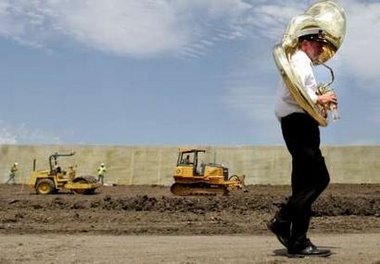

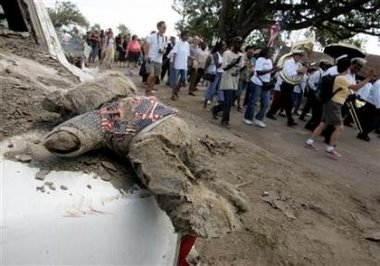
New Orleans mourns Katrina's dead with jazz funeral
Reuters on Yahoo.com
By Jeffrey JonesMon May 29, 4:08 PM ET
Yvonne Wise recalled many customers of her clothes alteration business as she marched past smashed homes and rusting, overturned cars of New Orleans' Lower Ninth Ward to the joyous sounds of a brass band.
Moments before, in New Orleans jazz funeral tradition, the Treme Brass Band's renditions were somber as Wise and dozens of others stood where a levee gave way nine months earlier to the day, sending a torrent through the streets of the Lower Ninth.
There, residents of the neighborhood read the names of more than 1,000 Louisianians killed by Hurricane Katrina and its aftermath. Wise, 58, recognized some of them.
"It went to the heart, you know? To lose that amount of people, and there are still people unaccounted for," she said as the parade wound around the predominantly black and poor community that remains largely a debris field. "I lost a son, not in Katrina but after Katrina. I think he just basically died of heartbreak."
The Memorial Day service and jazz funeral parade was to pay tribute to the more than 1,500 people killed in the disaster, along with U.S. military personnel killed over the years in battle. It was organized by the Lower Ninth Ward Neighborhood Empowerment Network Association, formed by residents who aim to make sure their community gets rebuilt.
Jazz funerals end on a lively note with the band belting out signature tunes like "When the Saints go Marching In" and "Down by the Riverside." Monday's version was no exception.
'HISTORY'
"That's history, that's home, that's what we do," said Patricia Jones, president of the neighborhood group. The 31-year-old accountant also recognized some of the names read.
Several pastors were on hand to offer encouragement, and to lead a prayer for the newly repaired concrete floodwall three days before the start of the 2006 hurricane season.
Offering optimism is no small feat with destruction, empty homes and now, yards full of weeds, just steps away. Only a small area of the Lower Ninth has running water restored.
"What we should learn from all this is that we need to transcend or rise above what we can see with our own eyes, from our own perspective," the Rev. Oliver Duvernay of Central Missionary Baptist Church told Reuters. "We need to get up a little higher."
Post-Katrina New Orleans is a city of stark contrast. Some neighborhoods are slowly recovering, their streets lined with government-supplied trailers that are temporary homes for families who are renovating.
But not the Lower Ninth. City officials and the U.S. Army Corps of Engineers have warned residents here and in New Orleans East their communities face the greatest risk of flooding again in the event of another hurricane this season.
Attendees at the service were told it was not a time to point fingers over the disaster that struck the neighborhood where black families have owned homes for generations.
But residents could not hide their frustration with governments and the Corps, which have been accused by independent engineers of not adequately maintaining flood protection systems.
Across town, about 200 people gathered near the spot where the 17th Street canal breached, sending salty waters of Lake Pontchartrain through the Lakeview neighborhood. Mourners dropped 1,577 carnations into the canal's muddy water, one for each person who died in the storm last year.
A bagpipe played against the thump of a pile driver pounding supports for flood gates at the opening of the canal onto the lake. The gates are designed to stop a storm surge from swamping the canal.
(Additional reporting by Peter Henderson)
Photos AP Photo/Alex Brandon:

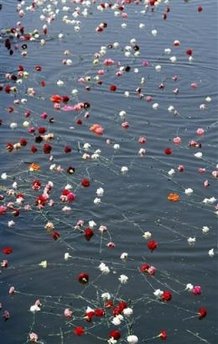


New Orleans mourns Katrina's dead with jazz funeral
Reuters on Yahoo.com
By Jeffrey JonesMon May 29, 4:08 PM ET
Yvonne Wise recalled many customers of her clothes alteration business as she marched past smashed homes and rusting, overturned cars of New Orleans' Lower Ninth Ward to the joyous sounds of a brass band.
Moments before, in New Orleans jazz funeral tradition, the Treme Brass Band's renditions were somber as Wise and dozens of others stood where a levee gave way nine months earlier to the day, sending a torrent through the streets of the Lower Ninth.
There, residents of the neighborhood read the names of more than 1,000 Louisianians killed by Hurricane Katrina and its aftermath. Wise, 58, recognized some of them.
"It went to the heart, you know? To lose that amount of people, and there are still people unaccounted for," she said as the parade wound around the predominantly black and poor community that remains largely a debris field. "I lost a son, not in Katrina but after Katrina. I think he just basically died of heartbreak."
The Memorial Day service and jazz funeral parade was to pay tribute to the more than 1,500 people killed in the disaster, along with U.S. military personnel killed over the years in battle. It was organized by the Lower Ninth Ward Neighborhood Empowerment Network Association, formed by residents who aim to make sure their community gets rebuilt.
Jazz funerals end on a lively note with the band belting out signature tunes like "When the Saints go Marching In" and "Down by the Riverside." Monday's version was no exception.
'HISTORY'
"That's history, that's home, that's what we do," said Patricia Jones, president of the neighborhood group. The 31-year-old accountant also recognized some of the names read.
Several pastors were on hand to offer encouragement, and to lead a prayer for the newly repaired concrete floodwall three days before the start of the 2006 hurricane season.
Offering optimism is no small feat with destruction, empty homes and now, yards full of weeds, just steps away. Only a small area of the Lower Ninth has running water restored.
"What we should learn from all this is that we need to transcend or rise above what we can see with our own eyes, from our own perspective," the Rev. Oliver Duvernay of Central Missionary Baptist Church told Reuters. "We need to get up a little higher."
Post-Katrina New Orleans is a city of stark contrast. Some neighborhoods are slowly recovering, their streets lined with government-supplied trailers that are temporary homes for families who are renovating.
But not the Lower Ninth. City officials and the U.S. Army Corps of Engineers have warned residents here and in New Orleans East their communities face the greatest risk of flooding again in the event of another hurricane this season.
Attendees at the service were told it was not a time to point fingers over the disaster that struck the neighborhood where black families have owned homes for generations.
But residents could not hide their frustration with governments and the Corps, which have been accused by independent engineers of not adequately maintaining flood protection systems.
Across town, about 200 people gathered near the spot where the 17th Street canal breached, sending salty waters of Lake Pontchartrain through the Lakeview neighborhood. Mourners dropped 1,577 carnations into the canal's muddy water, one for each person who died in the storm last year.
A bagpipe played against the thump of a pile driver pounding supports for flood gates at the opening of the canal onto the lake. The gates are designed to stop a storm surge from swamping the canal.
(Additional reporting by Peter Henderson)
Photos AP Photo/Alex Brandon:

Sunday, October 09, 2005
Jazz Funeral in Nola
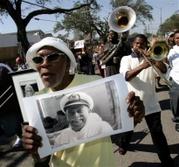
Jazz Funeral Procession Back in Big Easy
By RACHEL LA CORTE, Associated Press Writer 51 minutes ago
This city's historical jazz funeral procession returned to debris-lined streets Sunday to honor a famous chef who died last month in Atlanta, where he had evacuated after being rescued from Hurricane Katrina's floodwaters.
More than two dozen people carrying black and white photos of a smiling Austin Leslie marched down the streets of the devastated Seventh Ward in New Orleans, celebrating the life of the famous chef whose Chez Helene soul food restaurant inspired the television show "Frank's Place" in the 1980s.
Leslie, 71, was rescued from his home two days after Hurricane Katrina and went to Atlanta to be with relatives. He died Sept. 29 after falling ill. An autopsy report was pending.
A brass band started Sunday's procession with a spiritual hymn, "A Closer Walk With Thee," which was followed by dancing, singing and the waving and twirling of yellow umbrellas.
Stan "Pampy" Barre, the owner of Pampy's Creole Kitchen in New Orleans, the restaurant where Leslie had last worked and where the procession began, said the crowd was "going to march into New Orleans and dance him into heaven."
The group made several stops, including the former location of Chez Helene, dancing past debris and garbage that remained along the streets six weeks after Katrina flooded the city.
"It's going to get back to normal eventually," said snare drum player Dinerral Shavers, 24. "We're going to bring the life back."
As the procession made its way toward the Backstreet Cultural Museum on the outskirts of the French Quarter, the few residents who have returned home came out of their houses and joined in the jubilance by dancing, clapping and singing.
Mildred Matthews, 79, was swaying on her front porch waving a fly swatter in the air as they passed.
"You all come back to New Orleans," she yelled out.
Gralen Banks, a member of a local social club leading the procession, said the scaled-back procession was a first-step toward restoring New Orleans' jazz heritage.
"This is how we do it. We ain't closed. Tell your friends," he said.
But Jason Berry, an author who has written a history of New Orleans music and is working on a book about the history of jazz funerals in the city, said the city's musical establishment still has a way to go before returning to its pre-Katrina status.
"On a sentimental level, one can't help but be delighted," he said. "It certainly speaks about the endurance of the art form of jazz and the funeral traditions associated with it.
"Until all the musicians are back, and until the brass bands as a community gather and begin to play funerals on a regular basis, I don't think it's fair to say that New Orleans has regained that cultural territory that was so rich and beautiful."
A similar jazz funeral for Leslie was held Friday in Atlanta.
Subscribe to:
Posts (Atom)


