From the political website Counterpunch
Israel's Cultural Warriors
A Music School Silenced in Gaza
By NADIA HIJAB
There was a music school in Gaza. It was just six months old. The 31 children aged seven to 11 could choose one of five instruments, including the guitar, oud (lute), and piano. Most of the 19 girls gravitated to the guitar and piano while many of the 12 boys showed a preference for the oud.
The school worked out of rented premises in the Palestinian Red Crescent Society building just across the street from the Preventive Security Forces compound in Gaza City. The compound was targeted in the first wave of Israeli bombardments on December 27, and twice more the next day. The five-story building was vaporized; a flat gravel surface is all that remains.
Like other buildings in the neighborhood, the Gaza Music School was shattered; window frames and doors were blown out, and holes were punched in the walls. The force of the blast imploded the four ouds, just like it had the compound.
By some miracle, the children had not yet arrived for their lessons and so were spared the fate of those in other schools in the path of Israeli bombs.
In the midst of all the death and destruction in Gaza, the school's short life rouses particular emotion. That there was such a school at all is astonishing, not just because of the 18 month siege that followed the decades of "de-development" of Gaza under Israeli occupation but also because one might expect it to be contrary to an Islamist social program.
There is almost no musical education in Gaza. The school project was developed in response to community demand, particularly from among the 11,600 children who are members of the Qattan Center for the Child. The Center provides extra-curricular activities and a library for the children. It is impressive: With its 103,000 books, it is one of the largest children's libraries in the Arab world.
The children who attended the Center's music workshops and concerts started asking for more. "They said, 'We want to play instruments too,'" explained Ziad Khalaf, the Ramallah-based director of the Qattan Foundation, which established the school with co-funding from the Swedish development organization SIDA.
The school provided a window on another world for the besieged Gazans. "Many parents sat in on the theory lessons so they could better support their kids' homework," said Khalaf.
The five music teachers include two Russian women married to Palestinian men. They refused to leave Gaza when the border was briefly opened to enable foreigners to flee. For them, Gaza with all its misery and deprivation is still home, just as it is for the 1.5 million other Palestinians living there.
And what about Hamas' supposed social rigidity? Some websites did take a strong line against musical education, complaining that Hamas was allowing music to be taught under its rule instead of the Sharia. But they were ignored. Khalaf emphasizes that the Foundation has experienced full support from all authorities and communities in its different places of operation.
The day after the music school was hit, its coordinator called each of the children and their parents to make sure they were safe, and also to assure them that the school would be repaired, restocked, and reopened as soon as possible.
In Ramallah, the Edward Said National Conservatory of Music is planning a fundraiser soon to help rebuild the school. "Some friends from Amsterdam and London who saw the damage to Gaza music school on the Foundation's website said they will be fundraising to help," Khalaf said.
These plans, too, arouse emotion: Palestinians rebuild even as the rubble rises around them. They have had 60 years to learn how to do so, and show no signs of giving up their quest for their rights -- not even the right to learn how to play a musical instrument.
Nadia Hijab is a senior fellow at the Insitute for Palestine Studies.
Showing posts with label maghreb. Show all posts
Showing posts with label maghreb. Show all posts
Monday, January 12, 2009


Monday, July 21, 2008
Heavy Metal Islam: Rock, REsistance, and the Struggle for the Soul of Islam (book review)
From the NYT
July 20, 2008
Rock the Casbah
By HOWARD HAMPTON
Skip to next paragraph
HEAVY METAL ISLAM
Rock, Resistance, and the Struggle for the Soul of Islam.
By Mark LeVine.
Illustrated. 296 pp. Three Rivers Press. Paper, $13.95.
This professor of Middle Eastern history walks into a bar in Fez, Morocco — right from the get-go, Mark LeVine’s “Heavy Metal Islam: Rock, Resistance, and the Struggle for the Soul of Islam” is not your typical dry academic slog. (Did I mention he’s also a longhaired Jewish rock guitarist whose bio lists gigs with Mick Jagger and Dr. John?) So when somebody in that hotel bar starts talking up the local punk and metal scenes, an incredulous LeVine is hooked. “There are Muslim punks? In Morocco?” Quicker than you can whistle “Rock the Casbah,” he’s on the trail of Western-influenced underground music movements that have blossomed under authoritarian regimes across the Middle East and North Africa.
Going to meet the seven-string guitarist Marz of Hate Suffocation, a Cairo band, LeVine confesses sheepishly, “I still couldn’t tell the difference between death, doom, black, melodic, symphonic, grind-core, hard-core, thrash and half a dozen other styles.” (Marz explains that his group plays a cross between death and black metal: “But it’s not blackened death metal!”) Despite a certain amount of scholarly dogma that goes with the territory — here any combination of “neoliberal” and “globalization” is as ominous an epithet as Black Sabbath’s “War Pigs” — “Heavy Metal Islam” offers the hit-and-run (as well as hit-and-miss) pleasures of a lively road trip. Practicing a first-person brand of shuttle diplomacy as he moves between countries and cultures, musicians and Islamic activists, LeVine manages to unpack enough cross-cultural incongruities to mount his own mosh pit follow-up to “You Don’t Mess With the Zohan.”
An ex-Mossad hairdresser is scarcely more anomalous than disheveled Moroccan riot grrrls, virtuoso Egyptian metalheads, Lebanese “muhajababes” (young women wearing full head scarves, army fatigues, tight black T-shirts and Hezbollah wristbands), Tupac-influenced Palestinian M.C.’s, “the Israeli Oriental death-doom metal band Orphaned Land” (complete with a devoted Arab following) and rapt Iranian Iron Maiden acolytes. A participatory, hands-on guy, LeVine not only meets and eats with Muslim headbangers, he jams with them in apartments, studios and outdoor festivals, taking in the food and the noise and the people as if it were all a movable metal feast.
Eagerly seizing on the stereotype-busting possibilities of “an 18-year-old from Casablanca with spiked hair, or a 20-year-old from Dubai wearing goth makeup,” LeVine would like us to see them as the faces of an emerging Muslim world, potentially a much less monochromatic place than the one represented on TV by the usual “Death to America” brigades. “Heavy Metal Islam” turns the notion of irreconcilable differences between Islam and the West on its head, appealing to the universality of youth culture as “a model for communication and cooperation” in the Internet age. LeVine reckons the likes of Metallica and Slayer provide a brute lingua franca that knows no borders, opening up breathing room in cloistered societies, gradually undermining rigid belief systems — a benign, bottom-up brand of globalization as opposed to the ruthless corporate or state-sponsored kind.
It’s that old-time Lennon/Bono rock idealism reimagined for a post-Cannibal Corpse world, and that’s winning on a case-by-case basis. In lands where playing “satanic” music or even attending semi-clandestine concerts can get you thrown in jail (actually charged with things like “shaking the foundations of Islam”), there’s something truly heartening about the Moroccan thrash girls Mystik Moods striving to break through centuries-old sexist taboos, or Hate Suffocation trying to carve out a niche to play music and “be left alone by both the government and society.” In theocratic Iran, when Arthimoth’s leader wears a T-shirt reading “Your God Is Dead,” he’s risking a fate much worse than being suspended from school or getting dirty looks at the mall.
“Heavy Metal Islam” gets trapped by its good intentions whenever it attempts to shoehorn the headbangers’ intransigence into preconceived political slots. Metal music, however you parse it, is dystopian in the extreme: hyper-aggressively embracing the death instinct, regimented chaos, deliriously fetishized morbidity. Call it cathartic, sure, even a way of keeping sane in an insane world (as one performer here says, “We play heavy metal because our lives are heavy metal”), but don’t confuse it with “If I Had a Hammer.” Unless it’s a hammer of the nihilist gods aimed at your forehead — not to hammer out justice or a warning or “the common struggle for democracy and economic equality,” but to crack your skull open, scrape out your pulverized brains and feed them to the wolverines.
Even though these antisocial bands want no part of hard-liners like the mystical Justice and Spirituality Association in Morocco or the spooky Muslim Brotherhood in Egypt (and the disdain is often mutual), LeVine thinks if they could all put aside their petty differences and work together, they could start a domino effect in the Middle East like the one that toppled the Eastern bloc. (He’s like the straight arrow in comic books who’d invariably look around at the scene of Armageddon and say with a sigh, “If only we could have harnessed their mutant energy for goodness.”) The punch line of LeVine’s informative, valuable and moderately mad book is twofold: this conscientious anti-imperialist has written a swell tract in favor of large-scale cultural imperialism — a Marshall Amps Plan — and his program is undoubtedly the first to enlist death metal as the spearhead of a new Peace Corps(e).
Howard Hampton is the author of “Born in Flames: Termite Dreams, Dialectical Fairy Tales, and Pop Apocalypses.”
Tuesday, May 13, 2008
Gnawa in NYT travel section

New York Times
May 11, 2008
Music Issue
Rockin’ the Casbah
By STEVE DOUGHERTY
FROM his perch on a rooftop terrace near the crenelated western ramparts of the walled city, a visitor from England watched the sun set in spectacular display over the Atlantic Ocean. As it disappeared on the cloudless horizon, the sun’s rays cast a golden glow on a rising crescent moon decorated on the eve of the summer solstice by a silvery alignment of planets and stars.
“Nice touch, that,” quipped Bill Corbett, a 39-year-old London photographer, D.J. and music fanatic whose visit to Essaouira, an exotic, wind- and sun-swept Moroccan city on the northwest coast of Africa, for the 10th-annual Gnawa and World Music Festival, would prove a transforming experience. “This really is a midsummer night’s dream.”
And one with an exhilarating soundtrack — courtesy of 25 Moroccan Gnawa musical brotherhoods, whose exuberant, hypnotically rhythmic and joy-infused music drew an estimated 400,000 fans from Morocco and across North Africa, Europe and North America to Essaouira (pronounced ess-ah-WEER-ah) last June for the five-day festival. Midsummer revelers heard more than 30 other jazz fusion, rock, reggae, African, Brazilian, Afro-Cuban and hip-hop acts from more than a dozen countries — as well as Hoba Hoba Spirit, a crowd-wowing multilingual “Moroc ’n roll!” band from Casablanca — performing on nine festival stages scattered in and around Essaouira’s walled, maze-like medina.
Unlike festivals staged, à la Woodstock, in muddy, middle-of-nowhere pastures, or worse, in vast, overheated football stadiums, the Gnawa’s setting, in a small, friendly and almost impossibly picturesque, wind-cooled seaside city, is as magical and mesmerizing as the music.
“I thought about going to Glastonbury,” Mr. Corbett said of the popular rock festival outside London that was being muddied by cold, drenching rains as he spoke. A sharp-featured, good-humored fellow, my new-found friend was ensconced on the roof terrace at Taros, a watering hole popular among tourists and expatriates, as well as a surprising number of Moroccans who felt unconstrained by Islam’s admonitions against alcohol. “Why see a bunch of boring new rock bands when you can see amazing ancient ones?” he said.
He made a sweeping gesture that took in the stars, the moon, the walls of the ramparts silhouetted against the sky and the gleaming superstructure of the main festival stage below on the Place Moulay Hassan, Essaouira’s central square. “And in a setting like this?”
We were both still buzzing after catching an 11 p.m. concert by a Gnawa group led by the maalem (master musician) Abdenbi El Gadari, on a small festival stage in the Marché aux Grains (Grain Market), a square enclosed by colonnaded arches where, until little more than 100 years ago, slaves were bought and sold at auction.
A descendant, like almost all Gnawa musicians, of black African slaves who for centuries were brought across the Sahara to serve the sultans, pashas and wealthy families of Morocco, Mr. Gadari sat on a floor cushion at the center of a stage covered with lush, colorfully patterned Moroccan carpets. Arrayed around him were more than a dozen members of his musical brotherhood: drummers, steel castanet players, dancers and singers who wore ankle-length white satin robes and tasseled fezzes beaded with white seashells.
With the commanding presence of the American Delta bluesmen with whom he shares musical roots and mojo, the maalem thrummed and plucked bluesy figures on his guimbri — a three-string lute, much like a bass guitar — and sang a gospely call and response in a rich baritone.
The music built slowly to an exhilarating crescendo of intricate rhythms and cross rhythms created by propulsive beating on hand-held drums and large, tambourinelike bendirs, staccato hand claps and the incessant, syncopated clack and clatter of the steel castanets. As the spirit moved them, musicians put down their instruments and stepped to the front of the stage to dance, displaying footwork and moves that resembled those of their African-American cousins, from the Temptations’ stylized line steps and James Brown’s knee drops to hip-hop’s exaggerated lopping turns, as well as whirls, leaps, back flips and hussar-like two-legged kicks that defied choreographic categorization, not to mention gravity.
Like all Gnawa brotherhoods, Mr. Gadari’s group performed music that for centuries was played only in secret spirit-possession and healing ceremonies called lilas that have evolved from ancient African animistic and Islamic Sufi rituals. The brotherhoods continue to perform in such religious rites — though only in strictly private gatherings — in which conjured healing spirits are said “to mount” the possessed, who whirl and writhe in ecstatic trance, during which they often cut or flail themselves with ceremonial daggers or iron batons.
“To me, these spectacles are filled with great beauty,” Paul Bowles, the expatriate American composer and writer who spent much of his life in Morocco, wrote of often bloody ceremonies that most Westerners would find gruesome to behold, “because their obvious purpose is to prove the power of the spirit over the flesh.”
“YOU’RE American?” the unsmiling young Moroccan manning a closet-size shop in the Spices Souk demanded. I balked, wondering if it would be wise to say I was Canadian, as advised in a post on a travel blog by a countryman concerned, as I was, about anti-American sentiment stirred by the war in Iraq, 3,000 miles east.
Though not an Arab country, Morocco is a Muslim nation with a diverse population and a long history of tolerance and openness to the West. It is a monarchy, and its present king, the 44-year-old Mohammed VI, has liberalized many of his long-ruling father’s more repressive policies. A far less severe form of Islam is practiced there than in more conservative and puritanical Muslim countries, where an event like the Gnawa Festival — with music fans, foreigners and Moroccans alike, dancing and singing in the streets and where women wear whatever they want — would be unheard of, if not illegal.
But there were bombings in Casablanca in 2003 and 2007, and the State Department’s warning in its information about traveling to Morocco that “the potential for terrorist violence against American interests and citizens remains high” gave me pause.
But my anxieties evaporated as soon as I arrived in Marrakesh, where the cab ride from the airport to my hotel in the center of the red-hued medieval city was a senses-jolting experience. Minicabs and motorbikes sped through ancient streets filled with horse-drawn carts, donkeys laden with bulging sacks and pedestrians dressed as though they’d been plucked from the streets of Jerusalem at the time of Jesus.
The next day, after a two-and-a-half-hour cab drive west through forbidding desert landscapes where funnel clouds of brown dust rose in the distance and a goatherd sought refuge from the blistering sun in the nearly nonexistent shade of a lone and scrawny tree, I arrived in Essaouira. Its sprawl of white homes and apartment buildings was spread along low hills overlooking a broad, blue bay and the tall, sand-colored walls that enclosed the medina, the heart of the old city.
“You will love Essaouira,” a young Moroccan woman who is studying architecture in Florida assured me before I left. “It’s magical.”
I understood what she meant after a single afternoon and evening walking around the medina, with its dramatic, castlelike battlements where ramparts bristle with cannons pointing out to sea, its dark, serpentine alleyways, hidden courtyards, graceful archways and sunny, colonnaded squares and its souks selling spices, oils, aphrodisiacs and the makings of potions said to cast spells.
At first glance a bewildering maze of circuitous, tunnel-like side streets, the medina, commissioned by an 18th-century sultan and designed, by a French architect, Theodore Cornut, with two wide boulevards as central axes and thoroughfares linking three main gates, soon proved easily navigable.
From the humanlike cries of gulls reeling in the cloudless skies and the cooling Atlantic trade winds whistling through the streets and rustling the crowns of the ancient palms, to the staccato chatter of street musicians’ steel castanets and the muezzin’s musical, mystical call to evening prayers, the city was alive with sound even when the festival stages stood silent.
After an hour of aimless wandering, I found myself in the Spices Souk, where the young merchant demanded to know if I was an American.
“Yes,” I finally replied. “I’m from New York.”
“You came all this way to visit my country?” the man exclaimed. With that, he poured heaping tablespoons of powdered saffron into a plastic bag and handed it to me.
“This is a gift — for America,” he said with a smile. “Here. Take it. And now come in for a glass of tea.”
“I was 19 and a hippie among thousands of them who came to Morocco in those days,” Loy Ehrlich, a French guitarist who is an artistic director of the Gnawa Festival, recalled of his first pilgrimage to Essaouira in 1971.
Then an out-of-the-way, off-the-tourist-map town with no rail or regular bus service, no good roads to accommodate it if there were and only a handful of hotels, Essaouira, formerly known by its Portuguese name, Mogador, was beloved by Moroccans for its beauty, its near-perfect climate — even in the depths of the African summer when the interior swelters, ocean breezes sweep clouds from the sky and keep the so-called Windy City pleasant in the day and cool at night — and its friendly inhabitants. (“Essaouira people always smile,” said a Gnawa fan from Fez).
Artists like Bowles, who visited in 1959 while recording Gnawa music for the Library of Congress, and Orson Welles, who spent nearly two years there off and on in the late 1940s and early 50s filming “Othello,” using the city’s ramparts, hammams and arched gateways as a fitting North African backdrop for the tragedy of the Moor, were also charmed by the city’s beauty.
But it was a sojourn by Jimi Hendrix, the guitar idol who vacationed in Essaouira in 1969, a year before his death, that inspired visits by Mr. Ehrlich and countless other musicians and fans, many of whom believe that Hendrix’s song “Castles Made of Sand” was inspired by Borj El Baroud, the ghostly, turreted remains of a Portuguese fort decomposing off the beach south of the city. Like most of the legends surrounding Hendrix’s brief visit, when he supposedly spent weeks jamming with local musicians and fathering children among his many lovers, the story is a pipe dream. Hendrix, who arrived without a guitar and spent a single night or two in the Hôtel d’Îles with his girlfriend, recorded the song two years before he arrived in Morocco.
It was Hendrix’s star that Mr. Ehrlich followed to Essaouira. But it was Gnawa music that transfixed him when he arrived. Terminus of the ancient desert trade routes to Timbuktu and sub-Saharan Africa, where the Gnawas’ enslaved ancestors had their origins, Essaouira remains home to the largest concentration of the musical brotherhoods in Morocco.
“When I first heard Gnawa, it was like a discovery, like something was revealed to me,” Mr. Ehrlich said. “I felt the power of the music and its connection to the blues. The Africans who were brought to America created the blues; those sent to Morocco created Gnawa. It was like two worlds mixing — the African and rock ’n’ roll.”
Performing on the third night of the festival with a group formed for the occasion in homage to Hendrix, Mr. Ehrlich led the Band of Gnawa (after Hendrix’s Band of Gypsys), a cross-cultural mix of musicians playing electric guitars, guimbri, bendirs, electric keyboards and castanets, through renditions of Led Zeppelin’s “Immigrant Song” (with a maalem in emerald satin channeling Jimmy Page on his guimbri), as well as Hendrix’s “Stone Free” and, yes, “Castles Made of Sand.”
“In a crazy world where rich and poor, black and white, Christian and Islam are divided,” Mr. Ehrlich said, “musicians try to create something to unite the world.”
In keeping with that creed, he rewrote the refrain of a familiar Beatles singalong. “Come together, right now,” the vast crowd gathered on Place Moulay Hassan sang along with Mr. Ehrlich’s Band of Gnawa, “Essa-Weer-Ah!”
“IT’S positively biblical,” Bill Corbett marveled on the last day of the music festival as he sat in the shade of a tree outside L’Horloge, a popular cafe on a side street near a graceful clock tower. “Everywhere you look you see Marys and Josephs and wise men.”
He was watching the passing scene of colorfully turbaned men in ankle-length tunics, caftans and djellabas; brightly robed women, some in burqas and niqabs, some veiled and others with their hair wrapped in elaborately rolled silk head scarves (hijabs). Mr. Corbett, who arrived from England wearing a T-shirt and cutoffs, now looked quite New Testament himself in a long, white hooded djellaba, a knitted skullcap and sandals.
Besotted by Essaouira’s beauty, he would extend his stay for a week after the festival ended, fall in love with a Muslim woman and return a month later to court her and to explore the possibilities of starting a business exporting Essaouiran argan oil to Britain.
“I came for the music,” he said, “and found the magic.”
A WORLD OF MUSIC, AND A BEACH
The 11th edition of the Gnawa Festival (www.festival-gnaoua.net) will take place June 26 to 29. Admission to performances on outdoor festival stages in and around the medina is free.
Visas are not required for Americans traveling to Morocco, but visitors are advised to check the State Department international travel information online at travel.state.gov for up-to-date security information.
While almost all Moroccans speak French, many also speak English.
Essaouira is a small city with limited hotel accommodations; unless you are willing to barter with residents for spare bedrooms or sofa space or to sleep on the beach, be sure to book early. Most accommodations are sold out well before the festival begins, but you’re bound to see dozens of men and boys shake key rings at passing cars as they come into town, a signal that they have rooms to rent.
Because Islam takes a dim view of alcohol, it is kept out of sight, served only in hotels and restaurants that cater mostly to tourists, and never in sidewalk cafes or restaurants. Brown-bagging is almost unheard of and no beer, wine or liquor is sold at festival concessions, with the happy result that the high spirits of Gnawa are generated by the music and not the bottle.
Even so, the large festival crowds coursing through the narrow streets of a city with chronic poverty and unemployment attract pickpockets and drug dealers among other petty criminals.
GETTING THERE
Royal Air Maroc (www.royalairmaroc.com) flies from Kennedy Airport to Marrakesh through Casablanca. Fares for the festival week start around $1,450 round trip.
Essaouira is a three-hour bus ride from the Marrakesh rail station on the Supratours (www.supratours.ma) express bus. At festival time the fare is 65 dirhams, about $8.65 at 7.5 dirhams to the dollar; no reservations are taken. Taxis from the Supratours bus terminal usually make the drive in less than three hours for the equivalent of about $50.
At Bab Marrakesh, the main gate to the medina, porters will load your bags into pushcarts and guide you to your hotel in the medina for 40 dirhams.
WHERE TO STAY
The chief attractions at La Casa Del Mar (35, rue D’Oujda; 212-68-94-38-39; www.casadelmar-essaouira.com) are dramatic views from the whitewashed roof terrace of sunsets and offshore rock outcroppings. While clean and affordable (doubles in high season start at 750 dirhams), this small bed-and-breakfast is in a sector of the medina behind the crumbling north ramparts, where visitors should be cautious after dark.
The Palais L’Heure Bleu (2, rue Ibn Batouta; 212-24-78-34-34; www.heure-bleue.com) offers spacious, sumptuously appointed rooms, fine courtyard dining (prix-fixe dinner is 60 euros) and a rooftop swimming pool, as well as a hamman, Morocco’s version of a Turkish steam bath. Doubles from 300 to 540 euros.
With its stone archways, lush courtyard and wrought-iron balconies, the Riad Al Madina (9, rue Attarine; 212-24-47-59-07; www.riadalmadina.com ) looks like a colonial-era haven that might have inspired Graham Greene. Doubles are 814 dirhams.
Riad le Grand Large (2, rue Oum-Rabia; 212-44-47-28-66; www.riadlegrandlarge.com) is, despite its name (the big big?), a small hotel with friendly management and quiet, simply furnished rooms. Doubles from 550 dirhams, with breakfast.
Villa Maroc (10, rue Abdellah Ben Yassin; 212-24-47-31-47; www.villa-maroc.com) features simply furnished but charming rooms with wood-beam ceilings, common rooms with fireplaces and a roof terrace overlooking one of the main Gnawa Festival stages on Place Moulay Hassan. Doubles from 950 dirhams.
WHERE TO EAT
Le Mogadorien (7, place Chefchaoni; 212-24-47-49-50; www.lemogadorien.c.la) is an inviting, well-lighted grotto of graceful archways and comfortable dining alcoves serving traditional fare, including excellent tagines, fish soups and colorful salades Morrocaine. The three-course menu is 175 dirhams. Alcohol is not served.
Taros Cafe (2, rue de la Skala at Place Moulay Hassan; 212-24-47-64-07; www.taroscafe.com) is housed in a restored mansion, complete with a dark-wood library-cum-dining room. It is better known for its music than its food ( I had soggy prawns, an O.K. Moroccan salad and crème brûlée); meals cost 250 to 300 dirhams. On the rooftop terrace, rocking American music by bands and D.J.s helps make this perhaps the most popular bar in town.
Dar Loubane (24, rue de Rif, off Place Chefchaoni; 212-24-47-62-96) offers wonderful beef curries (95 dirhams), fish tagines (115 dirhams) and Moroccan salads (42 dirhams) in an eccentric setting: the courtyard of an 18th-century mansion filled with kitschy, eye-bending artwork. Much of it was collected in the flea markets of Paris by the Casablanca-born proprietor, Jean-Claude Dulac, gregarious host to lively gatherings of the young and hip, locals and tourists alike.
Cafe L’Horloge (Place Chefchaoni; no phone) provides a shady refuge from the heat and tumult of the medina. The service is friendly, if not exactly like clockwork; a cheese omelet and sweet mint tea set me back all of 25 dirhams.
Snak La Mouette (110, rue Mohamed Ben Abdellah; no phone), one of countless storefront snack shops in the medina, was a favorite of locals and festivalgoers, many of whom lined up at 2 a.m. for delectable post-concert chicken and pepper sauce baguettes (35 dirhams).
STEVE DOUGHERTY has written extensively on popular music, including an article on Bob Dylan’s Minnesota for the Travel section.
Monday, June 04, 2007
Profile of North African/Tuareg Band Tinariwen
SLATE
music box
Enter Sandmen
Is Tinariwen the greatest band on earth?
By Jody Rosen
Posted Thursday, May 31, 2007, at 3:42 PM ET

For rockers and rappers of a certain stripe, a hard-bitten back story is an indispensable part of their mystique and a bold-face item in their press releases. What would 50 Cent be without the gun battle that left a bullet shard lodged in his tongue? (Answer: about $50 million poorer.) Of course, there's hard-bitten and there's hard-bitten. These self-styled rebels and gangstas would do well to consider the case of Tinariwen, a rock group, of sorts, from the swath of the Sahara that stretches northeast of Timbuktu. Tinariwen is made up of Tuareg, Berber nomads who waged a decades-long separatist struggle against the Malian government that disposed them of their traditional territories. The band was formed in the early 1980s by three teenagers, Ibrahim Ag Alhabib, Hassan Ag Touhami, and Inteyeden Ag Ableline, living in exile in southern Algeria. The musicians were typical of the Tuareg youth of their generation—adrift and nearly destitute, hungry for self-determination and revenge—and they poured their emotions into confessional songs sung in Tamashek and French, and laced with rough-hewn guitar work. Eventually, the three friends found themselves in Muammar Qaddafi's's Tuareg training camps in Libya, and then back in Mali, fighting in a brief, bloody guerilla war. They were rock 'n' roll rebels whose rebellion, for once, wasn't just metaphorical.
A lesser band could build a following on the strength of that colorful past alone. But Tinariwen, now featuring eight members, happens to make extraordinary music. The songs are modal vamps, with gruff call-and-response vocals, congas, handclaps, and layered guitar riffs, which build to trancelike fugues. For years, the band's recordings circulated through the Sahara samizdat-style, on cassette tapes, but Westerners began to take notice in 2001, after a performance at Le Festival au Désert, an annual concert in Essakane, Mali. In 2004, Tinariwen released a superb CD, Amassakoul (Traveler), and toured Europe, collecting admirers (including some famous ones, like Robert Plant). Now comes another, even better record, Aman Iman (Water Is Life) (produced by Plant's guitarist Justin Adams), whose spellbinding dozen songs make a case that Tinariwen is one of finest bands on earth.
They certainly know how to play their guitars. On the new album, nearly all the songs open with ruminative riffing on a lone guitar before settling into inexorable grooves, with guitar lines stacked in counterpoint above a propulsive bass. Tinariwen has six guitarists, and they're all aces. In many songs, the rhythm players are so crisp, cutting, and lyrical that they sound like they are playing leads. You don't need the lyric sheet's Tamashek-English translation to know that "Tamatant Tilay" ("Death Is Here") is a battle hymn: You can hear fear and blood-lust in Hassan Ag Touhami's scrappy picking. Mali is famous for great guitarists like Boubacar Traoré and the late Ali Farka Touré, and while Tinariwen makes use of a similar mélange of influences—mashing up the ancient modal scales of Arab and West African music with American blues—its sound is fiercer, and thicker. Call Tinariwen a rock band, if you like. Guitar orchestra might be more accurate.

Frontman Ibrahim Ag Alhabib definitely looks the part of guitar hero, glowering beneath an extravagant mop of curls on the Aman Iman album cover. Ag Alhabib plays guitar like he sings, in a rugged staccato style, but his songwriting is full of yearning and tenderness, laments for lost love and lost land. He is a George Jones of the Sahara, a weeper specialist. In "Cler Achel" ("Spent the Day"), he sings: "You've gone, Mila, you've already gone, and I've plunged deeper into my dreams/ Whatever my thoughts, she occupies them all, and my heart cries out still." The one-chord drone in "Imidiwan Winaklin" ("Friends of My Country") is jaunty, but the lyrics are wrenching: "I'm in a motherless land and my soul burns with unhappiness/ I consume my thoughts with the smoke of cigarettes, and it amplifies my pain." Homesickness is Tinariwen's great theme, but in addition to plaints, the band sings pastoral reveries, songs whose lyrics and vast, ringing sound evoke the majesty of the "white, naked, and empty" desert. (Tinariwen means "empty places" in Tamashek.)
Empty places, camels beneath beating sun, poet-warriors crisscrossing an ocean of sand: Tinariwen is an Orientalist fantasy come to life, and it's hard for a Western listener not to exoticize the musicians, particularly when the ululating cries of Mina Wallet Oumar, the group's sole female member, ripple over the churning music. Like any successful band, Tinariwen has learned to exploit its image—just check out the Aman Iman album package, with its photos of the band in billowing traditional garb framed against forbidding desert landscapes. Robert Plant has spoken of his discovery of Tinariwen as an epiphany—"I felt this was the music I'd been looking for all my life"—and many reviewers have described Tinariwen as a throwback to "roots of the blues."
It's true that Tinariwen's music is steeped in ancient folk melodies. It's also true that Ag Alhabib's first guitar was a contraption fashioned from a stick, a jerrycan, and some bicycle brake wire. But some of the earliest songs he learned on that guitar were American rock and pop hits. (Carlos Santana was a favorite—no surprise given Ag Alhabib's look.) And while Tinariwen's desert odes inspire romantic thoughts of a distant past, this is not a band on a nostalgia trip. One of the best songs on the new album, "Mano Dayak," is an anthem about the Tuareg freedom struggle that ends with a striking image of modernity: "Now I've seen something that fills me with joy/ A Tamashek whose living well/ And communicating through a satellite phone/ Tied to the tree under which he rests." It's an ecstatic ode to the globalized present, and Aman Iman sounds as gleamingly contemporary as any record I've heard this year—great 21st-century dance music, made with just a few guitars and a lot of clapping hands.
Jody Rosen is Slate's music critic. He lives in New York City. He can be reached at slatemusic@gmail.com.
Article URL: http://www.slate.com/id/2166480/
Sunday, June 04, 2006
Another Cheikha Rimitti Obituary
From the Los Angeles Times
OBITUARIES
Cheikha Rimitti, 83; Algerian Singer, `Mother of Rai'
By Jocelyn Y. Stewart
Times Staff Writer
June 4, 2006
In the 1930s no respectable Algerian woman dared to make music about sexual pleasure, alcohol consumption, poverty, oppression.
Cheikha Rimitti sang anyway.
The artist, whose pioneering recordings inspired younger generations in her homeland and around the world and earned her the title of "mother of rai," the Algerian music of dissent, died of a heart attack May 15 in Paris. She was 83.
"I don't know that the world has anyone ready to step into those shoes," said Leigh Ann Hahn, director of programming for Grand Performances and a longtime fan, who helped bring Rimitti to Los Angeles for a historic performance. "It's a huge, huge loss."
Just last month Rimitti, who was still performing concerts in Europe, released a new recording, N'ta Goudami ("Face Me").
Rimitti began singing as a means of surviving. Born Saadia Bediaf near Sidi Bel Abbes in Algeria on May 8, 1923, Rimitti was orphaned at an early age and struggled for daily existence. When she sang at weddings and parties as a youth, "people gave me food to eat."
"Misery was like a school for me," Rimitti said in a 2001 interview with Afropop Worldwide, a radio program and website dedicated to African pop music. "It taught me my trade."
At 20, Rimitti joined a group of musicians who sang at religious festivals, weddings, births and other rites. Her predecessors included early rai singer Cheikha Tetma.
Cheikha is a title given to female rai singers, who in the early days of rai were regarded as outcasts and often took on nicknames or stage names.
In Arabic the word rai means "opinion" or "way of seeing." In its early form, the music was rooted in the concerns of everyday people — the joys, the pains, the unspeakable. It was dance music, sung in the language of the streets.
Nourredine Gafaiti, Rimitti's most recent producer, called the music "as happy as funk" and "as deep as the blues." It is both hopeful and melancholy, Gafaiti said in a biography of Rimitti posted on the singer's official website.
Algeria was a colony of France when Rimitti began singing. Her first recorded hit, "Charrak Gatta" ("Tear, Lacerate"), was released in 1954, the year the Algerian War of Independence began.
The song has been described as an attack on the virtue of virginity and an invitation for women in the Muslim nation to rethink their views on morality. Her signature husky voice led later observers to describe her music as earthy, raw and bold.
"It's a matter of observing and reflecting," Rimitti said in a 2001 interview with Afropop Worldwide.
"Rai music has always been a music of rebellion, a music that looks ahead. At that time, it was even more so, with just the flute and the tam-tam," a type of gong.
But in the new Algeria there was little tolerance for the bold or the brash. The religious considered her immoral. The revolutionaries considered her anti-revolutionary and apolitical. In the 1960s the new government banned Rimitti and other rai artists from performing on the radio, relegating the music to private parties and black-market cassette tapes.
In 1978, she moved to France, but her heart — and her musical legacy — remained in Algeria. Years later, rai would experience renewed popularity and Rimitti complained that younger artists took her songs and "exploited them without giving me my due."
In 1994 Rimitti collaborated with Flea, bassist from the Red Hot Chili Peppers, and Robert Fripp on the album "Sidi Mansour." The musicians recorded in Los Angeles, while Rimitti recorded vocals in Paris. The collaboration, she later said, opened the door to realizing her long-held dream of performing in the United States.
By the time Rimitti performed in the U.S. in 2001, she was 78, but she was still vibrant and innovating. The next year she performed at California Plaza in downtown Los Angeles as part of a Grand Performances lineup of world music artists.
Many who attended the performance were local fans who had never had an opportunity to see Rimitti perform live. Others there were open to exploring Arabic "cultural tradition in order to be able to take a different look or perspective on the global community" in the aftermath of 9/11, Hahn said.
Times writer Lynell George described Rimitti striding out "in a dress as white and elaborate as a wedding cake. A sparkling tiara rests atop her long blue-black tresses."
"Suddenly turning, arms close to body, gold-slippered feet shuffling like a moving hieroglyph, she makes two passes across the stage before a ragged voice curls out from somewhere way, way low — a map, a road, a history unscrolling," George wrote.
Over the years, even as the times changed, the bold, raw flavor of her lyrics remained.
"I sang the life I had seen, my own history," Rimitti said.
Tuesday, May 30, 2006
Cheikha Rimitti, Pioneer of Algerian Raï Music (1923-2006)

New York Times
May 28, 2006
Cheikha Rimitti, 83, Rebel of Algerian Music, Is Dead
By JON PARELES
Cheikha Rimitti, a pioneer of the rebellious Algerian pop called ra-2006), died on May 15 in Paris, where she had lived since 1978. She was 83.
The cause was a heart attack, her Web site said.
Cheikha Rimitti was considered the queen of raï (RYE or rah-AY), which means opinion in Arabic. She sang daringly and forthrightly about sexuality, poverty, drinking, oppression and independence. "Misfortune is my teacher," she often said.
Her brash lyrics and deep, rough-hewn voice made her an international star. She defied taboos, and her music was often banned.
"Raï music has always been a music of rebellion, a music that looks ahead," she said in a 2001 interview with Afropop Worldwide, a syndicated radio program and Web site. Two nights before her death, she performed at the Zénith concert hall in Paris.
She was born in 1923 in the village of Tessala near Sidi Bel-Abbés in Western Algeria. Her parents named her Saadia, which means joyful. But she was orphaned as a young girl and grew up poor, often homeless.
To support herself, she began singing at weddings. She arrived in the town of Relizane and joined a troupe of traveling musicians when she was 20, performing at festivals as a singer, a dancer and an equestrienne, riding with a rifle in each hand.
Her stage name, Rimitti, was derived from the French word remettez (put it back, or slang for another). Various stories link the name to her buying rounds of drinks for fans or calling for refills herself. Later, the honorific Cheikha was added.
North Africa has a tradition of bawdy wedding songs, performed by and for women. Cheikha Rimitti began to sing them for mixed audiences in public. She also wrote songs about social conditions, including, in the 1940's, the harshness of French colonial rule and the epidemics that ravaged Algeria. She wrote about rough lives and about the temporary diversions of sex and alcohol.
"I sang all the subjects back then," she told Afropop Worldwide. "I sang about misery. I sang about love. I sang about the condition of women. I sang about ordinary life, concrete things. I sang the life I had seen, my own history."
Although she composed hundreds of songs, Cheikha Rimitti was illiterate. "Words sing silent in my head until I sing them loud," she once said. "No need to take either a pencil or a notebook."
A well-known Algerian musician, Mohammed Ould Ennems, helped arrange her first radio broadcasts in the 1940's. She made her first recording in 1952, and in 1954 she caused a controversy with a song called "Charrag Gataa" ("Tear, Lacerate"), which was taken as an attack on the virtue of female virginity. "He crushes, whips and beats me," she sang. "I say that I'm going away, but I still spend the night."
When Algeria became independent of France in 1962, the new conservative Islamic government banned her songs from radio and television. She continued to perform at private gatherings, as raï music circulated on underground cassettes.
In 1976, she made a pilgrimage to Mecca and gave up drinking and smoking. She emigrated to Paris in 1978, but continued to visit Algeria, which eventually removed the ban on her music.
According to her manager, Nourredine Gafaaiti, she is survived by her 3 children and 18 grandchildren, all of whom live in Algeria.
By the 1980's, her songs had been taken up by a younger generation of raï musicians, though they often did not credit her. She was rediscovered by the world-music audience in the 1990's and modernized her music. Her 1994 album "Sidi Mansour" included the guitarist Robert Fripp from King Crimson, and Flea, the bassist from the Red Hot Chili Peppers, although she never met the musicians; she was recorded in Paris and the backup tracks were recorded in Los Angeles.
She continued to make albums, and one, "N'ta Goudami" (Because Music), was released this month. It was recorded in Oran, Algeria, the birthplace of raï.
In 2001 she made her United States debut with a triumphant concert at Central Park SummerStage.
"When I'm on stage, I don't cheat," she told Afropop Worldwide afterward. "I give everything I have in my soul and my spirit."
Monday, October 10, 2005
A Slain Berber Singer's Voice Rouses His Hometown

New York Times
October 10, 2005
A Slain Berber Singer's Voice Rouses His Hometown
By MICHAEL SLACKMAN
TIZI OUZOU, Algeria - High in the jagged mountains covered with olive and fig trees, his voice booms from a minivan as it twists along narrow winding roads to drop off students after a day of school.
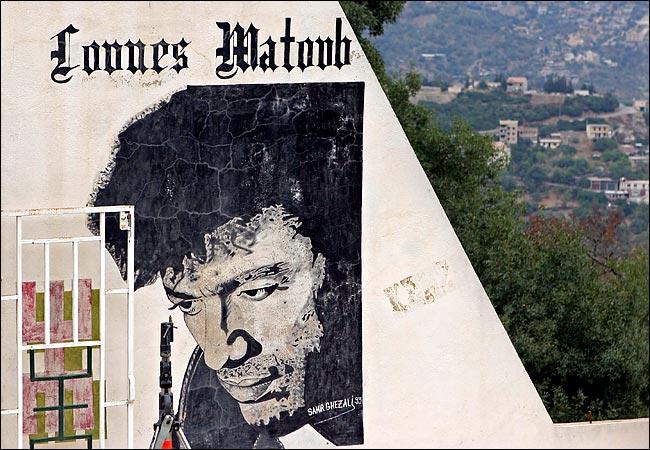
Head down into this city and there he is again, this time larger than life, in a poster mounted on a cafe wall while, of course, his voice booms from the stereo behind the counter. In shops, offices, restaurants - everywhere in this region, it seems - is the voice of Lounès Matoub.
"Never surrender, never surrender," he sings, strong and folksy. "Of course times change, but you should never forget."
Someone tried to silence Mr. Matoub on June 25, 1998; his car was sprayed with 79 bullets. Instead, he became in death a powerful symbol of defiance for an ethnic minority that has challenged the government's decision to define Algeria as an Arab nation.
This is Kabylia, one of Algeria's most restive regions - home to a stubborn and proud ethnic minority of Berbers who since independence four decades ago have fought to preserve their cultural identity and independence. While politicians and village elders have helped lead the fight, the soul of this struggle is captured in music, especially the music of Mr. Matoub.
"Music is much more a symbol of our identity than it is about entertainment," said Ousmail Abderrahmane, owner of a music shop in this city, the Kabylia region's capital.
Considered by many the original inhabitants of northern Africa, the Berbers had their own language, music and culture until the region was effectively Arabized as Islam spread a thousand years ago.
While many people in Algeria have Berber ancestors, those in the Kabylia region cling to their language and customs, even while adopting Islam as a faith. The women wear bright-colored traditional dress, and the men participate in elder councils, which govern affairs in their mountain villages. The Berbers were also known as fierce fighters, and Kabylia contributed many forces during the eight-year war of independence from France.
But after more than a century under French rule, Algeria's new government decided to forge an Arab identity, and the Berbers felt betrayed. They had believed that independence would give them greater autonomy over their affairs, not less. Over time, the Berbers of Kabylia began to organize, politically and socially, staging boycotts and acts of civil disobedience to force the government into talks. There have been violent confrontations as well.
In battles of identity, language often becomes the front line, and so while the issues for the Berbers are many, the flash point is the government's insistence that Arabic serve as the only official language. People from this region want their language, Tamazight, to have equal status, but the president refuses to budge.
"Algeria above all," read a recent headline in El Moudjahid, the government-controlled daily newspaper. "The head of state has chaired a rally on Thursday in Constantine, and he has stated Arabic will remain the sole official language."
Through brutal force and careful political calculation, the government has managed to secure the country. But the people of Kabylia are still fighting: boycotting elections, refusing to pay utility bills, insisting on greater democracy and some degree of self-rule. Music has helped pass the struggle from generation to generation, to unite political factions behind common ideas and to help keep the fires of resistance burning.
The region's four most popular musicians sing about the struggle for identity. Indeed, one of them, Idir, has an album titled "Identity." But Mr. Matoub remains the biggest seller, said Mr. Abderrahmane, the music shop owner. His lyrics tell of daily life in Kabylia, of oppression and of contemporary events, like the day in 2001 when the military opened fire on citizens protesting and rioting after a local boy was killed while in custody.
"O my life, o my life, the mountains are my life, Kabylia is my whole life." The words are Mr. Matoub's, but they are being sung softly by three young women standing side by side on the edge of a mountain road. Dahbir Ouidir is 19 years old. Sabina Wahan and Yasmine Lasmi are 16. They are a year behind in their studies because they joined thousands of other young people in a one-year school boycott as a sign of defiance.
They came home from school in a minivan, as the driver played a Matoub album. Stepping out, they said they would be happy to sing their favorite Matoub song, and soon the three , eyes closed, drew a crowd.
"People identify with his poetry," Ms. Ouidir said, her face flushed after singing.
Samir Rehane, a tall, slender 18-year-old with a book bag under his arm, overheard the conversation and walked over. "Matoub is a son of my village," he said. "He is a teacher for us. He is a symbol of freedom."
Down the road, in the village of Taourirt Moussa, a red marble tomb is decorated with dozens of tiny Algerian flags. It is where Mr. Matoub is buried, and it has become a pilgrimage site. The tomb is in front of Mr. Matoub's childhood home, which has been transformed into a shrine. The bullet-riddled Mercedes sedan he was driving when he was killed is parked in the garage, with a piece of tape on the driver's seat that marks a hole from the fatal bullet.
"We are not only interested in his music," said Ali Yashir, 21, who visited the grave one recent day. "We are interested in what he stands for. His struggle and his ideas will go on forever."
There is another shrine for Mr. Matoub at the mountainside scene of the ambush. A large metal sculpture, it depicts the Berber symbol of freedom, a crude stick figure of a person with raised hands. Mounted between the hands is a drawing by a popular Algerian political cartoonist, Ali Dilem, which was used as one of Mr. Matoub's album covers.
There is also a carved stone plaque nearby with a phrase that might well have been a chorus in one of Mr. Matoub's own songs: "Even if you are dead, you are still alive. A History. A Struggle. A Hope."
Subscribe to:
Posts (Atom)


