A great series of interviews with Carol Kaye produced by Snapshots Music:
Showing posts with label guitar. Show all posts
Showing posts with label guitar. Show all posts
Friday, May 31, 2013


Monday, December 12, 2011
Thursday, July 29, 2010
Guitar and Bass Flip/Swing/Spin Fails
Yes, some people spend hours practices whirling their guitar or bass guitar around their backs for dramatic stage action. And sometimes, such actions fail and really make people look like fools. First, the practice fails.
Bass Swing practice fail:
Especially nice are the live performance fails.
Guitar flip fail:
Bass flip fails:
This one is probably my favorite.
Bass Swing practice fail:
Especially nice are the live performance fails.
Guitar flip fail:
Bass flip fails:
This one is probably my favorite.
Tuesday, May 26, 2009
New Orleans Guitarist Snooks Eaglin (1936-2009)
OFFBEAT
I have been waiting for a good obit for Snooks. As always, Offbeat comes through:
Snooks Eaglin 1936-2009
By Jeff Hannusch
The generation that made the defining records in New Orleans’ rhythm and blues became a little smaller when Snooks Eaglin died February 18 from cardiac arrest. He was 73. Eaglin is remembered for his ability to mimic almost any song after a cursory listen and his unique guitar style. His fretting hand often completed chords with his thumb, or he used it to play bass runs that complimented his rhythm and lead playing. Instead of picks, he flailed at the guitar strings with his thumb and fingers. It often appeared that his fingers were bent backwards at a 90 degree angle.
“He can play a job with just a drummer and make it sound like a four-piece group,” said the late Earl King in 1987. “I’ve seen Snooks play for years, but I still shake my head every time he picks up the guitar.”
Fird Eaglin, Jr. was born January 21, 1936. He was rendered blind at the age of 19 months, after an emergency operation to remove a brain tumor. Being blind though didn’t keep Eaglin out of mischief as a child.
“That’s how I got the name Snooks,” said Eaglin, in 1987. “There was a radio program with a character named Baby Snooks. Baby Snooks was always getting into trouble. They started calling me Snooks, because I was always getting into something.”
Eaglin was five when his father brought home an inexpensive Harmony guitar. He learned to play and at age 11 won a talent contest at WNOE for his rendition of the, “Twelfth Street Rag.” At 15, he purchased his first electric guitar, a Twintone, and a small amplifier. He briefly attended the Louisiana School for the Blind in Scotlandville, but withdrew to play music professionally.
In the early 1950s, Eaglin hung out at Victor Augustine’s curio shop on Dryades Street, where many musicians rehearsed. Augustine, a part time songwriter with his own label, got Eaglin to record one of his songs, “Jesus Will Fix It.” Around this time, Eaglin was approached by Sugar Boy Crawford who was looking for a guitarist to replace Irving Bannister—who was drafted—in the Shaw-weez. This led to the historic 1953 Checker session where Eaglin provided the slashing rhythm guitar on the Carnival classic, “Jock-a-Mo.”
When Bannister returned and reclaimed his job, Eaglin joined the Flamingos, a group that patterned themselves after the popular Hawkettes. The band featured Allen Toussaint on piano.
“Snooks was phenomenal even then,” said Toussaint in 1987. “People in the audience would call out a popular song and Snooks would play them note-for-note. The rest of us just stumbled on behind.”
In 1958, folklorist Dr. Harry Oster and Richard Allen recorded 57 Eaglin performances that appeared on several labels. Allen and Oster had heard about Eaglin from his neighbors and recorded him playing traditional blues, pop songs, folk and rock ’n’ roll. The liner notes on the original albums portrayed Eaglin as a troubadour who busked for spare change in the French Quarter. That didn’t sit well with Eaglin.
“I never played in the streets once in my life,” said Eaglin. “I was making plenty money playing in nightclubs.”
Eaglin tried to persuade Oster to record the Flamingos, but he wasn’t interested, and the group disbanded when Shirley and Lee raided it for a tour. In 1960, Imperial’s Dave Bartholomew signed Eaglin and produced several uninspired singles under the name “Ford” Eaglin. “I thought those records could have come out better,” said Eaglin. “Dave had his way, and I had mine. But by him being the producer, he won most of the arguments.”
After Imperial folded, he cut one other single on the Fun label before moving to Donaldsonville, Louisiana in the mid-1960s to play clubs along Bayou Lafourche. In 1970, he moved to St. Rose and began playing regularly at the Playboy Club in the French Quarter. It was there that he encountered a young Quint Davis, who was in the early stages of organizing the New Orleans Jazz and Heritage Festival. Davis paired Eaglin with the newly rediscovered Professor Longhair, a coupling which benefited both musicians and produced some mind-boggling recordings.
The following year, Eaglin made an LP for Sam Charters’ “Legacy of the Blues” series that appeared in Europe, and he recorded two legendary albums with the Wild Magnolias in 1974. But after that, it was more than a decade before he returned to the studio.
“The money wasn’t right,” said Eaglin, “I had several offers, but I want my money up front. I don’t like royalties.”
Eventually, Eaglin struck up a relationship with Hammond Scott, who won Eaglin’s trust. In 1986, they recorded Baby, You Can Get Your Gun for Scott’s Black Top label. Several more Eaglin/Black Top albums appeared, which exposed Eaglin to a wider audience. Tours of Europe and virtually every important American blues festival would follow.
In recent years, Eaglin’s appearances were confined to the Jazz Fest and the Mid-City Lanes’ Rock ’n’ Bowl, where he regularly packed the house. A well-attended visitation for Eaglin was held at the Howlin’ Wolf on February 27 which included musical tributes by Irma Thomas, Allen Toussaint and Deacon John. A traditional jazz funeral followed. Eaglin was laid to rest in Providence Park Cemetery in Jefferson Parish. His passing is the end of a chapter in New Orleans’ music history.
Published May 2009, OffBeat Louisiana Music & Culture Magazine, Volume 22, No. 5.
Wednesday, February 04, 2009
Eddie Van Halen reinvents the guitar
CNN
Eddie Van Halen reinvents the guitar
By Denise Quan
CNN
LOS ANGELES, California (CNN) -- There are rock stars, and then there are Rock Stars. Eddie Van Halen is a Rock Star.
Take an incident in the summer of 2007. A security guard stopped me as I attempted to drive through the gates of Center Staging, a rehearsal studio across the street from Burbank Airport.
"That's odd," I thought. "They've never had security before. I wonder what's going on?"
Pretty soon, I discovered the reason for the limited access. A black BMW convertible drove up, and a baby-faced teenager jumped out of the driver's seat. The passenger door opened, and out walked Eddie Van Halen. Everyone stopped talking and stared, including Ben Harper and the Innocent Criminals, who were outside taking a break from their own rehearsal.
Van Halen and the other members of the band had just announced a big reunion tour with original singer David Lee Roth at a splashy news conference in Beverly Hills, and I had inadvertently discovered where they were prepping for their journey. Eddie and his son Wolfgang -- named for Mozart -- greeted a couple of people in the parking lot and quickly disappeared inside the soundstage.
Moments later, the earth trembled as the loudest guitar I've ever heard in my life was fired up. It was like a sonic boom -- only the sound wasn't coming from the airport. It was coming from inside the soundstage. The legendary guitarist launched into the familiar intro to Van Halen's 1978 hit, "Ain't Talkin' 'Bout Love." That was followed by "Runnin' With the Devil."
Joss Stone ran out of her own rehearsal studio -- barefoot -- and begged a security guard for entry. She was turned away.
Months later, I would catch Van Halen, the band, during their triumphant hometown concert in Los Angeles. Little did I know that during that tour, Eddie had been road-testing a series of prototype guitars he was designing with Fender. The instrument was called "the Wolfgang," after his son, who's Van Halen's current bass player. VideoWatch Van Halen show off his new axe »
After years of wearing down metal frets and having pieces of his guitar rip off or malfunction during shows, Van Halen says he's built a guitar that even he can't destroy. On the Wolfgang, frets are fashioned of stainless steel, and metal gadgets are custom-made by a company that specializes in medical tools. Sections of wood are left unpainted so the instrument can breathe and age -- "like a Stradivarius," the 54-year-old musician explains with a degree of pride.
We recently caught up with Eddie at his 5150 Studio, high in the hills above Los Angeles. It's where the album "1984" was recorded, along with every subsequent Van Halen record. The studio sits on seven acres, just a stone's throw from the Tudor mansion he bought in 1980. He and his fiancee/publicist, Janie Liszewski, scoot around the property in golf carts. The red, white and black-striped motif of his signature Van Halen guitar is painted on the walkway. The following is an edited version of the interview.
CNN: You've been tearing guitars apart and redesigning them all your life, haven't you?
Eddie Van Halen: It kind of started when I went to a Radio Shack-type of store in Pasadena. They had a 12-string guitar hanging there, and I didn't want 12 -- I wanted six. And so I asked the guy, "Could I take six strings off and try it?" And the guy said, "No, not unless you buy it." So I borrowed the money from my parents, bought it, took six strings off and voila -- did what I wanted. The guitar -- it's on the first album cover. It's called Frankenstein.
I'm always tinkering with stuff. And basically, the new Wolfgang is a combination of all the years of tearing things apart, ruining things, creating things and coming up with things that I later found out I could patent.
CNN: How many guitars have you accidentally broken on stage?
Van Halen: On stage? (He shrugs.) During the last show, I actually tried to break a Wolfgang, and it wouldn't break. I picked it up and I couldn't break the damn thing. I threw it up in the air, and later put it out in the rain. I picked it up half an hour later, and it was still in tune. It pissed me off.
CNN: The Wolfgang sells for about $3,000. Are you worried about introducing a high-end guitar when the economy is taking such a hit?
Van Halen: I just don't think that way. I'm really not a businessman, so to speak. The only reason I do it is because people are always asking me where they can get what I use.
CNN: Who are some of the musicians who have asked?
Van Halen: Everybody uses my stuff. They just don't like talking about it.
CNN: I'm told you can hear things that most people can't with the naked ear.
Van Halen: I have selective hearing. (Laughs)
CNN: I think a lot of men do!
Van Halen: Obviously, I've lost a little bit, at very high frequencies -- which is kind of like a woman screaming at ya.
CNN: "Ed, did you take the trash out?" "Can you wipe the dishes?" Are you hearing anything?
Van Halen: What was that? (Laughs) I don't know. I'm blessed with a good pair of ears. That's how I fooled my piano teacher. I'd watch his fingers and I'd listen to it, and I just kind of basically learned it by myself.
I can't read music. Instead, I'd do stuff inside the piano, do harmonics and all kinds of crazy things. They used to put me in these annual piano contests down at Long Beach City College, and two years in a row, I won first prize -- out of like 5,000 kids! The judges were like, "Very interesting interpretation!" I thought I was playing it right.
But everything is open to interpretation. Imagine if Beethoven had a tape recorder. Then you'd know exactly what he meant. Maybe he meant (singing the opening notes to the Fifth Symphony), "Da da da da" instead of "Boom boom boom boom!" Who knows.
CNN: Did you ever take formal guitar lessons?
Van Halen: No. That's why I do all this crazy stuff. It's not taught.
CNN: Do you think you'd approach music differently if you had taken guitar lessons?
Van Halen: Probably. But you only have 12 notes. Do what you want with them.
CNN: What kind of music do you listen to when you're at home?
Van Halen: I don't listen to anything, really. Believe it or not, I'm so slammed with ideas, and the man upstairs overloads me with stuff, so I'm always doing my own thing.
CNN: How was it having Wolfie on the road with you on the last tour? He was 16 when he took over as Van Halen's bass player in 2007.
Van Halen: It was a dream! That kid is truly amazing. I did name him after the right guy. (Laughs)
CNN: He's still in high school. Did he have a tutor on the road?
Van Halen: Yeah, he had four hours of school and then a gig at night. He worked three times harder than any of us.
CNN: How was it touring with David Lee Roth after all these years?
Van Halen: It was great.
CNN: No smackdowns?
Van Halen: No, no. Everything went great. It went smooth.
CNN: Is there going to be another Van Halen tour?
Van Halen: Oh, I know so. I mean, we're a band! That wasn't just a one-off thing. It's officially a band. And Wolfgang Van Halen is the bass player. Janie and I are getting married in June, and my son's going to graduate, and we'll pick it up after that. Obviously, I hope we record some new stuff. I'm writing, and just doing the same thing I always do.
CNN: Is Wolfie going to be in the wedding?
Van Halen: He's going to be my best man. My brother's marrying us.
CNN: Oh, that's right! Alex (the drummer in Van Halen) is an ordained minister.
Van Halen: Yeah. Reverend Al! (Laughs) We're going to do it right here in the backyard. Small, intimate wedding. ... We'll get a string quartet for part of it and a DJ for afterwards, although I'm not much of a dancer.
CNN: Sounds like a very traditional, non-rock star-type of wedding. So many people can pick out an Eddie Van Halen guitar solo, but not a lot of people know who you are as a human being.
Van Halen: I just consider myself slightly left-of-center. I'm not your average bear. I -- what's the word? I'm not -- normal. (Laughs) I sound like Michael Jackson. I'm not like other guys.
CNN: You hate interviews, don't you?
Van Halen: Well, believe it or not, I really don't have much to say -- 'cause the equipment speaks for itself. And so does the music.
CNN: If I play your new Wolfgang guitar, will I sound like you?
Van Halen: Why would you want to sound like anyone else? Get your own guitar. They're available!
Friday, September 19, 2008

Tuesday, June 03, 2008
The night Bo Diddley banned the Beat
L.A. Times
AN APPRECIATION
The night Bo Diddley banned the Beat
How do you play with a legend without doing it the legendary way? By learning his lesson of keeping himself new.
By Dave Alvin
Special to The Times
June 4, 2008
"Whatever you do, do not play 'the Beat!' "
That was the first thing Bo Diddley said to us before we walked onto the stage of the Music Machine club in West L.A. for two sets in 1983. We were a mix of members of the Blasters and X who had agreed, with great enthusiasm, to back up one of our greatest heroes for free at a benefit show for the Southern California Blues Society.
To say that we were upset by his announcement/warning would be an understatement. How could you play Bo Diddley songs and not play the powerful, infectious and sensual Bo Diddley Beat?
Since Bo's first records for the Chess label back in the mid-'50s, his "Beat" (a primal and relentless mix of the old shave-and-a-haircut riff, Chicago blues grooves and Latin rhythms) had been borrowed, stolen or adapted by everyone from Buddy Holly to the Rolling Stones to David Bowie for their own hit records.
Now, even though Bo had used various permutations of the Beat over the course of his long career, he was asking us to abandon it entirely in favor of . . . what? It's sort of like asking an actor to do "Hamlet" but don't use any of Shakespeare's words.
Blasters drummer Bill Bateman and X drummer DJ Bonebreak, sharing the drum and percussion duties for the night, asked Bo to clarify what beat they should play. He tapped out some rhythm that stressed a different accent, but, to be honest, I couldn't tell what the difference was. Fortunately, Bill and DJ picked up on his instructions, and by the end of the first song Bo seemed pretty happy.
It was a very good band, with Bill and DJ teaming for the essential duties on drums, timbales and maracas, X's John Doe and Blasters bassist John Bazz sharing the bass position, while my brother Phil, who also played some harmonica, and I followed Bo as best we could on guitars.
Most of the songs in the first set were new songs that Bo had recently recorded but none of us had ever heard, let alone studied. We (and just about every other musician in the modern age) had been dissecting all of his old records for years with the passion of theology students poring over the Dead Sea Scrolls or physicists debating string theory. A couple of the songs in the set were straight blues that easily fell into a comfortable pocket, but the rest were extended one-chord, semi-funk jams that wound up sounding as much like "Bitches Brew"-era Miles Davis as they did classic Bo Diddley.
As the set progressed and I began to get comfortable with Bo's new beats, I started thinking that it was close-minded of me to expect him to play the old songs the same old way. Wasn't Bo Diddley as much of a musical revolutionary as Bob Dylan? Weren't his original recordings of "Mona" or "Who Do You Love?" as musically unique, pivotal and influential in their day as Dylan's?
Maybe Bo wasn't the genius lyricist that Dylan is, but in rock 'n' roll (or blues and folk), lyrics aren't everything. If Dylan could change the melodies, grooves and even lyrics to his songs to keep exploring the possibilities of his art, why couldn't Bo Diddley?
Some people would argue that Bo was one of the architects of funk and, if that's the case, why shouldn't he be allowed to follow his own rhythmic path to wherever it might lead him? Why should Bo Diddley have to be stuck in the past just because that's where a part of his audience (and perhaps his backing bands) wanted him to remain?
I remember smiling on stage like a goofball as I realized all of this and came to the conclusion that if you really dig Bo Diddley, then let Bo Diddley be Bo Diddley! I was a young guy at the time who was trying his best to replicate old music -- and that's the best way to learn, believe me -- but that night Bo taught me a lesson about growing and surviving as a musician/artist: Stay true to yourself.
After the first set I approached Bo backstage and told him what I had been thinking while I played with him. "That's right," he said, laughing. "I already made all them old records years ago. Now I'm keeping myself new."
But as we walked back onstage for the second set, Bo turned to us, smiled and said, "You know, you boys are pretty good, so I'll tell what: The first song is gonna be 'Mona' and you can play with the Bo Diddley Beat." And we did.
Thank you, Bo, for all your incredible music over the years and, especially, the wise life lesson you taught me.
Singer, songwriter and guitarist Dave Alvin has been a member of the Blasters X and the Knitters and leads his own roots-rock group, the Guilty Men.
Monday, June 02, 2008
Bo Diddley (1928-2008)
New York Times
June 3, 2008
Bo Diddley, Who Gave Rock His Beat, Dies at 79
By BEN RATLIFF
Bo Diddley, a singer and guitarist who invented his own name, his own guitars, his own beat and, with a handful of other musical pioneers, rock ’n’ roll itself, died Monday at his home in Archer, Fla. He was 79.
The cause was heart failure, a spokeswoman, Susan Clary, said. Mr. Diddley had a heart attack last August, only months after suffering a stroke while touring in Iowa.
In the 1950s, as a founder of rock ’n’ roll, Mr. Diddley — along with Chuck Berry, Little Richard, Jerry Lee Lewis and a few others — helped to reshape the sound of popular music worldwide, building on the templates of blues, Southern gospel, R&B and postwar black American vernacular culture.
His original style of rhythm and blues influenced generations of musicians. And his Bo Diddley syncopated beat — three strokes/rest/two strokes — became a stock rhythm of rock ’n’ roll.
It can be found in Buddy Holly’s “Not Fade Away,” Johnny Otis’s “Willie and the Hand Jive,” the Who’s “Magic Bus,” Bruce Springsteen’s “She’s the One” and U2’s “Desire,” among hundreds of other songs.
Yet the rhythm was only one element of his best records. In songs like “Bo Diddley,” “Who Do You Love,” “Mona,” “Crackin’ Up,” “Say, Man,” “Ride On Josephine” and “Road Runner,” his booming voice was loaded up with echo and his guitar work came with distortion and a novel bubbling tremolo. The songs were knowing, wisecracking and full of slang, mother wit and sexual cockiness. They were both playful and radical.
So were his live performances: trancelike ruckuses instigated by a large man with a strange-looking guitar. It was square and he designed it himself, long before custom guitar shapes became commonplace in rock.
Mr. Diddley was a wild performer: jumping, lurching, balancing on his toes and shaking his knees as he wrestled with his instrument, sometimes playing it above his head. Elvis Presley, it has long been supposed, borrowed from Mr. Diddley’s stage moves; Jimi Hendrix, too.
Still, for all his fame, Mr. Diddley felt that his standing as a father of rock ’n’ roll was never properly acknowledged. It frustrated him that he could never earn royalties from the songs of others who had borrowed his beat.
“I opened the door for a lot of people, and they just ran through and left me holding the knob,” he told The New York Times in 2003.
He was a hero to those who had learned from him, including the Rolling Stones and the Beatles. A generation later, he became a model of originality to punk or post-punk bands like the Clash and the Fall.
In 1979 Joe Strummer and Paul Simonon of the Clash asked that Mr. Diddley open for them on the band’s first American tour. “I can’t look at him without my mouth falling open,” Mr. Strummer, star-struck, said during the tour.
For his part Mr. Diddley had no misgivings about facing a skeptical audience. “You cannot say what people are gonna like or not gonna like,” he explained later to the biographer George R. White. “You have to stick it out there and find out! If they taste it, and they like the way it tastes, you can bet they’ll eat some of it!”
Mr. Diddley was born Otha Ellas Bates in McComb, Miss., a small city about 15 miles from the Louisiana border. He was reared primarily by Gussie McDaniel, the first cousin of his mother, Esther Wilson. After the death of her husband, Ms. McDaniel, who had three children of her own, took the family to Chicago, where young Otha’s name was changed to Ellas B. McDaniel. Gussie McDaniel became his legal guardian and sent him to school.
He was 6 when the family resettled on Chicago’s South Side. He described his youth as one of school, church, trouble with street toughs and playing the violin for both band and orchestra, under the tutelage of O. W. Frederick, a prominent music teacher at the Ebenezer Baptist Church, where Gussie McDaniel taught Sunday school. Ellas studied classical violin from 7 to 15 and started on guitar at 12, when a family member gave him an acoustic model.
He then enrolled at Foster Vocational School, where he built a guitar as well as a violin and an upright bass. But he dropped out before graduating. Instead, with guitar in hand, he began performing in a duo with his friend Roosevelt Jackson, who played the washtub bass. The group became a trio when they added another guitarist, Jody Williams, then a quartet when they added a harmonica player, Billy Boy Arnold.
The band, first called the Hipsters and then the Langley Avenue Jive Cats, started playing at the Maxwell Street open-air market. They were sometimes joined by another friend, Samuel Daniel, known as Sandman because of the shuffling rhythms he made with his feet on a wooden board sprinkled with sand.
Mr. Diddley could not make a living playing with the Jive Cats in the early days, so he found jobs where he could: at a grocery store, a picture-frame factory, a blacktop company. He worked as an elevator operator and a meat packer. He also started boxing, hoping to turn professional.
In 1954 Mr. Diddley made a demonstration recording with his band, which now included Jerome Green on maracas. Phil and Leonard Chess of Chess Records liked the demo, especially Mr. Diddley’s tremolo on the guitar, a sound that seemed to slosh around like water. They saw it as a promising novelty and encouraged the group to return.
By Billy Boy Arnold’s account, the next day, as the band and the men who were soon to be their producers were setting up for a rehearsal, they were idly casting about for a stage name for Ellas McDaniel when Mr. Arnold thought of Bo Diddley. The name described a “bow-legged guy, a comical-looking guy,” Mr. Arnold said, as quoted by Mr. White in his 1995 biography, “Bo Diddley: Living Legend.”
That may be all there is to tell about the name, except for the fact that a certain one-string guitar — native to the Mississippi Delta, often homemade, in which a length of wire is stretched between two nails in a board — is called a diddley bow. By his account, however, Mr. Diddley had never played one.
In any case, Otha Ellas McDaniel had a new name and the title of a new song, whose lyrics began, “Bo Diddley bought his babe a diamond ring.” “Bo Diddley” became the A side of his first single, in 1955, on the Checker label, a subsidiary of Chess. It reached No. 2 on the Billboard singles chart.
Mr. Diddley said he had first heard the “Bo Diddley beat” — three-stroke/rest/two-stroke, or bomp-ba-domp-ba-domp, ba-domp-domp — in a church in Chicago. But variations of it were in the air. The children’s game hambone used a similar rhythm, and so did the ditty that goes “shave and a haircut, two bits.”
The beat is also related to the Afro-Cuban clave, which had been popularized at the time by the New Orleans mambo carnival song “Jock-A-Mo,” recorded by Sugar Boy Crawford in 1953.
Whatever the source, Mr. Diddley felt the beat’s power. In early songs like “Bo Diddley” and “Pretty Thing,” he arranged the rhythm for tom-toms, guitar, maracas and voice, with no cymbals and no bass. (Also arranged in his signature rhythm was the eerie “Mona,” a song of praise he wrote for a 45-year-old exotic dancer who worked at the Flame Show Bar in Detroit; this song became the template for Buddy Holly’s “Not Fade Away.”)
Appearing on “The Ed Sullivan Show” in 1955, Mr. Diddley was asked to play “Sixteen Tons,” the song popularized by Tennessee Ernie Ford. Without telling Mr. Sullivan, he played “Bo Diddley” instead. Afterward, in an off-camera confrontation, Mr. Sullivan told him that he would never work in television again. Mr. Diddley did not play again on a network show for 10 years.
For decades Mr. Diddley was bitter about his relationship with the Chess family, whom he accused of withholding money owed to him. In her book “Spinning Blues Into Gold,” Nadine Cohodas quoted Marshall Chess, Leonard’s son, as saying, “What’s missing from Bo’s version of events is all the gimmes.” Mr. Diddley would borrow so heavily against projected royalties, Mr. Chess said, that not much was left over in the final accounting.
Mr. Diddley’s watery tremolo effect, from 1955 onward, came from one of the first effects boxes to be manufactured for guitars: the DeArmond Model 60 Tremolo Control. But Mr. Diddley contended that he had already built something similar himself, with automobile parts and an alarm-clock spring.
His first trademark guitar was also handmade: he took the neck and the circuitry off a Gretsch guitar and connected it to a square body he had built. In 1958 he asked Gretsch to make him a better one to the same specifications. Gretsch made it as a limited-edition guitar called “Big B.”
On songs like “Who Do You Love,” his guitar style — bright chicken-scratch rhythm patterns on a few strings at a time — was an extension of his early violin playing, he said.
“My technique comes from bowing the violin, that fast wrist action,” he told Mr. White, explaining that his fingers were too big to move around easily. Rather than fingering the fretboard, Mr. Diddley said, he tuned the guitar to an open E and moved a single finger up and down to create chords.
As his fame rose, his personal life grew complicated. His first marriage, at 18, to Louise Woolingham, lasted less than a year. His second marriage, in 1949, to Ethel Smith, unraveled in the late 1950s. He then moved from Chicago to Washington, settling in the Mount Pleasant district, where he built a studio in his home.
Separated from his wife, he was performing in Birmingham, Ala., when, backstage, he met a young door-to-door magazine saleswoman named Kay Reynolds, a fan, who was 15 and white. They moved in together in short order and were soon married, in spite of Southern taboos against intermarriage.
During the late 1950s Mr. Diddley’s band featured a female guitarist, Peggy Jones (stage-named Lady Bo), at a time when there were scarcely any women in rock. She was replaced by Norma-Jean Wofford, whom Mr. Diddley called the Duchess. He pretended she was his sister, he said, to be in a better position to protect her on the road.
The early 1960s were low times. Chess, searching for a hit, had Mr. Diddley make albums to capitalize on the twist dance craze, as Chubby Checker had done, and on the surf music of the Beach Boys. But soon a foreign market for his earlier music began to grow, thanks in large part to the Rolling Stones, a newly popular band that was regularly playing several of his songs in its concerts. It paved the way for Mr. Diddley’s successful tour of Britain in the fall of 1963, performing with the Everly Brothers, Little Richard and the Rolling Stones, the opening act.
But Mr. Diddley was not willing to move to Europe, and in America the picture worsened: the Beatles, the Stones, Bob Dylan and the Byrds quickly made him sound quaint. When work all but dried up, Mr. Diddley moved to New Mexico in the early 1970s and became a deputy sheriff in the town of Los Lunas. With his sound updated to resemble hard rock and soul, he continued to make albums for Chess until his contract expired in 1974.
His recording career never picked up after that, despite flirtations with synthesizers, religious rock and hip-hop. But he continued apace as a performer and public figure, popping up in places both obvious, like rock ’n’ roll nostalgia revues, and not so obvious: a Nike advertisement, the film “Trading Places” with Eddie Murphy, the 1979 tour with the Clash, and inaugural balls for two presidents, George H. W. Bush and Bill Clinton.
His last recording was the 1996 album “A Man Amongst Men” (Code Blue/Atlantic), which was nominated for a Grammy. He was inducted into the Rock and Roll Hall of Fame in 1987 and in 1998 was inducted into the National Academy of Recording Arts and Sciences Hall of Fame as a musician of lasting historical importance.
Since the early 1980s Mr. Diddley had lived in Archer, Fla., near Gainesville, where he owned 76 acres and a recording studio. His passions were fishing and old cars, including a 1969 purple Cadillac hearse.
The last of Mr. Diddley’s marriages was to Sylvia Paiz, in 1992; his spokeswoman, Ms. Clary, said they were no longer married. His survivors include his children, Evelyn Kelly, Ellas A. McDaniel, Tammi D. McDaniel and Terri Lynn McDaniel; a brother, the Rev. Kenneth Haynes; and 15 grandchildren, 15 great-grandchildren and three great-great-grandchildren.
Mr. Diddley attributed his longevity to abstinence from drugs and drinking, but in recent years he had suffered from diabetes. After a concert in Council Bluffs, Iowa, on May 13, 2007, he had a stroke and was taken to Creighton University Medical Center in Omaha. On Aug. 28 he suffered a heart attack in Gainesville and was hospitalized.
Mr. Diddley always believed that he and Chuck Berry had started rock ’n’ roll, and the fact that he couldn’t financially reap all that he had sowed made him a deeply suspicious man.
“I tell musicians, ‘Don’t trust nobody but your mama,’ ” he said in an interview with Rolling Stone magazine in 2005. “And even then, look at her real good.”
Friday, July 06, 2007
YouTube Guitar Lessons Pulled in Copyright Spat
NPR
Media
YouTube Guitar Lessons Pulled in Copyright Spat
by Frank Langfitt
Morning Edition, July 6, 2007 · Thousands of guitar students lost a valuable resource last week. The most popular guitar teacher on YouTube saw his more than 100 videos yanked from the site. The reason: a music company accused him of copyright infringement for an instructional video on how to play a Rolling Stones song.
Digital Culture
Learning Guitar for Free (for Now) on YouTube
All Things Considered, April 2, 2007 · Let's say you want to learn to play guitar — but you don't have the time or money for lessons.
Why not try YouTube? A number of people teach guitar on the video-sharing Web site, offering lessons for free.
In the past few months, two teachers have posted around 200 videos that demonstrate everything from basic strumming techniques to the opening riff of "Sweet Home Alabama." So far, people around the world have watched the videos a total of more than 3.5 million times.
One of the teachers is David Taub, who lives in San Diego and often appears wearing a flannel shirt and a backwards baseball cap. A one-time bar band rocker from New Jersey, he opens each video with the same line: "What's up, good people!"
His most popular video, a simplified version of the Eagles' "Hotel California," has been viewed more than 125,000 times.
The other teacher is Justin Sandercoe, who lives in London, where he teaches guitar and plays with a famous pop singer. He's a mellow presence with an impish grin. Among his song lessons is an acoustic version of Britney Spear's "Hit Me Baby One More Time" that is surprisingly affecting.
The teachers play slowly and use close-ups, showing each finger movement. If you don't get it at first, you can hit replay. It's like having a teacher with endless patience.
The lessons are informal and feel home-made. Sandercoe sometimes appears sitting on his floor, with his hair matted at different angles. Taub's lessons are mostly unedited and include moments like his golden retriever eating his guitar pick.
Taub sees the videos, at least in part, as a marketing tool for his paid instructional Web site, NextLevelGuitar.com. His videos emerged last year as an experiment when one of his students, Tim Gilberg, shot video of Taub teaching.
"We filmed about 10 minutes in his backyard," Gilberg recalls. "I put it up on Google. Then I forgot about it. Basically, two months later I went to see how many visitors we had. There were about 6,800 visitors, and I was like: Wow!"
Then they posted the videos to YouTube, and the audience took off.
On the free videos, Taub teaches the basic chords to popular songs, but he holds off explaining some of the riffs so he can drive people to his site. After playing a riff from Sheryl Crow's "If It Makes You Happy," he stops playing and says, "But if you want to learn that, you're going to have to go to our full site for the lead lines, okay?"
Gilberg says the Web site has hundreds of members after only six weeks.
Justin Sandercoe also has a teaching Web site — justinguitar.com. He has a few ads and takes donations through Paypal to cover the site's hosting fees. But Sandercoe doesn't charge visitors; he says he sees the site as more of a public service.
"I like the idea of being able to deliver quality guitar lessons to people who can't afford lessons, or who are in places where there's not that kind of access to somebody who can teach them the right stuff," he says.
When Sandercoe was growing up in Tasmania, it wasn't easy for him to find great teachers. He hopes his videos will help kids in places like Sri Lanka or India who may not be able to learn otherwise.
Sandercoe now has fans around the world, who often e-mail him with questions and requests for specific lessons. One is Linda Dumitru, who lives in the Netherlands and used to pay $26 for a half-hour lesson. But she stopped, she says, because she couldn't afford it. Then one day she typed "Johnny B. Goode" into YouTube and found one of Sandercoe's videos.
Now, she plays along to his videos in her apartment after dinner. Dumitru says Sandercoe's laid-back approach makes her want to learn. She talks about him as if he were a helpful, next-door neighbor.
"Every time he comes, he says: 'Hi, I'm Justin.' He says, 'Don't worry if you have trouble with the chords, because everybody has problems with it.'"
She adds: "It's like he understands you. He knows what you're going through."
When Sandercoe isn't teaching, he plays with Katie Melua, a star in Europe, so he's used to some attention. But his work on the Internet is raising his profile in ways he didn't expect.
"I got recognized on a bus the other day," he says, sounding amazed. "I literally went into town to do a bit of shopping, and I was on the way back and this kid goes: 'Are you Justin, the guy who teaches from YouTube?'"
But if learning pop songs for free online sounds too good to be true, it may be.
John Palfrey, executive director of the Berkman Center for Internet and Society at Harvard Law School, says most of the songs Sandercoe and Taub teach are under copyright. He thinks it's only a matter of time before a licensing company orders YouTube to take them down.
"There's a very strong argument that the re-use of well-known chords in the sequence the instructor played them would be a violation of the copyright," Palfrey says.
Sandercoe doesn't think he's doing anything wrong. After all, he says, he rarely plays the songs all the way through. But Palfrey says all it takes is a few notes.
And although Sandercoe sees his Internet teaching as a public service, he has benefited from it.
Since he put his Web site up last year, he has developed a long waiting list for the lessons he teaches in person. And both he and Taub say that's still the best way to learn.
If someone tells Sandercoe to take down his song lessons, he says he will. But his most valuable videos are the ones that teach guitar basics — things like strumming, scales and finger-picking.
And even in the digital age, no one holds a copyright on those things.
M&C Note: As far as I know, you cannot copyright chord progressions.
Monday, January 01, 2007
Home Shopping Network's Esteban

From phoenixnewtimes.com
Originally published by Phoenix New Times 2000-09-21
©2005 New Times, Inc. All rights reserved.
The Tao of Esteban
Confounding all his critics, an aging Scottsdale lounge guitarist transforms himself into the heartthrob of TV's Home Shopping Network
By Gilbert Garcia
[Photo: Paolo Vescia
Latin lite: Esteban, in full Zorro regalia, does his flamenco flourishes at the Arizona Biltmore.]
Esteban is stressed out and exhausted.
The immensely popular Tempe-based flamenco guitarist usually spends about three months recording an album, but, for reasons that have more to do with marketing than art, he's given himself only a week to cut an ambitious double CD, called At Home With Esteban.
It's a Friday afternoon, day five of recording, but the days and hours have begun to blur at the Sound Lab, a state-of-the-art studio nestled behind an allergy lab in south Tempe. All week, Esteban has followed the same grueling schedule: get to the studio at 10 a.m., lay down tracks for 16 hours, go home at 2 a.m.
Recording should have been completed by now, but Esteban has decided to cut one final tune, a solo version of an old Russian folk song that, in English form, provided Mary Hopkin with the 1968 hit "Those Were the Days." Normally, he has sheet music to work from, but since this song is a late addition, he's having to rely on a skeletal chord chart -- and his own memory.
If one of his many devoted fans walked into the Sound Lab today, they probably wouldn't recognize him. Seeing him in street clothes is a bit like catching KISS' Gene Simmons without his platform boots and makeup.Onstage, Esteban is the personification of the dark, mysterious Latin lover. He dresses in all-black Zorro ensembles, with a bolero hat and impenetrable shades. Whenever he tilts his head down in deep concentration, it's easy to imagine that he's younger than his 52 years. His right hand sports long, acrylic fingernails that dance across his guitar strings with dramatic tremolo flourishes. In the minds of his fans, he's Rudolf Valentino and Antonio Banderas rolled into one, and wrapped in Ricardo Montalban's rich Corinthian leather.
But the guitarist sitting in the recording booth at the Sound Lab with his foot propped on two Yellow Pages books is not Esteban the stage persona. He's Stephen Paul, the blue-collar gringo kid from Pittsburgh with hippie affectations. He wears a gray tee shirt, navy blue shorts and white athletic socks, but no shoes. His long blond hair is bundled in a ponytail. He refers to everyone he meets as "bro." Periodically, he lifts his shades to look at his chart, squinting like an old man trying to decipher a road sign.
He makes a few practice passes at "Those Were the Days," then decides he's ready.
"I'll probably screw it up, but let's try it," he softly grumbles to house engineer B Gerdes.
Sure enough, he struggles through seven or eight takes, botching a few performances by scraping his nails across the strings.
Finally, with a note of exasperation that's rare for this placid man, he blurts out, to no one in particular: "What am I doing?"
The answer is simple. Esteban is punishing himself with this breakneck schedule because, after nearly half a century of devoting himself to the guitar, his career is suddenly accelerating beyond his wildest dreams, and he doesn't dare slam on the brakes.
Last November, Esteban made his first national television appearance on QVC, pitching his musical wares alongside the Miracle Mop, the Marie Osmond fine porcelain doll collections and the gaudy pink pendants that are the lifeblood of the home-shopping industry. He wasn't the first musician to market his product on TV. People like Kenny Rogers and Lionel Richie had already experienced moderate success with it.
But Rogers and Richie were already established names. Esteban was a nobody, a star only to the devoted cult that repeatedly returned to the lobby bar of Scottsdale's Hyatt Regency, where he'd slowly built a worshipful following over the last decade.
To the astonishment of many in the home-shopping biz, Esteban was an immediate sensation at QVC, quickly selling more than 100,000 CDs. He's since moved on to the Home Shopping Network, and two months ago, after a rapturously received debut appearance on the network, he sold 56,000 CDs in one week, simultaneously placing two of his albums in the Top 54 of the Billboard 200 album chart.
Incredibly, a middle-aged instrumental artist with no record-label support, minimal radio airplay and negligible press interest had outsold Limp Bizkit and Celine Dion.
The Esteban phenomenon is also a business coup for his self-created local label, Daystar Productions. Only folk-punk troubadour Ani DiFranco, with her Righteous Babe imprint, can rival his success at moving product without relying on the muscle of the record industry.
But DiFranco built her following with the help of stacks of glowing reviews and positive buzz from her peers. When Esteban is not being ignored by other musicians, he's generally being ridiculed, accused of taking classical guitar techniques and dragging them through the mire of cheesy song selections ("Don't Cry for Me Argentina," "Happy Trails") and bland new-age arrangements.
"I'd put him in the category of a John Tesh: easy-listening music without harmonic or rhythmic complexity," says Eric Bart, a local jazz guitarist. "And something that's very, very heavily marketed."
Bart is one of several local musicians who cringe at the mention of Esteban's name, and they're all quick to emphasize that it's neither sour grapes nor their considerable dislike of his music that fuels their animosity. What really gets up their noses is the way Esteban has spent the last decade milking his murky 1970s association with the late, legendary classical-guitar master Andrés Segovia.
Although the only evidence of his studies with Segovia is a photograph and a brief, autographed note that Segovia wrote to him, Esteban has rarely missed an opportunity to invoke the name of his beloved "maestro." He's repeatedly claimed to be one of only 14 guitarists in the world endorsed by Segovia, a number unsupported by any factual evidence, and even says that he began using the name Esteban (Spanish for "Stephen") because that's what Segovia called him.
Cynics are quick to note that this appropriation of Segovia's reputation didn't begin until after the Spanish classical-guitar virtuoso died in 1987, and therefore could no longer speak for himself.
"It's disrespectful. It's like pissing on his grave," Bart says.
Frank Koonce, music professor and director of guitar studies at Arizona State University, agrees with Bart.
"Segovia dedicated his life to elevating the guitar to the stature of a serious concert instrument, and he had a disdain for popular and commercial music," Koonce says. "With regard to Esteban, I think it is fine that he has found a formula for success with his brand of popular music. However, I think it is inappropriate for him to use Segovia's name as though it is an endorsement of what he is doing."
If it's hard to imagine Segovia embracing Esteban's Latin-lite sound, at the very least, Esteban does share his hero's all-consuming work ethic.
He's scrambling to ready his next album for the holiday season, because HSN is already preparing a big campaign to coincide with its release. He must finish mixing the disc on a Monday night, because on Tuesday morning he's flying to New York for two weeks to talk business with several major record labels who are awed by his power to reach the housewives of middle America. As soon as he gets back to the Valley, he must prepare for another round of HSN showcases, a performance at the Arizona Biltmore and a concert at Scottsdale Center for the Arts.
"I don't have any furniture, I don't have a girlfriend, I don't have time for anything but music," he says, with a mixture of pride and embarrassment. "I'm a weird guy. I don't have any of the normal things."
Esteban's contention that he owns no furniture is slightly exaggerated, but the interior of his pink stucco, two-story Tempe home does have a slapdash quality about it. Books are scattered all over the floor, and his living room has little room for anything but instruments, amplifiers and a Harley-Davidson pinball machine. His upstairs office is more like a storage room, where CDs, press packets and sheet music are stacked on tables.
It's Saturday, the day after Esteban completed recording his album. Because another band booked the Sound Lab for the day, he'll have to wait until tomorrow to begin mixing the tracks. So he has a rare day off. He tries to unwind.
"Where's my Mozart? I always have Mozart playing," he mumbles as he walks into the study.
The moment you enter the room, it hits you. Up on the wall is a mammoth framed photo of Esteban with Segovia, taken sometime in the mid-'70s. The two men are sitting on a couch. Esteban has long black hair, parted down the middle in a manner that makes him look like '70s teen idol Shaun Cassidy. He's holding a guitar in his left hand, and he's got a giddy smile on his face.
Segovia, well into his 80s, looks old and frail. He's leaning back on the couch like he's about to fall asleep. His face is a blank page.
The picture dwarfs everything in the house, and not just physically. After all, the spirit of Segovia has dwarfed everything in Esteban's life since he was a child.
Esteban was born Stephen Paul, the first of four children, to a Pittsburgh steel-mill worker and his wife.
"It was a blue-collar atmosphere and there wasn't a lot of culture," he recalls. "The only thing that was good was when I went to visit my uncle George. He was always playing music. He was a great clarinet player. He loved Benny Goodman and all the '40s swing stuff.
"He always put on Segovia or flamenco guitarists like Vicente Gomez. I always heard these songs and liked the feeling and the sound of the guitar and the big old stereo he had with a 15-inch speaker. It was the coolest thing and it sounded so great."
It was Esteban's uncle who bought him his first guitar, a nylon-stringed Goya ("the same one they used in The Sound of Music"), at the age of eight and a half.
"That cost my uncle a couple hundred bucks, and that was a lot of money back then. A lot of times kids get guitars and they're hard to play, so they give up. But that was a dream to play."
He says that he taught himself to play well enough to win talent shows at his parochial school. By the time he started taking lessons, at the age of 12, he was already teaching other kids how to play, charging $3 for a half-hour.
The only interest that could compete with music was baseball. He says he was a promising pitcher, but at the age of 12 he was blinded in his left eye by a screaming line drive. From then on, all he had was the guitar.
After high school, he enrolled at Carnegie Mellon University, where he double majored in English and music. During the same period, he says, he taught 150 guitar students a week and found time to play in clubs at night.
He'd progressed as a player over the years, but he says no one in Pittsburgh could teach him the authentic classical guitar skills that he craved. He knew that he needed to study with the best in the world: Andrés Segovia.
Born in 1893, Segovia had practically defined the instrument since the 1920s, not only adapting much of the classical repertoire for guitar, but also playing with a virtuosity which had never before been heard from the instrument. He approached the guitar with a near religious sense of commitment, stubbornly refusing to allow concert microphones to be placed near his guitar, for fear that it would spoil the acoustic purity of his sound.
"I had this insatiable drive to study with Segovia," Esteban says. "Everybody tried to study with him and very few got to. The waiting lines were immense. So it was disheartening. I couldn't figure out a way to study with him."
After graduating from college, Esteban moved to Los Angeles, where he began avidly pursuing his idol. For two years, he sent unsigned notes to every hotel at which Segovia was staying. The message was always the same: "My life is meaningless unless I can study under you."
In 1972, he finally met Segovia in L.A. The details of the encounter have varied a bit, depending on whom Esteban is telling the story to. Most often, he says that he impersonated a courier, knocked on Segovia's hotel-room door and was rebuffed by a suspicious road manager. When Segovia came to the door, Esteban repeated the message he'd written on his cards, and Segovia shouted, "It's you, it's you."
However, in a 1998 interview with Scottsdale Magazine, Esteban offered a different account of the meeting, saying, "Finally, [Segovia] looks me up in L.A., knocks on my door, and I greet him with the same phrase. He says, 'So you're the one.'"
This discrepancy is only one of the puzzling components of Esteban's relationship with Segovia.
Esteban says that after nervously playing for Segovia, the master gave him a list of music to study. A year later, when Segovia was back in L.A., they hooked up again, and Segovia invited him to Spain.
He says he took part in Segovia's master classes in Santiago and was invited by Segovia for private classes at the guitar legend's home in Madrid.
"He would only teach once in a while, but one class with Segovia could last you three years," he says.
"He would just stop me in the middle of tunes. As soon as he heard an imperfection or an incorrect analysis or a wrong note, he would just stop you, look for a moment, and point out what it was. Then he would play it himself. The next hour or hour and a half would be like that. So I'd study for the next two or three weeks."
Esteban says he studied with Segovia, off and on, for five years, splitting his time between Spain and California. In Spain, he often stayed at youth hostels for four dollars a day, earning money by playing in flamenco clubs or busking on the street.
He says Segovia, the classical purist, objected to his playing flamenco music.
"The only thing that bothered me about Segovia was he didn't like flamenco music, and that's the real essence of the folk and peasant music of his country," Esteban says. "So I asked him about it. Well, he had a little ego, and he talked about it. He was the father of the classical guitar and here's this kid asking him about it. He's ready to hit me over the head with his guitar case. So I learned my place from that."
In 1976, Esteban got married in Los Angeles. Two years later, while Segovia was in California, Esteban obtained a note from the master. Segovia signed a copy of his then-new autobiography, adding the following message: "To Stephen Paul, who loves the guitar and the guitar loves him -- an artist."
It was a modest compliment, particularly considering that Segovia was known to be very generous with his fans. But Esteban has used this simple message as proof that he was "endorsed" by Segovia, and has made it a crucial part of his mystique. The implication is that Esteban is the heir to Segovia's legacy, carrying it into the 21st century by delivering music "for the new global awareness," as his Web site proclaims.
The problem is that most musicians don't buy it. Chris McGuire, president of the Fort Worth Classical Guitar Society, studied with Segovia and says he saw him sign autographs for countless people.
"There are literally thousands of autographs like that out there," McGuire says of Esteban's note from Segovia. "There is a very clear distinction between signings on memorabilia and his actual written endorsements."
Local classical guitarist Chris Hnottavange agrees: "No doubt, hundreds of people have received autographs from Segovia or have had pictures taken with him. It's unlikely that that alone carries the weight of a special endorsement."
McGuire says he once saw an attractive young female guitarist approach Segovia for an autograph. Segovia flirted with her and wrote a note that praised her guitar work, although he'd never even heard her play.
Although there is no doubt that Esteban met Segovia, many musicians question whether he was as close to the master as he claims. They point out that Esteban is not mentioned in any of Segovia's biographies and never received the kind of public acknowledgements that Segovia reserved for his true favorites.
For example, Segovia wrote of John Williams, one of his most talented disciples: "A prince of the guitar has arrived in the musical world. . . . God has laid a finger on his brow, and it will not be long before his name becomes a byword in England and abroad, thus contributing to the spiritual domain of his race."
Williams subsequently asked his record company and management not to use the quote, because he didn't want to ride Segovia's coattails.
Another Segovia favorite was Eliot Fisk, whom he described as "one of the most brilliant, intelligent and gifted young musical artists of our time." After Segovia's death, his widow, Emilia, specifically asked Fisk to record some newly discovered compositions by her late husband.
Esteban argues that he doesn't like to make a big deal about his "endorsement" from Segovia. Pointing to the handwritten note, he says, "That's what all the little guitar critics around the world wish they had. But I don't even care. I don't say anything about this unless somebody asks. It's a personal thing."
Such a statement appears disingenuous, to say the least. Every piece of publicity surrounding Esteban, every interview he's given and every appearance on the home-shopping channels has been dominated by references to Segovia. What's most galling to Segovia loyalists like Bart -- who says his life was transformed at the age of 12 when his dad took him to see the master in concert -- is the way Segovia's name was appropriated for the Hyatt's drink menu, which cited Esteban as "one of 14 guitarists in the world endorsed by the legendary Andrés Segovia."
In an August 7 front-page story in the Wall Street Journal, Esteban conceded that he doesn't know how he arrived at that number or who else is on the list.
When asked about his critics, he says he won't utter anything negative about another musician. But he does offer a passive-aggressive jab at Bart, a musician he says he's never met.
"He's so frustrated," Esteban says. "The guy's working for 40 or 50 bucks a night. He's pissed off, so he says, 'Esteban plays elevator music. It's the worst shit in the world.' People can say that if they want, but usually people don't feel that way."
Esteban's musical direction changed drastically, and irrevocably, in 1980.
He says he'd spent the previous two years playing straight classical music, touring colleges, and making between $600 and $700 a night. "I wanted to do other things, but I didn't dare tread off the path that Segovia had laid for me."
In 1978, after suffering through a frightening Southern California earthquake, he sold his house and moved his wife, Jackie, and his young daughter Teresa (the first of his three children) to Phoenix.
Two years later, he was driving north on Third Street at McDowell at 1 a.m. with his mother, whom he had just picked up at the airport. A drunk driver going south at 60 miles an hour smashed into the driver's side of Esteban's car, fracturing his ribs, knocking his teeth out and rendering his one good eye resistant to bright light.
He says he spent a month in the hospital, but even as he slowly recuperated, he couldn't regain his ability to play. Nerve damage had left him with no feeling in his fingertips.
With a wife and two young daughters, and no way of supporting them, he applied for a variety of jobs.
"Nobody would hire me," he says. "I was this long-haired hippie-looking guy, although I never did drugs. So I tried to cut my hair short.
"I went into sales to make money. I sold energy-management systems, I sold solar systems for Reynolds Aluminum, and I was very successful at it. I ended up running a franchise dealership for Reynolds Aluminum. I did pretty well, but I was so unhappy. I felt like I was going to explode inside, so I put everything into business."
He says that in 1988, a combination of acupuncture and Chinese herbs brought back the feeling in his fingers. By the end of 1989, he'd started playing a few gigs. But his approach was different than it had been a decade earlier.
"After that car crash, an enlightening thing happened," he says. "I said, 'I don't give a damn about precedent. I'm going to play music for anybody that I want to and I'll play any kind of music that I love.' And since I love all these kinds of music, that's what I do: I play everything from love songs to bossa nova, jazz, world music, classical music, flamenco, and I mix it all up."
He began playing at the Hyatt Regency at Gainey Ranch. Initially, he'd play Sunday brunches for three people and a bunch of empty chairs. But, even early on, if there was a convention happening, he'd draw a huge crowd, and the reaction was usually enthusiastic.
He started playing five nights a week, five hours a night. In 1991, he released the first of his nine CDs. In 1992, he added keyboardist Robert Brock to the mix. It was his first step in putting together a band, which now also includes drums, bass and trumpet.
Brock, whom Esteban described in a 1995 concert video as "my best friend in the music world," had played in a series of Top 40 bands and gotten burned out on the local bar scene. But playing with Esteban rekindled his enthusiasm for music.
"His gig at the Hyatt was a totally different vibe," the 30-year-old Brock says. "It was awesome. As far as a musician having a steady gig in town, there was absolutely no better gig to have."
As audience response became more boisterous, the Hyatt began to promote him. They sold his CDs in their gift shops and paid for full-color ads in trade magazines.
On the rare occasions when Esteban performed at concert venues, he found that about half of his audience would buy his CDs, an unheard of figure in the music business.
"Locally, he's always had a good following, but you always wondered whether he could take this to a much bigger level," Brock says. "And one thing I've always known about him is that when you see him live it's a very different experience from what you hear on the records.
"It's very difficult to capture that whole vibe and persona that he has. I've always known that when people see him, they immediately fall in love with him."
Last year, Esteban's name came to the attention of Joy Mangano, a popular QVC fixture who'd invented household accessories like the Miracle Mop and the Rolykit closet organizers. A fan of Esteban's kept telling her that the guitarist was ripe for stardom and would be an ideal addition to her company, Ingenious Designs LLC. Mangano wasn't interested in working with a musician, but after she heard one of his CDs, she was intrigued enough to fly from New York to Atlanta to see Esteban play at the Hyatt.
"Everybody I watched, everybody who came into the hotel stopped and sat down," says the 44-year-old Mangano. "He was just so captivating. It was really mind-boggling to think that 10 fingers could do that. I instantly knew that if you could get it across on TV, he'd be hugely successful."
Convincing the executives at QVC was a bigger hurdle. No one at the network believed that an unknown musician could be successful with home shoppers.
So Mangano organized an Esteban concert in one of the network's West Chester, Pennsylvania studios. She invited QVC execs, but didn't tell them what they were going to be hearing. She says they immediately sensed the same power that had captivated her in Atlanta.
"His appeal is what made Elvis Elvis," she says. "There's a star quality, a charisma. Included with the talent, there's a picture that goes with it. It's the ability to take an audience and truly mesmerize them."
Weeks after his history-making November appearance on QVC, Home Shopping Network bought Mangano's company, including Esteban. So, after the six-month non-compete period that was in his QVC contract, he made his debut at HSN on June 29. The network packaged together his two most recent albums, Heart of Gold and All My Love, as a $24.50 special discount deal.
The prospect of playing with cameras whirring and TV hosts bopping to the wrong beat would be unsettling for many musicians, but Esteban's years of experience at the Hyatt pay off mightily on HSN. He comes across as relaxed yet enthused, and his band -- which recently added former Tower of Power trumpet player Jesse McGuire -- is a solid, efficient unit.
On June 29, the group romped through slightly shortened versions of Esteban staples like "Malagueña" and "Don't Cry for Me Argentina," sat for interviews with a chirpy female host and took gushing calls from devoted fans. In two sets of appearances on the network, Esteban sold an estimated 132,000 CDs.
He says he sells his CDs to Mangano's company for "a couple of dollars each," she sells them to HSN for about two dollars' profit, and they sell them to home shoppers for $10-$12 a pop. It's not a perfect setup, but it's still a better percentage deal than most artists have with major labels, and it's provided Esteban with several hundred thousand dollars in the last year alone.
"It's not that I haven't sold a lot of CDs before this, because I have," he says, adding that his record label has moved a million units domestically over the last nine years. "But I've never been on TV. This is the thing I've always dreamed about, to find a way to sell my product, to get my music out there so people can buy it easily."
Esteban likes to say that there's no precedent for the kind of music he's making, that it's a revolutionary ethnic fusion of styles.
But if Esteban's musical approach owes a debt to anyone, it's not Segovia, or some modern world-beat artist. It's Liberace, the patron saint of Vegas kitsch.
Liberace, like Esteban, was a classically trained musician who realized there was more money to be made doing frilly, pseudo-classical versions of lightweight pop songs than attempting to compete with serious concert pianists.
While Esteban convincingly argues that he started playing pop music because he genuinely liked it, some of his detractors suggest that practicality played a part in the move. They doubt that he would have ever been able to make a mark on the classical world.
"One has to realize the playing field," Bart says. "There are 12-year-old kids who are virtuosos compared to Esteban. At best, he's a remedial classical guitarist."
Liberace's bejeweled costumes and trademark candelabras may have made him a joke to serious music aficionados, but his power was with the silent majority, which didn't care about musical authenticity, but simply wanted to be entertained.
This same crowd gasps at Esteban's every glissando.
"I can't tell you how many times people have come up and said, 'I've never even listened to music, but I really find that I can listen to this all the time,'" Brock says.
One of those fans, a woman from Pennsylvania, called into QVC last November during Esteban's showcase. She asked the host: "Is that the most exciting and sexy music you've ever heard?" The woman said she'd seen him for the first time in Scottsdale, and was so impressed that the following year she rerouted a vacation so she could see him perform again.
The Esteban experience was a bit less exhilarating for Devon Bridgewater, a jazz musician who played violin and trumpet for Esteban for four and a half years, until he was fired by the guitarist.
"It was one of the most embarrassing situations I was ever in as a musician," Bridgewater says. "Because other musicians would walk into the lobby after working in different parts of the hotel, and they'd just look at me and shake their heads, like, 'How can you be doing that, man?'"
He says when Esteban went through a 1996 divorce, he asked Bridgewater a few questions about his own divorce, but aside from that, Esteban never opened up to him.
"I never went to his house, I never knew where he lived," Bridgewater says. "And we never rehearsed. When we went in for a recording session, I never got to hear any of the playbacks, and I was never invited to any of the mixdown sessions. When I heard it, it was already packaged, and there were a lot of things I thought I could have done better."
As for Esteban's musicianship, Bridgewater acknowledges that the guitarist "has got a good right hand," but says he's limited in his ability to improvise with his previously injured left hand, and as a result, the musical arrangements tend to be mind-numbingly repetitive.
Bridgewater also found Esteban's song introductions to be rife with questionable anecdotes.
"He'd say, 'This song was found in an archaeological dig in Egypt in the '20s and we found it and have written it out.' And it was just some kind of minor scale. I mean, there's no notation from Egypt. He'd tell people some song was found on a piece of papyrus in the temple of the gods. I don't know how people bought into it."
Bridgewater says in 1998, Esteban contacted him on his pager and fired him, with no warning. He offered the standard "creative differences" rationale, but Bridgewater had a hard time believing it.
"He said, 'I'm taking the band in a different direction,'" Bridgewater says. "But, after that, it was just the same old 30-minute versions of 'Don't Cry for Me Argentina.'"
Esteban is a major record label's dream. He's a hard-working artist with a built-in following that isn't dependent on radio airplay or positive reviews.
He says he's currently being courted by Warner Bros., Sony, Atlantic and Universal, among others. He can't decide whether he wants to sign with a major label, but he knows one thing for sure: He's tired of dealing with business issues.
"I want to play, bro," he says. "I just want to play and write. I don't want to have anything else going on. Because life is so complicated, if you take on other things, it gets hard to focus."
For someone so comfortable with the hard-sell hustle of home-shopping television, he gets remarkably cosmic when he talks about his music.
"This is really a quiet voice in a world of noise and confusion," he says of his sound. "So it's something that's appropriate for the times. We're so bombarded by outside influences and by nonpeaceful entities, that it's really nice to have peace. And that's what it brings people. And that's what's gratifying.
"The world is kind of like a penal colony at times. And one of the things that helps is beautiful music that people can relate to and think of good times in their lives."
He talks about keeping up with musical tastes -- he says he's even written a hip-hop tune -- but one of his most endearing traits is actually his lack of understanding of contemporary music. When he talks about how he's started to get into "New Wave," you wonder if he's aware that the term hasn't been in vogue for two decades.
As he reclines in his study and soaks in his Mozart, Esteban ponders for a moment, and recalls the last time he played for Segovia. He says Segovia listened, then pointed at him and said, "You will play for countless millions of people."
Thinking about the recent splash he made in Billboard, Esteban says, "We were beating Def Leppard and all these rock bands. And I'm just a classical guitar player, turned eclectic. So Segovia's prophecy is turning out right."
Wednesday, November 22, 2006
Blues guitarist Robert Lockwood Jr. (1915-2006)
Robert Lockwood Jr.; Disciple Of Blues Legend Robert Johnson
WaPo
By Adam Bernstein
Washington Post Staff Writer
Thursday, November 23, 2006; B06
Robert Lockwood Jr., 91, a Delta blues guitarist who became the torchbearer of Robert Johnson's guitar legacy and a revered musician in his own right, died Nov. 21 at University Hospitals Case Medical Center in Cleveland. He had a brain aneurysm and a stroke.
Few guitarists had the enduring mystique of Johnson, a hard-living, hard-loving musician who created soulful blues landmarks before his death at 27 from poisoned whiskey.
Growing up in rural Arkansas, Mr. Lockwood learned guitar fundamentals from Johnson, who also functioned as an occasional stepfather although there was only a four-year age difference.
A professional musician at 15, Mr. Lockwood reached wider audiences through radio work in the early 1940s from a station in Helena, Ark. One listener, B.B. King, became Mr. Lockwood's pupil, and years later Mr. Lockwood advised the addition of horns to King's band to disguise his imperfect sense of keeping time.
Mr. Lockwood, who also sang and composed songs, was a well-disciplined musician -- some called him the least-known elder statesman in music. In the past few decades, he almost exclusively played the 12-string guitar.
In Chicago, he became a fixture of blues and jazz recording sessions for Chess and other record labels. He played with nearly every blues giant who passed through the city in the 1940s and 1950s, including guitarist Muddy Waters; singer Howlin' Wolf; pianists Roosevelt Sykes, Curtis Jones, Sunnyland Slim and Eddie Boyd; and harmonica player Little Walter.
Long settled in Cleveland, he began recording as a soloist in the 1970s after appearances at the Ann Arbor Blues and Jazz Festival. He continued playing at clubs, college campuses and festivals around the world and received prestigious awards and blues hall of fame inductions.
Mr. Lockwood was born March 27, 1915, on a farm in Turkey Scratch, Ark., about 25 miles from Helena. His parents separated when he was young, and he learned guitar from two of his cousins. The grandson of a preacher, he also enjoyed playing the blues on the organ.
When he was 11, Johnson showed up on his doorstep. "He followed my momma home," Mr. Lockwood told the publication Living Blues. "And she couldn't get rid of him. He wouldn't leave. He hung around there and hung around there. And he and my momma stayed together off and on for 10 years."
After Johnson's death in 1938, Mr. Lockwood went to Chicago and made his first recordings, backing singer Doctor Clayton. His experiments on the electric guitar gained wide notice on the "King Biscuit Time," a 15-minute radio program broadcast during the noon hour from Helena. He later switched to an all-jazz format for a competing show sponsored by Mother's Best Flour that had national reach.
In 1950, he became a session guitarist for Chess Records, the premier blues label. During that boom period in postwar urban blues, he was particularly adept at blending in with classically educated musicians and those with little formal training.
"Most of the blues singers were kinda uneducated, so maybe they didn't know when they were being shorted," he said in 1994 of the notoriously bad bookkeeping at most record labels. "The Chess brothers were a little afraid of me because I was outspoken.
"One time, Little Walter got shot," he said. "When they took him to the hospital, the police pried open his fist, and he had three sticks of marijuana. They chained Little Walter to the bed, so I told Leonard Chess what happened.
"He said, 'That [expletive] Walter's gonna give me a heart attack, yet.' I told him, 'I don't know about that, but I do know that he made you a millionaire, so what you gonna do?' Chess called out there, and they took the chains off of Little Walter, just like that."
An old friend, harmonica player Sonny Boy Williamson II (also called "Rice" Miller), lured him to Cleveland in 1960. He stayed, figuring he had less competition than in Chicago.
He worked as a chauffeur and nightclub manager and made an impressive guitar-piano duet with Otis Spann, who had been Muddy Waters's pianist. Their "Otis Spann Is the Blues" (1960) featured a rollicking version of what became Mr. Lockwood's unofficial theme song, "Little Boy Blue."
Mr. Lockwood began his solo career in the 1970s, and his records combined fierce Delta-style picking with horn-backed swing blues. The Rounder label paired him with fellow Johnson disciple Johnny Shines on the albums "Hangin' On" (1979) and "Mr. Blues Is Back to Stay" (1980).
His 1998 release "I've Got to Find Me a Woman," including a guitar duet with B.B. King, received a Grammy Award nomination for traditional blues album. "Delta Crossroads" (2000), released on the Telarc label, received a second nomination.
Mr. Lockwood received two W.C. Handy Awards, the highest honor in blues music. Then-first lady Hillary Clinton presented him in 1995 with the National Endowment for the Arts National Heritage Fellowship award.
Until his health failed in recent weeks, he performed weekly at a Cleveland club. With a typically profane flourish, he once told a reporter that the secret to his vitality was buying meat from the Amish.
"People are putting that dumb [expletive] in the food to make the [expletive] cows grow," he said. "That's why you see so many tall children. You buy that [expletive] in the stores? It's bad news. I'm sorry."
His first wife, Annie Roberts Lockwood, died in 1997. Survivors include his wife, Mary Smith Lockwood of Cleveland; four stepchildren from the first marriage; and four stepchildren from the second marriage.
Monday, August 21, 2006
Now the Music Industry Wants Guitarists to Stop Sharing

New York Times
August 21, 2006
E-Commerce Report
Now the Music Industry Wants Guitarists to Stop Sharing
By BOB TEDESCHI
The Internet put the music industry and many of its listeners at odds thanks to the popularity of services like Napster and Grokster. Now the industry is squaring off against a surprising new opponent: musicians.
In the last few months, trade groups representing music publishers have used the threat of copyright lawsuits to shut down guitar tablature sites, where users exchange tips on how to play songs like “Knockin’ on Heaven’s Door,” “Highway to Hell” and thousands of others.
The battle shares many similarities with the war between Napster and the music recording industry, but this time it involves free sites like Olga.net, GuitarTabs.com and MyGuitarTabs.com and even discussion boards on the Google Groups service like alt.guitar.tab and rec.music.makers.guitar.tablature, where amateur musicians trade “tabs” — music notation especially for guitar — for songs they have figured out or have copied from music books.
On the other side are music publishers like Sony/ATV, which holds the rights to the songs of John Mayer, and EMI, which publishes Christina Aguilera’s music.
“People can get it for free on the Internet, and it’s hurting the songwriters,” said Lauren Keiser, who is president of the Music Publishers’ Association and chief executive of Carl Fischer, a music publisher in New York.
So far, the Music Publishers’ Association and the National Music Publishers’ Association have shut down several Web sites, or have pressured them to remove all of their tabs, but users have quickly migrated to other sites. According to comScore Media Metrix, an Internet statistics service, Ultimate-Guitar.com had 1.4 million visitors in July, twice the number from a year earlier.
The publishers, who share royalties with composers each time customers buy sheet music or books of guitar tablature, maintain that tablature postings, even inaccurate ones, are protected by copyright laws because the postings represent “derivative works” related to the original compositions, to use the industry jargon.
The publishers told the sites that if they did not remove the tablatures, they could face legal action or their Internet service providers would be pressured to shut down their sites. All of the sites have taken down their tabs voluntarily, but grudgingly.
The tablature sites argue that they are merely conduits for an online discussion about guitar techniques, and that their services help the industry.
“The publishers can’t dispute the fact that the popularity of playing guitar has exploded because of sites like mine,” said Robert Balch, the publisher of Guitar Tab Universe (guitartabs.cc), in Los Angeles. “And any person that buys a guitar book during their lifetime, that money goes to the publishers.”
Mr. Balch, who took down guitar tabs from his site in late July at the behest of the music publishers, added that, “I’d think the music publishers would be happy to have sites that get people interested in becoming one of their customers.”
Cathal Woods, who manages Olga.net, one of the pioneer free tablature sites, said he had run the site for 14 years with the help of a systems administrator, “and we’ve never taken a penny.” Mr. Woods, who teaches philosophy at Virginia Wesleyan College in Norfolk, said Olga.net had earned an undisclosed amount of money by posting ads on Google’s behalf, but he said that money had paid for bandwidth and a legal defense fund.
Anthony DeGidio, a lawyer for Olga.net, said he was still formulating a legal strategy, while also helping decide whether the site could pay licensing fees “in the event that that’s required.” For now, though, the site remains unavailable to users.
Because the music tablature sites are privately held, they do not disclose sales figures, and because industry analysts generally do not closely follow tablature sites, it is unclear how much revenue they generate. But with the Internet advertising market surging, almost any Web site with significant traffic can generate revenue.
Google also dabbles in tablature through its Google Groups discussion board service, in which guitar players trade tabs they have figured out by listening to the songs, or by copying tabs found elsewhere. A Google spokesman, Steve Langdon, said Google would take down music tablature from its Groups service if publishers claimed the materials violated copyright agreements and if Google determined that infringement was likely. Under the Digital Millennium Copyright Act, Web hosts may review, case by case, a publisher’s claims regarding instances of copyright infringement.
To hear music publishers tell it, though, the tablature sites are getting away with mass theft. Mr. Keiser, of the Music Publishers’ Association, said that before these sites started operating in the early ‘90s, the most popular printed tablatures typically sold 25,000 copies in a year. Now the most popular sell 5,000 copies at most.
But Mike Happoldt, who was a member of the ’90’s band Sublime and whose music is sold in sheet music books, said he sympathized with the tablature sites.
“I think this is greed on the publishers’ parts,” said Mr. Happoldt, who played guitar on Sublime’s hit “What I Got.”
“I guess in a way I might be losing money from these sites, but as a musician I look at it more as a service,” said Mr. Happoldt, who now owns an independent record company, Skunk Records. “And really, those books just don’t sell that much for most people.”
Assuming a tablature site musters the legal resources to challenge the publishers in court, some legal scholars say they believe publishers may have difficulty arguing their complaints successfully. Jonathan Zittrain, the professor of Internet governance and regulation at Oxford University, said “it isn’t at all clear” that the publishers’ claim would succeed because no court doctrine has been written on guitar tablature.
Mr. Zittrain said the tablature sites could well have a free speech defense. But because the Supreme Court, in a 2003 case involving the extension of copyright terms, declined to determine when overenforcement or interpretation of copyright might raise a free speech problem, the success of that argument was questionable. “It’s possible, though, that this is one reason why guitar tabs generated by people would be found to fit fair use,” Mr. Zittrain said, “or would be found not to be a derivative work to begin with.”
Doug Osborn, an executive vice president with Ultimate-Guitar.com said his site violated no laws because its headquarters were in Russia, and the site’s practices complied with Russian laws.
Jacqueline C. Charlesworth, senior vice president and general counsel of the National Music Publishers’ Association, would not comment on the legality of specific sites, including Ultimate-Guitar, but she said she had seen no international licensing agreements that might make free United States distribution of guitar tablature legal.
Online discussion boards have been thick with comments from guitar tablature fans, looking for sites that are still operating and lamenting the fate of sites they frequented. One user of the guitarnoise.com forums, who calls himself “the dali lima,” said he had no doubt that the music publishers would win the battle.
“Hopefully we will get to a place where the sheet music/tab will be available online just like music — $0.99 a song. The ironic thing might be that a service like that — with fully licensed music/tab offered at a low per song rate — might actually benefit guitar players by providing the correct music/tab and not the garbage that we currently sift through.”
A small handful of sheet music sites now sell guitar tablature. Mr. Keiser, of the Music Publishers’ Association, estimated that, including overhead costs, tablature could cost about $800 per song to produce, license and format for downloading.
Musicnotes, an online sheet music business based in Madison, Wis., is considering a deeper push into guitar tablature, said Tim Reiland, the company’s chairman and chief financial officer. The site has a limited array of tablature available now for about $5 a song, and it also offers tablature as part of $10 downloadable guitar lessons.
But Mr. Reiland said that with the music publishers “dealing with the free sites,” and a stronger ad market, his business might be able to lower the cost of its guitar tabs.
“Maybe we could sell some of the riffs to Jimmy Page’s solo in ‘Stairway to Heaven’ for a buck, since that’s really what the kids want to learn anyway,” Mr. Reiland said.
Low prices are only part of the battle, though, Mr. Reiland said. The free tablature sites often host vibrant communities of musicians, who rate each other’s tablature and trade ideas and commentary, and Musicnotes would have to find a way to replicate that environment on its site. Furthermore, these communities often create tablature for songs that have little or no commercial value, he said.
“Less than 25 percent of the music out there ends up in sheet music because sometimes it just doesn’t pay to do it,” Mr. Reiland said. “So the fact that someone comes up with a transcription themselves just because they love that song and want to share it with people, there’s some value to that.”
“I don’t have an answer for that,” Mr. Reiland added. “But I think the industry needs to play around with it, because it could be a nice source of revenue for songwriters, and for the community it could be a really good thing.”
Tuesday, May 23, 2006
All About Taylor Guitars
Strummin' along ...
Love of woodworking yields guitars that are Taylor-made
By Frank Green
UNION-TRIBUNE STAFF WRITER
May 23, 2006
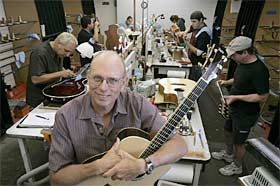 Taylor Guitars president and co-founder Bob Taylor, shown in the final finishing area at the El Cajon factory, has seen the 32-year-old company grow from three employees to 420. SCOTT LINNETT / Union-Tribune
Bob Taylor has never been one to go with the grain.
While his playmates spent their days on baseball and similar pursuits in the mid-1960s, Taylor was already showing signs of being a woodworking wizard, working with his father to build some of the family's furniture in San Diego's Clairemont neighborhood.
“I was a dweeb, a dork, a wood shop nerd who couldn't catch a ball, didn't have a girlfriend,” remembers Taylor, who won several state industrial-arts awards during his junior high and high school years, including one for fashioning a palm-sized jeweler's vise.
“My dreams came true building things . . . guitars, a desk lamp made out of sheet metal, an ice cream scoop,” he said.
That natural penchant for design and engineering has brought the sweet sounds of success for Taylor, a master guitar maker and co-founder and president of Taylor Guitars in El Cajon.
Taylor, who built his first guitar while in high school, presides over a $62 million company that will produce 67,000 guitars this year. That's up from $45 million and 46,000 guitars five years ago, as a higher percentage of Americans tap into their inner John Mayer.
Taylor guitars range from a $368 basic spruce Baby Taylor to a $12,348 Brazilian rosewood acoustic-electric 12-string.
Among the rock and country music cognoscente who pluck Taylor's elegant, high-gloss acoustic instruments are Prince, R.E.M., Clint Black and Pearl Jam.
“Qualitywise, (Taylor guitars) are universally accepted as top-notch,” said Teja Gerken, gear editor at Acoustic Guitar magazine in San Anselmo.
Jason Mraz, the million-selling singer-songwriter, travels to concerts lugging seven Taylors, including a new nylon-string Grand Concert model with a mahogany back and sides, red cedar top, Indian rosewood overlay and an ebony bridge.
“Other brands tend to change sound when all you hear is just the amplified version of the instrument,” said Mraz, who wrote hits like “Wordplay” in his bedroom at home in San Diego. “So when it comes time to perform, I want the guitar to sound as intimate as it does at home.”
Taylor, tall and bespectacled, reminisced recently in his office at the company factory off Gillespie Way. He was dressed as he is on most workdays in T-shirt, jeans and running shoes.
Taylor, born in Oakland to a Navy family struggling to pay the bills, settled in San Diego in 1964 when he was 9 and beginning to show talent as a wood and metal craftsman. As a boy, Taylor also was curious as to how model locomotives and other machines functioned.
“He got a clock once and took it apart to see how it worked, then put it back together perfectly,” said Dick Taylor, his father and a woodworker himself. “Bob didn't like sitting around watching TV or reading. He liked building things.”
Taylor tried to build his first guitar when he was in the fourth grade, using one he'd bought from a friend for several dollars. He ended up sawing off the guitar neck in an attempt to build a better model.
Later, Taylor would watch boyhood friend Michael Broward play guitar in his garage across the street. “I'd plug in my amp, stand next to the washer and dryer and play to the songs on the radio, like 'I'm Henry VIII, I Am,' ” said Broward.
Taylor subsequently took guitar lessons from a teacher who came to the Taylor home and tutored him on a low-end guitar bought at Fedmart.
He didn't get serious about constructing an instrument from scratch until his junior year in wood shop at Madison High School. “I'd seen an EKO 12-string guitar in a music store window, but couldn't afford it,” Taylor said.
Armed with the book “Classic Guitar Construction” presented to him by his wood shop teacher, he proceeded to build three guitars during the next two years.
The construction quality got him a job at a Lemon Grove guitar factory upon high school graduation in 1973. It was a somewhat unlikely job for Taylor, a religious man who's also politically conservative.
The facility, American Dream, was “a hippie shop. . . . If you hung out, you got a work bench,” Taylor recalled.
It was there that Taylor first met Kurt Listug, who would become his longtime business partner. The two and another investor bought the shop in 1974 with $10,000 raised from family members and friends.
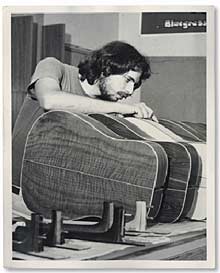
Bob Taylor, who founded Taylor Guitars with Kurt Listug and another partner in 1974, inspected a group of Dreadnought guitars in the El Cajon company's early days.
Building guitars was one thing, but learning to market them took years of trial and error. For the first several years, the company barely sold enough instruments to keep the spray paint machines running.
“When I first met him, he was eating tomato soup out of a can. . . . He was not making any money,” said Cindy Taylor, who's been married to Taylor for 28 years.
Listug often would go on the road to persuade music stores to carry the guitars, while Taylor minded the store. “I was hand carving guitars from 7 a.m. to midnight for three to four years,” said Taylor, who also found time to play up to four concerts a week in a Christian music band.
One of the first signs that all the hard work was being appreciated came with the release of Neil Young's concert documentary “Rust Never Sleeps” in 1978. On the big screen was the folk-rocker playing a Taylor.
Other indirect endorsements came in the early '80s from the Eagles' Glenn Frey and rocker David Crosby, who was quoted as saying, “I didn't buy two (Taylor guitars) by accident.”
Taylor Guitars entered a higher level in the mid-1980s when funk-rock star Prince began playing a Taylor in the artist's trademark purple. It was during this period that Taylor fashioned a green guitar for the cover of a Christmas album by country rockers Alabama and a red guitar for Sammy Hagar.
Taylor guitars were in vogue, if not yet too hot to handle.
Today, Taylor Guitars employs 420 at its El Cajon factory and a new factory south of the border in Tecate. The Tecate facility provides woodwork support for the firm's entry-level guitars and for guitar cases as the company battles lower-cost – some say lower-quality – manufacturers in China and elsewhere.
The factory “is the answer for the mid-price guitar market,” said Taylor. “If Tijuana and Tecate are doing well, that's good for San Diego.”
Taylor Guitars competes in the $7.5 billion instrument industry with such companies as Nazareth, Penn.-based Martin Guitars, whose client roster includes icons like Bob Dylan and Joni Mitchell.
Taylor and Martin “have a good relationship and friendship, even if there is more than healthy competition,” said Martin spokesman Dick Boak, noting that his larger company will have revenues this year of nearly $90 million and produce about 90,000 acoustic instruments.
“It's not uncommon for our employees to take a tour of their factory, and vice versa,” he said.
Taylor, who's hand-carved hundreds of guitars over the years, remains an active woodworker – but rarely touches a headstock or guitar neck. The production of Taylor guitars is now mostly accomplished via computer-programmed milling machines that render accuracy of better than .0005 of an inch, while the wood used to connect neck and bottom is likewise formed to machine specifications.
“I love this technology and do not regret going toward it,” said Taylor, noting that nearly every guitar factory has followed his lead over the years. He partly attributed the easy transition the company has made to sophisticated tooling machines to industrial arts classes he took in high school.
“Machines have never scared me, whereas many luthiers have never really worked with machines, as they approached guitar making from an arts-crafts point of view,” he said.
Taylor often retreats to his wood shop near the factory; it's equipped with high-end table saws, sanders and other equipment. His current project is building a walnut desk for his office.
He attends weekly services at Skyline Wesleyan Church in La Mesa with his wife and until a recent break had played guitar at services for 20 years.
“I've never lapsed,” said Taylor. “I made up my mind about (religious) things early, and I live my life accordingly.”
The couple recently bought a $700,000, 10,000-square-foot house in Indiana to accommodate up to four missionary families who need rest from religious work in Croatia and other world hot spots.
The Taylors' daughters are on their own now: Minet, 25, works at Neiman Marcus, and Natalie, 20, is a student at Vanguard University in Costa Mesa.
If Taylor has a pet peeve, it's the demise in the public school system of industrial arts programs like the ones he thrived on as a youngster. Part of the problem has been the trend to focus on academic study programs tailored for precollege work, he said.
The company has tried to do its part to keep musical interests alive in children by donating more than 1,000 guitars to area school districts in the last five or six years.
Taylor's next project will be overseeing construction of a new Rancho San Diego home, an Italian courtyard-style residence that could cost up to $4 million. In addition to 6,000 square feet of living space, the floor plan includes a 2,000-square-foot quilting room.
And, of course, a 2,500-square-foot wood shop.
Love of woodworking yields guitars that are Taylor-made
By Frank Green
UNION-TRIBUNE STAFF WRITER
May 23, 2006
 Taylor Guitars president and co-founder Bob Taylor, shown in the final finishing area at the El Cajon factory, has seen the 32-year-old company grow from three employees to 420. SCOTT LINNETT / Union-Tribune
Bob Taylor has never been one to go with the grain.
While his playmates spent their days on baseball and similar pursuits in the mid-1960s, Taylor was already showing signs of being a woodworking wizard, working with his father to build some of the family's furniture in San Diego's Clairemont neighborhood.
“I was a dweeb, a dork, a wood shop nerd who couldn't catch a ball, didn't have a girlfriend,” remembers Taylor, who won several state industrial-arts awards during his junior high and high school years, including one for fashioning a palm-sized jeweler's vise.
“My dreams came true building things . . . guitars, a desk lamp made out of sheet metal, an ice cream scoop,” he said.
That natural penchant for design and engineering has brought the sweet sounds of success for Taylor, a master guitar maker and co-founder and president of Taylor Guitars in El Cajon.
Taylor, who built his first guitar while in high school, presides over a $62 million company that will produce 67,000 guitars this year. That's up from $45 million and 46,000 guitars five years ago, as a higher percentage of Americans tap into their inner John Mayer.
Taylor guitars range from a $368 basic spruce Baby Taylor to a $12,348 Brazilian rosewood acoustic-electric 12-string.
Among the rock and country music cognoscente who pluck Taylor's elegant, high-gloss acoustic instruments are Prince, R.E.M., Clint Black and Pearl Jam.
“Qualitywise, (Taylor guitars) are universally accepted as top-notch,” said Teja Gerken, gear editor at Acoustic Guitar magazine in San Anselmo.
Jason Mraz, the million-selling singer-songwriter, travels to concerts lugging seven Taylors, including a new nylon-string Grand Concert model with a mahogany back and sides, red cedar top, Indian rosewood overlay and an ebony bridge.
“Other brands tend to change sound when all you hear is just the amplified version of the instrument,” said Mraz, who wrote hits like “Wordplay” in his bedroom at home in San Diego. “So when it comes time to perform, I want the guitar to sound as intimate as it does at home.”
Taylor, tall and bespectacled, reminisced recently in his office at the company factory off Gillespie Way. He was dressed as he is on most workdays in T-shirt, jeans and running shoes.
Taylor, born in Oakland to a Navy family struggling to pay the bills, settled in San Diego in 1964 when he was 9 and beginning to show talent as a wood and metal craftsman. As a boy, Taylor also was curious as to how model locomotives and other machines functioned.
“He got a clock once and took it apart to see how it worked, then put it back together perfectly,” said Dick Taylor, his father and a woodworker himself. “Bob didn't like sitting around watching TV or reading. He liked building things.”
Taylor tried to build his first guitar when he was in the fourth grade, using one he'd bought from a friend for several dollars. He ended up sawing off the guitar neck in an attempt to build a better model.
Later, Taylor would watch boyhood friend Michael Broward play guitar in his garage across the street. “I'd plug in my amp, stand next to the washer and dryer and play to the songs on the radio, like 'I'm Henry VIII, I Am,' ” said Broward.
Taylor subsequently took guitar lessons from a teacher who came to the Taylor home and tutored him on a low-end guitar bought at Fedmart.
He didn't get serious about constructing an instrument from scratch until his junior year in wood shop at Madison High School. “I'd seen an EKO 12-string guitar in a music store window, but couldn't afford it,” Taylor said.
Armed with the book “Classic Guitar Construction” presented to him by his wood shop teacher, he proceeded to build three guitars during the next two years.
The construction quality got him a job at a Lemon Grove guitar factory upon high school graduation in 1973. It was a somewhat unlikely job for Taylor, a religious man who's also politically conservative.
The facility, American Dream, was “a hippie shop. . . . If you hung out, you got a work bench,” Taylor recalled.
It was there that Taylor first met Kurt Listug, who would become his longtime business partner. The two and another investor bought the shop in 1974 with $10,000 raised from family members and friends.

Bob Taylor, who founded Taylor Guitars with Kurt Listug and another partner in 1974, inspected a group of Dreadnought guitars in the El Cajon company's early days.
Building guitars was one thing, but learning to market them took years of trial and error. For the first several years, the company barely sold enough instruments to keep the spray paint machines running.
“When I first met him, he was eating tomato soup out of a can. . . . He was not making any money,” said Cindy Taylor, who's been married to Taylor for 28 years.
Listug often would go on the road to persuade music stores to carry the guitars, while Taylor minded the store. “I was hand carving guitars from 7 a.m. to midnight for three to four years,” said Taylor, who also found time to play up to four concerts a week in a Christian music band.
One of the first signs that all the hard work was being appreciated came with the release of Neil Young's concert documentary “Rust Never Sleeps” in 1978. On the big screen was the folk-rocker playing a Taylor.
Other indirect endorsements came in the early '80s from the Eagles' Glenn Frey and rocker David Crosby, who was quoted as saying, “I didn't buy two (Taylor guitars) by accident.”
Taylor Guitars entered a higher level in the mid-1980s when funk-rock star Prince began playing a Taylor in the artist's trademark purple. It was during this period that Taylor fashioned a green guitar for the cover of a Christmas album by country rockers Alabama and a red guitar for Sammy Hagar.
Taylor guitars were in vogue, if not yet too hot to handle.
Today, Taylor Guitars employs 420 at its El Cajon factory and a new factory south of the border in Tecate. The Tecate facility provides woodwork support for the firm's entry-level guitars and for guitar cases as the company battles lower-cost – some say lower-quality – manufacturers in China and elsewhere.
The factory “is the answer for the mid-price guitar market,” said Taylor. “If Tijuana and Tecate are doing well, that's good for San Diego.”
Taylor Guitars competes in the $7.5 billion instrument industry with such companies as Nazareth, Penn.-based Martin Guitars, whose client roster includes icons like Bob Dylan and Joni Mitchell.
Taylor and Martin “have a good relationship and friendship, even if there is more than healthy competition,” said Martin spokesman Dick Boak, noting that his larger company will have revenues this year of nearly $90 million and produce about 90,000 acoustic instruments.
“It's not uncommon for our employees to take a tour of their factory, and vice versa,” he said.
Taylor, who's hand-carved hundreds of guitars over the years, remains an active woodworker – but rarely touches a headstock or guitar neck. The production of Taylor guitars is now mostly accomplished via computer-programmed milling machines that render accuracy of better than .0005 of an inch, while the wood used to connect neck and bottom is likewise formed to machine specifications.
“I love this technology and do not regret going toward it,” said Taylor, noting that nearly every guitar factory has followed his lead over the years. He partly attributed the easy transition the company has made to sophisticated tooling machines to industrial arts classes he took in high school.
“Machines have never scared me, whereas many luthiers have never really worked with machines, as they approached guitar making from an arts-crafts point of view,” he said.
Taylor often retreats to his wood shop near the factory; it's equipped with high-end table saws, sanders and other equipment. His current project is building a walnut desk for his office.
He attends weekly services at Skyline Wesleyan Church in La Mesa with his wife and until a recent break had played guitar at services for 20 years.
“I've never lapsed,” said Taylor. “I made up my mind about (religious) things early, and I live my life accordingly.”
The couple recently bought a $700,000, 10,000-square-foot house in Indiana to accommodate up to four missionary families who need rest from religious work in Croatia and other world hot spots.
The Taylors' daughters are on their own now: Minet, 25, works at Neiman Marcus, and Natalie, 20, is a student at Vanguard University in Costa Mesa.
If Taylor has a pet peeve, it's the demise in the public school system of industrial arts programs like the ones he thrived on as a youngster. Part of the problem has been the trend to focus on academic study programs tailored for precollege work, he said.
The company has tried to do its part to keep musical interests alive in children by donating more than 1,000 guitars to area school districts in the last five or six years.
Taylor's next project will be overseeing construction of a new Rancho San Diego home, an Italian courtyard-style residence that could cost up to $4 million. In addition to 6,000 square feet of living space, the floor plan includes a 2,000-square-foot quilting room.
And, of course, a 2,500-square-foot wood shop.
Subscribe to:
Posts (Atom)


