Showing posts with label latin jazz. Show all posts

Friday, May 07, 2010

Francisco Aguabella (1925-2010)


Legendary Cuban drummer Francisco Aguabella died today after a battle with cancer. Aguabella was born in the Cuban city of Matanzas on October 10, 1925, the youngest of seven children though only one of two to survive a typhus epidemic. Though neither of his parents were musicians, Francisco began playing music while a child and was drawn to the music that surrounded him in Matanzas. He began to play the sacred batá drums at age twelve, taught by another youngster at the time, the legendary Esteban Vega Bacallao, popularly known as Cha-Chá (1925-2007). According to Raul Fernandez' book From Afro-Cuban Rhythms to Latin Jazz, Aguabella apprenticed on the supporting drums for five years (two on okónkolo, three on itótele) before studying the lead drum of this ensemble. He became known as a fierce and powerful drummer in both sacred and secular contexts, becoming, by his own account, the lead soloist for a local comparsa group at age 16, an accomplishment of which he was very proud. At age eighteen Aguabella was initiated into a local Abakuá potencia (an Afro-Cuban male initiation society). During this time he also became friends with drummer Julito Collazo (1925-2004), who would later become, along with Aguabella, an important source of batá drumming in the United States.

In his early twenties Aguabella worked on docks in Havana and Matanzas while continuing to drum during his free time. Eventually he was asked by influential Havana drummers to join their show troupe in Havana. In Havana, Aguabella also played in various sacred, band, and comparsa groups. In 1953 American dancer Katherine Dunham saw Aguabella perform in a nightclub and requested his services for a show scene in a movie (Mambo, starring Shelley Winters and Anthony Quinn)that was being filmed in Havana. Dunham invited Aguabella to join her company, and he soon accompanied her to Italy, the first of many tours. In addition to drumming, Aguabella had small dance and acting roles in the company's productions.

After touring with Dunham, Aguabella came to the United States at a time when Latin music was mixing with popular jazz. While fellow drummer Collazo settled in New york, Aguabella settled in California, living in Los Angeles and San Francisco for the rest of his life. Aguabella had an impressive career, including recordings, performances, and tours with artists such as Dizzy Gillespie, Frank Sinatra, Tito Puente, Mongo Santamaria, Eddie Palmieri, Cachao, Lalo Schifrin, Cal Tjader, Nancy Wilson, Weather Report, Poncho Sanchez, Bebo Valdes, Carlos Santana, Malo, Three Dog Night, Paul Simon, and the Doors. (According to Francisco, Sinatra would introduce him to audiences as "My Italian conga drummer, Francisco Aguabella.") Aguabella also led his own Latin jazz group, playing concerts and issuing recordings for many years. He also composed music for his and other ensembles, mostly works that took advantage of his extensive drumming knowledge. Importantly, Aguabella was a source of authentic sacred Afro-Cuban music in the United States at a time when few knew the secrets of sacred drumming. Aguabella was awarded the National Heritage Fellowship from the National Endowment for the Arts, the Durfee Foundation's Master Musicians' Fellowship, and was recognized by the Los Angeles County Arts Commission. He was the subject of a documentary film by Les Blank titled "Sworn to the Drum." Agubella taught Afro-Cuban music at UCLA from the mid-1990s until 2008.

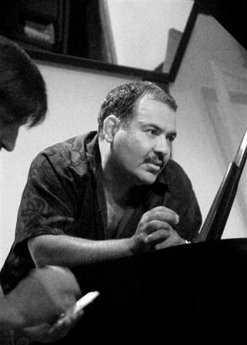
Aguabella was the strongest, fiercest drummer I have ever seen. I once saw him play a sacred tambor in the 1980s (for Changó, with frighteningly fast, loud, and long sections of drumming), and also at the famed Conga Summit concert in San Francisco. By the time I got to study with him a bit in the mid to late 1990s, he had mellowed considerably from his earlier days, when he had the reputation of being a tough taskmaster. I last saw him in late 2008, when the photos below were taken.


Information above was based on Aguabella's own biography, Raul Fernandez' From Afro-Cuban Rhythm to Latin jazz, and personal communication.

Wednesday, April 01, 2009

NYC Percussionist Manny Oquendo dies

World Music Central

Master Timbalero and Bandleader Manny Oquendo Dies in New York

Saturday, March 28 2009 @ 02:22 PM EDT

Renowned salsa musician Manny Oquendo died March 25, 2009 at a New York hospital. Oquendo was a veteran of the days when Latin bands crowded into a studio to polish off a recording in an all-night session. "The first recording (singer) Tito Rodriguez did, we took the 7th Avenue train to record for SMC label," Oquendo recalled. "Tito Puente did the arrangements. You recorded on monaural, with just a few mikes. You couldn't stop and overdub. You just played."

Oquendo's musical education consisted of the old-school, "just play" approach, and he was in the right place to learn. He grew up on Kelly Street in the Bronx, New York, not far from the great Cuban tres player, Arsenio Rodriguez. Colin Powell, who'd later become a general, lived on the block too, so did pianist Noro Morales. And a lot of kids who'd later make their names in Latin music, such as Joe Cuba, the Palmieri brothers, Little Ray Romero, grew up playing stickball on Kelly Street.

Oquendo became an expert on Cuban rhythms and began playing bongo and timbales with a succession of New York's top bands , with José Curbelo and Vicentico Valdes before moving into the orchestras of Tito Puente and Tito Rodriguez.

In 1963, he joined La Perfecta, the conjunto organized by pianist Eddie Palmieri. "La Perfecta was struggling at that time, trying to compete with all the other bands at the Palladium," says Oquendo. "I'm talking about big bands with 15 people in them. Eddie's was a small conjunto group. But what made us different was the music and the playing " we were looser, more free."

In 1974, Oquendo and Jerry Gonzalez left La Perfecta to move in their own direction. In the years since, Manny Oquendo and Libre became preservationists of the tipico sound, nurturing some of the most dedicated sidemen in the business.

1979 interview with bassist Andy González

González, the prince of Latin bass playing (I'd put Cachao as the king), was interviewed in 1979 by Roberta Singer. Descarga.com reprints this excellent interview about the NYC Latin and Latin jazz scene HERE.

Friday, October 03, 2008

Grupo Folklorico y Experimental Nuevayorquino Reunion

NPR [with sound files]

Grupo Folklorico: A Classic Reunites
By Latino USA

KUT, October 1, 2008 - On a recent Saturday afternoon in Washington, D.C., Latin music history was made. A handful of original members of a seminal Afro-Caribbean band reunited to play music that, after three decades, still has the power to move hearts and hips.

Grupo Folklorico y Experimental Nuevayorquino played its first gig at the Smithsonian Institution's Folk Life Festival 33 years ago. Back then, Grupo Folklorico, as the band became known, was about to shake up the Latin music world with two albums of jazz-influenced explorations of Cuban and Puerto Rican folk rhythms. Grupo Folklorico was a collective of younger musicians brought up on the music of Afro-Cuban masters, as well as a few of those legends themselves.

On this humid day, some of those masters have died, and those once-younger musicians are now considered the guardians of Afro-Cuban musical tradition and history.

A Long Time Coming

In the back of a giant outdoor tent, just blocks from the Capitol on the National Mall, musicians take their horns out of their cases, tune up congas and reminisce. While sound technicians set up the band's equipment on stage, just across the mall the rest of the group is escaping the heat in a small air-conditioned trailer. Quietly sitting across from each other amid the chaos of younger musicians excited to be part of history are two original members, timbalero Manny Oquendo and bassist Andy Gonzalez, who says the reunion has been a long time coming.

"We had been planning it for a while," Gonzalez says. "We realized that we made quite an impact when we made our original recordings."

Out Of The '70s

Gonzalez says that the music on those recordings got its start in jam sessions in the basement of his parents' home in the Bronx. Andy and his brother Jerry, who plays congas and trumpet, were already performing in the vibrant New York City salsa scene of the early '70s with musicians such as Eddie Palmieri, Ray Barreto and even jazz master Dizzy Gillespie.

But the Gonzalez brothers and other musicians felt something was missing in the salsa that was taking the world by storm back then. The music they made in those basement jam sessions became their musical statement — a look to the past to move the music forward.

"It really reflected the kind of stuff we were interested in in New York," Gonzalez says, "which was Afro-Cuban folklore and Puerto Rican folklore, and not just trying to be truthful to those roots. More like using that as a starting point and experimenting with it."

Home Schooling

Those experiments were the lab work for the home schooling they were getting in Afro-Caribbean music from Rene Lopez. Lopez was an amateur ethnomusicologist who was taking notes on his own Afro-Caribbean culture with a massive collection of historic Cuban and Puerto Rican recordings. He held listening sessions at his home, but Gonzalez says that they were much more than social visits.

"We had rules," Gonzalez says. "No talking during the playing of the record. We would talk after the record, but while they were being played, not talking. If anybody opened their mouth, we would say, 'Shut up.' We really put our minds to listening with more care than usual. It was a casual thing, [but] we were going to school. This was a classroom."

High Water Marks

In 1975, Grupo Folklorico released Concepts in Unity, which was followed a year later by Lo Dicen Todo. Both records are considered high water marks of Latin music — not only for the music, but also for the extensive liner notes written by Rene Lopez, who also produced the albums.

Lopez says that the recording sessions were just as organic as the jam sessions that spawned them.

"Fifteen people without music, they didn't believe it," Lopez says. "We did all except one on first take."

But the logistics of trying to book a band of sidemen who were making a living in recording studios and on the road led to the demise of Grupo Folklorico as a working band.

Anticipation And Nostalgia

Thirty-three years later, at the same festival where it all started, nostalgia is mixed with eager anticipation. Trombonist Reynaldo Jorge and percussionist Gene Golden were here 34 years ago.

"First time I played here, I was 26," Jorge says. "Now, I'm 56."

"It's beyond words," Golden adds.

Andy Kaufman, who co-produced the Grupo Folklorico albums with Lopez, is here to celebrate and to reminisce.

"We had the time of our lives, and we wouldn't trade it for anything," Kaufman says.

Sweaty And Joyous

After a brief ceremony, during which the Smithsonian honored Rene Lopez for his work documenting Afro-Caribbean music and culture, the band kicks off and doesn't stop for a sweaty, joyous and inspired 90 minutes.

At the end, longtime fans and newcomers rush the stage to congratulate the musicians and Rene Lopez. Tres player Nelson Gonzalez is greeting friends just outside of the massive tent where the concert was held. He was also part of the basement jam sessions three decades ago, and he's at a loss for words to describe the emotions of today's reunion. So he turns to one of the Afro-Cuban masters to explain why they've come together again.

"Imagine, after over 30 years of not playing together," Gonzalez says. "This is an incredible thing. It feels like the old times. It's like Cachao used to say: 'We cannot let tradition die.' It's up to us to continue this tradition, but to also move it forward."

Andy Gonzalez and Rene Lopez have already booked Grupo Folklorico in New York for a gig in November. And, for a band with such a formidable past, there is now news about the future: Gonzalez and Lopez say there are plans for an album of new material.

Friday, June 06, 2008

Jazz prodigy Esperanza Spalding, still eager to teach – and learn

Christian Science Monitor
Jazz prodigy Esperanza Spalding, still eager to teach – and learn
Bassist Esperanza Spalding takes her Latin fusion mainstream.
By Stephen Humphries | Staff writer of The Christian Science Monitor

from the May 30, 2008 edition

When Esperanza Spalding was still a senior at Boston's Berklee College of Music, the jazz singer and bassist had a startling moment of self-recognition. Traveling on a bus into the city, she glanced up at the college – briefly visible from the highway – and saw a multistory poster of herself on the wall of The Berklee Performance Center. "I had no idea!," she exclaims.

The billboard, an early indicator of stardom in 2005, is appropriate for a larger-than-life personality who, at age 20, became the youngest faculty member in the college's history. Now, Ms. Spalding is having a different kind of banner year. She's about to appear on David Letterman and Jimmy Kimmel as her second album of Latin jazz knocks on the door of mainstream success.

Remarkably, it's not a "crossover record." A couple of the songs are in Portuguese, for starters. As her voice sambas over vibrant South American rhythms and her Elastigirl fingers climb up and down the double-bass's skyscraper neck, you'd swear the girl was from Ipanema, not Portland, Ore. Even people who think they don't like jazz may respond to the melodies on "Esperanza."

"[Musicians] are taking more risks, adding more colors and sounds to the music, ultimately to the benefit of the listener," she says in a phone interview.

Spalding has worked with saxophonist Joe Lovano and bassist Stanley Clarke. She's even been the opening act for comedian Bill Cosby, who offered to find her a record deal. She beat him to it.

"I recognized right away that she had a lot to say and was also unlike any musician I had ever run across before," raves legendary jazz guitarist Pat Metheny, in an e-mail. "Her unique quality is something that goes beyond her pretty amazing musical skills; She has that rare 'x' factor of being able to transmit a certain personal kind of vision and energy that is all her own."

Growing up in a single-parent household, Spalding was introduced to a world beyond the gunfire in her inner-city neighborhood by a Yo-Yo Ma appearance on "Mister Rogers' Neighborhood." Instead of trying cello, she taught herself rudimentary violin. By age 5, she'd been welcomed into The Chamber Music Society of Oregon. Ten years later she was its concert master.

After enrolling in high school, she ditched the violin once she discovered bass. At 15, she left home and then, a year later, left high school with a GED to continue a musical apprenticeship on the local club circuit. Home schooling, she says, made her realize "how much time was being wasted in the classroom."

The singer's love of learning hasn't dimmed. When her mother recently shared an inspirational Thornton Wilder passage about women overcoming adversity, for example, Spalding posted the "The Bridge of San Luis Rey" excerpt on her MySpace blog.

Also on her MySpace page: A black- and-white television clip from the early to mid-1960s of Sister Rosetta Tharpe, an African-American rhythm and blues artist, playing wild electric guitar in front of a gospel choir. Spalding wants everyone to know about the little-known singer she calls "the mother of rock 'n' roll."

"My alarm clock wakes me up to a local jazz station every morning, and she was guest singing on some big-band recording," she recalls. "I remembered her name and so when I finally woke up and got out of bed, I investigated who she was. I bought a book about her life and one of her records and put that YouTube up there once I found it."

Being an African-American woman herself, Spalding is worried that her successes – such as a scholarship to Berklee at age 16 – might be attributed to affirmative action. The work ethic spurred by that concern led her to commute three hours from Boston's outer suburbs each day – lugging an instrument shaped like a pregnant giraffe – to attend Berklee when she couldn't afford a city apartment.

"I remember many times being on the commuter rail and young kids my age, or even guys I thought were cute, looking at me and going, 'This woman is out of her mind!' " she laughs.

An audition to spend a summer touring with jazz singer Patti Austin turned her finances around. Later, her experience as a performer led to Berklee hiring her as an instructor after graduation.

"She has a seriousness about her, even though she's very relaxed, that I appreciate," says Rich Appleman, chair of Berklee's bass department. "That's one of the reasons she's gone on to teach in addition to perform."

This year Spalding is relishing a tour and the prospect of artistic growth. "I have a lot to learn," she says. "I'm trying to do an art form that takes decades to [master]."

Thursday, August 23, 2007

Mario Rivera obituary

Miami Herald
Posted on Tue, Aug. 14, 2007
Mario Rivera, favorite sideman of music legends, dies
BY ENRIQUE FERNANDEZ
Mario Rivera's apartment on the Upper West Side of Manhattan was filled with musical instruments. Every room. Wall to wall.

When he hosted friends, at the ungodly hours when musicians go home from playing gigs, he'd encourage them, regardless of musical skills, to beat on drums, bang soft hammers on a xylophone, finger keyboards, pluck bass guitars, strum regular ones, blow on all manner of wind instruments, knock claves, rasp gourds, shake maracas and chekeres, jam.

''Go ahead!'', he'd say, ''¡cúrate!'', roughly translated, ``get your ya-yas out.''

If Rivera, who died in New York on Friday after a two-year battle with bone cancer, had not made a name for himself as one of the most sought-after sidemen in jazz and Latin jazz, he could have had a successful career as a music therapist.

Rivera, 68, had played with a who's who of jazz and Latin masters: Tito Puente, Machito, Eddie Palmieri, George Coleman, Dizzy Gillespie, Slide Hampton, Chico O'Farrill. He was in Miami in October, backing veteran Cuban piano master Bebo Valdés, with whom he also recorded a big-band CD.

Sidemen are the unsung heroes of music; they back legends but seldom become superstars. But Rivera was a legend on his own right.

His main ax was the saxophone and his riffs and solos are as good as any big name saxman's in any genre. For, yes, Rivera dominated all the musical languages. He could be an orquesta de salsa workhorse. Or an intense jazz combo artist. Or a big-band soulman. Or, his natural habitat, the linchpin of a Latin jazz group -- most notably, he was a mainstay of Tito Puente's Latin jazz ensembles.

''Mario was such a vital individual that death is nothing short of incongruous,'' says Latin jazz historian and producer Nat Chediak, who worked with Rivera on recordings as well as the music documentary Calle 54. As for his artistry, Chediak believes that ``there are few Latino musicians in jazz who can touch him.''

In 1993, Rivera made his own wonderful CD, El Comandante, a playful and infectious fusion of Dominican merengue and jazz.

Rivera was Dominican. Before the diaspora of the '80s, which transformed Washington Heights, north of Rivera's home, into Quisqueya Heights, the gifted musician was, along with Fania Records founder Johnny Pacheco, a prominent Dominican figure in a Latin scene dominated by Puerto Ricans and Cubans.

When merengue nudged salsa aside in the '80s and early '90s, major artists from the Dominican Republic doing New York concerts would go to Rivera's home to pay their respects to their countryman.

Artists of all backgrounds respected Rivera, for he was a musician's musician. And in the music world, as in all arts, crafts and professions, there is no greater honor than to have colleagues think you're great. In Mario Rivera's case, the greatest.

Friday, August 04, 2006

Club: Tape negates claims on Hilton Ruiz death

AP
Club: Tape negates claims on Ruiz death

By JANET McCONNAUGHEY, Associated Press WriterFri Aug 4, 11:06 AM ET

Bouncers at a Bourbon Street dance club threw the late jazz pianist and composer Hilton Ruiz face-first into heavy wooden doors and then onto the floor after he was attacked by a club patron, his daughter claims in court papers filed Thursday.

But a representative for Club Utopia said its tapes show Ruiz signing a tab for more than $200, leaving by himself and walking without incident along an alley.

Tapes from a club next door show Ruiz tripping minutes later and hitting his face on the curb, Jacques Chrysocoos said.

Ruiz, of Teaneck, N.J., was hospitalized after being injured May 19. He died June 6, never regaining consciousness. He had come to New Orleans to make a video to go with a Hurricane Katrina benefit recording.

Attorney Scott M. Galante filed the new allegations against the club for Aida Ruiz, as an amended version of a lawsuit brought in June against Utopia and others. The allegations are based on statements by a witness, Galante said.

In the suit, Aida Ruiz claims that the club's bouncers failed either to protect her 54-year-old father or to help him after a patron attacked and beat him.

Chrysocoos said the review of that morning's tapes shows that the only disagreement that came close to a fight was between two other patrons, who were asked to leave. He said the club is sending its tapes to police.

Police have repeatedly said they investigated Ruiz's injuries as an attack, but found only evidence of an accidental fall.

Tuesday, June 06, 2006

Latin Jazz pianist Hilton Ruiz dies


Jazzman Hilton Ruiz dies at 54

By JANET McCONNAUGHEY, Associated Press Writer1 hour, 24 minutes ago

Jazz pianist and composer Hilton Ruiz, who came to New Orleans to work on a Hurricane Katrina benefit recording, died early Tuesday, his agent and manager said.

Ruiz, who turned 54 on May 29, had been comatose at East Jefferson General Hospital since he fell early May 19 in front of a French Quarter bar.

He died about 3:50 a.m. Tuesday, agent Joel Chriss said in a telephone interview from New York.

Ruiz, of Teaneck, N.J., has been described as one of the most versatile musicians in jazz, playing bop, Afro-Cuban, stride and many other styles.

"He's one of the few musicians on the scene that is equally at home in both the jazz genre and the Afro-Cuban genre in a complete sense. ... He really can play the blues, too. For real," trombone player Steve Turre, who had known Ruiz since 1975, said in an interview the week after Ruiz fell. "There's a lot of people who dabble with both worlds. But very few can authentically deal with both. And he's one of them. That's your rarity."

He described Ruiz as a complex man and a brilliant musician, a pianist, composer and bandleader of genius.

Ruiz came to New Orleans with Marco Matute, a producer for the M27 World label, to shoot video to go along with a Hurricane Katrina benefit compact disc of New Orleans music, attorney Mary Howell said before his death. They arrived May 18, she said.

"They spent the whole day filming, riding in carriages, talking to people about New Orleans," She said.

She said Ruiz "got very involved in the situation here" after playing in a New York benefit concert for the hurricane's victims.

The family has been "inundated with calls from people wanting to help." They asked for prayers; an account to help pay Ruiz' medical expenses was set up, Howell said.

Trained in classical music as well as jazz, Ruiz played at Carnegie Recital Hall when he was 8 years old. His teachers included jazz pianist and composer Mary Lou Williams; in his early 20s, he and Turre both worked with saxophone player Rahsaan Roland Kirk.

In an interview with Ted Panken, for liner notes on his 2003 CD, "Enchantment," Ruiz said Kirk — known, among other things, for playing a saxophone and two of its turn-of-the-century cousins at once — nurtured and demanded versatility.

"All the music I enjoyed was part of the Rahsaan experience," Ruiz told Panken. "He played the music of Fats Waller and James P. Johnson. Real down-home blues, as they're called. The great composers of classical music. Music from all over the world — Africa, the Orient, the Middle East. We had to play all these musical flavors every night."

He was playing with Latin groups in his early teens. His first recording, at age 14, was with a group called Ray Jay and the East Siders. While still in his teens, Ruiz worked with tenor saxophonists Frank Foster and Joe Henderson and trumpeters Joe Newman, Freddie Hubbard and Cal Massey.

"I was pretty lucky in being exposed to a lot of different kinds of music, and studying them with good teachers," he said, quoted in a biography on the Telarc International Corp.'s Web site.

The many musicians with whom he worked included Tito Puente, Dizzy Gillespie and Charles Mingus.

He was among musicians featured on the 1997 video "The Best of Latin Jazz," and his song "Something Grand" is part of the "American Beauty" soundtrack.


and here is a previous story about his injury:

Hilton Ruiz Suffered Injuries in Fall, Not Attack

By Ben Mattison
May 26, 2006

The head injuries that have left jazz pianist Hilton Ruiz in a coma resulted from a fall, not an attack, the Associated Press reports.

An attorney for Ruiz's family told the AP that it appeared that Ruiz, who was found with broken bones in his skull and face on Bourbon Street in New Orleans last week, had fallen and hit his face on the curb. Ruiz's agent had previously said that his injuries made it seem as if he had been attacked.

Ruiz also suffered a heart attack in the ambulance on the way to the hospital after the incident, which is believed to have occurred at about 5 a.m. on May 19.

A native of New York, the 53-year-old Ruiz studied with Mary Lou Williams and has played with Freddie Hubbard and Rahsaan Roland Kirk, as well as leading his own bebop and Latin jazz groups.

Send questions and comments to the Webmaster
Copyright © 2002 Playbill, Inc. All Rights Reserved.

Friday, February 17, 2006

Latin Jazz Drummer Ray Barretto Dies


Latin Jazz Drummer Ray Barretto Dies

2 hours, 34 minutes ago

Ray Barretto, a Grammy-winning Latin jazz percussionist known for integrating the conga drum into jazz, died Friday, officials said. He was 76.

Barretto had undergone heart bypass surgery in January and suffered from pneumonia, said George Rivera, a friend and family spokesman. He died at Hackensack University Medical Center with his wife and two sons by his bedside.

"He was suffering too much, so the Lord took him," Fidel Estrada, a family friend, told The Associated Press in San Juan, Puerto Rico.

Puerto Rico Gov. Anibal Acevedo Vila said news of Barretto's death was met with great sadness.

"He left us a great musical legacy of humility, love and fullness that should be emulated to serve as an inspiration for the benefit of future generations," the governor said in a written statement. "We give thanks to God for the opportunity to have celebrated his music, and the happiness that characterized all of his life."

Barretto won a Grammy for best Tropical Latin performance in 1989 for the song "Ritmo en el Corazon" with Celia Cruz.

The following year, Barretto was inducted into the International Latin Music Hall of Fame, and last month, he was named one of the National Endowment for the Arts' Jazz Masters of 2006, the nation's highest jazz honor.

Barretto's "Time Was - Time Is," released last September, was nominated for a Grammy this year as Best Latin Jazz Album.

His 1979 album "Ricanstruction" is considered one of the classic salsa recordings.

Barretto grew up in New York City listening to the music of Puerto Rico and to the jazz of Duke Ellington, Count Basie and Benny Goodman.

In the late 1950s, he played in Tito Puente's band, and his popularity grew in the New York jazz scene. Over the years, he recorded with such musicians as Cannonball Adderley, Freddie Hubbard, Cal Tjader and Dizzy Gillespie.