June 12, 2006
A Ring Tone Meant to Fall on Deaf Ears
By PAUL VITELLO
In that old battle of the wills between young people and their keepers, the young have found a new weapon that could change the balance of power on the cellphone front: a ring tone that many adults cannot hear.
In settings where cellphone use is forbidden — in class, for example — it is perfect for signaling the arrival of a text message without being detected by an elder of the species.
"When I heard about it I didn't believe it at first," said Donna Lewis, a technology teacher at the Trinity School in Manhattan. "But one of the kids gave me a copy, and I sent it to a colleague. She played it for her first graders. All of them could hear it, and neither she nor I could."
The technology, which relies on the fact that most adults gradually lose the ability to hear high-pitched sounds, was developed in Britain but has only recently spread to America — by Internet, of course.
Recently, in classes at Trinity and elsewhere, some students have begun testing the boundaries of their new technology. One place was Michelle Musorofiti's freshman honors math class at Roslyn High School on Long Island.
At Roslyn, as at most schools, cellphones must be turned off during class. But one morning last week, a high-pitched ring tone went off that set teeth on edge for anyone who could hear it. To the students' surprise, that group included their teacher.
"Whose cellphone is that?" Miss Musorofiti demanded, demonstrating that at 28, her ears had not lost their sensitivity to strangely annoying, high-pitched, though virtually inaudible tones.
"You can hear that?" one of them asked.
"Adults are not supposed to be able to hear that," said another, according to the teacher's account.
She had indeed heard that, Miss Musorofiti said, adding, "Now turn it off."
The cellphone ring tone that she heard was the offshoot of an invention called the Mosquito, developed last year by a Welsh security company to annoy teenagers and gratify adults, not the other way around.
It was marketed as an ultrasonic teenager repellent, an ear-splitting 17-kilohertz buzzer designed to help shopkeepers disperse young people loitering in front of their stores while leaving adults unaffected.
The principle behind it is a biological reality that hearing experts refer to as presbycusis, or aging ear. While Miss Musorofiti is not likely to have it, most adults over 40 or 50 seem to have some symptoms, scientists say.
While most human communication takes place in a frequency range between 200 and 8,000 hertz (a hertz being the scientific unit of frequency equal to one cycle per second), most adults' ability to hear frequencies higher than that begins to deteriorate in early middle age.
"It's the most common sensory abnormality in the world," said Dr. Rick A. Friedman, an ear surgeon and research scientist at the House Ear Institute in Los Angeles.
But in a bit of techno-jujitsu, someone — a person unknown at this time, but probably not someone with presbycusis — realized that the Mosquito, which uses this common adult abnormality to adults' advantage, could be turned against them.
The Mosquito noise was reinvented as a ring tone.
"Our high-frequency buzzer was copied. It is not exactly what we developed, but it's a pretty good imitation," said Simon Morris, marketing director for Compound Security, the company behind the Mosquito. "You've got to give the kids credit for ingenuity."
British newspapers described the first use of the high-frequency ring tone last month in some schools in Wales, where Compound Security's Mosquito device was introduced as a "yob-buster," a reference to the hooligans it was meant to disperse.
Since then, Mr. Morris said his company has received so much attention — none of it profit-making because the ring tone was in effect pirated — that he and his partner, Howard Stapleton, the inventor, decided to start selling a ring tone of their own. It is called Mosquitotone, and it is now advertised as "the authentic Mosquito ring tone."
David Herzka, a Roslyn High School freshman, said he researched the British phenomenon a few weeks ago on the Web, and managed to upload a version of the high-pitched sound into his cellphone.
He transferred the ring tone to the cellphones of two of his friends at a birthday party on June 3. Two days later, he said, about five students at school were using it, and by Tuesday the number was a couple of dozen.
"I just made it for my friends. I don't use a cellphone during class at school," he said.
How, David was asked, did he think this new device would alter the balance of power between adults and teenagers? Or did he suppose it was a passing fad?
"Well, probably it is," said David, who added after a moment's thought, "And if not, I guess the school will just have to hire a lot of young teachers."
Kate Hammer and Nate Schweber contributed reporting for this article.
Tuesday, June 13, 2006


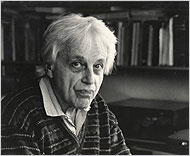
Composer Gyorgy Ligeti (1923-2006)
New York Times
June 13, 2006
Gyorgy Ligeti, Central-European Composer of Bleakness and Humor, Dies at 83
By PAUL GRIFFITHS
Gyorgy Ligeti, the Central European composer whose music was among the most innovative of the last half of the 20th century — sometimes eerie, sometimes humorous usually fantastical and always polished — died yesterday in Vienna. He was 83.
His family confirmed his death but declined to divulge the cause, saying only that he had been ill for several years.
Mr. Ligeti produced much of his pioneering music against the backdrop of a Europe in turmoil. Born into a Hungarian-Jewish family, he survived the Holocaust but lost his father and brother in it. With the war's end he felt Soviet repression and fled when liberal revolution was smashed.
Mr. Ligeti became widely known when extracts from his work appeared on the soundtrack of Stanley Kubrick's movie "2001: A Space Odyssey" in 1968 and caught the public's fancy. The works — the Requiem, for voices and orchestra; "Lux Aeterna," for unaccompanied chorus; and "Atmospheres," for orchestra — are characterized by dense texture and very slow change. They were used in the film to suggest the desolation of the moon and the discovery there of a mysterious monolith. The music was not the film's well-known fanfare, composed by Richard Strauss, but it won Mr. Ligeti a worldwide audience.
The moon music was indicative of only one of his expressive modes, however. After fleeing Hungary in 1956, he also showed himself to be a master of a fast, mechanical and comic sort of music. Between these two poles — the "Clocks and Clouds," to quote the title of a later work, alluding to an essay by the philosopher Karl Popper — he created works of exuberant variety and range.
During the late 1950's and 60's, he was close to leaders of the European avant-garde like Karlheinz Stockhausen and Pierre Boulez. He had always been more skeptical than others in that circle, but he still felt adrift when the rule of modernism began to break down in the 1970's. His initial response was a comic opera, "The Great Macabre," his most ambitious work, which was first produced in Sweden in 1978.
He had difficulty in regaining his creative direction after that, but the appearance in 1985 of his first six Etudes for piano signaled a return to vitality. The pieces were prompted in part by the wild, irregular rhythms and processes of Conlon Nancarrow's player-piano studies, and in part by Mr. Ligeti's ability to find new stimulation in recorded music from around the world, including that of Afro-Caribbean dance bands and Indonesian percussion orchestras. From all these sources he distilled his unique late compositions.
Fastidious and self-critical, Mr. Ligeti demanded high standards from those around him. But where he felt sympathy, he could be open, warm and generous. He knew his worth, but he did not make that a barrier between himself and life or let it dampen his curiosity.
"I am in a prison," he once explained. "One wall is the avant-garde, the other is the past. I want to escape."
Gyorgy Sandor Ligeti (pronounced JURGE SHAN-dor LIG-ih-tee) was born on May 28, 1923. His family lived near Cluj (Kolozsvar to Hungarians), the principal city of Transylvania. The region was part of Romania then, and is now again, but in 1940 it was granted by fascist Germany to its ally Hungary.
The annexation seemed to have had little effect on the young composer at first. Between 1941 and 1943 he studied with two of the more important Hungarian composers of the post-Bartok generation, Ferenc Farkas in Cluj and Pal Kadosa in Budapest. He also wrote the earliest pieces he was later to publish, a pair of movements for piano duet.
But in 1943 his education was halted when he was drafted into a military labor corps to support the front-line Axis troops. Mr. Ligeti considered the conscription a lucky break, because it exempted him, as it did other Jews in the service, from deportation to concentration camps, a fate that befell his mother, father and brother. Only his mother returned.
In September 1945, Mr. Ligeti enrolled in the Liszt Academy of Music in Budapest, where he studied with Farkas again and with two other eminent members of the same generation, Sandor Veress and Pal Jardanyi. Life in the new socialist Hungary was propitious for a young idealist, and Mr. Ligeti was able to extend his creative horizons. But in 1949, when he graduated, the country fell under the grip of Stalinism. Only music that was optimistic and close to folk song had a hope of being published or performed.
Mr. Ligeti supplied works of this type, chiefly songs and choruses, while also taking a teaching position at the Liszt academy. The more radical works he was writing at the same time, like "Musica Ricercata" for piano (1951-3) or his First String Quartet (1953-4), had to be kept private.
Later, Mr. Ligeti spoke disparagingly of himself during this period as the "prehistoric Ligeti," emphasizing the lack of information in Hungary about artistic movements in the West, the moratorium in his country on modernism (even Bartok's modernism), and the compulsion to be upbeat and nationalist.
He left Budapest with his wife, Vera, a Hungarian psychiatrist, in December 1956, after the Russians had sent in tanks to crush the more liberal government of Imre Nagy. His destination was Cologne, where Mr. Stockhausen had arranged a stipend for him at the electronic music studio of West German Radio. At the age of 33, he was starting anew. The first works he produced in the West were electronic.
In 1959 he moved to Vienna, eventually became an Austrian citizen, and began "Atmospheres," whose first performance, in 1961, made his professional reputation. Though other composers, including Mr. Stockhausen, had begun to think in slow-moving sounds and tangled webs, Mr. Ligeti's orchestral mastery was unrivaled.
His sense of humor was also unusual. After "Atmospheres" came "Adventures" (1962) and "New Adventures" (1962-5), miniature operas for three singers who express themselves without words but very concretely, by means of musical gestures from a nonsensical phonetic text.
Crazy and comic, these works are also touching. The singers, deprived of language, bravely go on trying to communicate their fears, joys and jealousies. And in the sighs, moans and excited outbursts of Mr. Ligeti's music, they do so effectively.
In the Requiem (1963-5), he responded to the subject of death as both ominous certainty and black joke. The Requiem, with its depictions of damnation and pleas to avoid it, shows how much he had learned as a musician in Western Europe, and how much he had learned as a man who had lost his family in German concentration camps and had suffered severe creative strictures at the hands of Nazi occupiers and their Soviet successors.
Besides surveying its composer's past, the score includes something new: the pristine pleasure of simple intervals occurring within a complex context. Mr. Ligeti was then able to recover something of the sound of the Romantic orchestra in "Lontano" (1967), and gradually to elaborate a new harmonic-melodic language that was, as he liked to say, neither tonal nor atonal.
In 1971 he made a visit to San Francisco, where he was impressed by the music of Harry Partch, whose unconventional tunings began to have an effect on his harmony. He was also drawn to the work of Steve Reich and Terry Riley, to whom he paid musical homage in the middle part of his triptych "Monument — Self Portrait — Movement" for two pianos (1976).
In 1973 he took a teaching post at the Hamburg Music Academy and remained in Hamburg until a few years ago while always wishing, he said in an interview, that he were somewhere else. During those years his wife remained in Vienna with their son, Lukas, later himself a composer. Both survive him.
Mr. Ligeti's first big project in Hamburg was "The Great Macabre," whose subject was again death and the end of the world. Again, too, the subject was treated both as an awesome calamity and as a trick played on humanity. The opera had its premiere in Stockholm, where the composer and his music had found an eager audience since the 1960's. It was later produced in a revised version at the 1997 Salzburg Festival.
After "The Great Macabre," the Horn Trio of 1980 turned out to be a false trail in leading back to more conventional kinds of phrasing and form. Mr. Ligeti found a new path for himself in his first book of Etudes for piano (1985), which opened the door into a style of extreme virtuosity, both creative and re-creative, and for which in 1986 he received the Grawemeyer Award (at $150,000 the largest prize in classical music). Complex rhythms and dazzling speeds combined to produce music of wonder and wit, and he went on to write a second book of Etudes (1988-94) and begin a third.
Meanwhile he explored the implications of his new style on a broader scale in concertos for piano (1985-8), violin (1989-93) and horn (1998-2001). A second opera, on the Alice books of Lewis Carroll, was long contemplated but not seriously begun. His last new work was his 18th Etude, "Canon" (2001). Soon after writing it, he returned to his wife's home in Vienna, where his health slowly worsened.
Mr. Ligeti's late works, fast and busy, are very unlike the music of "2001," but not so far from the compositions he had produced as a young man in Hungary. He was returning to what had always interested him: the scales and rhythms of Central European folk music, if now within a style of much greater sophistication. Long into his exile, what obsessed him was the notion of home.
As a man who grew up in Hungary under German and Soviet tyrannies, when home was exactly where you did not want to be, who moved to Western Europe after the Russians extinguished Hungarian independence, and who had been footloose ever since, Mr. Ligeti had no simple notion of where he belonged, and this feeling informed his work.
One movement in his Trio for Violin, Horn and Piano from 1982, for example, is composed, as he put it, of "an imaginary, synthetic folklore of Latin-American and Balkan elements"; another recalls "the Gypsy music which affected me so strongly as a child."
What, Mr. Ligeti asked himself, is being expressed here: "Nostalgia for a homeland that no longer exists?" And there he put his finger on something: home is not just a place, but also a time.
Monday, June 12, 2006
Dancer sues; claims firing because breasts grew

Body Suit
She Grew in Her Career as a Dancer, Maybe Too Much. Cue the Lawyers.
By Sarah Kaufman
Washington Post Staff Writer
Monday, June 12, 2006; C01
MIAMI
Alice Alyse is quite plainly a bombshell, a knockout: She's slim, leggy and gorgeous, with long, dark hair and a great set of cheekbones.
Also, she's stacked.
And that, she says, is why she's out of a job.
Alyse claims that her generous breast size got her fired from the cast of "Movin' Out," the Broadway show choreographed by Twyla Tharp to songs by Billy Joel. Alyse was an ensemble dancer in the national tour until her bra size "naturally increased" from a C cup to a D, according to her lawsuit against the production company. The growth spurt happened while she was on leave last year with an injured big toe; the 29-year-old says she neither gained weight nor got implants. When she returned to the show, she needed new bras sewn into her costumes, and for this, she alleges in her 42-page complaint, she was sexually harassed, verbally abused and wrongfully dismissed.
Let's leave aside, for the moment, questions about what other factors might have been behind Alyse's dismissal (which we can't really answer, because the show's management won't tell us its side) and whether a woman can continue to develop well past puberty. Musical theater is an entertainment outlet that routinely depicts women as sexpots, curvy dimwits and window dressing -- so if you believe Alyse's account, the hypocrisy is evident. Allegedly getting fired for the prudish-sounding sin of busting out of one's costume is even more surprising given that Tharp's all-dance spectacular bumps and grinds from start to finish. With Joel's rock-and-roll framing a Vietnam-era loss-of-innocence tale, the show rides on an orgy of go-go.
But the dance world doesn't necessarily view such firing decisions as hypocritical; they are merely business as usual. The Body Police enforce specifications that have nothing to do with the ability to perform. Some women have resorted to breast reduction to conform with the slim standards of ballet. Anastasia Volochkova, a leading ballerina at Moscow's Bolshoi Ballet, made headlines two years ago over a similar issue, when she was fired for being too fat (at a reported weight of 110 pounds). She sued for damages and was unsuccessful, though she did get her job back.
Alyse is fighting back with a $100 million lawsuit that names Tharp, the production stage manager and the show's producers among the defendants (though not Joel). And if the dollar amount weren't attention-getting enough, Alyse has hired onetime Washington gadfly Larry Klayman, a notoriously combative attorney who, judging from his record, relishes a scandal. Klayman, founder of the conservative watchdog group Judicial Watch, became famous for suing the Clinton administration over numerous alleged coverups and conspiracies. More recently, he has taken on top Republicans, including Vice President Cheney, over his secretive energy task force.
Klayman, 54, who moved here a few years ago to run (unsuccessfully) for the U.S. Senate, now works in private practice and has focused his attention on Alyse's case. The dancer met him in a restaurant when she was out with a friend; she was on leave from "Movin' Out" with her injury, living with her mother. Later, Alyse says, when problems collecting workers' compensation got in the way of scheduling surgery, she called Klayman.
Alyse, a classically trained ballerina who left the San Francisco Ballet to try her luck in other forms of theater, calls her attorney "a blessing from God" -- the man who she believes will help her win justice for a wrong that she says baffles her to this day.
"I lost my job for reasons that weren't my dancing," she says. "When they hired me I wasn't flat-chested. I mean, a C means -- ya got boobs."
The producers have filed motions to dismiss the case or proceed through arbitration. Though none of them would comment for this article, Joel has weighed in. Shortly after Alyse filed suit in March, he told the New York Daily News: "Under no circumstances would I ever have anyone fired for having breasts that were too large."
To which Klayman replies: He'll have to be deposed, since "he's insinuating he was involved in hiring and firing decisions."
The real targets are "Movin' Out's" deep-pocket backers, among them veteran Broadway producer Emanuel Azenberg and owners James and Scott Nederlander and Clear Channel Entertainment. Going up against them is just like fighting the White House, Klayman says. "They're powerful. And their arrogance is unlike anything in Washington."
Asked whether it isn't also arrogant to demand $100 million as payback for Alyse losing her $130,000-a-year job (yes, Broadway jobs are considerably plummier than the average dance gig), Klayman says: "The only way you prevent this from happening again is to hit them in their pocketbook. A hundred million dollars from these owners is like a quarter in our pocket."
For Klayman, whose hourly rate tops out at $600, the case is something of a populist crusade. He declined to discuss his fee arrangement, but says, "I've never written a complaint that detailed in my whole life." (It's on the Web at Movinoutlawsuit.com.) In the suit, he reconstructs the alleged comments of production stage manager Eric Sprosty when he first saw Alyse outside the wardrobe fitting room after she returned to the show. Such as: "We hired you at a size C and now you're a [expletive] D! . . . You need to lose those boobs now!"
(Through an attorney, Sprosty declined to comment.)
"He was screaming at me and I was apologizing," Alyse says of her run-in with Sprosty, her forehead crinkling at the thought. "I was being apologetic that I had boobs . I thought, 'I'm going to lose my job -- and I'm still skinny!' "
Appearance Is All
"It's a virtue to have bigger breasts on Broadway, in my expert opinion," Klayman observes one balmy evening, over dinner with Alyse at a seaside restaurant called Bongos. It certainly seems to be a virtue to have them in Miami: The city is awash in well-endowed women wearing tight-fitting tank tops and cleavage-baring camisoles.
Yet big breasts cannot truly be said to be a virtue for a dancer, unless her routine includes thigh-high boots and a pole. The Ziegfeldian hourglass shape has flattened out over time. On current stages, in the view of many directors and choreographers, a B cup might be just sexy enough, while a D may be too much. From ballet companies to Broadway, the preferred look is slender, long-stemmed and minimally jiggly. Especially when we're talking about fitting into a group, whether a kick line or the corps de ballet.
God forbid anyone should stick out. Prevailing theater wisdom warns that an ensemble dancer must not distract, and in many shows, that means buxom chorines no longer need apply. A D cup, according to Roberta Stiehm, a musical theater veteran, could commit the major no-no of pulling focus.
"I want to stick up for this girl," said Stiehm, a Maryland ballet and Pilates teacher who had featured roles in "Cats" and "A Chorus Line." "But I have to tell you, what if Pamela Anderson were a great dancer? You couldn't use her.
"You should be able to say, 'I don't care how big your breasts are, you should be in this show because you're a fabulous dancer,' " Stiehm said. "But in reality, there is a look that has to be maintained to fit in with the whole cast."
Maintaining the look is especially key in a Broadway show, where casting can be highly restrictive. A Broadway show sells only one image and auditions are famous for their cruel specificity -- if the part calls for a woman who's 5 feet 8, those an inch off the mark need not try out.
Showbiz jobs hang on a director's whim. In a perfect world, variations in body type would be no more remarkable than eye color. Yet as much as popular culture prizes a womanly figure, as much as breasts are objectified and magnified in magazines, on TV and in Hollywood, the dance field sees too much flesh as a flaw. Alyse is up against more than just the folks behind "Movin' Out" -- she is battling an industry-wide prejudice.
Alison Crosby trained as a ballet dancer, winning scholarships to prestigious academies such as the School of American Ballet, the New York City Ballet's training ground. But with a generous breast size on a petite 5-foot-3-inch frame that tended toward softness rather than leanness, she was never offered a job with a classical company. She once considered breast-reduction surgery as a way to land a contract.
"Sometimes I'd look at myself in the mirror and push my breasts out of the way to see what a difference that would make, what would that do to the balance of my body," Crosby said. "Would that mean I'd be awarded a job?"
Crosby turned to modern dance, a realm that she found less restrictive in terms of physique. For nearly 20 years, she has danced with several small Washington area companies. She says that as much as she loves dancing, she could not accept surgically altering her body for it. But, she says, a dancer friend with similar proportions did go under the knife -- and ended up with a successful New York dance career. Meeting up with her recently caused Crosby to question her own decision years ago: "I was envious."
Some choreographers are more apt than others to welcome the terrific dancer who deviates from the norm. Bob Fosse "loved to take all body types, even though he's famous for the long-legged American beauty," said Ann Reinking, the famed Fosse exemplar, Broadway star and choreographer. Among his favorites were exquisite movers like Barbara Sharma, whom Reinking described as "a beautiful little dumpling," and Louise Quick, who was "round and voluptuous . . . like a series of circles."
Absent Fosse's unconventional tastes, matching the standard, generic body type -- slim, long legs, with moderate bounce upstairs -- makes being a dancer that much harder, Reinking said. You've got to have the talent and the right physique. "But that's why you're in it," she said. "We were all in an audience one day and saw a beautifully slender, tall woman and that's what we bought in to. It was our choice."
'A Shock to Me'
Alice Alyse grew up in Milwaukee as Alice Lewitzke, the only child of a Nicaraguan mother and a father from Wisconsin of German heritage. She started dance lessons as a toddler. Her parents divorced when she was 11, and she moved with her mother to Coral Gables, Fla.
She attracted attention early on for her dancing, winning numerous talent shows and competitions. Offered scholarships to study at schools affiliated with major companies across the country, she accepted one at the Joffrey Ballet School. She joined Miami City Ballet when she was 16 and the San Francisco Ballet at 19, where she performed in classical ballets as well as in contemporary works by George Balanchine and Jerome Robbins. It was after leaving ballet that she changed her last name to the softer-sounding Alyse.
Alyse says she has faced the size issue throughout her dance career, though she was not quite as curvy when she was a ballet dancer. Costume fittings were always crucial, she says, so that her bodice provided adequate coverage. Beyond that, she says, her breasts had never been much of a liability.
Choreographer Mark Morris cast Alyse in two ballets he created for the San Francisco Ballet. One of today's most acclaimed and sought-after dance makers, he is unusually open-minded about body types and the variously sized members of his own modern-dance company reflect that. In a recent phone interview he raved about Alyse, saying she appealed to him because she was "gorgeous and elegant and tall" with "a fabulous legato," referring to a smooth, unbroken style of dancing.
Asked if he remembered her as curvaceous, he said, with typical bluntness: "Sure. She's stacked."
American culture is hopelessly confused about women's bodies, Morris continued. Big breasts are idolized in mass media "and yet it's naughty to look at them. . . . In our silly culture they're treated like primary sex characteristics. They're like genitals, almost."
Alyse says that when she joined the cast of "Movin' Out," she was happy to see that there were other dancers with noticeable breasts. So why, she is asked, did hers become an issue?
"No idea," she says. "I can't answer that."
Klayman, who is always hovering within earshot during the interviews, interjects: "You do have an idea why. There are a number of different reasons; it was discrimination. Sexual discrimination, national origin discrimination."
As to why her body suddenly blossomed, Alyse chalks it up to her genes.
"My mom developed later in life," she says. "She continuously developed. It could be that when I was off, my hormones kind of took over."
Of several medical groups approached about this issue, only one doctor would speculate as to what happened. Angelo Cuzalina, a cosmetic surgeon specializing in breast augmentation at Tulsa Surgical Arts, said that once Alyse became injured and stopped dancing, her muscle mass may have decreased while her fatty mass increased, "and that fat could go to her breasts." He added that he had never actually encountered such a case.
When she realized she had to buy bigger bras, "it was kind of a shock to me, and I was a little embarrassed," says Alyse. "I think that was my ballet background. You're self-conscious about that area."
Sending a Message
If Alyse is still shy about her body, she doesn't show it. She dresses in a way that shows off her figure: no baggy T-shirts, no minimizing her chest with hunched-over shoulders. (Her Web site includes cheesecake photos of her wearing a nightie and black stockings.) She comes across as warm and vividly expressive, embracing both Klayman and a visitor with quick kisses.
The next day is postcard-perfect, with a turquoise sky and brilliant sun. Alyse shows up for lunch on a hotel terrace overlooking the brilliant green waters of Biscayne Bay, ensconced between her mother and Klayman, who's decked out like Don Johnson in a sport coat and white slacks.
Alyse is wearing a pale blue camisole stretched tight over her curves, with blue teardrop earrings to match, and a short, filmy black skirt. Her 5-foot-7 height is accentuated by her pulled-up ballerina posture and wedge-heeled sandals. Under any other circumstances, she'd have a to-die-for figure, but she is given to self-criticism.
At such times, Alyse turns to her mother, who is herself amply equipped, for reassurance. "They put in your head that you have big breasts, which you don't," says Moryns Lewitzke, considering her daughter's chest with pursed lips and shaking her head. "I don't think you do . . .
"She's used to being a ballerina. Now she thinks, 'I got big boobs.' . . . She says that every day: 'Am I going to get big like you?' "
Alyse rolls her eyes and looks away. Mom adds with a shrug: "I say, give thanks to God. A lot of women have to pay for the big breasts."
Asked to sum up her own feelings about her body, Alyse is speechless. "Umm," she says, looking uncertain. Klayman has momentarily left the table; she glances at his empty seat as if willing him to materialize and help her out. She says nothing.
"I'll answer for her," says her mother. "She hasn't come to realize yet that she has a great body. . . . She hasn't realized yet: To hell with everybody."
This is, however, exactly what Alyse is trying to say with her lawsuit. She says she is hoping to shatter the mold of the quiet, submissive dancer who shuts up about what happens backstage: "The way they treated me is, I'm nothing. I don't matter. If I'm standing up, it's kind of like for everybody."
© 2006 The Washington Post Company
Composer Gyorgy Ligeti (1923-2006)
AP
'Space Odyssey' composer Ligeti dies
By WILLIAM J. KOLE, Associated Press Writer 53 minutes ago
Composer Gyorgy Ligeti, who survived the Holocaust and fled Hungary after the 1956 revolution, then won acclaim for his opera "Le Grand Macabre" and his work on the soundtrack for "2001: A Space Odyssey," died Monday. He was 83.
Ligeti, celebrated as one of the world's leading 20th century musical pioneers, died in Vienna after a long illness, said Christiane Krauscheid, a spokeswoman for his publisher, Germany-based Schott Music. Details were unavailable, but Austrian media said he spent the last three years in a wheelchair.
Ligeti (pronounced lig'-ih-tee) was born in 1923 to Hungarian parents in the predominantly ethnic Hungarian part of Romania's Transylvania region. His father and brother later were murdered by the Nazis. He took Austrian citizenship in 1967 after fleeing his ex-communist homeland.
He began studying music under Ferenc Farkas at the conservatory in Cluj, Romania, in 1941, and continued his studies in Budapest. But in 1943, he was arrested as a Jew and sentenced to forced labor for the rest of World War II.
"My life in the Nazi era and under communist rule was full of risks, and I believe I still reflect this feeling," he once told the Austria Press Agency in an interview.
After the war, Ligeti resumed his studies with Farkas and Sandor Veress at Budapest's Franz Liszt Academy. After graduation in 1949, he did research on Romanian folk music and then returned to the academy as an instructor in harmony, counterpoint and formal analysis.
Ligeti attracted wide atttention for "Macabre," which he wrote in 1978.
Ligeti's early work was heavily censored by Hungary's repressive regime, but his arrival in Vienna in 1956 opened up new possibilities. In the Austrian capital, he met key players in Western Europe's avant-garde music movement such as Karlheinz Stockhausen, Gottfried Michael Koenig and Herbert Eimert, who invited him to join an electronic music studio at West Germany's state radio in Cologne in 1957.
He won early critical acclaim for his 1958 electronic composition "Artikulation" and the orchestral "Apparitions." He gained notoriety for a technique he called "micropolyphony," which wove together musical color and texture in ways that transcended the traditional borders of melody, harmony and rhythm.
Ligeti spoke at least six languages, including his native Hungarian, German, French, and English, said Stephen Ferguson, who worked as his assistant and editor at Schott Music from 1992-96.
"He was one of the few avant-garde composers who found his way into the modern program," Ferguson said. "He was fascinated by patterns, but at the same time created wonderful atmospheres, such as in the music used in '2001: A Space Odyssey,' or in 'Clocks and Clouds.'
"He reintroduced techniques of polyphony out of the tradition of Bach and Palestrina with a playful and innovative sense of sound. He developed a new sound — cluster sound — which fascinated director Stanley Kubrick and propelled Ligeti to the top of the great composers of the second half of the 20th century."
Excerpts of his "Atmospheres," a requiem and 1966's "Lux Aeterna" were used on the bestselling soundtrack for Kubrick's "Space Odyssey." Although the music was not the film's well-known fanfare, which was composed by Richard Strauss, it won Ligeti a global audience.
Kubrick returned to Ligeti in 1999, using the composer's Musica Ricercata II (Mesto, rigido e cerimoniale), as the theme for what turned out to be his final film, "Eyes Wide Shut."
Ligeti, who for a time also lived in Germany and San Francisco and was a visiting professor at the Stockholm Academy of Music for many years, was known for striking a playful note with his music, epitomized by a piece he wrote for 100 metronomes.
Sir Simon Rattle was a fan of Ligeti and led many performances of his works during his tenure at the City of Birmingham Symphony Orchestra before taking over the Berlin Philharmonic.
Austrian Chancellor Wolfgang Schuessel hailed Ligeti on Monday as "the greatest Austrian in the 20th century music world," and the city of Vienna said it would offer a special grave site in honor of its adopted composer.
Ligeti is survived by his wife, Vera, and a son, Lukas, a percussionist who lives in New York. Funeral arrangements were incomplete.
___
Associated Press writer Melissa Eddy in Berlin contributed to this story.
'Space Odyssey' composer Ligeti dies
By WILLIAM J. KOLE, Associated Press Writer 53 minutes ago
Composer Gyorgy Ligeti, who survived the Holocaust and fled Hungary after the 1956 revolution, then won acclaim for his opera "Le Grand Macabre" and his work on the soundtrack for "2001: A Space Odyssey," died Monday. He was 83.
Ligeti, celebrated as one of the world's leading 20th century musical pioneers, died in Vienna after a long illness, said Christiane Krauscheid, a spokeswoman for his publisher, Germany-based Schott Music. Details were unavailable, but Austrian media said he spent the last three years in a wheelchair.
Ligeti (pronounced lig'-ih-tee) was born in 1923 to Hungarian parents in the predominantly ethnic Hungarian part of Romania's Transylvania region. His father and brother later were murdered by the Nazis. He took Austrian citizenship in 1967 after fleeing his ex-communist homeland.
He began studying music under Ferenc Farkas at the conservatory in Cluj, Romania, in 1941, and continued his studies in Budapest. But in 1943, he was arrested as a Jew and sentenced to forced labor for the rest of World War II.
"My life in the Nazi era and under communist rule was full of risks, and I believe I still reflect this feeling," he once told the Austria Press Agency in an interview.
After the war, Ligeti resumed his studies with Farkas and Sandor Veress at Budapest's Franz Liszt Academy. After graduation in 1949, he did research on Romanian folk music and then returned to the academy as an instructor in harmony, counterpoint and formal analysis.
Ligeti attracted wide atttention for "Macabre," which he wrote in 1978.
Ligeti's early work was heavily censored by Hungary's repressive regime, but his arrival in Vienna in 1956 opened up new possibilities. In the Austrian capital, he met key players in Western Europe's avant-garde music movement such as Karlheinz Stockhausen, Gottfried Michael Koenig and Herbert Eimert, who invited him to join an electronic music studio at West Germany's state radio in Cologne in 1957.
He won early critical acclaim for his 1958 electronic composition "Artikulation" and the orchestral "Apparitions." He gained notoriety for a technique he called "micropolyphony," which wove together musical color and texture in ways that transcended the traditional borders of melody, harmony and rhythm.
Ligeti spoke at least six languages, including his native Hungarian, German, French, and English, said Stephen Ferguson, who worked as his assistant and editor at Schott Music from 1992-96.
"He was one of the few avant-garde composers who found his way into the modern program," Ferguson said. "He was fascinated by patterns, but at the same time created wonderful atmospheres, such as in the music used in '2001: A Space Odyssey,' or in 'Clocks and Clouds.'
"He reintroduced techniques of polyphony out of the tradition of Bach and Palestrina with a playful and innovative sense of sound. He developed a new sound — cluster sound — which fascinated director Stanley Kubrick and propelled Ligeti to the top of the great composers of the second half of the 20th century."
Excerpts of his "Atmospheres," a requiem and 1966's "Lux Aeterna" were used on the bestselling soundtrack for Kubrick's "Space Odyssey." Although the music was not the film's well-known fanfare, which was composed by Richard Strauss, it won Ligeti a global audience.
Kubrick returned to Ligeti in 1999, using the composer's Musica Ricercata II (Mesto, rigido e cerimoniale), as the theme for what turned out to be his final film, "Eyes Wide Shut."
Ligeti, who for a time also lived in Germany and San Francisco and was a visiting professor at the Stockholm Academy of Music for many years, was known for striking a playful note with his music, epitomized by a piece he wrote for 100 metronomes.
Sir Simon Rattle was a fan of Ligeti and led many performances of his works during his tenure at the City of Birmingham Symphony Orchestra before taking over the Berlin Philharmonic.
Austrian Chancellor Wolfgang Schuessel hailed Ligeti on Monday as "the greatest Austrian in the 20th century music world," and the city of Vienna said it would offer a special grave site in honor of its adopted composer.
Ligeti is survived by his wife, Vera, and a son, Lukas, a percussionist who lives in New York. Funeral arrangements were incomplete.
___
Associated Press writer Melissa Eddy in Berlin contributed to this story.
Sunday, June 11, 2006
When academia and politics collide
From the Los Angeles Times
A Student's Forest Paper Sparks One Hot Debate
By Bettina Boxall and Janet Wilson
Times Staff Writers
June 11, 2006
SELMA, Ore. — During tedious days of counting tiny Douglas fir seedlings on blackened slopes west of here, Daniel Donato never imagined his work would put him in the crosshairs of Congress. He was just studying how forests grow back after a fire.
But after his research appeared in the online version of the journal Science in January, the Oregon State University graduate student began to feel like a lightning rod. A federal agency briefly yanked funding for his project, irate politicians and timber interests e-mailed Donato's dean to complain, congressmen grilled him, and professors at his own university tried unsuccessfully to keep the paper from being published in the print edition of Science.
His principal finding — that post-fire logging hindered forest regrowth — was hardly revolutionary. But the study, with Donato as lead author, was published just as Congress was considering legislation to make it easier for timber companies to undertake salvage logging of dead trees after fires on federal land. That bill, backed by the Bush administration and recently passed by the House, is based on an underlying assumption that burned forests recover more quickly if they are logged and then replanted.
Donato's results provided ammunition to the bill's opponents — and more broadly to environmentalists fighting salvage logging, which makes up roughly a third of the timber sales from national forests across the country. They argue that dead trees provide not only wildlife habitat, but the nourishment for a new forest that will ultimately provide a richer, more diverse ecosystem. That is anathema to timber advocates, who see dead wood left to rot unharvested as not only counterproductive but a waste of resources.
Donato, 29, and his five co-authors knew they were entering a fraught debate. Still, the reaction has stunned them.
"It's a one-page research note," Donato said, referring to the paper published in Science. "It's not that earth-shattering, and it really would be very easy to put the paper in context and sort of almost trivialize it.
"Instead," he said, "it's been turned into this giant political thing. It just blows me away. I never anticipated that."
The seedling paper exploded from the often-insular world of academic research onto the national stage at a time of growing acrimony between scientists and government policy makers, who've been accused of ignoring and suppressing research that doesn't fit their agendas.
The collision of politics, business and science is vividly highlighted in hundreds of e-mail exchanges obtained and publicly released by a Democratic Oregon state senator. They place Oregon State Forestry Dean Hal Salwasser — a former U.S. Forest Service official who has publicly advocated the salvage bill — at the center of efforts to counter the paper.
"Nice Work!" Oregon state Senate Republican leader Ted Ferrioli sarcastically declared in an e-mail to the dean. Such research, he wrote, amounted to "rifle shots politically directed at resource producers and timber-dependent communities."
Columbia Helicopters Inc. Vice President Max Merlich complained to Salwasser: "The likelihood of this paper being used successfully against us in court on salvage logging litigation is very high.
"How OSU handles this from this point on could play an important part on our issues," said Merlich, whose Oregon based-company hauls logs by helicopter out of steep or remote sites in national forest timber sales, much of it in salvage projects.
Merlich's comments could not be easily ignored by the College of Forestry, which gets 12% of its research funding from state timber receipts. Columbia describes itself as the largest helicopter logging operation in the world. Three years ago, the wife of Columbia's co-founder donated $1 million to the college for an endowed professorship.
The company largesse also reaches into politics. According to the Center for Responsive Politics, Columbia and its executives have given more than $300,000 to state and federal GOP committees and candidates, including some $22,000 to the Republican author of the salvage bill.
In an interview with The Times, the dean said he did not quibble with Donato's data but said the authors had overreached in their interpretation. "They found what they found," Salwasser said. "The whole argument is over the conclusions they made."
Nonetheless, his alliances are clear in the e-mails. In one message to a lumber company employee, he called anti-logging activists "scam artists" and "goons" and said their appeals and lawsuits are a variation on Mafia "protection" tactics.
Salwasser has since been faulted for his handling of the controversy by a college committee, which in a draft report last month cited the e-mails and said he had engaged in inappropriate behavior. A no-confidence vote was held last week in the college. Through a university spokesman, Salwasser declined to comment on the committee's work.
In the weeks after the paper's publication, the two leading sponsors of the salvage legislation, Republican Rep. Greg Walden of Oregon and Democratic Rep. Brian Baird of Washington, put Donato on the hot seat at a congressional field hearing in Oregon.
And in a highly unusual move, some senior forestry faculty wrote Science, saying the paper was not fit for publication.
"It certainly was an attempt" at censorship, said Science Editor in Chief Donald Kennedy, who explained that he ran the piece because it offered sound, peer-reviewed research on a subject of "considerable interest."
Kennedy, a former president of Stanford University, pointed to the brief suspension of the research project's funding by the U.S. Bureau of Land Management as part of a broader discord between science and politics. (The funding was reinstated after a Democratic congressman complained and the bureau said it was satisfied with the Donato team's responses to its concerns.)
"I do think there's a kind of attitude in [the Bush] administration that … prefers to constrain scientists to talk not about their own views and their own conclusions, but to stick to an administration line about many of these issues," Kennedy said.
The paper's critics deny any attempts at censorship and say they are simply reacting to a shoddy, incomplete piece of research.
"The conclusions drawn could not be supported by the data," John Sessions, a distinguished forest engineering professor and one of the senior signatories of the letter to Science, said in an interview last month in his book-lined office on Oregon State's Corvallis campus.
"They broke every rule of responsible conduct in research," he said.
Sessions was the chief author of a 2003 College of Forestry report on the same huge fire in southern Oregon's Rogue River-Siskiyou National Forest that Donato studied. Sessions' analysis — commissioned and paid for by Oregon's timber-dependent Douglas County — underpins the salvage legislation with its conclusion that, unless burned trees were logged and the slopes replanted, much of the forest might never return to its former state.
In contrast, two years after the fire, Donato's team found abundant natural regrowth on land that had been left alone and far fewer tree seedlings on plots that had been logged. The researchers also found fallen wood from timber operations that could fuel future fires. From this, they concluded that "post-fire logging, by removing naturally seeded conifers and increasing surface fuel loads, can be counterproductive."
Science is planning to soon publish Sessions' and Rep. Baird's critiques of the paper, along with responses by Donato's team.
"It is inherently flawed as science," said Baird, who holds a doctorate in psychology and formerly taught college statistics. "I have some real concerns with how this study came to be published and how it's been used since publication."
He and Sessions fault the research's statistical sampling techniques and argue the results would have been different if the salvage logging had occurred right after the fire, before seedlings became established, rather than two years later. They further note that just because seedlings sprout after a fire, there's no guarantee of long-term survival.
Amid the tumult, the paper's authors, who include a researcher with the U.S. Forest Service and an Oregon State professor in forest science, have maintained a low profile. They have posted responses to the criticism on the forestry college website but said little to the news media.
"Six independent statisticians have reviewed our data analysis and/or response to Congressman Baird," Joe Fontaine, an Oregon State doctoral student in fisheries and wildlife and one of Donato's co-authors, said in an e-mail. "All have supported our conclusions, while none have agreed with the congressman's analysis."
In the forestry school tug of war between timber and ecology, Donato says he understands both sides.
"A lot of us really consider ourselves to be in the middle," he said. "Certainly we need to understand some of the ecological effects. But we also need wood fiber and need to learn how to extract that. I don't see how the two necessarily have to be separate."
Ironically, he added, the hue and cry over his work has only served to highlight the study.
"I probably wouldn't have gotten half the attention I have, probably not even a quarter of the attention, without the efforts of those guys to try and stop it."
Times researcher Maloy Moore contributed to this article. Boxall reported from Oregon and Wilson from Los Angeles.
http://www.latimes.com/news/nationworld/nation/la-na-salvage11jun11,0,1900944,full.story?coll=la-home-nation
A Student's Forest Paper Sparks One Hot Debate
By Bettina Boxall and Janet Wilson
Times Staff Writers
June 11, 2006
SELMA, Ore. — During tedious days of counting tiny Douglas fir seedlings on blackened slopes west of here, Daniel Donato never imagined his work would put him in the crosshairs of Congress. He was just studying how forests grow back after a fire.
But after his research appeared in the online version of the journal Science in January, the Oregon State University graduate student began to feel like a lightning rod. A federal agency briefly yanked funding for his project, irate politicians and timber interests e-mailed Donato's dean to complain, congressmen grilled him, and professors at his own university tried unsuccessfully to keep the paper from being published in the print edition of Science.
His principal finding — that post-fire logging hindered forest regrowth — was hardly revolutionary. But the study, with Donato as lead author, was published just as Congress was considering legislation to make it easier for timber companies to undertake salvage logging of dead trees after fires on federal land. That bill, backed by the Bush administration and recently passed by the House, is based on an underlying assumption that burned forests recover more quickly if they are logged and then replanted.
Donato's results provided ammunition to the bill's opponents — and more broadly to environmentalists fighting salvage logging, which makes up roughly a third of the timber sales from national forests across the country. They argue that dead trees provide not only wildlife habitat, but the nourishment for a new forest that will ultimately provide a richer, more diverse ecosystem. That is anathema to timber advocates, who see dead wood left to rot unharvested as not only counterproductive but a waste of resources.
Donato, 29, and his five co-authors knew they were entering a fraught debate. Still, the reaction has stunned them.
"It's a one-page research note," Donato said, referring to the paper published in Science. "It's not that earth-shattering, and it really would be very easy to put the paper in context and sort of almost trivialize it.
"Instead," he said, "it's been turned into this giant political thing. It just blows me away. I never anticipated that."
The seedling paper exploded from the often-insular world of academic research onto the national stage at a time of growing acrimony between scientists and government policy makers, who've been accused of ignoring and suppressing research that doesn't fit their agendas.
The collision of politics, business and science is vividly highlighted in hundreds of e-mail exchanges obtained and publicly released by a Democratic Oregon state senator. They place Oregon State Forestry Dean Hal Salwasser — a former U.S. Forest Service official who has publicly advocated the salvage bill — at the center of efforts to counter the paper.
"Nice Work!" Oregon state Senate Republican leader Ted Ferrioli sarcastically declared in an e-mail to the dean. Such research, he wrote, amounted to "rifle shots politically directed at resource producers and timber-dependent communities."
Columbia Helicopters Inc. Vice President Max Merlich complained to Salwasser: "The likelihood of this paper being used successfully against us in court on salvage logging litigation is very high.
"How OSU handles this from this point on could play an important part on our issues," said Merlich, whose Oregon based-company hauls logs by helicopter out of steep or remote sites in national forest timber sales, much of it in salvage projects.
Merlich's comments could not be easily ignored by the College of Forestry, which gets 12% of its research funding from state timber receipts. Columbia describes itself as the largest helicopter logging operation in the world. Three years ago, the wife of Columbia's co-founder donated $1 million to the college for an endowed professorship.
The company largesse also reaches into politics. According to the Center for Responsive Politics, Columbia and its executives have given more than $300,000 to state and federal GOP committees and candidates, including some $22,000 to the Republican author of the salvage bill.
In an interview with The Times, the dean said he did not quibble with Donato's data but said the authors had overreached in their interpretation. "They found what they found," Salwasser said. "The whole argument is over the conclusions they made."
Nonetheless, his alliances are clear in the e-mails. In one message to a lumber company employee, he called anti-logging activists "scam artists" and "goons" and said their appeals and lawsuits are a variation on Mafia "protection" tactics.
Salwasser has since been faulted for his handling of the controversy by a college committee, which in a draft report last month cited the e-mails and said he had engaged in inappropriate behavior. A no-confidence vote was held last week in the college. Through a university spokesman, Salwasser declined to comment on the committee's work.
In the weeks after the paper's publication, the two leading sponsors of the salvage legislation, Republican Rep. Greg Walden of Oregon and Democratic Rep. Brian Baird of Washington, put Donato on the hot seat at a congressional field hearing in Oregon.
And in a highly unusual move, some senior forestry faculty wrote Science, saying the paper was not fit for publication.
"It certainly was an attempt" at censorship, said Science Editor in Chief Donald Kennedy, who explained that he ran the piece because it offered sound, peer-reviewed research on a subject of "considerable interest."
Kennedy, a former president of Stanford University, pointed to the brief suspension of the research project's funding by the U.S. Bureau of Land Management as part of a broader discord between science and politics. (The funding was reinstated after a Democratic congressman complained and the bureau said it was satisfied with the Donato team's responses to its concerns.)
"I do think there's a kind of attitude in [the Bush] administration that … prefers to constrain scientists to talk not about their own views and their own conclusions, but to stick to an administration line about many of these issues," Kennedy said.
The paper's critics deny any attempts at censorship and say they are simply reacting to a shoddy, incomplete piece of research.
"The conclusions drawn could not be supported by the data," John Sessions, a distinguished forest engineering professor and one of the senior signatories of the letter to Science, said in an interview last month in his book-lined office on Oregon State's Corvallis campus.
"They broke every rule of responsible conduct in research," he said.
Sessions was the chief author of a 2003 College of Forestry report on the same huge fire in southern Oregon's Rogue River-Siskiyou National Forest that Donato studied. Sessions' analysis — commissioned and paid for by Oregon's timber-dependent Douglas County — underpins the salvage legislation with its conclusion that, unless burned trees were logged and the slopes replanted, much of the forest might never return to its former state.
In contrast, two years after the fire, Donato's team found abundant natural regrowth on land that had been left alone and far fewer tree seedlings on plots that had been logged. The researchers also found fallen wood from timber operations that could fuel future fires. From this, they concluded that "post-fire logging, by removing naturally seeded conifers and increasing surface fuel loads, can be counterproductive."
Science is planning to soon publish Sessions' and Rep. Baird's critiques of the paper, along with responses by Donato's team.
"It is inherently flawed as science," said Baird, who holds a doctorate in psychology and formerly taught college statistics. "I have some real concerns with how this study came to be published and how it's been used since publication."
He and Sessions fault the research's statistical sampling techniques and argue the results would have been different if the salvage logging had occurred right after the fire, before seedlings became established, rather than two years later. They further note that just because seedlings sprout after a fire, there's no guarantee of long-term survival.
Amid the tumult, the paper's authors, who include a researcher with the U.S. Forest Service and an Oregon State professor in forest science, have maintained a low profile. They have posted responses to the criticism on the forestry college website but said little to the news media.
"Six independent statisticians have reviewed our data analysis and/or response to Congressman Baird," Joe Fontaine, an Oregon State doctoral student in fisheries and wildlife and one of Donato's co-authors, said in an e-mail. "All have supported our conclusions, while none have agreed with the congressman's analysis."
In the forestry school tug of war between timber and ecology, Donato says he understands both sides.
"A lot of us really consider ourselves to be in the middle," he said. "Certainly we need to understand some of the ecological effects. But we also need wood fiber and need to learn how to extract that. I don't see how the two necessarily have to be separate."
Ironically, he added, the hue and cry over his work has only served to highlight the study.
"I probably wouldn't have gotten half the attention I have, probably not even a quarter of the attention, without the efforts of those guys to try and stop it."
Times researcher Maloy Moore contributed to this article. Boxall reported from Oregon and Wilson from Los Angeles.
http://www.latimes.com/news/nationworld/nation/la-na-salvage11jun11,0,1900944,full.story?coll=la-home-nation
Tuesday, June 06, 2006
Latin Jazz pianist Hilton Ruiz dies
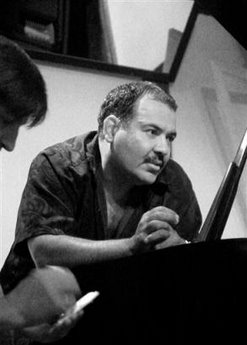
Jazzman Hilton Ruiz dies at 54
By JANET McCONNAUGHEY, Associated Press Writer1 hour, 24 minutes ago
Jazz pianist and composer Hilton Ruiz, who came to New Orleans to work on a Hurricane Katrina benefit recording, died early Tuesday, his agent and manager said.
Ruiz, who turned 54 on May 29, had been comatose at East Jefferson General Hospital since he fell early May 19 in front of a French Quarter bar.
He died about 3:50 a.m. Tuesday, agent Joel Chriss said in a telephone interview from New York.
Ruiz, of Teaneck, N.J., has been described as one of the most versatile musicians in jazz, playing bop, Afro-Cuban, stride and many other styles.
"He's one of the few musicians on the scene that is equally at home in both the jazz genre and the Afro-Cuban genre in a complete sense. ... He really can play the blues, too. For real," trombone player Steve Turre, who had known Ruiz since 1975, said in an interview the week after Ruiz fell. "There's a lot of people who dabble with both worlds. But very few can authentically deal with both. And he's one of them. That's your rarity."
He described Ruiz as a complex man and a brilliant musician, a pianist, composer and bandleader of genius.
Ruiz came to New Orleans with Marco Matute, a producer for the M27 World label, to shoot video to go along with a Hurricane Katrina benefit compact disc of New Orleans music, attorney Mary Howell said before his death. They arrived May 18, she said.
"They spent the whole day filming, riding in carriages, talking to people about New Orleans," She said.
She said Ruiz "got very involved in the situation here" after playing in a New York benefit concert for the hurricane's victims.
The family has been "inundated with calls from people wanting to help." They asked for prayers; an account to help pay Ruiz' medical expenses was set up, Howell said.
Trained in classical music as well as jazz, Ruiz played at Carnegie Recital Hall when he was 8 years old. His teachers included jazz pianist and composer Mary Lou Williams; in his early 20s, he and Turre both worked with saxophone player Rahsaan Roland Kirk.
In an interview with Ted Panken, for liner notes on his 2003 CD, "Enchantment," Ruiz said Kirk — known, among other things, for playing a saxophone and two of its turn-of-the-century cousins at once — nurtured and demanded versatility.
"All the music I enjoyed was part of the Rahsaan experience," Ruiz told Panken. "He played the music of Fats Waller and James P. Johnson. Real down-home blues, as they're called. The great composers of classical music. Music from all over the world — Africa, the Orient, the Middle East. We had to play all these musical flavors every night."
He was playing with Latin groups in his early teens. His first recording, at age 14, was with a group called Ray Jay and the East Siders. While still in his teens, Ruiz worked with tenor saxophonists Frank Foster and Joe Henderson and trumpeters Joe Newman, Freddie Hubbard and Cal Massey.
"I was pretty lucky in being exposed to a lot of different kinds of music, and studying them with good teachers," he said, quoted in a biography on the Telarc International Corp.'s Web site.
The many musicians with whom he worked included Tito Puente, Dizzy Gillespie and Charles Mingus.
He was among musicians featured on the 1997 video "The Best of Latin Jazz," and his song "Something Grand" is part of the "American Beauty" soundtrack.
and here is a previous story about his injury:
Hilton Ruiz Suffered Injuries in Fall, Not Attack
By Ben Mattison
May 26, 2006
The head injuries that have left jazz pianist Hilton Ruiz in a coma resulted from a fall, not an attack, the Associated Press reports.
An attorney for Ruiz's family told the AP that it appeared that Ruiz, who was found with broken bones in his skull and face on Bourbon Street in New Orleans last week, had fallen and hit his face on the curb. Ruiz's agent had previously said that his injuries made it seem as if he had been attacked.
Ruiz also suffered a heart attack in the ambulance on the way to the hospital after the incident, which is believed to have occurred at about 5 a.m. on May 19.
A native of New York, the 53-year-old Ruiz studied with Mary Lou Williams and has played with Freddie Hubbard and Rahsaan Roland Kirk, as well as leading his own bebop and Latin jazz groups.
Send questions and comments to the Webmaster
Copyright © 2002 Playbill, Inc. All Rights Reserved.
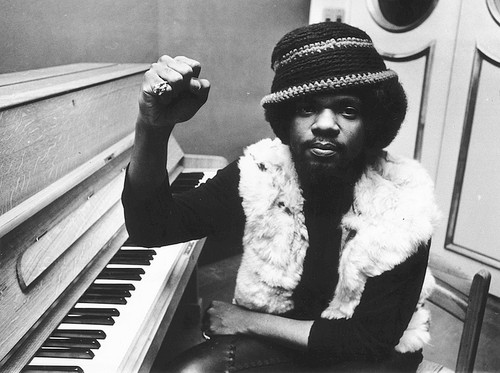
Singer-songwriter Billy Preston dead at 59

http://www.latimes.com/news/obituaries/la-me-preston7jun07,0,2842449.story?coll=la-home-headlines
From the Los Angeles Times
Famed Soul Singer Billy Preston Dies
By Geoff Boucher
Times Staff Writer
7:03 PM PDT, June 6, 2006
Billy Preston, a soul singer and keyboardist who scored such hits as "Nothing From Nothing" and "Outa-Space" in the 1970s but was best known for sitting in on historic recording sessions with the Beatles, the Rolling Stones, Aretha Franklin and Bob Dylan, died Tuesday in Arizona. He was 59.
The charismatic Preston had suffered for years from kidney-related ailments and slipped into a coma in November, according to Joyce Moore, his manager. On Saturday, his condition worsened and he was taken to a hospital in Scottsdale, she told the Associated Press.
Preston's renal problems were the result of his longtime drug use, which also led to his some dark chapters in the 1990s, when he entered court-ordered rehabilitation and was jailed for a variety of offenses.
Those grim days stand in stark contrast to the image of Preston in the public mind: With his amiable personality, toothy grin and towering afro, Preston became a well-known character in the 1960s and '70s rock scene and a coveted player in the studio and on stage.
"Billy was a fantastic and gifted musician ... a superb singer in both recording sessions and onstage," Stones singer Mick Jagger said Tuesday in a statement. "He was great fun to be with ... and I will miss him a lot."
Elton John also praised Preston as a true master of the organ and piano: "He was one of my true inspirations, one of the greatest keyboard players of all time and not too shabby a vocalist, either."
Preston had a stunning career odyssey that again and again put him in the same room with music history. He was there during the "Let It Be" session with the Beatles and not only made memorable keyboard contributions to "Get Back" but joined them in a London rooftop concert that turned out to be the iconic band's final live performance.
"Musically, my favorite moment was on the roof for 'Let It Be,' " Preston told the Chicago Sun-Times in a 2004 interview.
Preston also was in on studio sessions for Sly & the Family Stone's "There's a Riot Goin' On," Dylan's "Blood on the Tracks," Franklin's "Young, Gifted and Black" and the Stones epic "Exile on Main Street." Preston even showed up in a notable track listing he didn't play on: Miles Davis named a song in his honor on his 1975 double album "Get Up With It."
Born in Houston on Sept. 9, 1946, but raised in Los Angeles, William Everett Preston had his hands on the keyboard from age 3 and, by 10, he was playing for gospel icon Mahalia Jackson. In 1958, he portrayed a young W.C. Handy in the film "St. Louis Blues," which told Handy's life story and put Preston on the same set as Nat "King" Cole, Ella Fitzgerald, Cab Calloway and Pearl Bailey.
Preston become accustomed to collaborating with the biggest names in popular music. In the early 1960s, he toured with Ray Charles and Little Richard and while at the Star Club in Hamburg, Germany, met a young British act called the Beatles. At the end of the decade, it was his work with the Fab Four that made for Preston's most memorable career moment.
George Harrison, the band's guitarist, invited Preston to sit in during the making of "Let It Be," the album and sour documentary film that found the group splintering badly. Harrison later said that Preston's presence was one of the few sources of positive energy during that time and that by merely being in the room he probably prevented the Beatles from walking out on one another.
The label on the single of "Get Back" reads "The Beatles and Billy Preston," marking the only time anyone besides the four members was given a credit on a Beatles single. That's one of the reasons some observers took to calling Preston the "fifth Beatle."
He also played organ on the song "Let It Be," and played keyboards on two tracks from "Abbey Road," "(I Want You) She's So Heavy" and "Something."
Preston played with Ringo Starr and John Lennon on several of their solo projects, but Preston and Harrison remained especially close. The keyboardist joined the former Beatle at the sessions for his hugely successful solo debut, "All Things Must Pass," and again at the Harrison-led all-star Concert for Bangladesh. When the 1971 live recording was named album of the year, Preston collected a Grammy for his contribution. He nearly stole the show with his energized performance of his gospel song "That's the Way God Planned It," in which he leaped off his bench and danced across the stage in front of such rock icons as Harrison, Eric Clapton and Leon Russell.
In the 1970s, Preston became a familiar presence in the circle of a different British outfit: He played on five Rolling Stones albums and toured with the band repeatedly as sideman and, in 1973, as an opening act. As the decade wore on, though, Preston and the Stones parted ways after a tiff involving song credit and money. Years later, though, Preston again teamed up with Jagger and company when he sat in on sessions for the 1997 "Bridges to Babylon" album.
The 1970s also saw Preston step into his own spotlight. He won a Grammy for the 1973 instrumental "Outa-Space," and scored other hits with "Will It Go 'Round in Circles" and "With You I'm Born Again," a duet with Syreeta Wright. Preston also helped write a monster hit for Joe Cocker with "You Are So Beautiful."
Preston dropped in on television history as the musical guest on the first episode of "Saturday Night Live," which aired Oct. 11, 1975, and also featured George Carlin and Andy Kaufman. On that show, Preston performed "Nothing From Nothing," the No. 1 1974 hit that became his signature solo song. Thirty years later, Preston was a guest on another bookend show in a notable franchise: he was on the finale episode of "American Idol" last year. He also appeared in the films "Sgt. Pepper's Lonely Hearts Club Band" and "Blues Brothers 2000."
In addition to his problems with drugs and his health, Preston ran afoul of the law in a 1998 insurance fraud case.
Jail "was a great lesson, an awakening. I needed to reflect, to get rid of some of the dead weight around me," he later said. "You take the bitter with the sweet and I have to say it was my faith that kept me going. I had nothing else to fall back on."

Singer-songwriter Billy Preston dead at 59
AP
By BOB CHRISTIE, Associated Press Writer1 hour, 3 minutes ago
Billy Preston, the exuberant keyboardist who landed dream gigs with the Beatles and the Rolling Stones and enjoyed his own series of hit singles, including "Outta Space" and "Nothing From Nothing," died Tuesday at 59.
Preston's longtime manager, Joyce Moore, said Preston had been in a coma since November in a care facility and was taken to a hospital in Scottsdale Saturday after his condition deteriorated.
"He had a very, very beautiful last few hours and a really beautiful passing," Moore said by telephone from Germany. "He went home good."
Preston had battled chronic kidney failure, and he received a kidney transplant in 2002. But the kidney failed and he has been on dialysis ever since, Moore said earlier this year.
Known for his big smile and towering Afro, Preston was a teen prodigy on the piano and organ, and lent his gospel-tinged touch to classics such as the Beatles' "Get Back" and the Stones' "Can't You Hear Me Knocking?"
He broke out as a solo artist in the 1970s, winning a best instrumental Grammy in 1973 for "Outta Space," and scoring other hits with "Will It Go 'Round In Circles," "Nothing From Nothing" and "With You I'm Born Again," a duet with Syreeta Wright.
He also wrote Joe Cocker's weeper, "You Are So Beautiful," and co-wrote with Quincy Jones the score for 1970 movie "They Call Me Mr. Tibbs." Other achievements included being a musical guest on the 1975 debut of "Saturday Night Live," and having a song named after him by Miles Davis. Among his film credits: "Blues Brothers 2000" and "Sgt. Pepper's Lonely Hearts Club Band."
Preston's partnership with the Beatles began in early 1969 when friend George Harrison recruited him to play on "Let It Be," a back-to-basics film and record project that nearly broke down because of feuding among band members. Harrison himself quit at one point, walking out on camera after arguing with Paul McCartney.
Preston not only inspired the Beatles to get along — Harrison likened his effect to a feuding family staying on its best behavior in front of a guest — but contributed a light, bluesy solo to "Get Back," performing the song with the band on its legendary "roof top" concert, the last time the Beatles played live. He was one of many sometimes labeled "The Fifth Beatle."
Preston remained close to Harrison and performed at Harrison's all-star charity event, "The Concert for Bangladesh" and at the "Concert for George," a tribute to Harrison, who died of cancer in 2001. He played on solo records by Harrison, Ringo Starr and John Lennon.
Preston also toured and recorded extensively with the Rolling Stones, playing on such classic albums as "Sticky Fingers" and "Exile on Main Street." In the mid-'70s, he parted from the Stones, reportedly unhappy over not getting proper credit for "Melody" and other songs. He reunited with the band in 1997 on its "Bridges to Babylon" record.
His sessions credits included Aretha Franklin's "Young, Gifted and Black," Bob Dylan's "Blood on the Tracks" and Sly and Family Stone's "There's a Riot Goin' On," three of the most acclaimed albums of the past 35 years.
The Houston native earned his performance chops at age 10 playing the keyboard for gospel singer Mahalia Jackson, and at 12 portraying a young W. C. Handy in the 1958 biopic "St. Louis Blues." He toured with mentors and fellow piano greats Ray Charles and Little Richard in the early 1960s, first encountering the Beatles while on the road in Germany.
Preston had numerous personal troubles in recent years. In 1992, he was given a suspended jail sentence, but ordered incarcerated for nine months at a drug rehabilitation center for his no-contest pleas to cocaine and assault charges. Five years later, he was sentenced to three years in prison for violating probation. In 1998, he pleaded guilty to insurance fraud and agreed to testify against other defendants in an alleged scam that netted about $1 million.
Monday, June 05, 2006
Digital publishing roils print industry
NYT
June 5, 2006
Digital Publishing Is Scrambling the Industry's Rules
By MOTOKO RICH
When Mark Z. Danielewski's second novel, "Only Revolutions," is published in September, it will include hundreds of margin notes listing moments in history suggested online by fans of his work. Nearly 60 of his contributors have already received galleys of the experimental book, which they're commenting about in a private forum at Mr. Danielewski's Web site, www.onlyrevolutions.com.
Yochai Benkler, a Yale University law professor and author of the new book "The Wealth of Networks: How Social Production Transforms Markets and Freedom" (Yale University Press), has gone even farther: his entire book is available — free — as a download from his Web site. Between 15,000 and 20,000 people have accessed the book electronically, with some of them adding comments and links to the online version.
Mr. Benkler said he saw the project as "simply an experiment of how books might be in the future." That is one of the hottest debates in the book world right now, as publishers, editors and writers grapple with the Web's ability to connect readers and writers more quickly and intimately, new technologies that make it easier to search books electronically and the advent of digital devices that promise to do for books what the iPod has done for music: making them easily downloadable and completely portable.
Not surprisingly, writers have greeted these measures with a mixture of enthusiasm and dread. The dread was perhaps most eloquently crystallized last month in Washington at BookExpo, the publishing industry's annual convention, when the novelist John Updike forcefully decried a digital future composed of free downloads of books and the mixing and matching of "snippets" of text, calling it a "grisly scenario."
Hovering above the discussion of all these technologies is the fear that the publishing industry could be subject to the same upheaval that has plagued the music industry, where digitalization has started to displace the traditional artistic and economic model of the record album with 99-cent song downloads and personalized playlists. Total album sales are down 19 percent since 2001, while CD sales have dropped 16 percent during the same period, according to Nielsen SoundScan. Sales of single digital music tracks have jumped more than 1,700 percent in just two years.
What writers think about technological developments in the literary world has a lot to do with where they are sitting at the moment. As a researcher and scholar, Anne Fadiman, author of "The Spirit Catches You and You Fall Down" and "Ex Libris: Confessions of a Common Reader," thinks a digital library of all books would be a "godsend" during research, allowing her to "sniff out all the paragraphs" on a given topic. But, she said: "That's not reading. For reading, you have to read a book in its entirety and I think there's no substitute for the look and feel and smell of a real book — the magic of the paper and thread and glue."
Others have a much less fixed notion of books. Lisa Scottoline, the author of 13 thrillers, the most recent of which, "Dirty Blonde," spent four weeks on the New York Times hardcover fiction best-seller list earlier this spring, offers the first chapter or two of each book on her Web site; and her publisher, HarperCollins, hands out "samplers" of a few chapters of her titles in bookstores. Any of these formats are fine with her, she says. Whether its "paper, pulp, gold rimmed or digitized, I don't think you can take away from the best stories," she said.
Liberating books from their physical contexts could make it easier for them to blend into one another, a concept heralded by Kevin Kelly in an article in The New York Times Magazine last month. "Once text is digital, books seep out of their bindings and weave themselves together," wrote Mr. Kelly in an article that was derided by Mr. Updike in his BookExpo polemic. "The collective intelligence of a library allows us to see things we can't see in a single, isolated book."
"Does that mean 'Anna Karenina' goes hand in hand with my niece's blog of her trip to Las Vegas?" asked Jane Hamilton, author of "The Book of Ruth" and a forthcoming novel, "When Madeline Was Young." "It sounds absolutely deadly." Reading books as isolated works is precisely what she wants to do, she said. "When I read someone like Willa Cather, I feel like I'm in the presence of the divine," Ms. Hamilton said. "I don't want her mixed up with anybody else. And I certainly don't want to go to her Web site."
For unknown authors struggling to capture the attention of busy readers, however, the Web offers an unprecedented way to catapult out of obscurity. Glenn Greenwald, a lawyer who started a political blog, "Unclaimed Territory," just eight months ago, was recruited by a foundation financed by Working Assets, a credit card issuer and telecommunications company, to write a book this spring. Mr. Greenwald promoted the result, called "How Would a Patriot Act? Defending American Values From a President Run Amok," on his own blog and his publisher e-mailed digital galleys to seven other influential bloggers, who helped to send it to the No. 1 spot on Amazon.com before it was even published. This Sunday it will hit No. 11 on the New York Times nonfiction paperback best-seller list. "I think people who are sort of on the outside of the institutions and new voices entering will be a lot more excited about this technology," Mr. Greenwald said. "That's one of the effects that technology always has. It democratizes things and brings in new readers and new authors."
For many authors, the question of how technology will shape book publishing inevitably leads to the question of how writers will be paid. Currently, publishers pay authors an advance against royalties, which are conventionally earned at the rate of 15 percent of the cover price of each copy sold.
But the Internet makes it a lot easier to spread work free. "I've had pieces put up on Web sites legally and otherwise that get hundreds of thousands of hits, and believe me I sit around thinking 'Boy, if I got a dollar every time that somebody posted an op-ed that I wrote, I'd be a very happy writer,' " said Daniel Mendelsohn, author of the forthcoming book "The Lost: A Search for Six of Six Million," a memoir about his hunt to discover what happened to relatives who were killed in the Holocaust.
Mr. Mendelsohn said he understood that technological shakeups take time to play out, and that he can't bemoan every lost penny. "But as an author who creates texts that people consume, I want my authorship to be recognized and I want to get compensated," he said.
Mr. Benkler, the Yale professor and author, argues that people will continue to pay for books if the price is low enough. "Even in music, price can compete with free," Mr. Benkler said. "The service has to be sufficiently better and the moral culture needs to be one where, as an act of respect, when the price is reasonable, you pay. Its not clear to me why, if people are willing to pay 99 cents for a song they won't be willing to pay $3 for a book."
He argues that without the costs of paper and physical book production, publishers could afford to give authors a higher cut of the sale price as royalties.
In the context of history, the changes that today's technology will impose on literary society may not be as earth-shattering as some may think. In fact, books themselves are a relatively new construct, inheritors of a longstanding oral storytelling culture. Mass-produced books are an even newer phenomenon, enabled by the invention of the printing press that likely put legions of calligraphers and bookbinders out of business.
That history gives great comfort to writers like Vikram Chandra, whose 1,000-page novel, "Sacred Games," will be published in January. Mr. Chandra, a former computer programmer who already reads e-books downloaded to his pocket personal computer, said he saw no point in resisting technology. "I think circling the wagons and defending the fortress metaphors are a little misplaced," he said. "The barbarians at the gate are usually willing to negotiate a little, and the guys in the fort usually end up yelling that 'we are the only good things in the world and you guys don't understand it,' at which point the barbarians shrug, knock down your walls with their amazingly powerful weapons, and put a parking lot over your sacred grounds.
"If they are in a really good mood," he added, "they put up a pyramid of skulls."
Mr. Danielewski said that the physical book would persist as long as authors figure out ways to stretch the format in new ways. "Only Revolutions," he pointed out, tracks the experiences of two intersecting characters, whose narratives begin at different ends of the book, requiring readers to turn it upside down every eight pages to get both of their stories. "As excited as I am by technology, I'm ultimately creating a book that can't exist online," he said. "The experience of starting at either end of the book and feeling the space close between the characters until you're exactly at the halfway point is not something you could experience online. I think that's the bar that the Internet is driving towards: how to further emphasize what is different and exceptional about books."
June 5, 2006
Digital Publishing Is Scrambling the Industry's Rules
By MOTOKO RICH
When Mark Z. Danielewski's second novel, "Only Revolutions," is published in September, it will include hundreds of margin notes listing moments in history suggested online by fans of his work. Nearly 60 of his contributors have already received galleys of the experimental book, which they're commenting about in a private forum at Mr. Danielewski's Web site, www.onlyrevolutions.com.
Yochai Benkler, a Yale University law professor and author of the new book "The Wealth of Networks: How Social Production Transforms Markets and Freedom" (Yale University Press), has gone even farther: his entire book is available — free — as a download from his Web site. Between 15,000 and 20,000 people have accessed the book electronically, with some of them adding comments and links to the online version.
Mr. Benkler said he saw the project as "simply an experiment of how books might be in the future." That is one of the hottest debates in the book world right now, as publishers, editors and writers grapple with the Web's ability to connect readers and writers more quickly and intimately, new technologies that make it easier to search books electronically and the advent of digital devices that promise to do for books what the iPod has done for music: making them easily downloadable and completely portable.
Not surprisingly, writers have greeted these measures with a mixture of enthusiasm and dread. The dread was perhaps most eloquently crystallized last month in Washington at BookExpo, the publishing industry's annual convention, when the novelist John Updike forcefully decried a digital future composed of free downloads of books and the mixing and matching of "snippets" of text, calling it a "grisly scenario."
Hovering above the discussion of all these technologies is the fear that the publishing industry could be subject to the same upheaval that has plagued the music industry, where digitalization has started to displace the traditional artistic and economic model of the record album with 99-cent song downloads and personalized playlists. Total album sales are down 19 percent since 2001, while CD sales have dropped 16 percent during the same period, according to Nielsen SoundScan. Sales of single digital music tracks have jumped more than 1,700 percent in just two years.
What writers think about technological developments in the literary world has a lot to do with where they are sitting at the moment. As a researcher and scholar, Anne Fadiman, author of "The Spirit Catches You and You Fall Down" and "Ex Libris: Confessions of a Common Reader," thinks a digital library of all books would be a "godsend" during research, allowing her to "sniff out all the paragraphs" on a given topic. But, she said: "That's not reading. For reading, you have to read a book in its entirety and I think there's no substitute for the look and feel and smell of a real book — the magic of the paper and thread and glue."
Others have a much less fixed notion of books. Lisa Scottoline, the author of 13 thrillers, the most recent of which, "Dirty Blonde," spent four weeks on the New York Times hardcover fiction best-seller list earlier this spring, offers the first chapter or two of each book on her Web site; and her publisher, HarperCollins, hands out "samplers" of a few chapters of her titles in bookstores. Any of these formats are fine with her, she says. Whether its "paper, pulp, gold rimmed or digitized, I don't think you can take away from the best stories," she said.
Liberating books from their physical contexts could make it easier for them to blend into one another, a concept heralded by Kevin Kelly in an article in The New York Times Magazine last month. "Once text is digital, books seep out of their bindings and weave themselves together," wrote Mr. Kelly in an article that was derided by Mr. Updike in his BookExpo polemic. "The collective intelligence of a library allows us to see things we can't see in a single, isolated book."
"Does that mean 'Anna Karenina' goes hand in hand with my niece's blog of her trip to Las Vegas?" asked Jane Hamilton, author of "The Book of Ruth" and a forthcoming novel, "When Madeline Was Young." "It sounds absolutely deadly." Reading books as isolated works is precisely what she wants to do, she said. "When I read someone like Willa Cather, I feel like I'm in the presence of the divine," Ms. Hamilton said. "I don't want her mixed up with anybody else. And I certainly don't want to go to her Web site."
For unknown authors struggling to capture the attention of busy readers, however, the Web offers an unprecedented way to catapult out of obscurity. Glenn Greenwald, a lawyer who started a political blog, "Unclaimed Territory," just eight months ago, was recruited by a foundation financed by Working Assets, a credit card issuer and telecommunications company, to write a book this spring. Mr. Greenwald promoted the result, called "How Would a Patriot Act? Defending American Values From a President Run Amok," on his own blog and his publisher e-mailed digital galleys to seven other influential bloggers, who helped to send it to the No. 1 spot on Amazon.com before it was even published. This Sunday it will hit No. 11 on the New York Times nonfiction paperback best-seller list. "I think people who are sort of on the outside of the institutions and new voices entering will be a lot more excited about this technology," Mr. Greenwald said. "That's one of the effects that technology always has. It democratizes things and brings in new readers and new authors."
For many authors, the question of how technology will shape book publishing inevitably leads to the question of how writers will be paid. Currently, publishers pay authors an advance against royalties, which are conventionally earned at the rate of 15 percent of the cover price of each copy sold.
But the Internet makes it a lot easier to spread work free. "I've had pieces put up on Web sites legally and otherwise that get hundreds of thousands of hits, and believe me I sit around thinking 'Boy, if I got a dollar every time that somebody posted an op-ed that I wrote, I'd be a very happy writer,' " said Daniel Mendelsohn, author of the forthcoming book "The Lost: A Search for Six of Six Million," a memoir about his hunt to discover what happened to relatives who were killed in the Holocaust.
Mr. Mendelsohn said he understood that technological shakeups take time to play out, and that he can't bemoan every lost penny. "But as an author who creates texts that people consume, I want my authorship to be recognized and I want to get compensated," he said.
Mr. Benkler, the Yale professor and author, argues that people will continue to pay for books if the price is low enough. "Even in music, price can compete with free," Mr. Benkler said. "The service has to be sufficiently better and the moral culture needs to be one where, as an act of respect, when the price is reasonable, you pay. Its not clear to me why, if people are willing to pay 99 cents for a song they won't be willing to pay $3 for a book."
He argues that without the costs of paper and physical book production, publishers could afford to give authors a higher cut of the sale price as royalties.
In the context of history, the changes that today's technology will impose on literary society may not be as earth-shattering as some may think. In fact, books themselves are a relatively new construct, inheritors of a longstanding oral storytelling culture. Mass-produced books are an even newer phenomenon, enabled by the invention of the printing press that likely put legions of calligraphers and bookbinders out of business.
That history gives great comfort to writers like Vikram Chandra, whose 1,000-page novel, "Sacred Games," will be published in January. Mr. Chandra, a former computer programmer who already reads e-books downloaded to his pocket personal computer, said he saw no point in resisting technology. "I think circling the wagons and defending the fortress metaphors are a little misplaced," he said. "The barbarians at the gate are usually willing to negotiate a little, and the guys in the fort usually end up yelling that 'we are the only good things in the world and you guys don't understand it,' at which point the barbarians shrug, knock down your walls with their amazingly powerful weapons, and put a parking lot over your sacred grounds.
"If they are in a really good mood," he added, "they put up a pyramid of skulls."
Mr. Danielewski said that the physical book would persist as long as authors figure out ways to stretch the format in new ways. "Only Revolutions," he pointed out, tracks the experiences of two intersecting characters, whose narratives begin at different ends of the book, requiring readers to turn it upside down every eight pages to get both of their stories. "As excited as I am by technology, I'm ultimately creating a book that can't exist online," he said. "The experience of starting at either end of the book and feeling the space close between the characters until you're exactly at the halfway point is not something you could experience online. I think that's the bar that the Internet is driving towards: how to further emphasize what is different and exceptional about books."
Yogyakarta Wounded
NYT
June 6, 2006
Tourism Suffers in Indonesian City Caught Between Quake and Volcano
By PETER GELLING
YOGYAKARTA, Indonesia, June 5 — In the southern part of this city a short street once alive with guest houses, restaurants, travel agencies and souvenir shops now sits quiet, with barely a soul to be found, just weeks before the onset of the tourist season.
The early morning earthquake on May 27 reduced the quaint street, Prawirotaman, to ruins. Throngs of half-awake, panicked tourists who were here that day and managed to survive relatively unharmed crawled out of rubble, wondering what to do and where to go.
The 15 guests at Hotel Prambanan, a two-story inn with about 30 rooms in the popular low-budget backpacking district, were all spared serious injury, as were the other visitors staying nearby.
"Blessed be to God that no one was hurt," said Jahyanto, 39, the manager of Hotel Prambanan, who like many Indonesians uses only one name. "They were confused and scared. I just tried to help them find the fastest way out of Yogyakarta."
Yogyakarta Province is the second most popular tourist destination in Indonesia, Bali being the first. Ancient temples, palaces and a vibrant artists' community draw hundreds of thousands of foreign tourists a year to this area. Tourism accounts for about 20 percent of the province's income and is second only to agriculture as a source of revenue.
Handicraft villages in Bantul, the hardest-hit district, supplied 40 percent of the souvenirs sold throughout Indonesia. Three thousand family kilns for pottery were destroyed in the quake, and most of the villages were nearly leveled.
On Monday, an official from Indonesia's Social Affairs Ministry announced that the death toll from the quake had been revised to 5,782 from 6,234, saying that some victims had been found alive and that others had been counted twice, The Associated Press reported.
Even before the quake, tourism here was threatened by fears of an eruption at Mount Merapi, just north of Yogyakarta. A marketing campaign to show tourists that Yogyakarta, 20 miles south of the volcano, is out of Merapi's reach began several weeks ago and included organized visits to the mountain's slopes.
Two days after the program began, and the first tourists arrived at Mount Merapi, the quake struck.
Yet tourism officials are optimistic that they can recover. Most of Yogyakarta's major tourist sites were undamaged and remain open, including the city's biggest draw, the Borobudur Buddhist temple, which is more than 1,000 years old and is a Unesco World Heritage site.
"Re-establishing the tourism industry here won't be easy," said Wiendu Nuryanti, secretary general of Yogyakarta's International Center for Culture and Tourism. "But we are working together with a lot of different agencies to help the tourism industry."
Along with local and national government officials, Ms. Nuryanti has created a task force to help rehabilitate tourism in Yogyakarta.
The office of the task force, the Java Crisis Tourism Media Center, is busy with volunteers collecting data on damaged tourist areas. Regular meetings are held to discuss strategies for recovery.
Indonesia's minister of culture and tourism, Jero Wacik, has already indicated that the government will provide subsidized loans to ruined businesses, and tax incentives for struggling hotels and tourist agencies.
Condroyono, the provincial director of tourism, said strategies were being developed to use the earthquake and volcano as a way of diversifying tourism. Though Javanese culture will always be the primary reason tourists come here, he said, there are plans for tours to areas of geological significance, like massive fissures in the Gudung Kidul district, caused by the quake, or the ash-stained slopes of Mount Merapi.
"There is the potential for a kind of adventure tourism here now," he said. Indeed, in the last few weeks a large number of domestic and foreign tourists have brushed aside danger, driving to evacuated areas to take pictures in front of Merapi.
Ms. Nuryanti said her task force planned a major campaign for Mount Merapi, trying to capitalize on the recent international news coverage. The volcano is an important symbol in Javanese culture. Its spirits are believed to protect the ancient kingdom of Yogyakarta, and the designs of many of the temples are modeled after the volcano's shape.
Mr. Condroyono admitted that it would be a long time before most potential tourists saw Yogyakarta as something other than a disaster area. "This will take a long time, more than two years probably, before tourism can start growing here again," he said.
Standing alone among the remains of his former business, Mr. Jahyanto, the hotel manager, said all he needed was a little money to start again. "Maybe it's a dream," he said. "But it is the dream of everyone on this street to rebuild and reopen our businesses."
June 6, 2006
Tourism Suffers in Indonesian City Caught Between Quake and Volcano
By PETER GELLING
YOGYAKARTA, Indonesia, June 5 — In the southern part of this city a short street once alive with guest houses, restaurants, travel agencies and souvenir shops now sits quiet, with barely a soul to be found, just weeks before the onset of the tourist season.
The early morning earthquake on May 27 reduced the quaint street, Prawirotaman, to ruins. Throngs of half-awake, panicked tourists who were here that day and managed to survive relatively unharmed crawled out of rubble, wondering what to do and where to go.
The 15 guests at Hotel Prambanan, a two-story inn with about 30 rooms in the popular low-budget backpacking district, were all spared serious injury, as were the other visitors staying nearby.
"Blessed be to God that no one was hurt," said Jahyanto, 39, the manager of Hotel Prambanan, who like many Indonesians uses only one name. "They were confused and scared. I just tried to help them find the fastest way out of Yogyakarta."
Yogyakarta Province is the second most popular tourist destination in Indonesia, Bali being the first. Ancient temples, palaces and a vibrant artists' community draw hundreds of thousands of foreign tourists a year to this area. Tourism accounts for about 20 percent of the province's income and is second only to agriculture as a source of revenue.
Handicraft villages in Bantul, the hardest-hit district, supplied 40 percent of the souvenirs sold throughout Indonesia. Three thousand family kilns for pottery were destroyed in the quake, and most of the villages were nearly leveled.
On Monday, an official from Indonesia's Social Affairs Ministry announced that the death toll from the quake had been revised to 5,782 from 6,234, saying that some victims had been found alive and that others had been counted twice, The Associated Press reported.
Even before the quake, tourism here was threatened by fears of an eruption at Mount Merapi, just north of Yogyakarta. A marketing campaign to show tourists that Yogyakarta, 20 miles south of the volcano, is out of Merapi's reach began several weeks ago and included organized visits to the mountain's slopes.
Two days after the program began, and the first tourists arrived at Mount Merapi, the quake struck.
Yet tourism officials are optimistic that they can recover. Most of Yogyakarta's major tourist sites were undamaged and remain open, including the city's biggest draw, the Borobudur Buddhist temple, which is more than 1,000 years old and is a Unesco World Heritage site.
"Re-establishing the tourism industry here won't be easy," said Wiendu Nuryanti, secretary general of Yogyakarta's International Center for Culture and Tourism. "But we are working together with a lot of different agencies to help the tourism industry."
Along with local and national government officials, Ms. Nuryanti has created a task force to help rehabilitate tourism in Yogyakarta.
The office of the task force, the Java Crisis Tourism Media Center, is busy with volunteers collecting data on damaged tourist areas. Regular meetings are held to discuss strategies for recovery.
Indonesia's minister of culture and tourism, Jero Wacik, has already indicated that the government will provide subsidized loans to ruined businesses, and tax incentives for struggling hotels and tourist agencies.
Condroyono, the provincial director of tourism, said strategies were being developed to use the earthquake and volcano as a way of diversifying tourism. Though Javanese culture will always be the primary reason tourists come here, he said, there are plans for tours to areas of geological significance, like massive fissures in the Gudung Kidul district, caused by the quake, or the ash-stained slopes of Mount Merapi.
"There is the potential for a kind of adventure tourism here now," he said. Indeed, in the last few weeks a large number of domestic and foreign tourists have brushed aside danger, driving to evacuated areas to take pictures in front of Merapi.
Ms. Nuryanti said her task force planned a major campaign for Mount Merapi, trying to capitalize on the recent international news coverage. The volcano is an important symbol in Javanese culture. Its spirits are believed to protect the ancient kingdom of Yogyakarta, and the designs of many of the temples are modeled after the volcano's shape.
Mr. Condroyono admitted that it would be a long time before most potential tourists saw Yogyakarta as something other than a disaster area. "This will take a long time, more than two years probably, before tourism can start growing here again," he said.
Standing alone among the remains of his former business, Mr. Jahyanto, the hotel manager, said all he needed was a little money to start again. "Maybe it's a dream," he said. "But it is the dream of everyone on this street to rebuild and reopen our businesses."
Sunday, June 04, 2006
Another Cheikha Rimitti Obituary
From the Los Angeles Times
OBITUARIES
Cheikha Rimitti, 83; Algerian Singer, `Mother of Rai'
By Jocelyn Y. Stewart
Times Staff Writer
June 4, 2006
In the 1930s no respectable Algerian woman dared to make music about sexual pleasure, alcohol consumption, poverty, oppression.
Cheikha Rimitti sang anyway.
The artist, whose pioneering recordings inspired younger generations in her homeland and around the world and earned her the title of "mother of rai," the Algerian music of dissent, died of a heart attack May 15 in Paris. She was 83.
"I don't know that the world has anyone ready to step into those shoes," said Leigh Ann Hahn, director of programming for Grand Performances and a longtime fan, who helped bring Rimitti to Los Angeles for a historic performance. "It's a huge, huge loss."
Just last month Rimitti, who was still performing concerts in Europe, released a new recording, N'ta Goudami ("Face Me").
Rimitti began singing as a means of surviving. Born Saadia Bediaf near Sidi Bel Abbes in Algeria on May 8, 1923, Rimitti was orphaned at an early age and struggled for daily existence. When she sang at weddings and parties as a youth, "people gave me food to eat."
"Misery was like a school for me," Rimitti said in a 2001 interview with Afropop Worldwide, a radio program and website dedicated to African pop music. "It taught me my trade."
At 20, Rimitti joined a group of musicians who sang at religious festivals, weddings, births and other rites. Her predecessors included early rai singer Cheikha Tetma.
Cheikha is a title given to female rai singers, who in the early days of rai were regarded as outcasts and often took on nicknames or stage names.
In Arabic the word rai means "opinion" or "way of seeing." In its early form, the music was rooted in the concerns of everyday people — the joys, the pains, the unspeakable. It was dance music, sung in the language of the streets.
Nourredine Gafaiti, Rimitti's most recent producer, called the music "as happy as funk" and "as deep as the blues." It is both hopeful and melancholy, Gafaiti said in a biography of Rimitti posted on the singer's official website.
Algeria was a colony of France when Rimitti began singing. Her first recorded hit, "Charrak Gatta" ("Tear, Lacerate"), was released in 1954, the year the Algerian War of Independence began.
The song has been described as an attack on the virtue of virginity and an invitation for women in the Muslim nation to rethink their views on morality. Her signature husky voice led later observers to describe her music as earthy, raw and bold.
"It's a matter of observing and reflecting," Rimitti said in a 2001 interview with Afropop Worldwide.
"Rai music has always been a music of rebellion, a music that looks ahead. At that time, it was even more so, with just the flute and the tam-tam," a type of gong.
But in the new Algeria there was little tolerance for the bold or the brash. The religious considered her immoral. The revolutionaries considered her anti-revolutionary and apolitical. In the 1960s the new government banned Rimitti and other rai artists from performing on the radio, relegating the music to private parties and black-market cassette tapes.
In 1978, she moved to France, but her heart — and her musical legacy — remained in Algeria. Years later, rai would experience renewed popularity and Rimitti complained that younger artists took her songs and "exploited them without giving me my due."
In 1994 Rimitti collaborated with Flea, bassist from the Red Hot Chili Peppers, and Robert Fripp on the album "Sidi Mansour." The musicians recorded in Los Angeles, while Rimitti recorded vocals in Paris. The collaboration, she later said, opened the door to realizing her long-held dream of performing in the United States.
By the time Rimitti performed in the U.S. in 2001, she was 78, but she was still vibrant and innovating. The next year she performed at California Plaza in downtown Los Angeles as part of a Grand Performances lineup of world music artists.
Many who attended the performance were local fans who had never had an opportunity to see Rimitti perform live. Others there were open to exploring Arabic "cultural tradition in order to be able to take a different look or perspective on the global community" in the aftermath of 9/11, Hahn said.
Times writer Lynell George described Rimitti striding out "in a dress as white and elaborate as a wedding cake. A sparkling tiara rests atop her long blue-black tresses."
"Suddenly turning, arms close to body, gold-slippered feet shuffling like a moving hieroglyph, she makes two passes across the stage before a ragged voice curls out from somewhere way, way low — a map, a road, a history unscrolling," George wrote.
Over the years, even as the times changed, the bold, raw flavor of her lyrics remained.
"I sang the life I had seen, my own history," Rimitti said.
OBITUARIES
Cheikha Rimitti, 83; Algerian Singer, `Mother of Rai'
By Jocelyn Y. Stewart
Times Staff Writer
June 4, 2006
In the 1930s no respectable Algerian woman dared to make music about sexual pleasure, alcohol consumption, poverty, oppression.
Cheikha Rimitti sang anyway.
The artist, whose pioneering recordings inspired younger generations in her homeland and around the world and earned her the title of "mother of rai," the Algerian music of dissent, died of a heart attack May 15 in Paris. She was 83.
"I don't know that the world has anyone ready to step into those shoes," said Leigh Ann Hahn, director of programming for Grand Performances and a longtime fan, who helped bring Rimitti to Los Angeles for a historic performance. "It's a huge, huge loss."
Just last month Rimitti, who was still performing concerts in Europe, released a new recording, N'ta Goudami ("Face Me").
Rimitti began singing as a means of surviving. Born Saadia Bediaf near Sidi Bel Abbes in Algeria on May 8, 1923, Rimitti was orphaned at an early age and struggled for daily existence. When she sang at weddings and parties as a youth, "people gave me food to eat."
"Misery was like a school for me," Rimitti said in a 2001 interview with Afropop Worldwide, a radio program and website dedicated to African pop music. "It taught me my trade."
At 20, Rimitti joined a group of musicians who sang at religious festivals, weddings, births and other rites. Her predecessors included early rai singer Cheikha Tetma.
Cheikha is a title given to female rai singers, who in the early days of rai were regarded as outcasts and often took on nicknames or stage names.
In Arabic the word rai means "opinion" or "way of seeing." In its early form, the music was rooted in the concerns of everyday people — the joys, the pains, the unspeakable. It was dance music, sung in the language of the streets.
Nourredine Gafaiti, Rimitti's most recent producer, called the music "as happy as funk" and "as deep as the blues." It is both hopeful and melancholy, Gafaiti said in a biography of Rimitti posted on the singer's official website.
Algeria was a colony of France when Rimitti began singing. Her first recorded hit, "Charrak Gatta" ("Tear, Lacerate"), was released in 1954, the year the Algerian War of Independence began.
The song has been described as an attack on the virtue of virginity and an invitation for women in the Muslim nation to rethink their views on morality. Her signature husky voice led later observers to describe her music as earthy, raw and bold.
"It's a matter of observing and reflecting," Rimitti said in a 2001 interview with Afropop Worldwide.
"Rai music has always been a music of rebellion, a music that looks ahead. At that time, it was even more so, with just the flute and the tam-tam," a type of gong.
But in the new Algeria there was little tolerance for the bold or the brash. The religious considered her immoral. The revolutionaries considered her anti-revolutionary and apolitical. In the 1960s the new government banned Rimitti and other rai artists from performing on the radio, relegating the music to private parties and black-market cassette tapes.
In 1978, she moved to France, but her heart — and her musical legacy — remained in Algeria. Years later, rai would experience renewed popularity and Rimitti complained that younger artists took her songs and "exploited them without giving me my due."
In 1994 Rimitti collaborated with Flea, bassist from the Red Hot Chili Peppers, and Robert Fripp on the album "Sidi Mansour." The musicians recorded in Los Angeles, while Rimitti recorded vocals in Paris. The collaboration, she later said, opened the door to realizing her long-held dream of performing in the United States.
By the time Rimitti performed in the U.S. in 2001, she was 78, but she was still vibrant and innovating. The next year she performed at California Plaza in downtown Los Angeles as part of a Grand Performances lineup of world music artists.
Many who attended the performance were local fans who had never had an opportunity to see Rimitti perform live. Others there were open to exploring Arabic "cultural tradition in order to be able to take a different look or perspective on the global community" in the aftermath of 9/11, Hahn said.
Times writer Lynell George described Rimitti striding out "in a dress as white and elaborate as a wedding cake. A sparkling tiara rests atop her long blue-black tresses."
"Suddenly turning, arms close to body, gold-slippered feet shuffling like a moving hieroglyph, she makes two passes across the stage before a ragged voice curls out from somewhere way, way low — a map, a road, a history unscrolling," George wrote.
Over the years, even as the times changed, the bold, raw flavor of her lyrics remained.
"I sang the life I had seen, my own history," Rimitti said.
The Return of Fania record label
New York Times
June 4, 2006
The Return of Fania, the Record Company That Made Salsa Hot
By JODY ROSEN
FANIA RECORDS, the legendary New York label that pioneered salsa, has often been called the Latin Motown. In its heyday, from the late 1960's through the 70's, Fania, like Motown, had a superstar-packed roster, a virtual monopoly on salsa's A-list: Celia Cruz, Willie Colón, Hector Lavoe, Johnny Pacheco, Rubén Blades, Eddie Palmieri, Ray Barretto, Bobby Valentin, Larry Harlow and other greats. Like Motown, Fania began as a humble cottage industry — its releases were once sold out of the trunk of a car on the streets of Harlem and the Bronx — and became a multimillion-dollar business that carried a bracing musical hybrid to the nation and the world.
But the comparison soon breaks down. Today Motown looms gigantic in American cultural memory, a cornerstone of the 60's nostalgia industry, the subject of innumerable books and documentaries, its hits still ubiquitous on the airwaves decades after they made the charts. Fania, on the other hand, is recalled mostly by collectors and Latinos of a certain age. And where Motown's records have been endlessly reissued and anthologized, Fania's catalog languished for years, its master tapes moldering in a warehouse in Hudson, N.Y. Dozens of its most important recordings are out of print, and others were so shoddily transferred to CD — often directly from the original vinyl — as to be virtually unlistenable.
Now, though, a Fania revival is stirring. Marc Anthony and Jennifer Lopez just finished shooting "El Cantante," a biopic about the short, tragic life of the singing star Hector Lavoe. More important, the music itself is at last being reissued properly, with informative liner notes (in Spanish and English) and shimmering remastered sound that conjures a bygone era: the funky tumult of Latin New York in the years of Vietnam, Watergate and Jimmy Carter. Emusica, the Miami company that purchased the Fania catalog last year in a deal worth several million dollars, recently released the first 30 of a planned 300 reissues. This bounty holds surprises even for longtime Fania aficionados and offers non-initiates a chance to catch up with some of the greatest music from one of pop's most fertile periods.
"Fania is the catalog of salsa music, an unmatched body of recordings," said David Garcia, an assistant professor of music at the University of North Carolina and an expert on Latin music. Larry Harlow, the keyboardist and bandleader who produced and arranged many of Fania's classic records (his 1979 album "Yo Soy Latino" is among the first reissued Fania CD's), called the label's output "a chronological biography of the whole Latin music scene from the mid-60's through the early 80's." Fania, Mr. Harlow said, "is Latin music." The label was the brainchild of unlikely business partners: the Dominican flutist and bandleader Johnny Pacheco and Jerry Masucci, an Italian-American former New York City police officer turned lawyer who fell in love with Latin music during a brief stay in Cuba in the early 60's. In 1964, Mr. Masucci (who died in 1997) and Mr. Pacheco teamed up and began signing hot New York musicians, including Ray Barretto (who died in February at 76), a conga virtuoso and leader of one of the city's best dance bands, as well as younger bandleaders like Bobby Valentin and Mr. Harlow.
By the late 60's the label's roster had swelled with young talent, and Fania would soon annex several smaller Latin labels. The roster included Willie Colón, a gifted trombonist and composer with eclectic musical tastes, and Hector Lavoe, a Puerto Rican singer with a luminous tenor voice. Together these musicians honed a new sound — a blend of bustling Afro-Cuban rhythms, big-band jazz, street-smart R&B and other styles — in a combustive atmosphere of collaboration and friendly rivalry.
"It was a very competitive time," recalled Mr. Colón, who in recent years has become involved in New York City politics, running for public advocate in 2001 and serving as co-chairman of Mayor Michael R. Bloomberg's re-election campaign last year. "Within the label, there was a lot of competition. We were all trying to innovate and outdo each other."
Those innovations are all over the first batch of Fania reissues. The music is built on a rock-solid Afro-Cuban base, on the clave beat and on the sensuous big-band stylings of Cuban son, with numerous other styles stirred into the mix, from mambo and rumba to Puerto Rican plena and bomba. But on early albums like "El Malo" (1967) by Mr. Colón, and classic 70's releases like "Rey del Bajo" by Mr. Valentin and "El Maestro" by Mr. Pacheco (both 1974), a sophisticated new style emerges, with son's 1-4-5 chord structures giving way to jazz chords and harmonies, complex arrangements and far more aggressive rhythm than is typical of Cuban music.
Cold war geopolitics played a role in the development of that sound. The Cuban embargo cut off virtually all contact between the island and musicians based in the United States, and a distinctively New York style was incubated in the city's dozens of Latin nightclubs. The Fania reissues radiate big-city cosmopolitanism. The label was a melting pot, with a lineup that included black and white Latinos: Puerto Ricans (Mr. Valentin, Ismael Rivera, Pete Rodriguez), Dominicans (Mr. Pacheco), Panamanians (Mr. Blades), Cubans (Celia Cruz), native New Yorkers (Mr. Barretto, Mr. Colón), even gringos like Mr. Harlow, né Lawrence Kahn, whose keyboard skills earned him the nickname El Judio Maravilloso (the Marvelous Jew). Their music drew on bebop, soul, rock and other sounds of the polyglot metropolis, and the lyrics were steeped in grit and street reportage.
"We were making city music, talking about, you know, city things — what's happening on the corner, stories about drugs, violence, looking for a job," Mr. Colón said. "The stuff that was coming from Cuba was more rural, you know, 'my grass shack' and all that. We were kind of doing an urban folklore."
Mr. Colón in particular cultivated an image as a New York street tough, toying with gangster iconography and glowering on the covers of records like "El Malo" ("The Bad One"), whose artwork includes photos of his band performing in prisoners' uniforms.
What really shines through on these remastered records is extraordinary musicianship. Albums like "Celia & Johnny" (1974), Mr. Pacheco's collaboration with Ms. Cruz, and Roberto Roena's "Roberto Roena y Su Apollo Sound 5" (1973) are the essence of classic salsa: tough, gleaming, unstoppable dance music, with brass fanfares braying over crackling syncopation from claves, timbales and congas.
Jazz fans who have not caught up with salsa will be impressed by the virtuosity packed into tight pop song structures: Eddie Palmieri's cluster-chord-thick electric piano solo on the title track of his 1971 "progressive salsa" landmark "Vamonos Pa'l Monte," or Mr. Colón's blazing trombone improvisations on "El Malo." Most of these records are headlined, à la big-band jazz, by bandleader-instrumentalists. By the mid-1980's, with the arrival of a new style, salsa romántico, singers routinely got top billing. (In that period Fania dissolved amid a string of lawsuits involving royalties.)
Fania's heroic sound was a singer's: the high, pure voice of Hector Lavoe, whose mastery of both velvety crooning and fierce, percussive vocal improvisation set the standard for all salseros who followed. On the remastered version of his 1975 solo album "La Voz," one hears the disarmingly boyish warmth of his voice, a yearning quality that fires both love ballads and up-tempo numbers like "Mi Gente" ("My People"), the Johnny Pacheco song that became Mr. Lavoe's anthem. The sweetness of Mr. Lavoe's singing belied his hard living and hard luck — battles with drug abuse, the murder of his son, suicide attempts and an AIDS-related death at 46 — and today, 13 years after his death, he remains salsa's tragic saint. (His cult, one suspects, will only grow when "El Cantante" hits theaters.)
Fania will forever be defined by those hard-driving salsa records from the mid-70's, not least by the albums of its flagship band, the Fania All-Stars, which featured most of the label's biggest names. (Emusica is planning several Fania All-Star releases.) But the new reissues reveal the surprising breadth of Fania's catalog: it wasn't just a salsa label. The recordings include a remarkable album by the eccentric vocalist La Lupe, singing torchy boleros with string orchestra accompaniment; groove-oriented Latin jazz by the Cuban conga legend Mongo Santamaria; "Cuba y Puerto Rico Son," a superb 1966 collaboration between Tito Puente and a young Celia Cruz; and several very funky boogaloo and Latin soul releases from the middle and late 60's. The best of these is Joe Bataan's "Riot" (1968), whose cover photo of weapon-wielding Latin youth captures the growing militancy of the barrio in those turbulent years.
One of the hallmarks of Fania's golden age is politics, the social-consciousness messages musicians brought to songs that had previously stuck to themes of romance and dancing. "It was revolution time," Mr. Harlow remembered. "It was Woodstock time. It was the Black Panthers. It was Vietnam. When Latin music got cut off from Cuba in the 1960's, New York musicians added that new kind of lyrical content. We would sing about love, we would sing about war, we would sing about protest."
The pivotal figure was Rubén Blades, the singer-songwriter whose poetic lyrics carried forceful, often satirical messages about racism, social justice and cultural pride. "Siembra," Mr. Blades's 1978 collaboration with Mr. Colón, was a sweeping concept album with propulsive salsa tunes (and disco parodies) lampooning American materialism and calling for Latino unity, which for years stood as the top-selling Latin album of all time.
Like nearly all Fania albums, "Siembra" was recorded in a Manhattan studio. Your local record store will probably shelve these CD's in the world music section with all the other non-Anglophone stuff, but salsa is homegrown American music, as much a part of the indigenous musical landscape as jazz or rock or hip-hop.
At a moment when the country is convulsed by debate over the latest waves of Latin immigration, the Fania rereleases are reminders of the deep roots of Latinos here — the first Puerto Rican tradesmen arrived in New York in the 17th century — and of the profound role they have played in both shaping United States culture and exporting it back to points south.
"Fania really led the way in spreading salsa throughout South America and the Caribbean," Professor Garcia said. Leading second- and third-generation salsa musicians have hailed from such places as Colombia and Venezuela, and it wasn't just Fania's music but also its messages that took root. The huge popularity throughout Latin America of politically trenchant albums like "Siembra," with its feisty calls for pan-Latin pride, is just one dramatic example of the ways that the Latin diaspora has spoken back to the homeland.
Latin music has found a growing audience among gringos in the United States. But is the audience that embraced the Buena Vista Social Club's prerevolutionary Cuban son ready to discover some more Latin music, not nearly as genteel, from a lot closer to home?
The sound should certainly be familiar to most American listeners. Fania's songwriters were inspired by American pop like Marvin Gaye's "What's Going On," but the influence ran both ways: the sonic texture of Gaye's album, with its gently percolating congas, is audibly indebted to salsa. Fania's sound seeped into soul and classic rock, into Stevie Wonder and Curtis Mayfield, into Santana and even Led Zeppelin, whose album radio staple "Fool in the Rain" is a salsa pastiche. And no one who has lived in a city with a significant Latino population in the last four decades can have missed the festive music blasting from cars and open apartment windows on sultry summer evenings.
To younger Latinos enamored of today's Fania equivalent, reggaetón, these old albums will doubtless sound old-fashioned. But music this rhythmically tough could never be dowdy. It's late-20th-century music ready to ignite 21st-century dance floors.
June 4, 2006
The Return of Fania, the Record Company That Made Salsa Hot
By JODY ROSEN
FANIA RECORDS, the legendary New York label that pioneered salsa, has often been called the Latin Motown. In its heyday, from the late 1960's through the 70's, Fania, like Motown, had a superstar-packed roster, a virtual monopoly on salsa's A-list: Celia Cruz, Willie Colón, Hector Lavoe, Johnny Pacheco, Rubén Blades, Eddie Palmieri, Ray Barretto, Bobby Valentin, Larry Harlow and other greats. Like Motown, Fania began as a humble cottage industry — its releases were once sold out of the trunk of a car on the streets of Harlem and the Bronx — and became a multimillion-dollar business that carried a bracing musical hybrid to the nation and the world.
But the comparison soon breaks down. Today Motown looms gigantic in American cultural memory, a cornerstone of the 60's nostalgia industry, the subject of innumerable books and documentaries, its hits still ubiquitous on the airwaves decades after they made the charts. Fania, on the other hand, is recalled mostly by collectors and Latinos of a certain age. And where Motown's records have been endlessly reissued and anthologized, Fania's catalog languished for years, its master tapes moldering in a warehouse in Hudson, N.Y. Dozens of its most important recordings are out of print, and others were so shoddily transferred to CD — often directly from the original vinyl — as to be virtually unlistenable.
Now, though, a Fania revival is stirring. Marc Anthony and Jennifer Lopez just finished shooting "El Cantante," a biopic about the short, tragic life of the singing star Hector Lavoe. More important, the music itself is at last being reissued properly, with informative liner notes (in Spanish and English) and shimmering remastered sound that conjures a bygone era: the funky tumult of Latin New York in the years of Vietnam, Watergate and Jimmy Carter. Emusica, the Miami company that purchased the Fania catalog last year in a deal worth several million dollars, recently released the first 30 of a planned 300 reissues. This bounty holds surprises even for longtime Fania aficionados and offers non-initiates a chance to catch up with some of the greatest music from one of pop's most fertile periods.
"Fania is the catalog of salsa music, an unmatched body of recordings," said David Garcia, an assistant professor of music at the University of North Carolina and an expert on Latin music. Larry Harlow, the keyboardist and bandleader who produced and arranged many of Fania's classic records (his 1979 album "Yo Soy Latino" is among the first reissued Fania CD's), called the label's output "a chronological biography of the whole Latin music scene from the mid-60's through the early 80's." Fania, Mr. Harlow said, "is Latin music." The label was the brainchild of unlikely business partners: the Dominican flutist and bandleader Johnny Pacheco and Jerry Masucci, an Italian-American former New York City police officer turned lawyer who fell in love with Latin music during a brief stay in Cuba in the early 60's. In 1964, Mr. Masucci (who died in 1997) and Mr. Pacheco teamed up and began signing hot New York musicians, including Ray Barretto (who died in February at 76), a conga virtuoso and leader of one of the city's best dance bands, as well as younger bandleaders like Bobby Valentin and Mr. Harlow.
By the late 60's the label's roster had swelled with young talent, and Fania would soon annex several smaller Latin labels. The roster included Willie Colón, a gifted trombonist and composer with eclectic musical tastes, and Hector Lavoe, a Puerto Rican singer with a luminous tenor voice. Together these musicians honed a new sound — a blend of bustling Afro-Cuban rhythms, big-band jazz, street-smart R&B and other styles — in a combustive atmosphere of collaboration and friendly rivalry.
"It was a very competitive time," recalled Mr. Colón, who in recent years has become involved in New York City politics, running for public advocate in 2001 and serving as co-chairman of Mayor Michael R. Bloomberg's re-election campaign last year. "Within the label, there was a lot of competition. We were all trying to innovate and outdo each other."
Those innovations are all over the first batch of Fania reissues. The music is built on a rock-solid Afro-Cuban base, on the clave beat and on the sensuous big-band stylings of Cuban son, with numerous other styles stirred into the mix, from mambo and rumba to Puerto Rican plena and bomba. But on early albums like "El Malo" (1967) by Mr. Colón, and classic 70's releases like "Rey del Bajo" by Mr. Valentin and "El Maestro" by Mr. Pacheco (both 1974), a sophisticated new style emerges, with son's 1-4-5 chord structures giving way to jazz chords and harmonies, complex arrangements and far more aggressive rhythm than is typical of Cuban music.
Cold war geopolitics played a role in the development of that sound. The Cuban embargo cut off virtually all contact between the island and musicians based in the United States, and a distinctively New York style was incubated in the city's dozens of Latin nightclubs. The Fania reissues radiate big-city cosmopolitanism. The label was a melting pot, with a lineup that included black and white Latinos: Puerto Ricans (Mr. Valentin, Ismael Rivera, Pete Rodriguez), Dominicans (Mr. Pacheco), Panamanians (Mr. Blades), Cubans (Celia Cruz), native New Yorkers (Mr. Barretto, Mr. Colón), even gringos like Mr. Harlow, né Lawrence Kahn, whose keyboard skills earned him the nickname El Judio Maravilloso (the Marvelous Jew). Their music drew on bebop, soul, rock and other sounds of the polyglot metropolis, and the lyrics were steeped in grit and street reportage.
"We were making city music, talking about, you know, city things — what's happening on the corner, stories about drugs, violence, looking for a job," Mr. Colón said. "The stuff that was coming from Cuba was more rural, you know, 'my grass shack' and all that. We were kind of doing an urban folklore."
Mr. Colón in particular cultivated an image as a New York street tough, toying with gangster iconography and glowering on the covers of records like "El Malo" ("The Bad One"), whose artwork includes photos of his band performing in prisoners' uniforms.
What really shines through on these remastered records is extraordinary musicianship. Albums like "Celia & Johnny" (1974), Mr. Pacheco's collaboration with Ms. Cruz, and Roberto Roena's "Roberto Roena y Su Apollo Sound 5" (1973) are the essence of classic salsa: tough, gleaming, unstoppable dance music, with brass fanfares braying over crackling syncopation from claves, timbales and congas.
Jazz fans who have not caught up with salsa will be impressed by the virtuosity packed into tight pop song structures: Eddie Palmieri's cluster-chord-thick electric piano solo on the title track of his 1971 "progressive salsa" landmark "Vamonos Pa'l Monte," or Mr. Colón's blazing trombone improvisations on "El Malo." Most of these records are headlined, à la big-band jazz, by bandleader-instrumentalists. By the mid-1980's, with the arrival of a new style, salsa romántico, singers routinely got top billing. (In that period Fania dissolved amid a string of lawsuits involving royalties.)
Fania's heroic sound was a singer's: the high, pure voice of Hector Lavoe, whose mastery of both velvety crooning and fierce, percussive vocal improvisation set the standard for all salseros who followed. On the remastered version of his 1975 solo album "La Voz," one hears the disarmingly boyish warmth of his voice, a yearning quality that fires both love ballads and up-tempo numbers like "Mi Gente" ("My People"), the Johnny Pacheco song that became Mr. Lavoe's anthem. The sweetness of Mr. Lavoe's singing belied his hard living and hard luck — battles with drug abuse, the murder of his son, suicide attempts and an AIDS-related death at 46 — and today, 13 years after his death, he remains salsa's tragic saint. (His cult, one suspects, will only grow when "El Cantante" hits theaters.)
Fania will forever be defined by those hard-driving salsa records from the mid-70's, not least by the albums of its flagship band, the Fania All-Stars, which featured most of the label's biggest names. (Emusica is planning several Fania All-Star releases.) But the new reissues reveal the surprising breadth of Fania's catalog: it wasn't just a salsa label. The recordings include a remarkable album by the eccentric vocalist La Lupe, singing torchy boleros with string orchestra accompaniment; groove-oriented Latin jazz by the Cuban conga legend Mongo Santamaria; "Cuba y Puerto Rico Son," a superb 1966 collaboration between Tito Puente and a young Celia Cruz; and several very funky boogaloo and Latin soul releases from the middle and late 60's. The best of these is Joe Bataan's "Riot" (1968), whose cover photo of weapon-wielding Latin youth captures the growing militancy of the barrio in those turbulent years.
One of the hallmarks of Fania's golden age is politics, the social-consciousness messages musicians brought to songs that had previously stuck to themes of romance and dancing. "It was revolution time," Mr. Harlow remembered. "It was Woodstock time. It was the Black Panthers. It was Vietnam. When Latin music got cut off from Cuba in the 1960's, New York musicians added that new kind of lyrical content. We would sing about love, we would sing about war, we would sing about protest."
The pivotal figure was Rubén Blades, the singer-songwriter whose poetic lyrics carried forceful, often satirical messages about racism, social justice and cultural pride. "Siembra," Mr. Blades's 1978 collaboration with Mr. Colón, was a sweeping concept album with propulsive salsa tunes (and disco parodies) lampooning American materialism and calling for Latino unity, which for years stood as the top-selling Latin album of all time.
Like nearly all Fania albums, "Siembra" was recorded in a Manhattan studio. Your local record store will probably shelve these CD's in the world music section with all the other non-Anglophone stuff, but salsa is homegrown American music, as much a part of the indigenous musical landscape as jazz or rock or hip-hop.
At a moment when the country is convulsed by debate over the latest waves of Latin immigration, the Fania rereleases are reminders of the deep roots of Latinos here — the first Puerto Rican tradesmen arrived in New York in the 17th century — and of the profound role they have played in both shaping United States culture and exporting it back to points south.
"Fania really led the way in spreading salsa throughout South America and the Caribbean," Professor Garcia said. Leading second- and third-generation salsa musicians have hailed from such places as Colombia and Venezuela, and it wasn't just Fania's music but also its messages that took root. The huge popularity throughout Latin America of politically trenchant albums like "Siembra," with its feisty calls for pan-Latin pride, is just one dramatic example of the ways that the Latin diaspora has spoken back to the homeland.
Latin music has found a growing audience among gringos in the United States. But is the audience that embraced the Buena Vista Social Club's prerevolutionary Cuban son ready to discover some more Latin music, not nearly as genteel, from a lot closer to home?
The sound should certainly be familiar to most American listeners. Fania's songwriters were inspired by American pop like Marvin Gaye's "What's Going On," but the influence ran both ways: the sonic texture of Gaye's album, with its gently percolating congas, is audibly indebted to salsa. Fania's sound seeped into soul and classic rock, into Stevie Wonder and Curtis Mayfield, into Santana and even Led Zeppelin, whose album radio staple "Fool in the Rain" is a salsa pastiche. And no one who has lived in a city with a significant Latino population in the last four decades can have missed the festive music blasting from cars and open apartment windows on sultry summer evenings.
To younger Latinos enamored of today's Fania equivalent, reggaetón, these old albums will doubtless sound old-fashioned. But music this rhythmically tough could never be dowdy. It's late-20th-century music ready to ignite 21st-century dance floors.
Thursday, June 01, 2006
Earthquake Threatens Javanese Arts
I have been worrying about this since the quake:
New York Times
June 1, 2006
Quake Upsets the Cradle of Indonesian Culture
By PETER GELLING
KASONGAN, Indonesia, May 31 — Behind a painted sign on a sidewalk reading, "This is not an exhibition, it's a disaster," hundreds of traditional ceramic sculptures lie shattered beneath a collapsed roof.
More than half the houses, shops and galleries lining this small street here were destroyed in the earthquake on Saturday and are littered with the broken remains of their owners' livelihoods. The hundreds of artists who live in Kasongan, a village in Bantul, the district hardest hit by the quake, have survived for generations by selling the pottery they make to tourists.
The region affected by the earthquake is part of the ancient kingdom of Yogyakarta, the cradle of Javanese art and culture, making it one of the most popular tourist destinations in Indonesia.
"I'm worried I will have nothing to give to my children now," said Buang, 50, who uses only one name. He has four adult offspring, all of whom worked in the family's shop.
His youngest son, Eno, who will spend Thursday, his 22nd birthday, looking after his injured mother and grandfather, was the only relative to escape the building that was the family's house and shop before it crashed down. In a panic, he followed the faint sounds of his mother's call for help, throwing aside pieces of brick wall. When he finally reached her, her face was bleeding heavily.
"I was scared and confused," Mr. Eno said. "There was so much happening. But all I could think of was reaching my family. My family is my treasure."
Mr. Eno dug everyone out, including his father, pinned beneath a fallen doorway. His cousin, however, who lived down the street, died instantly, with seven other people from this community of a few hundred people.
The Indonesian Social Welfare Ministry said nearly 6,000 people had died in the quake, which also left more than 130,000 homeless.
Mr. Eno's family, and five others, are sleeping in a tent. His mother, Gimah, 50, lies on the floor, recovering from a blow to her head. His grandfather, whose back is injured, is carried several times a day by neighbors to a nearby health clinic for observation.
Ms. Gimah comes from a long line of ceramic artists. She made most of the family's sculptures, while her children operated the store and her husband of more than 30 years supplied the materials.
In minutes on Saturday morning, the quake reduced all the family had worked for to waste.
"We have to start all over, like so many of the families here, from the beginning," Ms. Gimah said. Mr. Eno worried that the lack of tourists would prolong their despair.
In this region, thousands of shops make and sell handicrafts, traditional batik clothing, musical instruments and ceramic sculptures, many of them exported to the United States and Europe.
Performances of ancient Javanese shadow puppetry and gamelan orchestras — Indonesian musical ensembles with wind, string and percussion instruments — are frequent in Yogyakarta. Sophisticated galleries, teeming with collectors and contemporary exhibits, line its southern streets.
In the aftermath of the earthquake, many of these contemporary artists are mobilizing relief and offering their studios as temporary shelters. Others are trying to salvage mangled paintings from ruined workshops.
The Indonesian Art Institute in Yogyakarta, where famous artists regularly lecture and foreign students, many from the United States, come to study Indonesian art, had major structural damage. And 20 of its students died in the quake.
Nindityo Adipurnomo, curator of the internationally famous Cemeti Art House in Yogyakarta, has taken into his gallery nearly 20 neighbors whose houses were flattened. During the day, he drives to Bantul to deliver food and other supplies.
He said that many studios and galleries were damaged but that artists in the Yogyakarta area were trying to continue their work.
"It is important to keep busy, for artists to keep working and to continue displaying their art, it helps us to cope with what has happened," Mr. Adipurnomo said. He has decided to go ahead with an exhibition scheduled for next week in Jakarta.
Ki Timbul Hadiprayitno, a 73-year-old master puppeteer who lost his house, most of his puppets and all of his musical instruments, agreed. He is fully booked through August and has not canceled a single show.
Shadow puppetry is one of the oldest art forms in Indonesia. Its stories offer a glimpse into the layered philosophies of Javanese spiritualism, which includes elements of Hinduism and Islam. Many of the stories emphasize a philosophy of acceptance, known locally as pasrah.
"We can only just keep going," he said. "Bad luck, good luck, life, death, it is all God's will."
Mr. Hadiprayitno, who started performing in 1946 and regularly performed privately for Suharto, the former president, lives in Tegal Dowo, a village in Bantul that was almost leveled.
He lost three quarters of his finely detailed wooden puppets, some hundreds of years old, which depict everything from old-world kings and queens to monsters and clowns, and his two gamelan orchestras, which consist of several xylophones, hand drums, gongs and flutes.
"It is very hard for me to have lost my puppets," he said, sitting under a tarp outside his son's partly collapsed house, drawing on a crackling clove cigarette as minor aftershocks rumbled.
But he will find a way, he said, and will not postpone a coming performance in Bantul to celebrate the new harvest. The show is scheduled for Saturday — one week after the earthquake left his community in ruins.
New York Times
June 1, 2006
Quake Upsets the Cradle of Indonesian Culture
By PETER GELLING
KASONGAN, Indonesia, May 31 — Behind a painted sign on a sidewalk reading, "This is not an exhibition, it's a disaster," hundreds of traditional ceramic sculptures lie shattered beneath a collapsed roof.
More than half the houses, shops and galleries lining this small street here were destroyed in the earthquake on Saturday and are littered with the broken remains of their owners' livelihoods. The hundreds of artists who live in Kasongan, a village in Bantul, the district hardest hit by the quake, have survived for generations by selling the pottery they make to tourists.
The region affected by the earthquake is part of the ancient kingdom of Yogyakarta, the cradle of Javanese art and culture, making it one of the most popular tourist destinations in Indonesia.
"I'm worried I will have nothing to give to my children now," said Buang, 50, who uses only one name. He has four adult offspring, all of whom worked in the family's shop.
His youngest son, Eno, who will spend Thursday, his 22nd birthday, looking after his injured mother and grandfather, was the only relative to escape the building that was the family's house and shop before it crashed down. In a panic, he followed the faint sounds of his mother's call for help, throwing aside pieces of brick wall. When he finally reached her, her face was bleeding heavily.
"I was scared and confused," Mr. Eno said. "There was so much happening. But all I could think of was reaching my family. My family is my treasure."
Mr. Eno dug everyone out, including his father, pinned beneath a fallen doorway. His cousin, however, who lived down the street, died instantly, with seven other people from this community of a few hundred people.
The Indonesian Social Welfare Ministry said nearly 6,000 people had died in the quake, which also left more than 130,000 homeless.
Mr. Eno's family, and five others, are sleeping in a tent. His mother, Gimah, 50, lies on the floor, recovering from a blow to her head. His grandfather, whose back is injured, is carried several times a day by neighbors to a nearby health clinic for observation.
Ms. Gimah comes from a long line of ceramic artists. She made most of the family's sculptures, while her children operated the store and her husband of more than 30 years supplied the materials.
In minutes on Saturday morning, the quake reduced all the family had worked for to waste.
"We have to start all over, like so many of the families here, from the beginning," Ms. Gimah said. Mr. Eno worried that the lack of tourists would prolong their despair.
In this region, thousands of shops make and sell handicrafts, traditional batik clothing, musical instruments and ceramic sculptures, many of them exported to the United States and Europe.
Performances of ancient Javanese shadow puppetry and gamelan orchestras — Indonesian musical ensembles with wind, string and percussion instruments — are frequent in Yogyakarta. Sophisticated galleries, teeming with collectors and contemporary exhibits, line its southern streets.
In the aftermath of the earthquake, many of these contemporary artists are mobilizing relief and offering their studios as temporary shelters. Others are trying to salvage mangled paintings from ruined workshops.
The Indonesian Art Institute in Yogyakarta, where famous artists regularly lecture and foreign students, many from the United States, come to study Indonesian art, had major structural damage. And 20 of its students died in the quake.
Nindityo Adipurnomo, curator of the internationally famous Cemeti Art House in Yogyakarta, has taken into his gallery nearly 20 neighbors whose houses were flattened. During the day, he drives to Bantul to deliver food and other supplies.
He said that many studios and galleries were damaged but that artists in the Yogyakarta area were trying to continue their work.
"It is important to keep busy, for artists to keep working and to continue displaying their art, it helps us to cope with what has happened," Mr. Adipurnomo said. He has decided to go ahead with an exhibition scheduled for next week in Jakarta.
Ki Timbul Hadiprayitno, a 73-year-old master puppeteer who lost his house, most of his puppets and all of his musical instruments, agreed. He is fully booked through August and has not canceled a single show.
Shadow puppetry is one of the oldest art forms in Indonesia. Its stories offer a glimpse into the layered philosophies of Javanese spiritualism, which includes elements of Hinduism and Islam. Many of the stories emphasize a philosophy of acceptance, known locally as pasrah.
"We can only just keep going," he said. "Bad luck, good luck, life, death, it is all God's will."
Mr. Hadiprayitno, who started performing in 1946 and regularly performed privately for Suharto, the former president, lives in Tegal Dowo, a village in Bantul that was almost leveled.
He lost three quarters of his finely detailed wooden puppets, some hundreds of years old, which depict everything from old-world kings and queens to monsters and clowns, and his two gamelan orchestras, which consist of several xylophones, hand drums, gongs and flutes.
"It is very hard for me to have lost my puppets," he said, sitting under a tarp outside his son's partly collapsed house, drawing on a crackling clove cigarette as minor aftershocks rumbled.
But he will find a way, he said, and will not postpone a coming performance in Bantul to celebrate the new harvest. The show is scheduled for Saturday — one week after the earthquake left his community in ruins.
Subscribe to:
Posts (Atom)


