http://www.latimes.com/news/obituaries/la-me-dunham23may23,0,6806712.story?page=2&coll=la-home-obituaries
From the Los Angeles Times
OBITUARIES
Katherine Dunham, 96; Created Major Black Modern Dance Company
By Anne-Marie O'Connor
Times Staff Writer
May 23, 2006
Katherine Dunham, the groundbreaking choreographer, anthropologist and social activist who founded America's first major black modern dance company, died peacefully Sunday in her sleep in New York City, friends said. She was 96.
Dunham had been in failing health for several years. The cause of death was not announced.
An indomitable cultural figure that Dance Magazine once called a "one woman revolution," Dunham brushed past barriers and social prejudices to integrate the rhythms she learned in Haiti, Brazil and Cuba into American formal dance.
During Dunham's restless, passionate life, she took turns as a published anthropologist, the toast of Broadway, a dancer in Hollywood films and a mentor to young dancers in East St. Louis, Ill., one of America's poorest communities. Dunham's compositions, often showcased in popular revues, were an inspiration to young dancers such as Alvin Ailey and Jose Limon, who would win greater acclaim than she did in the modern dance world.
"Katherine Dunham lived through an America that was deeply segregated, where race was always an issue of crisis," said actor Harry Belafonte, a friend and supporter. "For her to have made the contribution she did to culture, through her dance and her intellect, enriched America. She brought, through her art and intellectual passion and power, an insight into black life that shaped everyone's thinking of who we are."
Judith Jamison, the artistic director of the Alvin Ailey American Dance Theater, said that Dunham "made it easier for dancers of color to realize the possibilities of being on stage; being visible; showcasing our theatricality, creativity and beauty as well as celebrating the [African] diaspora," she said in a statement. "Mr. Ailey was in total awe of her accomplishments and her contributions to make our dance lives possible."
"It's a huge loss," said Dance/USA spokeswoman Ann Norris. "Her choreography alone, and the barriers she broke, were unprecedented for her time. She was a very courageous woman."
Dunham was born in Glen Ellyn, Ill., on June 22, 1909, the daughter of an African American dry cleaner and a French Canadian mother who died when Dunham was a small child. She would grow into a young woman of unusual ambition and curiosity.
At the University of Chicago, she also became a promising anthropology student, winning the Julius Rosenwald Foundation fellowship to study anthropology in the Caribbean. But she always loved dance. At 21, she founded the Ballet Negre, her first company, in Chicago.
Her dance career would marry her two passions, drawing on her classical background studying with Russian dancer Ludmilla Speranzeva, and the Afro-Caribbean dances she discovered in her travels.
Elizabeth Chin, an associate professor of anthropology at Occidental College who studied with Dunham in 1993 in St. Louis, said Dunham taught the isolated movements of body parts that are now a staple of modern dance.
"People who were studying with her in New York in the 1940s say she invented isolationism, which is standard in jazz now," Chin said. "A lot of great dancers incorporated that. A lot of people say she is the one who started that thing. She was one of the really great African American pioneers of modern dance."
She aimed for a popular audience. She introduced New York to her shimmy in "Le Jazz Hot" in 1940. She created Georgia Brown for George Balanchine in his "Cabin in the Sky," (though she did not receive a choreography credit). She appeared in Hollywood films, such as "Carnival of Rhythm" and "Stormy Weather."
She took her popular Broadway "Tropical Revue" on an American tour that would inspire a teenage Ailey. Eventually, the renamed Katherine Dunham Dance Company would perform in more than 50 countries, until well into the 1960s.
She choreographed dozens of works that plunged modern dance into unabashed ethnicity, among them "Field Hands," "Drum Ritual," "Octoroon Ball" and "Jazz Finale."
In Dunham's heyday, "she would pack them in," said Cristyne Lawson, a former Alvin Ailey dancer, who recently stepped down as dean of the dance school at California Institute of the Arts in Valencia. "She was commercially more successful than the Martha Graham company, which I was [a part of ] in those days."
Dunham often turned down invitations to perform for segregated audiences in the South, and when she found her company booked at a whites-only theater, she lectured the audiences on the evils of segregation, and told them to integrate if they wanted her company back.
During a World War II-era tour, she filed successful racial discrimination lawsuits against hotels in Chicago and Cincinnati, according to the St. Louis Post-Dispatch.
Her complaints against similar conditions in Brazil, where she was enormously popular, are credited with providing the impetus for a bill against segregation there, according to "Kaiso," a new anthology about Dunham.
In 1951, she shocked audiences with "Southland," a dance about a Southern lynching that Dunham believes hurt her efforts to obtain U.S. sponsorship for her overseas travels.
For his part, Belafonte said he believed that "race played a big part" in her failure to achieve "the lofty level she deserved."
Dunham married her costume designer, John Pratt, in 1941 and they adopted an orphan, Marie-Christine, from Martinique. Pratt died in 1986.
Some were surprised when she and Pratt moved to impoverished East St. Louis in the mid-1960s and began a cultural program to teach dance and martial arts to young people there.
"She was a legendary person who was committed to doing the hard work you have to do … in a community like East St. Louis," said poet Quincy Troupe, a St. Louis native who visited her there.
"That's important work that sometimes goes unnoticed. It's not glamorous."
Dunham made international news from East St. Louis in 1992, when she undertook a 47-day hunger strike to protest the U.S. policy of turning back Haitian refugees to their military-ruled island.
It was in the early 1990s that Belafonte visited her and found her bedridden and stricken with arthritis.
"When I discovered her economic circumstances, I was absolutely shocked," he said. "I eventually convinced her to leave."
Belafonte underwrote her medical bills and found her a home in an assisted-living facility in Manhattan with a view of the Hudson River, with the help of friends such as actors Whoopi Goldberg and Danny Glover.
In the years since then, Dunham has lived comfortably, her life punctuated by honors and accolades.
A Harvard University website says Dunham has received 48 honorary doctorates, along with such honors as induction into the French Legion of Honor and the Presidential Medal of the Arts.
Dunham was at home in bed on Sunday when a former member of her dance company, Madeline Preston, who had spent the night at the apartment, tucked the covers around her and went out midmorning.
Preston said an aide called her and told her Dunham appeared to be in distress, but by the time Preston called 911, it was too late to revive Dunham.
"She was getting ready to go, very peacefully," Preston said. "She told me about three days ago that I shouldn't go before she goes. Maybe she was trying to choreograph this."
Preston called Dunham's daughter, Marie-Christine Pratt-Dunham, so she could fly in from her home in Rome.
In East St. Louis, Dunham's supporters had been planning a birthday celebration for Dunham on June 22 and preparing her home there for her.
"We were all taken by surprise," said Dr. Lena Weathers, the president of the board of directors of the Katherine Dunham Centers for Arts and Humanities in East St. Louis. "It makes it that much more important to carry on her legacy."
And from the WAPo:
Moving the World
Katherine Dunham Choreographed a Life That Stretched Beyond the Stage
By Sarah Kaufman
Washington Post Staff Writer
Tuesday, May 23, 2006; C01
It was a bitterly cold winter day three years ago when I last saw the pioneering choreographer Katherine Dunham teach. She was rolled into the Howard University dance studio in her wheelchair, bundled up like a prized antique. First a thick fur blanket was peeled off, then a woolen wrap, and then Dunham herself was revealed, somewhat hunched, wearing lots of gold jewelry. Peering through her oversize glasses at the more than 100 students sitting on the floor in front of her, she got right to work.
"Think of everything you learn from me today as part of a way of life," she announced in a low, raspy voice. "Now -- breathe."
This was not as simple as it sounds. For Dunham, a tireless activist who died Sunday at the age of 96, invested every aspect of her life -- indeed, you could say, every breath -- with meticulous attention and an unflinching eye.
And on this day in January 2003, that eye didn't see much it liked. Dunham hollered at the dancers to tilt their heads back, to hold their stomach muscles in, to undulate with the breath inside them. Then, unsatisfied with the beat that the drummers alongside her were producing, she leaned out of her wheelchair, grabbed one of their drumsticks and began keeping time on the table in front of her.
A few beats later, that tiny old lady had all the drummers grooving together and the whole room full of young adults breathing in unison.
Dunham's dance technique and her way of life went hand in hand. She was inquisitive, blazingly energetic and exacting as a dancer and a choreographer, but she didn't leave those qualities behind after the curtain fell. Her whole long life was about questions and activism and energy. The path that led her to Broadway, Hollywood and concert stages around the world eventually took her to Haiti, where she lived for a number of years, working feverishly and, to her great distress, ultimately unsuccessfully to bring about change for that nation's desperately poor people.
In her unparalleled career in dance, where she educated the world about the power of African dance as found throughout the diaspora, Dunham mixed academic research and showbiz flair. An anthropologist as well as a choreographer, she studied dance in the Caribbean islands, blending movements she found there with Western dance. Her style was not scholarly; she reveled in eroticism. She sought not to re-create specific rites but to transport the audience the way a spiritual experience might. And she wasn't afraid to use sex to do this. A sensuous performer, she frequently wore costumes that revealed well-muscled thighs and ample curves.
There were other dancers interested in Afro-Caribbean arts -- Pearl Primus, also an anthropologist, for one -- but Dunham had the most far-reaching success, perhaps because of her utter fearlessness. She founded her company in the 1930s, when a predominantly black dance troupe was unheard of. Her voluptuousness as a dancer made her especially marketable -- because, let's face it, audiences at that time were not especially sensitive to the art she was creating. She caught the eye of ballet master George Balanchine, who created the role of the sexpot Georgia Brown for her in the 1940 Broadway hit "Cabin in the Sky." Dunham and her company performed in other Broadway revues, and she also made her mark choreographing for film, in 1943's "Stormy Weather" and several others, in Hollywood and abroad.
But her twin artistic achievements were her body of choreography -- works such as "L'Ag'Ya," a story of love and death, and "Shango," drawn from Trinidadian cult rituals -- and the development of her own method of dancing.
"Dunham technique" became part of the bedrock of American modern dance, like the techniques of Martha Graham, Jose Limon and Merce Cunningham. Through her own flamboyance and interpretive beauty as a performer, as well as her rigor as a teacher, she raised African-based dance to a new level.
Growing up in an America that offered few opportunities for blacks, Dunham served as an inspiration to black artists who saw her achievements as especially formidable given the racism of the times.
"She set the bar for attaining excellence in art and she instilled in us a great sense of pride in our blackness," said singer Harry Belafonte, speaking by phone yesterday from California. Belafonte and his wife, Julie, were close friends of Dunham's for half a century, he said. Julie was member of Dunham's company; Harry credits Dunham with encouraging him to investigate the music of her beloved Haiti.
Without Dunham's effort to "reveal to me the beauty of that music," Belafonte said, he would never have recorded songs like the gentle, lilting ode "Yellow Bird."
However attuned she was to musical beauty and island mysticism, Dunham could breathe fire in the studio. She was a legendary taskmaster, and even in her nineties, during that class I witnessed at Howard as part of the International Association of Blacks in Dance Conference, she was capable of whipping her students into a lather.
"Now think of your anal opening!" she cried at one point. "Does everyone know what your anal opening is? Think of a pole from the top of your head through that hole. That's your strength!"
"Don't be nervous, don't be tired and above all, don't be bored," she lectured them. "Those are the three destroyers of freedom of movement."
She called on the dancers to be "strong and easy at the same time," swaying in her wheelchair, her arms floating, responding to the drumbeat with a remarkable fluidity.
Her eyes never strayed from the dancers, who by the end of the class were trying to keep up the relentless tempo on their tiptoes, with bent knees, stamping and shimmying their shoulders, adding turns if they could. Dunham technique seeks to balance tricky polyrhythmic equations, with the head nodding out one beat and torso and legs keeping time with another.
The trick, say those who have mastered it, is to move with such musical and muscular intricacy that you achieve complete freedom. Dunham was scheduled to teach for an hour; she kept at it for two.
Not long after that class, I visited Dunham in her Manhattan apartment. She was in bed, where she spent much of her time when she wasn't making appearances. She suffered from crippling arthritis and had had both kneecaps replaced. Reclining against a mound of pillows, wearing a peacock-blue top, and fixing me with her dark, wide-set eyes, she spoke not of weakness but of strength.
"There is a need in the body to express itself," she said. "Every culture has its own form of physical expression. An unfortunate thing about today -- about Western dance -- is it's too competitive in feeling. I don't dance because I can do this movement better than you. I do it because it's what I feel , and want to do."
"When I first saw how ever-present and powerful dance was," she said, "it came as a wonderful revelation."
Pressed regarding about her views on dance, though, it became clear she was speaking less about dance and more about an area of equal concern: human rights.
"It's a real job to recognize dance at all," she continued. "Until our Western need to compete begins to slow down and becomes a need to feel and love and express motion and care for our inner selves as well as our outer selves . . . if we can find a way to live in union with other people --" She looked out the window at her view of the skyline. "We have to love ourselves, love what we are doing, and find a way to express these things in unity with other people."
Dunham banged up against politics as she sought to spread her teaching in the island she so loved.
"Long before she could teach the healthy minds, she needed the healthy bodies," Belafonte said. She found herself feeding the students, seeing to their health care and welfare, and eventually spreading this concern into a wholesale human rights activism that included a hunger strike of 47 days in 1992 to protest the U.S. policy of deporting Haitian refugees. Sadly, most of her good works there came to naught without government support to sustain them.
"She didn't perform miracles, she performed acts of human kindness," Belafonte said. "Which should be viewed as a miracle in itself."
© 2006 The Washington Post Company
http://www.washingtonpost.com/wp-dyn/content/article/2006/05/22/AR2006052201838.html
Tuesday, May 23, 2006


Monday, May 22, 2006
Dancer Katherine Dunham Dies at Age 96
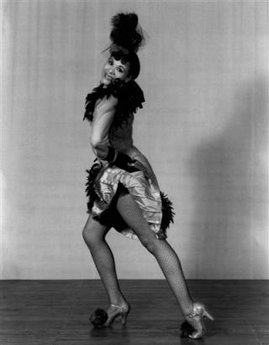
Dancer Katherine Dunham Dies at Age 96
By SAMANTHA GROSS, Associated Press WriterMon May 22, 1:19 AM ET
Katherine Dunham, a pioneering dancer and choreographer, author and civil rights activist who left Broadway to teach culture in one of America's poorest cities, has died. She was 96.
Dunham died Sunday at the Manhattan assisted living facility where she lived, said Charlotte Ottley, executive liaison for the organization that preserves her artistic estate. The cause of death was not immediately known.
Dunham was perhaps best known for bringing African and Caribbean influences to the European-dominated dance world. In the late 1930s, she established the nation's first self-supporting all-black modern dance group.
"We weren't pushing `Black is Beautiful,' we just showed it," she later wrote.
During her career, Dunham choreographed "Aida" for the Metropolitan Opera and musicals such as "Cabin in the Sky" for Broadway. She also appeared in several films, including "Stormy Weather" and "Carnival of Rhythm."
Her dance company toured internationally from the 1940s to the '60s, visiting 57 nations on six continents. Her success was won in the face of widespread discrimination, a struggle Dunham championed by refusing to perform at segregated theaters.
For her endeavors, Dunham received 10 honorary doctorates, the Presidential Medal of the Arts, the Albert Schweitzer Prize at the Kennedy Center Honors, and membership in the French Legion of Honor, as well as major honors from Brazil and Haiti.
"She is one of the very small handful of the most important people in the dance world of the 20th century," said Bonnie Brooks, chairman of the dance department at Columbia College in Chicago. "And that's not even mentioning her work in civil rights, anthropological research and for humanity in general."
After 1967, Dunham lived most of each year in predominantly black East St. Louis, Ill., where she struggled to bring the arts to a Mississippi River city of burned-out buildings and high crime.
She set up an eclectic compound of artists from around the globe, including Harry Belafonte. Among the free classes offered were dance, African hair-braiding and woodcarving, conversational Creole, Spanish, French and Swahili and more traditional subjects such as aesthetics and social science.
Dunham also offered martial arts training in hopes of getting young, angry males off the street. Her purpose, she said, was to steer the residents of East St. Louis "into something more constructive than genocide."
Government cuts and a lack of private funding forced her to scale back her programs in the 1980s. Despite a constant battle to pay bills, Dunham continued to operate a children's dance workshop and a museum.
Plagued by arthritis and poverty in the latter part of her life, Dunham made headlines in 1992 when she went on a 47-day hunger strike to protest U.S. policy that repatriated Haitian refugees.
"It's embarrassing to be an American," Dunham said at the time.
Dunham's New York studio attracted illustrious students like Marlon Brando and James Dean who came to learn the "Dunham Technique," which Dunham herself explained as "more than just dance or bodily executions. It is about movement, forms, love, hate, death, life, all human emotions."
In her later years, she depended on grants and the kindness of celebrities, artists and former students to pay for her day-to-day expenses. Will Smith and Harry Belafonte were among those who helped her catch up on bills, Ottley said.
"She didn't end up on the street though she was one step from it," Ottley said. "She has been on the edge and survived it all with dignity and grace."
Dunham was married to theater designer John Thomas Pratt for 49 years before his death in 1986.
___
Associated Press writer Herbert G. McCann in Chicago contributed to this report.
Contemporary Hip-hop's Inability to Romance
Washington Post
Hip-Hop's Tough-Guy Romance
By Jabari Asim
Monday, May 22, 2006; 12:00 AM
My friend Mark was the first of my college crew to get married. He was also the first to fall so deeply in love that he preferred the company of his intended to hanging out with us guys.
I remember the moment when everything changed. I called him at his girlfriend's place to suggest that he come play basketball, a sport at which he excelled.
"No thanks," he told me. "I'm comfortable where I am."
For a while after that, "comfortable" became our code word for being helplessly under the sway of feminine charms. Being mature, thoughtful young men, we teased our smitten pal at every opportunity. "We're going to the lakeshore," we'd taunt, "but we guess you're too comfortable to go."
We weren't surprised when Mark got married not much later. Twenty-one years have passed since then, and the comfortable couple is still together.
Those heady memories of young adulthood rode back to me on a delightful breeze the other day. The sun was shining, the weather was balmy and it felt like the kind of morning when even the most dedicated company man would entertain thoughts of skipping work. But work, unfortunately, was precisely where I was heading, as soon as I finished pumping gas.
The atmosphere didn't change all that much when a car pulled up near mine. The young man inside had a booming system that blared music powerfully enough to rattle the windows of the service station. I didn't mind. The music had a charming lilt, and the lyrics, though indecipherable, suggested a mellow day much like the one unfolding before me.
The song, I later learned, was by T.I., a popular Atlanta rapper. This particular tune was from his CD called "Urban Legend." In it, T.I. explains that he won't be spending time with his friends because he plans to spend some quality time with his significant other.
As the lyrics of the first verse became clear to me, I actually smiled, remembering when my friends and I began to seriously consider notions of commitment, responsibility and intimate adult relationships. Like my buddy Mark, T.I. was telling his friends that he was comfortable where he was. Then the chorus kicked in and he proclaimed, "I'm chillin' with my bitch today, I'm chillin' with my bitch today."
It's no secret that our popular culture's increasingly tepid offerings on romance reflect a general downward slide in the culture at large. Americans have trouble maintaining committed relationships between consenting adults, so we can hardly blame our artists for showing the same ignorance in their songs, literature and movies. Despite knowing all that, T.I.'s lyrics made my ears itch. In my lifetime, we've descended from Stevie Wonder's "My Cherie Amour," in which he borrows a metaphor from Shakespeare to compare his love to a summer's day, to R. Kelly, who tells a young lady that she reminds him of a jeep. After "Chillin With My Bitch," how much farther can we fall?
I shared my concerns with Sterling Warren, 22, a new graduate of Howard University who plans to be a filmmaker. Talented and ambitious, he's also a devoted hip-hop listener who counts OutKast as his favorite group.
"It's all about being a tough guy now, even when they're talking about relationships," he told me. "Back in the day, rappers were more well-rounded. They were surrounded by dancers and even danced themselves. Now rappers don't dance."
Significantly, when I asked him to name a classic hip-hop song about romance, he mentioned a song that's almost 20 years old -- the same song that I happened to be thinking of myself: "I Need Love" by LL Cool J.
"He was able to put himself in a sympathetic position, now rappers can't do that," Warren said. "If you want to express your love for a woman it has to be in some street-tough way. That's kind of silly. Everybody feels weak from love sometimes and the best artists don't hide their weakness."
Cool J's lyrics remind me that hip-hop artists can indeed express the tenderest of emotions when they choose to:
Romance sheer delight how sweet
I gotta find me a girl to make my life complete
You can scratch my back, we'll get cozy and huddle
I'll lay down my jacket so you can walk over a puddle
I'll give you a rose, pull out your chair before we eat
Kiss you on the cheek and say ooh girl you're so sweet
So it's not Shakespeare or Stevie Wonder. But at least it doesn't make our ears itch. It even makes me feel -- you'd guessed it -- kind of comfortable.
© 2006 The Washington Post Company
Hip-Hop's Tough-Guy Romance
By Jabari Asim
Monday, May 22, 2006; 12:00 AM
My friend Mark was the first of my college crew to get married. He was also the first to fall so deeply in love that he preferred the company of his intended to hanging out with us guys.
I remember the moment when everything changed. I called him at his girlfriend's place to suggest that he come play basketball, a sport at which he excelled.
"No thanks," he told me. "I'm comfortable where I am."
For a while after that, "comfortable" became our code word for being helplessly under the sway of feminine charms. Being mature, thoughtful young men, we teased our smitten pal at every opportunity. "We're going to the lakeshore," we'd taunt, "but we guess you're too comfortable to go."
We weren't surprised when Mark got married not much later. Twenty-one years have passed since then, and the comfortable couple is still together.
Those heady memories of young adulthood rode back to me on a delightful breeze the other day. The sun was shining, the weather was balmy and it felt like the kind of morning when even the most dedicated company man would entertain thoughts of skipping work. But work, unfortunately, was precisely where I was heading, as soon as I finished pumping gas.
The atmosphere didn't change all that much when a car pulled up near mine. The young man inside had a booming system that blared music powerfully enough to rattle the windows of the service station. I didn't mind. The music had a charming lilt, and the lyrics, though indecipherable, suggested a mellow day much like the one unfolding before me.
The song, I later learned, was by T.I., a popular Atlanta rapper. This particular tune was from his CD called "Urban Legend." In it, T.I. explains that he won't be spending time with his friends because he plans to spend some quality time with his significant other.
As the lyrics of the first verse became clear to me, I actually smiled, remembering when my friends and I began to seriously consider notions of commitment, responsibility and intimate adult relationships. Like my buddy Mark, T.I. was telling his friends that he was comfortable where he was. Then the chorus kicked in and he proclaimed, "I'm chillin' with my bitch today, I'm chillin' with my bitch today."
It's no secret that our popular culture's increasingly tepid offerings on romance reflect a general downward slide in the culture at large. Americans have trouble maintaining committed relationships between consenting adults, so we can hardly blame our artists for showing the same ignorance in their songs, literature and movies. Despite knowing all that, T.I.'s lyrics made my ears itch. In my lifetime, we've descended from Stevie Wonder's "My Cherie Amour," in which he borrows a metaphor from Shakespeare to compare his love to a summer's day, to R. Kelly, who tells a young lady that she reminds him of a jeep. After "Chillin With My Bitch," how much farther can we fall?
I shared my concerns with Sterling Warren, 22, a new graduate of Howard University who plans to be a filmmaker. Talented and ambitious, he's also a devoted hip-hop listener who counts OutKast as his favorite group.
"It's all about being a tough guy now, even when they're talking about relationships," he told me. "Back in the day, rappers were more well-rounded. They were surrounded by dancers and even danced themselves. Now rappers don't dance."
Significantly, when I asked him to name a classic hip-hop song about romance, he mentioned a song that's almost 20 years old -- the same song that I happened to be thinking of myself: "I Need Love" by LL Cool J.
"He was able to put himself in a sympathetic position, now rappers can't do that," Warren said. "If you want to express your love for a woman it has to be in some street-tough way. That's kind of silly. Everybody feels weak from love sometimes and the best artists don't hide their weakness."
Cool J's lyrics remind me that hip-hop artists can indeed express the tenderest of emotions when they choose to:
Romance sheer delight how sweet
I gotta find me a girl to make my life complete
You can scratch my back, we'll get cozy and huddle
I'll lay down my jacket so you can walk over a puddle
I'll give you a rose, pull out your chair before we eat
Kiss you on the cheek and say ooh girl you're so sweet
So it's not Shakespeare or Stevie Wonder. But at least it doesn't make our ears itch. It even makes me feel -- you'd guessed it -- kind of comfortable.
© 2006 The Washington Post Company
Sunday, May 21, 2006
BabyFirst: Television Steps Perilously Close to the Womb

New York Times
May 21, 2006
BabyFirst: Television Steps Perilously Close to the Womb
By DAVE ITZKOFF
WHO can we now rely upon in an age when Big Bird is no longer considered trustworthy? Earlier this year, when the Sesame Workshop released a DVD series, "Sesame Beginnings," designed for children 6 months to 2 years old, it sparked a surprisingly intense debate: public health advocates attacked the studio behind Bert and Ernie, insisting that no amount of television viewing is appropriate for children that young.
Yet the more fervently the television industry is warned about such dangers, the more intently it seems to want to touch the stove. The Disney Channel has recently turned "Mickey Mouse Clubhouse," an animated show intended to reintroduce Walt Disney's cash rodent to preschoolers aged 2 to 5, into a bona fide hit.
And last week, a channel called BabyFirstTV, initially available to DirecTV subscribers, became the first 24-hour cable and satellite network to offer programming aimed at viewers between 6 months and 3 years old.
Before advocacy groups take their shot BabyFirstTV, perhaps they should give a thought — quickly, before Viacom launches MTV Zygote and Nickelodeon Embryo — to the poor programmers charged with developing such content. Toddlers may be good at communicating what they want in a sippee cup, but they are not nearly as effective at conveying what they want in a television show: they simply will not sit still at focus groups, and are more likely to masticate extensive research questionnaires than to fill them out.
 One of the segments on BabyFirstTV, "Picture Pad," introduces viewers to the notion of creating art. Disembodied hands gradually render an illustration with colored pencils.
The founders of BabyFirstTV (including a former executive of the advertising firm BBDO and the former head of operations for the Israeli Network) clearly came prepared to immunize their offspring against the same criticism that "Sesame Beginnings" faced: they issued a guidebook full of approving pediatricians, psychologists and educators and the repeated injunction to parents to take an active role in their children's viewing. The guide says that television can "enlighten your baby's experience by opening up a world of imagination and images that he ordinarily wouldn't see in everyday life."
As you'd expect from new parents, it all sounds a bit boastful and a bit defensive. Especially when measured against the actual content of BabyFirstTV, some of the most gently benign programming ever to float across the airwaves. In almost every way, BabyFirstTV is an ideal match for its prospective demographic — at its best it is spirited, lively and full of simple wonder, and at its worst it is utterly innocuous.
The lineup consists entirely of short-form videos, both live-action and animated. There are no commercial breaks between shorts, and as viewers more accustomed to "CSI," "24" or "The O'Reilly Factor" will immediately notice, the pacing is decidedly unhurried: when an on-screen graphic introduces a segment about giraffes, you can expect several minutes of grazing herbivores, and when a cartoon jigsaw puzzle assembles itself, you'd better believe its pieces will try every possible configuration before the picture is complete.
Beyond the consistently bright palettes and upbeat instrumental music found in each video, the only element that unites these shorts is the BabyFirstTV logo, a smiling flower whose petals change color to indicate the types of skills the segment is intended to teach: a yellow flower, for example, signifies a lesson on patterns of thinking (like a recurring, one-of-these-things-is-not-like-the-other routine called "What's Different?"), while red stands for language and vocabulary (a short film about sign language), and pink means social and emotional skills (a video of children playing in a park).
The gradations can be so subtle at times that one wonders if the distinctions are even necessary, particularly when some of BabyFirstTV's best segments are those that teach lessons that can't be as easily categorized — catchy songs about why it's O.K. for a parent to put your security blanket in the washing machine, or what will happen if you try to cram too many things in a closet — or those that appear to teach no lesson at all.
It is when BabyFirstTV devotes valuable minutes to images of nothing more complicated than exotic animals wandering in the jungle, or infants playing in a pit of plastic balls, that it comes closest to fulfilling its mission: providing its young audience with one more window into an exciting, unknown world where every sensory stimulation is brand new, and is potentially being experienced for the very first time.
And if BabyFirstTV's viewers are anything like this former child, they will eagerly anticipate the many short films that introduce them to the experience of creating art, like "Picture Pad," in which a pair of disembodied hands slooooowly sketches an illustration with colored pencils, and "Sandman," an utterly transfixing segment in which an artist draws a picture with his fingertips on a backlit canvas of sand. (Not surprisingly, "Sandman" turns up with particular frequency on "Rainbow Dreams," the channel's late-night schedule meant to lull restless viewers of all ages back to sleep.)
What none of these videos seem to need are the superimposed cloud graphics that appear at the bottom of screen from time to time, containing textual reminders to parents that all but insist how each segment should be experienced with one's child ("Name and describe the objects on the screen to your infant"; "Make the animal's sound and encourage your child to do the same").
If BabyFirstTV is confident that its programming contains educational value, then it should also be confident that parents can figure out this value for themselves, and flexible enough to allow parents to use its programming in ways they may not have intended or anticipated. (Can't a segment about a family of lions teach more than the fact that they go "Roar"?) As they are used now, these interruptions feel less like an encouragement for parents to stay involved, and more like a gentle scolding to adults whose own attention spans may be momentarily waning.
To its credit, BabyFirstTV does not exude the same high-pressure atmosphere surrounding the Disney-owned "Baby Einstein" video series, which convinces parents they have failed if their progeny are not certifiable geniuses by the time they turn 2.
Nor does it exist to promote a boundless cornucopia of licensed merchandise; though BabyFirstTV is populated by its share of anthropomorphized mice, elephants and rabbits, and at least one cartoon jackdaw voiced by the Welsh actor Rhys Ifans, none of these characters have been commodified on American shores as stuffed toys, board games or designer baby bibs. This is a commendable quality, but it may also prove to be a stumbling block as the channel tries to establish itself on a cultural landscape already dominated by "Teletubbies," "Dora the Explorer" and Jim Henson's unparalleled Muppet pantheon.
Where BabyFirstTV will likely suffer most is in the minds of older viewers who cannot help but compare it to their own halcyon memories of "Sesame Street." BabyFirstTV may not yet have its own set of recognizable icons for children to latch on to, but the more obvious deficiency is its lack of pacing: there are no apparent thematic threads that tie its segments together — no obvious reasons why a video short about fingers and thumbs should be followed by a cartoon about what sound a duck makes, followed by another cartoon about what scientists do. Without a clearly defined beginning, middle and end to its programming blocks, there is no compelling need to turn on BabyFirstTV at any particular time of day, but more tellingly, there is no obvious indication — other than the alarm bells on an adult's internal clock — that it is time to turn it off.
In all fairness, "Sesame Street" has had more than 35 years to perfect its art, while BabyFirstTV has only been on the air a few days, and if its only ambition is to offer a few simple lessons in an entertaining and occasionally surprising format, it deserves many more months to hone its lineup.
There may be innumerable other purveyors of educational content that in the course of a sing-along song about the alphabet would fall back on predictable words like "fox" and "X-ray" to demonstrate the sound made by the letter X. But BabyFirstTV is thus far the only outlet I've seen that would go the extra distance and illustrate this point with the surreal image of a cartoon fox, its bones aglow as it stands behind an X-ray machine. Given enough time, the channel could eventually forge a language of its own from those same 26 familiar, perpetually mystifying symbols.
Monster Metal Finns Win Euro-Vision

Finns 'Turn the Amps Up,' Win Eurovision
By JILL LAWLESS, Associated Press WriterSat May 20, 11:01 PM ET
There's a giant stadium, highly toned participants, intense rivalry and flag-waving fans from many nations.
It's not the Olympics: It's the Eurovision Song Contest, the annual kitsch extravaganza, known for its bland dance music and bubble-gum pop, that sees acts from 24 countries face off before tens of millions of television viewers.
But in a stunning upset for the contest that launched the Swedish group ABBA, a Finnish metal band with monster masks and apocalyptic lyrics won the contest late Saturday.
The band Lordi scandalized some of their compatriots when their song "Hard Rock Hallelujah" was chosen to represent the nation. At a press conference, the band's frontman said his plan for the final was to "scream louder. And turn the amps up."
"This is a victory for rock music ... and also a victory for open-mindedness," the band's lead singer, Mr. Lordi, said after the win — Finland's first. "We are not Satanists. We are not devil-worshippers. This is entertainment."
Combining crunchy guitars, a catchy chorus and mock-demonic imagery, Lordi is reminiscent of U.S. '70s stars KISS — an acknowledged inspiration of Mr. Lordi.
Band members never appear without their elaborate masks and makeup, and do not reveal their true names.
Lordi beat an unusually eclectic 24-nation field, which ranged from the perky pop of Danish teenager Sidsel Ben Semmane and Malta's Fabrizio Faniello to the balladry of Ireland's Brian Kennedy and the country-pop of Germany's Texas Lightning.
Regarded by many as the contest good taste forgot, Eurovision is adored by fans of camp everywhere.
"You don't imagine something so bad could be so good," said Carmela Pellegrino, an Australian who traveled to Athens from London to watch rehearsal ahead of Saturday's finale.
Since 1956, it has pitted European nations against one another in pursuit of pop music glory. Previous winners include '60s chanteuse Lulu, ABBA — victors in 1974 with "Waterloo" — and Canada's Celine Dion, who won for Switzerland in 1988.
Saturday's showdown was broadcast live in 38 countries to a TV audience estimated at 100 million. Some 13,000 fans packed the indoor arena used during the 2004 Olympic Games, from Goth supporters of Lordi to cowboy-hatted Germans supporting Texas Lightning. Some 3,000 police officers were on duty for the event.
NBC announced plans earlier this year to replicate the formula — a forerunner of "American Idol"-style talent contests — in the United States, with acts from different states competing for viewers' approval.
The European Broadcasting Union, which runs Eurovision, said it was in talks with NBC over rights. If successful, the American version could go ahead as early as this fall, said the group's director of television, Bjorn Erichsen.
Athens staged the event because Greece won last year in Kiev, Ukraine.
Lordi received a trophy shaped like an ancient Greek column, and the show opened with a garish musical number inspired, organizers said, by Greece's rich history, mythology and sparkling seas. The hosts — Greek pop singer Sakis Rouvas and "Access Hollywood" correspondent Maria Menounous — made their entrance by "flying" onto the set, which resembled an ancient theater.
Some of the acts, like Switzerland's Six4One, stuck to the classic Eurovision formula of catchy tunes and blandly uplifting lyrics, singing, "If we all give a little, we can make this world a home for everyone."
Ireland's Brian Kennedy offered a syrupy ballad entitled "Every song is a cry for love," while Bosnia's Hari Mata Hari said it hoped to bring people together with the love song "Lejla."
Some acts were more daring: Latvia's Cosmos perform a cappella on "I Hear Your Heart." Others were optimistic: "We are the Winners," by Lithuania's LT United, consists largely of the lyrics "We are the winners of Eurovision."
Yet Eurovision victory is no guarantee of fame.
Dion and ABBA went on to glory — as did Olivia Newton John, who lost to ABBA while competing for Britain in 1974. Other winners have sunk without trace, victims of the "curse of Eurovision."
Many of this year's competitors are big stars in their home region but little known elsewhere. Swedish diva Carola — a previous winner, in 1991 — has sold millions of records, while Lithuania's Andrius Mamontovas has performed for crowds of 60,000 in his homeland.
___
On the Net:
http://www.eurovision.tv
Saturday, May 20, 2006
The Dixie Chicks: America Catches Up With Them

New York Times
May 21, 2006
The Dixie Chicks: America Catches Up With Them
By JON PARELES
THE DIXIE CHICKS call it "the Incident": the anti-Bush remark that Natalie Maines, their lead singer, made onstage in London in 2003. "Just so you know, we're ashamed the president of the United States is from Texas," said Ms. Maines, a Texan herself.
It led to a partisan firestorm, a radio boycott, death threats and, now, to an album that's anything but repentant: "Taking the Long Way" (Open Wide/Monument/ Columbia). The Dixie Chicks — Ms. Maines, Emily Robison and Martie Maguire — were the top-selling country group of the late 1990's and early 2000's. After country's gatekeepers disowned them over politics, they decided to keep their politics and let country music fend for itself.
The Incident is very much at the center of "Taking the Long Way." The album could have been "way safe and scared," Ms. Maines said. "We could have pandered." They didn't. The new songs are filled with reactions, direct and oblique, to the Incident. There are no apologies.
"We had to make this album," Ms. Maines said. "We could not have gotten past any of this without making this album. Even if nobody ever heard it."
The Dixie Chicks were in New York this month to make media appearances and to perform at the party for this year's Time 100, the magazine's list of influential people, which includes them. Sitting around a dinner table in a Chelsea loft that Ms. Maines owns but hasn't used much — a former gallery with artist friends' paintings parked on the brick walls — the three Dixie Chicks dug into takeout Italian food and sipped red wine. "I've thought about all this way too much," Ms. Maines said.
"Taking the Long Way," due out on Tuesday, is the first Dixie Chicks album on which group members collaborated in writing all the songs. The first single, "Not Ready to Make Nice," declares, "I'm not ready to back down/I'm still mad as hell," and starts with a tolling guitar more suitable for a Metallica dirge than a honky-tonk serenade. The Dixie Chicks and their manager insisted to their record company that "we need to approach everything like not one radio station is going to play one single song," Ms. Maines said. Asked about country radio, she said, "Do you really think we're going to make an album for you and trust the future of our career to people who turned on us in a day?"
Instead the album wraps gleaming California rock around its raw emotions. Although there's plenty of country in the music, "Taking the Long Way" reaches not for the lucrative yet insular country airwaves but for an adult pop mainstream. Meanwhile the core country audience may not be so hostile anymore. The album arrives at a time when approval for President Bush has dropped to as low as 29 percent, in a recent Harris Interactive poll.
On Amazon.com, preorders recently placed "Taking the Long Way" at No. 5 in a Top 10 that also includes albums with antiwar songs by Bruce Springsteen, Neil Young, Paul Simon and Pearl Jam.
For those who expect knee-jerk Republicanism from country singers, the Dixie Chicks never fit the stereotype to begin with. "I always knew people thought that about us, and it bugged me," Ms. Maines said. "Because I knew who we were, and I knew who I've been my whole life. So to me it was such a relief for people to know."
The Incident occurred on March 10, 2003, 10 days before the United States invaded Iraq. "It felt pretty trite to me to be doing a show on what was supposed to be the eve before war," Ms. Maines said, "and not say anything about it. At that stage too everyone in Europe, or everyone outside of the U.S., talked about the U.S. like we all thought one way. So it was important for me to let them know that you can't group us all into one."
Her remark was reported in Britain and quickly picked up. Right-wing blogs and talk shows vilified the Dixie Chicks as unpatriotic and worse, and the Incident reached the nightly news. On March 12 a Web site statement from Ms. Maines said: "I feel the president is ignoring the opinion of many in the U.S. and alienating the rest of the world. My comments were made in frustration, and one of the privileges of being an American is you are free to voice your own point of view." On March 14, 2003, she apologized to President Bush for being "disrespectful" to his office, but added, "I just want to see every possible alternative exhausted before children and American soldiers' lives are lost."
At the Time 100 party a few days before this interview, the Dixie Chicks performed "Not Ready to Make Nice." Afterward Ms. Maines recounted, the Fox News commentator Bill O'Reilly — who has regularly denounced her, and whom she pointedly calls "despicable" — rushed over to greet them. "It's like, 'Just want to say that was great!' " Ms. Maines said. " 'I really like that new song.' "
"And I go, 'But two million tops, right?' And he goes, 'What?' And I said, 'I saw your show when you said we wouldn't sell more than two million, tops.' And he was like, 'Oh, ah, well, two million's pretty good these days, right?' And I was just like, 'Right, yeah. You were saying it in a positive way.' "
Ms. Robison interrupted, laughing. "That's what you call a no-spin zone."
"So then he was just backtracking," Ms. Maines continued. "He says: 'We really respect what you did. And we really respect that you stand up for yourself and blah blah blah. We just wish you would say it over here.' And I said, 'I'll say it over here.' "
The complaint that she criticized the president on foreign soil has been a talk-radio talking point. Ms. Maines dismisses it. "It wasn't like we played 20 shows in America and I was saving up this comment for London," she said. "I was in London when the war was about to start. That's where I said it. I would have said it anywhere, because I didn't think that it was a bad thing to say or a controversial thing to say."
(The next day on "The O'Reilly Factor," Mr. O'Reilly acknowledged that Ms. Maines had "chided" him. He mentioned the radio boycott but did not endorse it. "Not Ready to Make Nice" is "a pretty good song," he said. "There's no reason not to play it.")
Ms. Maines's free speech was costly. Country radio stations were bombarded with calls demanding that the Dixie Chicks be dropped from playlists. Within days, songs from the Chicks' 2002 album, "Home," virtually disappeared from American airwaves. They had the No. 1 country single that week with "Travelin' Soldier," which mourns a soldier killed in Vietnam; it plummeted to No. 63.
The Dixie Chicks' two previous albums, "Wide Open Spaces" (1998) and "Fly" (1999), had each been certified "diamond" for shipping more than 10 million copies in the United States. Without airplay, "Home" stalled that March at six million.
"I understand everybody was in a place of fear, and everybody's nerves were on edge, and mothers were sending their sons and daughters off to war, and tensions were high," Ms. Maguire said. "But you know when it continues and continues and people are still mad about it, I think back to those words and think: How is that bad, what she said? It's so harmless. It's so nothing."
The United States concerts on the Dixie Chicks' tour were already sold out. Promoters offered refunds, although there were more requests for new tickets than there were returns. Protesters showed up outside concerts; others burned Dixie Chicks albums.
"We have video footage of this lady at one of the shows protesting, holding her 2-year-old son," Ms. Maines said. The woman commanded her son to shout along with an angry chant. "And I was just like, that's it right there. That's the moment that it's taught. She just taught her 2-year-old how to hate. And that broke my heart."
The band received death threats, including at least one, in Dallas, that the F.B.I. considered credible. A newspaper printed Ms. Maines's home address in Austin, Tex., and she ended up moving first outside the city and then to Los Angeles. On the American tour a handful of boos were drowned out by fervent cheers. Suddenly there was more at stake than toe-tapping tunes.
In a way there always had been. The Dixie Chicks were never a typical country act. They got started in Texas, not Nashville. And their music is built around a country rarity: female instrumentalists. Ms. Robison plays fiddle, and Ms. Maguire plays banjo; they are sisters, and they helped found the Dixie Chicks as a bluegrass band in Dallas in 1989. After Ms. Maines replaced the group's lead singer in 1995, the Dixie Chicks became a voice of assertive, irreverent femininity in mainstream country. They also brought the sound of the banjo, once considered "too country," back to country radio.
While the Dixie Chicks' music was never confrontational, each album grew bolder. In the upbeat "Goodbye Earl," a hit from "Fly," an abused wife murders her husband and gets away with it. The album "Home" — made in Austin and produced by the Dixie Chicks themselves along with Lloyd Maines, Natalie's father — deliberately set aside the slick, electric sound of current country for a largely acoustic, bluegrass-rooted production and some haunted songs.
After their own tour ended — it was the top-grossing country music tour of 2003 — the Dixie Chicks joined the Vote for Change concert series supporting John Kerry. They had babies; Ms. Maguire and Ms. Robison both had twins. And they decided to record their next album in Los Angeles. The producer they chose was Rick Rubin, who has made albums with the Beastie Boys, the Red Hot Chili Peppers, Johnny Cash and Shakira. The Incident had sparked Mr. Rubin's interest.
"After the Incident everyone started taking what they said seriously," Mr. Rubin said by telephone from Los Angeles. "To take a band that's popular not for that reason and give them that power seemed very exciting.
"It's the biggest thing that's ever happened to them, and it rattled them and it changed them," he added. "The pain of it is really lingering. I thought they needed to somehow address what happened in a way that was truthful about how they felt, whatever that was. I just wanted it to be an honest reflection of that, but also told in a way that if you didn't know what happened to them and just heard the songs, you might relate to it anyway."
On previous albums the Dixie Chicks wrote the more lighthearted songs and got serious material from other songwriters. This time, Ms. Maines said, "We knew we had things to write about." Mr. Rubin brought in co-writers including Gary Louris, from the Jayhawks, and Dan Wilson, from Semisonic. "They took the fear out of us," said Ms. Maines. "You know, 'You need to say that because that's the truth and that's the way you feel.' "
The studio band included the Chili Peppers' drummer, Chad Smith, and the guitarist Mike Campbell from Tom Petty's Heartbreakers. Mr. Rubin encouraged the Dixie Chicks to experiment on arrangements. With its layered acoustic guitars and elaborate vocal harmonies, "Taking the Long Way" often has more in common with 1970's Fleetwood Mac than with bluegrass or the Southern-rock electric guitars of the Nashville Muzic Mafia behind Gretchen Wilson and Big & Rich. ("Home" included the Dixie Chicks' version of Fleetwood Mac's "Landslide," which became a hit single.)
"I Like It" evolves from stark acoustic guitar to an ebullient Motown beat, while the gorgeous "Lullaby" uses no drums at all, as vocal harmonies cascade amid gently picked strings.
The Dixie Chicks sound determined not to whine on "Taking the Long Way," and they focus on personal reactions, not protests. The album is a defiant autobiography of their career, and "Not Ready to Make Nice" mentions the death threats after the Incident. But until it does, the song could be about the resentment following any breakup or betrayal.
"Lubbock or Leave It," a fierce country-rocker, describes Ms. Maines's Texas hometown as a hypocritical "fool's paradise" with "more churches than trees," blind to its own problems. But there aren't many other specifics on the album. Without the Dixie Chicks' back story, the songs work as meticulous pop vows of loyalty and determination.
Still, the Incident keeps peeking through the pretty arrangements. The countryish mandolin and pedal steel guitar of "Everybody Knows" carry the confession: "All the things I can't erase from my life/Everybody knows." An affectionate ballad, "Easy Silence," praises a companion who provides a refuge when "Anger plays on every station/Answers only make more questions." In the fiddle-topped waltz "Bitter End," one verse mocks fair-weather supporters: "As long as I'm the shiniest star,/Oh there you are." The album's finale, a gospel-soul anthem called "I Hope," insists, "I don't wanna hear nothin' else/About killin' and that it's God's will."
Three years after the Incident the Dixie Chicks insist that it liberated them. "When, no matter what you do, everybody's going to punch holes in it, then you just go and you do what you want," Ms. Maguire said. "And that's the most freeing place to be."
Ms. Maines added: "It will mean a lot to me if people buy the album just sort of out of protest. The naysayers and the people who were so organized to take us down did a really good job. And they succeeded. So it feels good to let the music win out in the end and say, 'Even your hatred can't stop what people want to listen to.' "
A smiling Ms. Maguire had the last word. "See you at the diamond record party," she said.
Thursday, May 18, 2006
Cheating in College; New Millenium edition
New York Times
May 18, 2006
Colleges Chase as Cheats Shift to Higher Tech
By JONATHAN D. GLATER
LOS ANGELES — At the University of California at Los Angeles, a student loaded his class notes into a handheld e-mail device and tried to read them during an exam; a classmate turned him in. At the journalism school at San Jose State University, students were caught using spell check on their laptops when part of the exam was designed to test their ability to spell.
And at the University of Nevada, Las Vegas, after students photographed test questions with their cellphone cameras, transmitted them to classmates outside the exam room and got the answers back in text messages, the university put in place a new proctoring system.
"If they'd spend as much time studying," said an exasperated Ron Yasbin, dean of the College of Sciences at U.N.L.V., "they'd all be A students."
With their arsenal of electronic gadgets, students these days find it easier to cheat. And so, faced with an array of inventive techniques in recent years, college officials find themselves in a new game of cat and mouse, trying to outwit would-be cheats this exam season with a range of strategies — cutting off Internet access from laptops, demanding the surrender of cellphones before tests or simply requiring that exams be taken the old-fashioned way, with pens and paper.
"It is kind of a hassle," said Ryan M. Dapremont, 21, who just finished his third year at Pepperdine University, and has had to take his exams on paper.
"My handwriting is so bad," he said. "Whenever I find myself having to write in a bluebook, I find my hand cramps up more, and I can't write as quickly."
Mr. Dapremont said technology had made cheating easier, but added that plagiarism in writing papers was probably a bigger problem because students can easily lift other people's writings off the Internet without attributing them.
Still, some students said they thought cheating these days was more a product of the mind-set, not the tools at hand.
"Some people put a premium on where they're going to go in the future, and all they're thinking about is graduate school and the next step," said Lindsay Nicholas, a third-year student at U.C.L.A. She added that pressure to succeed "sometimes clouds everything and makes people do things that they shouldn't do."
In a survey of nearly 62,000 undergraduates on 96 campuses over the past four years, two-thirds of the students admitted to cheating. The survey was conducted by Don McCabe, a Rutgers professor who has studied academic misconduct and helped found the Center for Academic Integrity at Duke.
David Callahan, author of "The Cheating Culture: Why More Americans Are Doing Wrong to Get Ahead" (Harcourt, 2004), suggested that students today feel more pressure to do well in order to get into graduate or professional school and secure a job.
"The rational incentives to cheat for college students have grown dramatically, even as the strength of character needed to resist those temptations has weakened somewhat," Mr. Callahan said.
Whatever the reasons for cheating, college officials say the battle against it is wearing them out.
Though Brian Carlisle, associate dean of students at U.C.L.A., said most students did not cheat, he spoke wearily about cases of academic dishonesty.
He told of the student who loaded his notes onto the Sidekick portable e-mail device last fall; students who have sought help from friends with such devices; students who have preprogrammed calculators with formulas. Some students have even deigned to use the traditional cheat sheet, he said.
"One of the things that we're going to be paying close attention to as time goes on is the use of iPods," Professor Carlisle added, pointing out that with a wireless earpiece, these would be hard to detect.
The telltale iPod headphone wire proved the downfall of a Pepperdine student a couple of years ago, after he had dictated his notes into the portable music player and tried to listen to them during an exam.
"I have taught for 30 years and each year something new comes on the scene," Sonia Sorrell, the professor who caught the student, said in an e-mail message.
At the Anderson School of Management at U.C.L.A., the building's wireless Internet hotspot is turned off during finals to thwart Internet access.
Richard Craig, a professor at the School of Journalism and Mass Communications at San Jose State, who caught students using spell check last year, said that for tests, he arranged the classroom desks so that the students faced away from him but he could see their desktop screens.
"It was just a devilishly simple way to handle it," Professor Craig said.
At the University of Nevada, Professor Yasbin, the dean, was not the only one upset by the camera phone cheating episode there, which occurred in 2003; honest students were appalled, too. They suggested that they police one another, by being exam proctors.
"The students walk around the classroom, and if they see something suspicious, they report it," Professor Yasbin said.
Amanda M. Souza, a third-year undergraduate who heads the proctor program, said her classmates had decidedly mixed reactions to the student monitors.
"The ones that aren't cheating think it's a great idea, " she said. "You always see students who are really well prepared covering their papers. But the ones that aren't prepared, probably don't like us."
At Mercer County Community College in West Windsor, N.J., students must clear their calculators' memory and sometimes relinquish their cellphones before tests. At Brigham Young University, exams are given in a testing center, where electronic devices are generally banned.
In some classes at Butler University in Indianapolis, professors use software that allows them to observe the programs running on computers students are taking tests on. And some institutions even install cameras in rooms where tests are administered.
To take a final exam last week, Alyssa Soares, a third-year law student at U.C.L.A., had to switch on software that cut her laptop's Internet access, wireless capability and even the ability to read her own saved files. Her computer, effectively, became a glorified typewriter. Ms. Soares, 28, said she did not mind. "This is making sure everyone is on a level playing field," she said.
Several professors said they tried to write exams on which it was hard to cheat, posing questions that outside resources would not help answer. And at many institutions, officials said that they rely on campus honor codes.
Several professors said the most important thing was to teach students not to cheat in the first place.
Timothy Dodd, executive director of the Center for Academic Integrity, said creating a "nuclear deterrent" to cheating in class, and perhaps implying that it is acceptable elsewhere, "is antithetical to what we should be doing as educators."
May 18, 2006
Colleges Chase as Cheats Shift to Higher Tech
By JONATHAN D. GLATER
LOS ANGELES — At the University of California at Los Angeles, a student loaded his class notes into a handheld e-mail device and tried to read them during an exam; a classmate turned him in. At the journalism school at San Jose State University, students were caught using spell check on their laptops when part of the exam was designed to test their ability to spell.
And at the University of Nevada, Las Vegas, after students photographed test questions with their cellphone cameras, transmitted them to classmates outside the exam room and got the answers back in text messages, the university put in place a new proctoring system.
"If they'd spend as much time studying," said an exasperated Ron Yasbin, dean of the College of Sciences at U.N.L.V., "they'd all be A students."
With their arsenal of electronic gadgets, students these days find it easier to cheat. And so, faced with an array of inventive techniques in recent years, college officials find themselves in a new game of cat and mouse, trying to outwit would-be cheats this exam season with a range of strategies — cutting off Internet access from laptops, demanding the surrender of cellphones before tests or simply requiring that exams be taken the old-fashioned way, with pens and paper.
"It is kind of a hassle," said Ryan M. Dapremont, 21, who just finished his third year at Pepperdine University, and has had to take his exams on paper.
"My handwriting is so bad," he said. "Whenever I find myself having to write in a bluebook, I find my hand cramps up more, and I can't write as quickly."
Mr. Dapremont said technology had made cheating easier, but added that plagiarism in writing papers was probably a bigger problem because students can easily lift other people's writings off the Internet without attributing them.
Still, some students said they thought cheating these days was more a product of the mind-set, not the tools at hand.
"Some people put a premium on where they're going to go in the future, and all they're thinking about is graduate school and the next step," said Lindsay Nicholas, a third-year student at U.C.L.A. She added that pressure to succeed "sometimes clouds everything and makes people do things that they shouldn't do."
In a survey of nearly 62,000 undergraduates on 96 campuses over the past four years, two-thirds of the students admitted to cheating. The survey was conducted by Don McCabe, a Rutgers professor who has studied academic misconduct and helped found the Center for Academic Integrity at Duke.
David Callahan, author of "The Cheating Culture: Why More Americans Are Doing Wrong to Get Ahead" (Harcourt, 2004), suggested that students today feel more pressure to do well in order to get into graduate or professional school and secure a job.
"The rational incentives to cheat for college students have grown dramatically, even as the strength of character needed to resist those temptations has weakened somewhat," Mr. Callahan said.
Whatever the reasons for cheating, college officials say the battle against it is wearing them out.
Though Brian Carlisle, associate dean of students at U.C.L.A., said most students did not cheat, he spoke wearily about cases of academic dishonesty.
He told of the student who loaded his notes onto the Sidekick portable e-mail device last fall; students who have sought help from friends with such devices; students who have preprogrammed calculators with formulas. Some students have even deigned to use the traditional cheat sheet, he said.
"One of the things that we're going to be paying close attention to as time goes on is the use of iPods," Professor Carlisle added, pointing out that with a wireless earpiece, these would be hard to detect.
The telltale iPod headphone wire proved the downfall of a Pepperdine student a couple of years ago, after he had dictated his notes into the portable music player and tried to listen to them during an exam.
"I have taught for 30 years and each year something new comes on the scene," Sonia Sorrell, the professor who caught the student, said in an e-mail message.
At the Anderson School of Management at U.C.L.A., the building's wireless Internet hotspot is turned off during finals to thwart Internet access.
Richard Craig, a professor at the School of Journalism and Mass Communications at San Jose State, who caught students using spell check last year, said that for tests, he arranged the classroom desks so that the students faced away from him but he could see their desktop screens.
"It was just a devilishly simple way to handle it," Professor Craig said.
At the University of Nevada, Professor Yasbin, the dean, was not the only one upset by the camera phone cheating episode there, which occurred in 2003; honest students were appalled, too. They suggested that they police one another, by being exam proctors.
"The students walk around the classroom, and if they see something suspicious, they report it," Professor Yasbin said.
Amanda M. Souza, a third-year undergraduate who heads the proctor program, said her classmates had decidedly mixed reactions to the student monitors.
"The ones that aren't cheating think it's a great idea, " she said. "You always see students who are really well prepared covering their papers. But the ones that aren't prepared, probably don't like us."
At Mercer County Community College in West Windsor, N.J., students must clear their calculators' memory and sometimes relinquish their cellphones before tests. At Brigham Young University, exams are given in a testing center, where electronic devices are generally banned.
In some classes at Butler University in Indianapolis, professors use software that allows them to observe the programs running on computers students are taking tests on. And some institutions even install cameras in rooms where tests are administered.
To take a final exam last week, Alyssa Soares, a third-year law student at U.C.L.A., had to switch on software that cut her laptop's Internet access, wireless capability and even the ability to read her own saved files. Her computer, effectively, became a glorified typewriter. Ms. Soares, 28, said she did not mind. "This is making sure everyone is on a level playing field," she said.
Several professors said they tried to write exams on which it was hard to cheat, posing questions that outside resources would not help answer. And at many institutions, officials said that they rely on campus honor codes.
Several professors said the most important thing was to teach students not to cheat in the first place.
Timothy Dodd, executive director of the Center for Academic Integrity, said creating a "nuclear deterrent" to cheating in class, and perhaps implying that it is acceptable elsewhere, "is antithetical to what we should be doing as educators."
Sunday, May 14, 2006
Digitizing Book: A Revolution in Knowledge
New York Times Magazine
May 14, 2006
Scan This Book!
By KEVIN KELLY
Correction Appended
In several dozen nondescript office buildings around the world, thousands of hourly workers bend over table-top scanners and haul dusty books into high-tech scanning booths. They are assembling the universal library page by page.
The dream is an old one: to have in one place all knowledge, past and present. All books, all documents, all conceptual works, in all languages. It is a familiar hope, in part because long ago we briefly built such a library. The great library at Alexandria, constructed around 300 B.C., was designed to hold all the scrolls circulating in the known world. At one time or another, the library held about half a million scrolls, estimated to have been between 30 and 70 percent of all books in existence then. But even before this great library was lost, the moment when all knowledge could be housed in a single building had passed. Since then, the constant expansion of information has overwhelmed our capacity to contain it. For 2,000 years, the universal library, together with other perennial longings like invisibility cloaks, antigravity shoes and paperless offices, has been a mythical dream that kept receding further into the infinite future.
Until now. When Google announced in December 2004 that it would digitally scan the books of five major research libraries to make their contents searchable, the promise of a universal library was resurrected. Indeed, the explosive rise of the Web, going from nothing to everything in one decade, has encouraged us to believe in the impossible again. Might the long-heralded great library of all knowledge really be within our grasp?
Brewster Kahle, an archivist overseeing another scanning project, says that the universal library is now within reach. "This is our chance to one-up the Greeks!" he shouts. "It is really possible with the technology of today, not tomorrow. We can provide all the works of humankind to all the people of the world. It will be an achievement remembered for all time, like putting a man on the moon." And unlike the libraries of old, which were restricted to the elite, this library would be truly democratic, offering every book to every person.
But the technology that will bring us a planetary source of all written material will also, in the same gesture, transform the nature of what we now call the book and the libraries that hold them. The universal library and its "books" will be unlike any library or books we have known. Pushing us rapidly toward that Eden of everything, and away from the paradigm of the physical paper tome, is the hot technology of the search engine.
1. Scanning the Library of Libraries
Scanning technology has been around for decades, but digitized books didn't make much sense until recently, when search engines like Google, Yahoo, Ask and MSN came along. When millions of books have been scanned and their texts are made available in a single database, search technology will enable us to grab and read any book ever written. Ideally, in such a complete library we should also be able to read any article ever written in any newspaper, magazine or journal. And why stop there? The universal library should include a copy of every painting, photograph, film and piece of music produced by all artists, present and past. Still more, it should include all radio and television broadcasts. Commercials too. And how can we forget the Web? The grand library naturally needs a copy of the billions of dead Web pages no longer online and the tens of millions of blog posts now gone — the ephemeral literature of our time. In short, the entire works of humankind, from the beginning of recorded history, in all languages, available to all people, all the time.
This is a very big library. But because of digital technology, you'll be able to reach inside it from almost any device that sports a screen. From the days of Sumerian clay tablets till now, humans have "published" at least 32 million books, 750 million articles and essays, 25 million songs, 500 million images, 500,000 movies, 3 million videos, TV shows and short films and 100 billion public Web pages. All this material is currently contained in all the libraries and archives of the world. When fully digitized, the whole lot could be compressed (at current technological rates) onto 50 petabyte hard disks. Today you need a building about the size of a small-town library to house 50 petabytes. With tomorrow's technology, it will all fit onto your iPod. When that happens, the library of all libraries will ride in your purse or wallet — if it doesn't plug directly into your brain with thin white cords. Some people alive today are surely hoping that they die before such things happen, and others, mostly the young, want to know what's taking so long. (Could we get it up and running by next week? They have a history project due.)
Technology accelerates the migration of all we know into the universal form of digital bits. Nikon will soon quit making film cameras for consumers, and Minolta already has: better think digital photos from now on. Nearly 100 percent of all contemporary recorded music has already been digitized, much of it by fans. About one-tenth of the 500,000 or so movies listed on the Internet Movie Database are now digitized on DVD. But because of copyright issues and the physical fact of the need to turn pages, the digitization of books has proceeded at a relative crawl. At most, one book in 20 has moved from analog to digital. So far, the universal library is a library without many books.
But that is changing very fast. Corporations and libraries around the world are now scanning about a million books per year. Amazon has digitized several hundred thousand contemporary books. In the heart of Silicon Valley, Stanford University (one of the five libraries collaborating with Google) is scanning its eight-million-book collection using a state-of-the art robot from the Swiss company 4DigitalBooks. This machine, the size of a small S.U.V., automatically turns the pages of each book as it scans it, at the rate of 1,000 pages per hour. A human operator places a book in a flat carriage, and then pneumatic robot fingers flip the pages — delicately enough to handle rare volumes — under the scanning eyes of digital cameras.
Like many other functions in our global economy, however, the real work has been happening far away, while we sleep. We are outsourcing the scanning of the universal library. Superstar, an entrepreneurial company based in Beijing, has scanned every book from 900 university libraries in China. It has already digitized 1.3 million unique titles in Chinese, which it estimates is about half of all the books published in the Chinese language since 1949. It costs $30 to scan a book at Stanford but only $10 in China.
Raj Reddy, a professor at Carnegie Mellon University, decided to move a fair-size English-language library to where the cheap subsidized scanners were. In 2004, he borrowed 30,000 volumes from the storage rooms of the Carnegie Mellon library and the Carnegie Library and packed them off to China in a single shipping container to be scanned by an assembly line of workers paid by the Chinese. His project, which he calls the Million Book Project, is churning out 100,000 pages per day at 20 scanning stations in India and China. Reddy hopes to reach a million digitized books in two years.
The idea is to seed the bookless developing world with easily available texts. Superstar sells copies of books it scans back to the same university libraries it scans from. A university can expand a typical 60,000-volume library into a 1.3 million-volume one overnight. At about 50 cents per digital book acquired, it's a cheap way for a library to increase its collection. Bill McCoy, the general manager of Adobe's e-publishing business, says: "Some of us have thousands of books at home, can walk to wonderful big-box bookstores and well-stocked libraries and can get Amazon.com to deliver next day. The most dramatic effect of digital libraries will be not on us, the well-booked, but on the billions of people worldwide who are underserved by ordinary paper books." It is these underbooked — students in Mali, scientists in Kazakhstan, elderly people in Peru — whose lives will be transformed when even the simplest unadorned version of the universal library is placed in their hands.
2. What Happens When Books Connect
The least important, but most discussed, aspects of digital reading have been these contentious questions: Will we give up the highly evolved technology of ink on paper and instead read on cumbersome machines? Or will we keep reading our paperbacks on the beach? For now, the answer is yes to both. Yes, publishers have lost millions of dollars on the long-prophesied e-book revolution that never occurred, while the number of physical books sold in the world each year continues to grow. At the same time, there are already more than a half a billion PDF documents on the Web that people happily read on computers without printing them out, and still more people now spend hours watching movies on microscopic cellphone screens. The arsenal of our current display technology — from handheld gizmos to large flat screens — is already good enough to move books to their next stage of evolution: a full digital scan.
Yet the common vision of the library's future (even the e-book future) assumes that books will remain isolated items, independent from one another, just as they are on shelves in your public library. There, each book is pretty much unaware of the ones next to it. When an author completes a work, it is fixed and finished. Its only movement comes when a reader picks it up to animate it with his or her imagination. In this vision, the main advantage of the coming digital library is portability — the nifty translation of a book's full text into bits, which permits it to be read on a screen anywhere. But this vision misses the chief revolution birthed by scanning books: in the universal library, no book will be an island.
Turning inked letters into electronic dots that can be read on a screen is simply the first essential step in creating this new library. The real magic will come in the second act, as each word in each book is cross-linked, clustered, cited, extracted, indexed, analyzed, annotated, remixed, reassembled and woven deeper into the culture than ever before. In the new world of books, every bit informs another; every page reads all the other pages.
In recent years, hundreds of thousands of enthusiastic amateurs have written and cross-referenced an entire online encyclopedia called Wikipedia. Buoyed by this success, many nerds believe that a billion readers can reliably weave together the pages of old books, one hyperlink at a time. Those with a passion for a special subject, obscure author or favorite book will, over time, link up its important parts. Multiply that simple generous act by millions of readers, and the universal library can be integrated in full, by fans for fans.
In addition to a link, which explicitly connects one word or sentence or book to another, readers will also be able to add tags, a recent innovation on the Web but already a popular one. A tag is a public annotation, like a keyword or category name, that is hung on a file, page, picture or song, enabling anyone to search for that file. For instance, on the photo-sharing site Flickr, hundreds of viewers will "tag" a photo submitted by another user with their own simple classifications of what they think the picture is about: "goat," "Paris," "goofy," "beach party." Because tags are user-generated, when they move to the realm of books, they will be assigned faster, range wider and serve better than out-of-date schemes like the Dewey Decimal System, particularly in frontier or fringe areas like nanotechnology or body modification.
The link and the tag may be two of the most important inventions of the last 50 years. They get their initial wave of power when we first code them into bits of text, but their real transformative energies fire up as ordinary users click on them in the course of everyday Web surfing, unaware that each humdrum click "votes" on a link, elevating its rank of relevance. You may think you are just browsing, casually inspecting this paragraph or that page, but in fact you are anonymously marking up the Web with bread crumbs of attention. These bits of interest are gathered and analyzed by search engines in order to strengthen the relationship between the end points of every link and the connections suggested by each tag. This is a type of intelligence common on the Web, but previously foreign to the world of books.
Once a book has been integrated into the new expanded library by means of this linking, its text will no longer be separate from the text in other books. For instance, today a serious nonfiction book will usually have a bibliography and some kind of footnotes. When books are deeply linked, you'll be able to click on the title in any bibliography or any footnote and find the actual book referred to in the footnote. The books referenced in that book's bibliography will themselves be available, and so you can hop through the library in the same way we hop through Web links, traveling from footnote to footnote to footnote until you reach the bottom of things.
Next come the words. Just as a Web article on, say, aquariums, can have some of its words linked to definitions of fish terms, any and all words in a digitized book can be hyperlinked to other parts of other books. Books, including fiction, will become a web of names and a community of ideas.
Search engines are transforming our culture because they harness the power of relationships, which is all links really are. There are about 100 billion Web pages, and each page holds, on average, 10 links. That's a trillion electrified connections coursing through the Web. This tangle of relationships is precisely what gives the Web its immense force. The static world of book knowledge is about to be transformed by the same elevation of relationships, as each page in a book discovers other pages and other books. Once text is digital, books seep out of their bindings and weave themselves together. The collective intelligence of a library allows us to see things we can't see in a single, isolated book.
When books are digitized, reading becomes a community activity. Bookmarks can be shared with fellow readers. Marginalia can be broadcast. Bibliographies swapped. You might get an alert that your friend Carl has annotated a favorite book of yours. A moment later, his links are yours. In a curious way, the universal library becomes one very, very, very large single text: the world's only book.
3. Books: The Liquid Version
At the same time, once digitized, books can be unraveled into single pages or be reduced further, into snippets of a page. These snippets will be remixed into reordered books and virtual bookshelves. Just as the music audience now juggles and reorders songs into new albums (or "playlists," as they are called in iTunes), the universal library will encourage the creation of virtual "bookshelves" — a collection of texts, some as short as a paragraph, others as long as entire books, that form a library shelf's worth of specialized information. And as with music playlists, once created, these "bookshelves" will be published and swapped in the public commons. Indeed, some authors will begin to write books to be read as snippets or to be remixed as pages. The ability to purchase, read and manipulate individual pages or sections is surely what will drive reference books (cookbooks, how-to manuals, travel guides) in the future. You might concoct your own "cookbook shelf" of Cajun recipes compiled from many different sources; it would include Web pages, magazine clippings and entire Cajun cookbooks. Amazon currently offers you a chance to publish your own bookshelves (Amazon calls them "listmanias") as annotated lists of books you want to recommend on a particular esoteric subject. And readers are already using Google Book Search to round up minilibraries on a certain topic — all books about Sweden, for instance, or books on clocks. Once snippets, articles and pages of books become ubiquitous, shuffle-able and transferable, users will earn prestige and perhaps income for curating an excellent collection.
Libraries (as well as many individuals) aren't eager to relinquish ink-on-paper editions, because the printed book is by far the most durable and reliable backup technology we have. Printed books require no mediating device to read and thus are immune to technological obsolescence. Paper is also extremely stable, compared with, say, hard drives or even CD's. In this way, the stability and fixity of a bound book is a blessing. It sits there unchanging, true to its original creation. But it sits alone.
So what happens when all the books in the world become a single liquid fabric of interconnected words and ideas? Four things: First, works on the margins of popularity will find a small audience larger than the near-zero audience they usually have now. Far out in the "long tail" of the distribution curve — that extended place of low-to-no sales where most of the books in the world live — digital interlinking will lift the readership of almost any title, no matter how esoteric. Second, the universal library will deepen our grasp of history, as every original document in the course of civilization is scanned and cross-linked. Third, the universal library of all books will cultivate a new sense of authority. If you can truly incorporate all texts — past and present, multilingual — on a particular subject, then you can have a clearer sense of what we as a civilization, a species, do know and don't know. The white spaces of our collective ignorance are highlighted, while the golden peaks of our knowledge are drawn with completeness. This degree of authority is only rarely achieved in scholarship today, but it will become routine.
Finally, the full, complete universal library of all works becomes more than just a better Ask Jeeves. Search on the Web becomes a new infrastructure for entirely new functions and services. Right now, if you mash up Google Maps and Monster.com, you get maps of where jobs are located by salary. In the same way, it is easy to see that in the great library, everything that has ever been written about, for example, Trafalgar Square in London could be present on that spot via a screen. In the same way, every object, event or location on earth would "know" everything that has ever been written about it in any book, in any language, at any time. From this deep structuring of knowledge comes a new culture of interaction and participation.
The main drawback of this vision is a big one. So far, the universal library lacks books. Despite the best efforts of bloggers and the creators of the Wikipedia, most of the world's expertise still resides in books. And a universal library without the contents of books is no universal library at all.
There are dozens of excellent reasons that books should quickly be made part of the emerging Web. But so far they have not been, at least not in great numbers. And there is only one reason: the hegemony of the copy.
4. The Triumph of the Copy
The desire of all creators is for their works to find their way into all minds. A text, a melody, a picture or a story succeeds best if it is connected to as many ideas and other works as possible. Ideally, over time a work becomes so entangled in a culture that it appears to be inseparable from it, in the way that the Bible, Shakespeare's plays, "Cinderella" and the Mona Lisa are inseparable from ours. This tendency for creative ideas to infiltrate other works is great news for culture. In fact, this commingling of creations is culture.
In preindustrial times, exact copies of a work were rare for a simple reason: it was much easier to make your own version of a creation than to duplicate someone else's exactly. The amount of energy and attention needed to copy a scroll exactly, word for word, or to replicate a painting stroke by stroke exceeded the cost of paraphrasing it in your own style. So most works were altered, and often improved, by the borrower before they were passed on. Fairy tales evolved mythic depth as many different authors worked on them and as they migrated from spoken tales to other media (theater, music, painting). This system worked well for audiences and performers, but the only way for most creators to earn a living from their works was through the support of patrons.
That ancient economics of creation was overturned at the dawn of the industrial age by the technologies of mass production. Suddenly, the cost of duplication was lower than the cost of appropriation. With the advent of the printing press, it was now cheaper to print thousands of exact copies of a manuscript than to alter one by hand. Copy makers could profit more than creators. This imbalance led to the technology of copyright, which established a new order. Copyright bestowed upon the creator of a work a temporary monopoly — for 14 years, in the United States — over any copies of the work. The idea was to encourage authors and artists to create yet more works that could be cheaply copied and thus fill the culture with public works.
Not coincidentally, public libraries first began to flourish with the advent of cheap copies. Before the industrial age, libraries were primarily the property of the wealthy elite. With mass production, every small town could afford to put duplicates of the greatest works of humanity on wooden shelves in the village square. Mass access to public-library books inspired scholarship, reviewing and education, activities exempted in part from the monopoly of copyright in the United States because they moved creative works toward the public commons sooner, weaving them into the fabric of common culture while still remaining under the author's copyright. These are now known as "fair uses."
This wonderful balance was undone by good intentions. The first was a new copyright law passed by Congress in 1976. According to the new law, creators no longer had to register or renew copyright; the simple act of creating something bestowed it with instant and automatic rights. By default, each new work was born under private ownership rather than in the public commons. At first, this reversal seemed to serve the culture of creation well. All works that could be copied gained instant and deep ownership, and artists and authors were happy. But the 1976 law, and various revisions and extensions that followed it, made it extremely difficult to move a work into the public commons, where human creations naturally belong and were originally intended to reside. As more intellectual property became owned by corporations rather than by individuals, those corporations successfully lobbied Congress to keep extending the once-brief protection enabled by copyright in order to prevent works from returning to the public domain. With constant nudging, Congress moved the expiration date from 14 years to 28 to 42 and then to 56.
While corporations and legislators were moving the goal posts back, technology was accelerating forward. In Internet time, even 14 years is a long time for a monopoly; a monopoly that lasts a human lifetime is essentially an eternity. So when Congress voted in 1998 to extend copyright an additional 70 years beyond the life span of a creator — to a point where it could not possibly serve its original purpose as an incentive to keep that creator working — it was obvious to all that copyright now existed primarily to protect a threatened business model. And because Congress at the same time tacked a 20-year extension onto all existing copyrights, nothing — no published creative works of any type — will fall out of protection and return to the public domain until 2019. Almost everything created today will not return to the commons until the next century. Thus the stream of shared material that anyone can improve (think "A Thousand and One Nights" or "Amazing Grace" or "Beauty and the Beast") will largely dry up.
In the world of books, the indefinite extension of copyright has had a perverse effect. It has created a vast collection of works that have been abandoned by publishers, a continent of books left permanently in the dark. In most cases, the original publisher simply doesn't find it profitable to keep these books in print. In other cases, the publishing company doesn't know whether it even owns the work, since author contracts in the past were not as explicit as they are now. The size of this abandoned library is shocking: about 75 percent of all books in the world's libraries are orphaned. Only about 15 percent of all books are in the public domain. A luckier 10 percent are still in print. The rest, the bulk of our universal library, is dark.
5. The Moral Imperative to Scan
The 15 percent of the world's 32 million cataloged books that are in the public domain are freely available for anyone to borrow, imitate, publish or copy wholesale. Almost the entire current scanning effort by American libraries is aimed at this 15 percent. The Million Book Project mines this small sliver of the pie, as does Google. Because they are in the commons, no law hinders this 15 percent from being scanned and added to the universal library.
The approximately 10 percent of all books actively in print will also be scanned before long. Amazon carries at least four million books, which includes multiple editions of the same title. Amazon is slowly scanning all of them. Recently, several big American publishers have declared themselves eager to move their entire backlist of books into the digital sphere. Many of them are working with Google in a partnership program in which Google scans their books, offers sample pages (controlled by the publisher) to readers and points readers to where they can buy the actual book. No one doubts electronic books will make money eventually. Simple commercial incentives guarantee that all in-print and backlisted books will before long be scanned into the great library. That's not the problem.
The major problem for large publishers is that they are not certain what they actually own. If you would like to amuse yourself, pick an out-of-print book from the library and try to determine who owns its copyright. It's not easy. There is no list of copyrighted works. The Library of Congress does not have a catalog. The publishers don't have an exhaustive list, not even of their own imprints (though they say they are working on it). The older, the more obscure the work, the less likely a publisher will be able to tell you (that is, if the publisher still exists) whether the copyright has reverted to the author, whether the author is alive or dead, whether the copyright has been sold to another company, whether the publisher still owns the copyright or whether it plans to resurrect or scan it. Plan on having a lot of spare time and patience if you inquire. I recently spent two years trying to track down the copyright to a book that led me to Random House. Does the company own it? Can I reproduce it? Three years later, the company is still working on its answer. The prospect of tracking down the copyright — with any certainty — of the roughly 25 million orphaned books is simply ludicrous.
Which leaves 75 percent of the known texts of humans in the dark. The legal limbo surrounding their status as copies prevents them from being digitized. No one argues that these are all masterpieces, but there is history and context enough in their pages to not let them disappear. And if they are not scanned, they in effect will disappear. But with copyright hyperextended beyond reason (the Supreme Court in 2003 declared the law dumb but not unconstitutional), none of this dark library will return to the public domain (and be cleared for scanning) until at least 2019. With no commercial incentive to entice uncertain publishers to pay for scanning these orphan works, they will vanish from view. According to Peter Brantley, director of technology for the California Digital Library, "We have a moral imperative to reach out to our library shelves, grab the material that is orphaned and set it on top of scanners."
No one was able to unravel the Gordian knot of copydom until 2004, when Google came up with a clever solution. In addition to scanning the 15 percent out-of-copyright public-domain books with their library partners and the 10 percent in-print books with their publishing partners, Google executives declared that they would also scan the 75 percent out-of-print books that no one else would touch. They would scan the entire book, without resolving its legal status, which would allow the full text to be indexed on Google's internal computers and searched by anyone. But the company would show to readers only a few selected sentence-long snippets from the book at a time. Google's lawyers argued that the snippets the company was proposing were something like a quote or an excerpt in a review and thus should qualify as a "fair use."
Google's plan was to scan the full text of every book in five major libraries: the more than 10 million titles held by Stanford, Harvard, Oxford, the University of Michigan and the New York Public Library. Every book would be indexed, but each would show up in search results in different ways. For out-of-copyright books, Google would show the whole book, page by page. For the in-print books, Google would work with publishers and let them decide what parts of their books would be shown and under what conditions. For the dark orphans, Google would show only limited snippets. And any copyright holder (author or corporation) who could establish ownership of a supposed orphan could ask Google to remove the snippets for any reason.
At first glance, it seemed genius. By scanning all books (something only Google had the cash to do), the company would advance its mission to organize all knowledge. It would let books be searchable, and it could potentially sell ads on those searches, although it does not do that currently. In the same stroke, Google would rescue the lost and forgotten 75 percent of the library. For many authors, this all-out campaign was a salvation. Google became a discovery tool, if not a marketing program. While a few best-selling authors fear piracy, every author fears obscurity. Enabling their works to be found in the same universal search box as everything else in the world was good news for authors and good news for an industry that needed some. For authors with books in the publisher program and for authors of books abandoned by a publisher, Google unleashed a chance that more people would at least read, and perhaps buy, the creation they had sweated for years to complete.
6. The Case Against Google
Some authors and many publishers found more evil than genius in Google's plan. Two points outraged them: the virtual copy of the book that sat on Google's indexing server and Google's assumption that it could scan first and ask questions later. On both counts the authors and publishers accused Google of blatant copyright infringement. When negotiations failed last fall, the Authors Guild and five big publishing companies sued Google. Their argument was simple: Why shouldn't Google share its ad revenue (if any) with the copyright owners? And why shouldn't Google have to ask permission from the legal copyright holder before scanning the work in any case? (I have divided loyalties in the case. The current publisher of my books is suing Google to protect my earnings as an author. At the same time, I earn income from Google Adsense ads placed on my blog.)
One mark of the complexity of this issue is that the publishers suing were, and still are, committed partners in the Google Book Search Partner Program. They still want Google to index and search their in-print books, even when they are scanning the books themselves, because, they say, search is a discovery tool for readers. The ability to search the scans of all books is good for profits.
The argument about sharing revenue is not about the three or four million books that publishers care about and keep in print, because Google is sharing revenues for those books with publishers. (Google says publishers receive the "majority share" of the income from the small ads placed on partner-program pages.) The argument is about the 75 percent of books that have been abandoned by publishers as uneconomical. One curious fact, of course, is that publishers only care about these orphans now because Google has shifted the economic equation; because of Book Search, these dark books may now have some sparks in them, and the publishers don't want this potential revenue stream to slip away from them. They are now busy digging deep into their records to see what part of the darkness they can declare as their own.
The second complaint against Google is more complex. Google argues that it is nearly impossible to track down copyright holders of orphan works, and so, it says, it must scan those books first and only afterward honor any legitimate requests to remove the scan. In this way, Google follows the protocol of the Internet. Google scans all Web pages; if it's on the Web, it's scanned. Web pages, by default, are born copyrighted. Google, therefore, regularly copies billions of copyrighted pages into its index for the public to search. But if you don't want Google to search your Web site, you can stick some code on your home page with a no-searching sign, and Google and every other search engine will stay out. A Web master thus can opt out of search. (Few do.) Google applies the same principle of opting-out to Book Search. It is up to you as an author to notify Google if you don't want the company to scan or search your copyrighted material. This might be a reasonable approach for Google to demand from an author or publisher if Google were the only search company around. But search technology is becoming a commodity, and if it turns out there is any money in it, it is not impossible to imagine a hundred mavericks scanning out-of-print books. Should you as a creator be obliged to find and notify each and every geek who scanned your work, if for some reason you did not want it indexed? What if you miss one?
There is a technical solution to this problem: for the search companies to compile and maintain a common list of no-scan copyright holders. A publisher or author who doesn't want a work scanned notifies the keepers of the common list once, and anyone conducting scanning would have to remove material that was listed. Since Google, like all the other big search companies — Microsoft, Amazon and Yahoo — is foremost a technical-solution company, it favors this approach. But the battle never got that far.
7. When Business Models Collide
In thinking about the arguments around search, I realized that there are many ways to conceive of this conflict. At first, I thought that this was a misunderstanding between people of the book, who favor solutions by laws, and people of the screen, who favor technology as a solution to all problems. Last November, the New York Public Library (one of the "Google Five") sponsored a debate between representatives of authors and publishers and supporters of Google. I was tickled to see that up on the stage, the defenders of the book were from the East Coast and the defenders of the screen were from the West Coast. But while it's true that there's a strand of cultural conflict here, I eventually settled on a different framework, one that I found more useful. This is a clash of business models.
Authors and publishers (including publishers of music and film) have relied for years on cheap mass-produced copies protected from counterfeits and pirates by a strong law based on the dominance of copies and on a public educated to respect the sanctity of a copy. This model has, in the last century or so, produced the greatest flowering of human achievement the world has ever seen, a magnificent golden age of creative works. Protected physical copies have enabled millions of people to earn a living directly from the sale of their art to the audience, without the weird dynamics of patronage. Not only did authors and artists benefit from this model, but the audience did, too. For the first time, billions of ordinary people were able to come in regular contact with a great work. In Mozart's day, few people ever heard one of his symphonies more than once. With the advent of cheap audio recordings, a barber in Java could listen to them all day long.
But a new regime of digital technology has now disrupted all business models based on mass-produced copies, including individual livelihoods of artists. The contours of the electronic economy are still emerging, but while they do, the wealth derived from the old business model is being spent to try to protect that old model, through legislation and enforcement. Laws based on the mass-produced copy artifact are being taken to the extreme, while desperate measures to outlaw new technologies in the marketplace "for our protection" are introduced in misguided righteousness. (This is to be expected. The fact is, entire industries and the fortunes of those working in them are threatened with demise. Newspapers and magazines, Hollywood, record labels, broadcasters and many hard-working and wonderful creative people in those fields have to change the model of how they earn money. Not all will make it.)
The new model, of course, is based on the intangible assets of digital bits, where copies are no longer cheap but free. They freely flow everywhere. As computers retrieve images from the Web or display texts from a server, they make temporary internal copies of those works. In fact, every action you take on the Net or invoke on your computer requires a copy of something to be made. This peculiar superconductivity of copies spills out of the guts of computers into the culture of computers. Many methods have been employed to try to stop the indiscriminate spread of copies, including copy-protection schemes, hardware-crippling devices, education programs, even legislation, but all have proved ineffectual. The remedies are rejected by consumers and ignored by pirates.
As copies have been dethroned, the economic model built on them is collapsing. In a regime of superabundant free copies, copies lose value. They are no longer the basis of wealth. Now relationships, links, connection and sharing are. Value has shifted away from a copy toward the many ways to recall, annotate, personalize, edit, authenticate, display, mark, transfer and engage a work. Authors and artists can make (and have made) their livings selling aspects of their works other than inexpensive copies of them. They can sell performances, access to the creator, personalization, add-on information, the scarcity of attention (via ads), sponsorship, periodic subscriptions — in short, all the many values that cannot be copied. The cheap copy becomes the "discovery tool" that markets these other intangible valuables. But selling things-that-cannot-be-copied is far from ideal for many creative people. The new model is rife with problems (or opportunities). For one thing, the laws governing creating and rewarding creators still revolve around the now-fragile model of valuable copies.
8. Search Changes Everything
The search-engine companies, including Google, operate in the new regime. Search is a wholly new concept, not foreseen in version 1.0 of our intellectual-property law. In the words of a recent ruling by the United States District Court for Nevada, search has a "transformative purpose," adding new social value to what it searches. What search uncovers is not just keywords but also the inherent value of connection. While almost every artist recognizes that the value of a creation ultimately rests in the value he or she personally gets from creating it (and for a few artists that value is sufficient), it is also true that the value of any work is increased the more it is shared. The technology of search maximizes the value of a creative work by allowing a billion new connections into it, often a billion new connections that were previously inconceivable. Things can be found by search only if they radiate potential connections. These potential relationships can be as simple as a title or as deep as hyperlinked footnotes that lead to active pages, which are also footnoted. It may be as straightforward as a song published intact or as complex as access to the individual instrument tracks — or even individual notes.
Search opens up creations. It promotes the civic nature of publishing. Having searchable works is good for culture. It is so good, in fact, that we can now state a new covenant: Copyrights must be counterbalanced by copyduties. In exchange for public protection of a work's copies (what we call copyright), a creator has an obligation to allow that work to be searched. No search, no copyright. As a song, movie, novel or poem is searched, the potential connections it radiates seep into society in a much deeper way than the simple publication of a duplicated copy ever could.
We see this effect most clearly in science. Science is on a long-term campaign to bring all knowledge in the world into one vast, interconnected, footnoted, peer-reviewed web of facts. Independent facts, even those that make sense in their own world, are of little value to science. (The pseudo- and parasciences are nothing less, in fact, than small pools of knowledge that are not connected to the large network of science.) In this way, every new observation or bit of data brought into the web of science enhances the value of all other data points. In science, there is a natural duty to make what is known searchable. No one argues that scientists should be paid when someone finds or duplicates their results. Instead, we have devised other ways to compensate them for their vital work. They are rewarded for the degree that their work is cited, shared, linked and connected in their publications, which they do not own. They are financed with extremely short-term (20-year) patent monopolies for their ideas, short enough to truly inspire them to invent more, sooner. To a large degree, they make their living by giving away copies of their intellectual property in one fashion or another.
The legal clash between the book copy and the searchable Web promises to be a long one. Jane Friedman, the C.E.O. of HarperCollins, which is supporting the suit against Google (while remaining a publishing partner), declared, "I don't expect this suit to be resolved in my lifetime." She's right. The courts may haggle forever as this complex issue works its way to the top. In the end, it won't matter; technology will resolve this discontinuity first. The Chinese scanning factories, which operate under their own, looser intellectual-property assumptions, will keep churning out digital books. And as scanning technology becomes faster, better and cheaper, fans may do what they did to music and simply digitize their own libraries.
What is the technology telling us? That copies don't count any more. Copies of isolated books, bound between inert covers, soon won't mean much. Copies of their texts, however, will gain in meaning as they multiply by the millions and are flung around the world, indexed and copied again. What counts are the ways in which these common copies of a creative work can be linked, manipulated, annotated, tagged, highlighted, bookmarked, translated, enlivened by other media and sewn together into the universal library. Soon a book outside the library will be like a Web page outside the Web, gasping for air. Indeed, the only way for books to retain their waning authority in our culture is to wire their texts into the universal library.
But the reign of livelihoods based on the copy is not over. In the next few years, lobbyists for book publishers, movie studios and record companies will exert every effort to mandate the extinction of the "indiscriminate flow of copies," even if it means outlawing better hardware. Too many creative people depend on the business model revolving around copies for it to pass quietly. For their benefit, copyright law will not change suddenly.
But it will adapt eventually. The reign of the copy is no match for the bias of technology. All new works will be born digital, and they will flow into the universal library as you might add more words to a long story. The great continent of orphan works, the 25 million older books born analog and caught between the law and users, will be scanned. Whether this vast mountain of dark books is scanned by Google, the Library of Congress, the Chinese or by readers themselves, it will be scanned well before its legal status is resolved simply because technology makes it so easy to do and so valuable when done. In the clash between the conventions of the book and the protocols of the screen, the screen will prevail. On this screen, now visible to one billion people on earth, the technology of search will transform isolated books into the universal library of all human knowledge.
Kevin Kelly is the "senior maverick" at Wired magazine and author of "Out of Control: The New Biology of Machines, Social Systems and the Economic World" and other books. He last wrote for the magazine about digital music.
Correction: May 14, 2006
An article on Page 42 of The Times Magazine today about the future of book publishing misstates the number and type of libraries in China from which a Chinese company, Superstar, has made digital copies of books. It is 200 libraries of all kinds, not 900 university libraries.
May 14, 2006
Scan This Book!
By KEVIN KELLY
Correction Appended
In several dozen nondescript office buildings around the world, thousands of hourly workers bend over table-top scanners and haul dusty books into high-tech scanning booths. They are assembling the universal library page by page.
The dream is an old one: to have in one place all knowledge, past and present. All books, all documents, all conceptual works, in all languages. It is a familiar hope, in part because long ago we briefly built such a library. The great library at Alexandria, constructed around 300 B.C., was designed to hold all the scrolls circulating in the known world. At one time or another, the library held about half a million scrolls, estimated to have been between 30 and 70 percent of all books in existence then. But even before this great library was lost, the moment when all knowledge could be housed in a single building had passed. Since then, the constant expansion of information has overwhelmed our capacity to contain it. For 2,000 years, the universal library, together with other perennial longings like invisibility cloaks, antigravity shoes and paperless offices, has been a mythical dream that kept receding further into the infinite future.
Until now. When Google announced in December 2004 that it would digitally scan the books of five major research libraries to make their contents searchable, the promise of a universal library was resurrected. Indeed, the explosive rise of the Web, going from nothing to everything in one decade, has encouraged us to believe in the impossible again. Might the long-heralded great library of all knowledge really be within our grasp?
Brewster Kahle, an archivist overseeing another scanning project, says that the universal library is now within reach. "This is our chance to one-up the Greeks!" he shouts. "It is really possible with the technology of today, not tomorrow. We can provide all the works of humankind to all the people of the world. It will be an achievement remembered for all time, like putting a man on the moon." And unlike the libraries of old, which were restricted to the elite, this library would be truly democratic, offering every book to every person.
But the technology that will bring us a planetary source of all written material will also, in the same gesture, transform the nature of what we now call the book and the libraries that hold them. The universal library and its "books" will be unlike any library or books we have known. Pushing us rapidly toward that Eden of everything, and away from the paradigm of the physical paper tome, is the hot technology of the search engine.
1. Scanning the Library of Libraries
Scanning technology has been around for decades, but digitized books didn't make much sense until recently, when search engines like Google, Yahoo, Ask and MSN came along. When millions of books have been scanned and their texts are made available in a single database, search technology will enable us to grab and read any book ever written. Ideally, in such a complete library we should also be able to read any article ever written in any newspaper, magazine or journal. And why stop there? The universal library should include a copy of every painting, photograph, film and piece of music produced by all artists, present and past. Still more, it should include all radio and television broadcasts. Commercials too. And how can we forget the Web? The grand library naturally needs a copy of the billions of dead Web pages no longer online and the tens of millions of blog posts now gone — the ephemeral literature of our time. In short, the entire works of humankind, from the beginning of recorded history, in all languages, available to all people, all the time.
This is a very big library. But because of digital technology, you'll be able to reach inside it from almost any device that sports a screen. From the days of Sumerian clay tablets till now, humans have "published" at least 32 million books, 750 million articles and essays, 25 million songs, 500 million images, 500,000 movies, 3 million videos, TV shows and short films and 100 billion public Web pages. All this material is currently contained in all the libraries and archives of the world. When fully digitized, the whole lot could be compressed (at current technological rates) onto 50 petabyte hard disks. Today you need a building about the size of a small-town library to house 50 petabytes. With tomorrow's technology, it will all fit onto your iPod. When that happens, the library of all libraries will ride in your purse or wallet — if it doesn't plug directly into your brain with thin white cords. Some people alive today are surely hoping that they die before such things happen, and others, mostly the young, want to know what's taking so long. (Could we get it up and running by next week? They have a history project due.)
Technology accelerates the migration of all we know into the universal form of digital bits. Nikon will soon quit making film cameras for consumers, and Minolta already has: better think digital photos from now on. Nearly 100 percent of all contemporary recorded music has already been digitized, much of it by fans. About one-tenth of the 500,000 or so movies listed on the Internet Movie Database are now digitized on DVD. But because of copyright issues and the physical fact of the need to turn pages, the digitization of books has proceeded at a relative crawl. At most, one book in 20 has moved from analog to digital. So far, the universal library is a library without many books.
But that is changing very fast. Corporations and libraries around the world are now scanning about a million books per year. Amazon has digitized several hundred thousand contemporary books. In the heart of Silicon Valley, Stanford University (one of the five libraries collaborating with Google) is scanning its eight-million-book collection using a state-of-the art robot from the Swiss company 4DigitalBooks. This machine, the size of a small S.U.V., automatically turns the pages of each book as it scans it, at the rate of 1,000 pages per hour. A human operator places a book in a flat carriage, and then pneumatic robot fingers flip the pages — delicately enough to handle rare volumes — under the scanning eyes of digital cameras.
Like many other functions in our global economy, however, the real work has been happening far away, while we sleep. We are outsourcing the scanning of the universal library. Superstar, an entrepreneurial company based in Beijing, has scanned every book from 900 university libraries in China. It has already digitized 1.3 million unique titles in Chinese, which it estimates is about half of all the books published in the Chinese language since 1949. It costs $30 to scan a book at Stanford but only $10 in China.
Raj Reddy, a professor at Carnegie Mellon University, decided to move a fair-size English-language library to where the cheap subsidized scanners were. In 2004, he borrowed 30,000 volumes from the storage rooms of the Carnegie Mellon library and the Carnegie Library and packed them off to China in a single shipping container to be scanned by an assembly line of workers paid by the Chinese. His project, which he calls the Million Book Project, is churning out 100,000 pages per day at 20 scanning stations in India and China. Reddy hopes to reach a million digitized books in two years.
The idea is to seed the bookless developing world with easily available texts. Superstar sells copies of books it scans back to the same university libraries it scans from. A university can expand a typical 60,000-volume library into a 1.3 million-volume one overnight. At about 50 cents per digital book acquired, it's a cheap way for a library to increase its collection. Bill McCoy, the general manager of Adobe's e-publishing business, says: "Some of us have thousands of books at home, can walk to wonderful big-box bookstores and well-stocked libraries and can get Amazon.com to deliver next day. The most dramatic effect of digital libraries will be not on us, the well-booked, but on the billions of people worldwide who are underserved by ordinary paper books." It is these underbooked — students in Mali, scientists in Kazakhstan, elderly people in Peru — whose lives will be transformed when even the simplest unadorned version of the universal library is placed in their hands.
2. What Happens When Books Connect
The least important, but most discussed, aspects of digital reading have been these contentious questions: Will we give up the highly evolved technology of ink on paper and instead read on cumbersome machines? Or will we keep reading our paperbacks on the beach? For now, the answer is yes to both. Yes, publishers have lost millions of dollars on the long-prophesied e-book revolution that never occurred, while the number of physical books sold in the world each year continues to grow. At the same time, there are already more than a half a billion PDF documents on the Web that people happily read on computers without printing them out, and still more people now spend hours watching movies on microscopic cellphone screens. The arsenal of our current display technology — from handheld gizmos to large flat screens — is already good enough to move books to their next stage of evolution: a full digital scan.
Yet the common vision of the library's future (even the e-book future) assumes that books will remain isolated items, independent from one another, just as they are on shelves in your public library. There, each book is pretty much unaware of the ones next to it. When an author completes a work, it is fixed and finished. Its only movement comes when a reader picks it up to animate it with his or her imagination. In this vision, the main advantage of the coming digital library is portability — the nifty translation of a book's full text into bits, which permits it to be read on a screen anywhere. But this vision misses the chief revolution birthed by scanning books: in the universal library, no book will be an island.
Turning inked letters into electronic dots that can be read on a screen is simply the first essential step in creating this new library. The real magic will come in the second act, as each word in each book is cross-linked, clustered, cited, extracted, indexed, analyzed, annotated, remixed, reassembled and woven deeper into the culture than ever before. In the new world of books, every bit informs another; every page reads all the other pages.
In recent years, hundreds of thousands of enthusiastic amateurs have written and cross-referenced an entire online encyclopedia called Wikipedia. Buoyed by this success, many nerds believe that a billion readers can reliably weave together the pages of old books, one hyperlink at a time. Those with a passion for a special subject, obscure author or favorite book will, over time, link up its important parts. Multiply that simple generous act by millions of readers, and the universal library can be integrated in full, by fans for fans.
In addition to a link, which explicitly connects one word or sentence or book to another, readers will also be able to add tags, a recent innovation on the Web but already a popular one. A tag is a public annotation, like a keyword or category name, that is hung on a file, page, picture or song, enabling anyone to search for that file. For instance, on the photo-sharing site Flickr, hundreds of viewers will "tag" a photo submitted by another user with their own simple classifications of what they think the picture is about: "goat," "Paris," "goofy," "beach party." Because tags are user-generated, when they move to the realm of books, they will be assigned faster, range wider and serve better than out-of-date schemes like the Dewey Decimal System, particularly in frontier or fringe areas like nanotechnology or body modification.
The link and the tag may be two of the most important inventions of the last 50 years. They get their initial wave of power when we first code them into bits of text, but their real transformative energies fire up as ordinary users click on them in the course of everyday Web surfing, unaware that each humdrum click "votes" on a link, elevating its rank of relevance. You may think you are just browsing, casually inspecting this paragraph or that page, but in fact you are anonymously marking up the Web with bread crumbs of attention. These bits of interest are gathered and analyzed by search engines in order to strengthen the relationship between the end points of every link and the connections suggested by each tag. This is a type of intelligence common on the Web, but previously foreign to the world of books.
Once a book has been integrated into the new expanded library by means of this linking, its text will no longer be separate from the text in other books. For instance, today a serious nonfiction book will usually have a bibliography and some kind of footnotes. When books are deeply linked, you'll be able to click on the title in any bibliography or any footnote and find the actual book referred to in the footnote. The books referenced in that book's bibliography will themselves be available, and so you can hop through the library in the same way we hop through Web links, traveling from footnote to footnote to footnote until you reach the bottom of things.
Next come the words. Just as a Web article on, say, aquariums, can have some of its words linked to definitions of fish terms, any and all words in a digitized book can be hyperlinked to other parts of other books. Books, including fiction, will become a web of names and a community of ideas.
Search engines are transforming our culture because they harness the power of relationships, which is all links really are. There are about 100 billion Web pages, and each page holds, on average, 10 links. That's a trillion electrified connections coursing through the Web. This tangle of relationships is precisely what gives the Web its immense force. The static world of book knowledge is about to be transformed by the same elevation of relationships, as each page in a book discovers other pages and other books. Once text is digital, books seep out of their bindings and weave themselves together. The collective intelligence of a library allows us to see things we can't see in a single, isolated book.
When books are digitized, reading becomes a community activity. Bookmarks can be shared with fellow readers. Marginalia can be broadcast. Bibliographies swapped. You might get an alert that your friend Carl has annotated a favorite book of yours. A moment later, his links are yours. In a curious way, the universal library becomes one very, very, very large single text: the world's only book.
3. Books: The Liquid Version
At the same time, once digitized, books can be unraveled into single pages or be reduced further, into snippets of a page. These snippets will be remixed into reordered books and virtual bookshelves. Just as the music audience now juggles and reorders songs into new albums (or "playlists," as they are called in iTunes), the universal library will encourage the creation of virtual "bookshelves" — a collection of texts, some as short as a paragraph, others as long as entire books, that form a library shelf's worth of specialized information. And as with music playlists, once created, these "bookshelves" will be published and swapped in the public commons. Indeed, some authors will begin to write books to be read as snippets or to be remixed as pages. The ability to purchase, read and manipulate individual pages or sections is surely what will drive reference books (cookbooks, how-to manuals, travel guides) in the future. You might concoct your own "cookbook shelf" of Cajun recipes compiled from many different sources; it would include Web pages, magazine clippings and entire Cajun cookbooks. Amazon currently offers you a chance to publish your own bookshelves (Amazon calls them "listmanias") as annotated lists of books you want to recommend on a particular esoteric subject. And readers are already using Google Book Search to round up minilibraries on a certain topic — all books about Sweden, for instance, or books on clocks. Once snippets, articles and pages of books become ubiquitous, shuffle-able and transferable, users will earn prestige and perhaps income for curating an excellent collection.
Libraries (as well as many individuals) aren't eager to relinquish ink-on-paper editions, because the printed book is by far the most durable and reliable backup technology we have. Printed books require no mediating device to read and thus are immune to technological obsolescence. Paper is also extremely stable, compared with, say, hard drives or even CD's. In this way, the stability and fixity of a bound book is a blessing. It sits there unchanging, true to its original creation. But it sits alone.
So what happens when all the books in the world become a single liquid fabric of interconnected words and ideas? Four things: First, works on the margins of popularity will find a small audience larger than the near-zero audience they usually have now. Far out in the "long tail" of the distribution curve — that extended place of low-to-no sales where most of the books in the world live — digital interlinking will lift the readership of almost any title, no matter how esoteric. Second, the universal library will deepen our grasp of history, as every original document in the course of civilization is scanned and cross-linked. Third, the universal library of all books will cultivate a new sense of authority. If you can truly incorporate all texts — past and present, multilingual — on a particular subject, then you can have a clearer sense of what we as a civilization, a species, do know and don't know. The white spaces of our collective ignorance are highlighted, while the golden peaks of our knowledge are drawn with completeness. This degree of authority is only rarely achieved in scholarship today, but it will become routine.
Finally, the full, complete universal library of all works becomes more than just a better Ask Jeeves. Search on the Web becomes a new infrastructure for entirely new functions and services. Right now, if you mash up Google Maps and Monster.com, you get maps of where jobs are located by salary. In the same way, it is easy to see that in the great library, everything that has ever been written about, for example, Trafalgar Square in London could be present on that spot via a screen. In the same way, every object, event or location on earth would "know" everything that has ever been written about it in any book, in any language, at any time. From this deep structuring of knowledge comes a new culture of interaction and participation.
The main drawback of this vision is a big one. So far, the universal library lacks books. Despite the best efforts of bloggers and the creators of the Wikipedia, most of the world's expertise still resides in books. And a universal library without the contents of books is no universal library at all.
There are dozens of excellent reasons that books should quickly be made part of the emerging Web. But so far they have not been, at least not in great numbers. And there is only one reason: the hegemony of the copy.
4. The Triumph of the Copy
The desire of all creators is for their works to find their way into all minds. A text, a melody, a picture or a story succeeds best if it is connected to as many ideas and other works as possible. Ideally, over time a work becomes so entangled in a culture that it appears to be inseparable from it, in the way that the Bible, Shakespeare's plays, "Cinderella" and the Mona Lisa are inseparable from ours. This tendency for creative ideas to infiltrate other works is great news for culture. In fact, this commingling of creations is culture.
In preindustrial times, exact copies of a work were rare for a simple reason: it was much easier to make your own version of a creation than to duplicate someone else's exactly. The amount of energy and attention needed to copy a scroll exactly, word for word, or to replicate a painting stroke by stroke exceeded the cost of paraphrasing it in your own style. So most works were altered, and often improved, by the borrower before they were passed on. Fairy tales evolved mythic depth as many different authors worked on them and as they migrated from spoken tales to other media (theater, music, painting). This system worked well for audiences and performers, but the only way for most creators to earn a living from their works was through the support of patrons.
That ancient economics of creation was overturned at the dawn of the industrial age by the technologies of mass production. Suddenly, the cost of duplication was lower than the cost of appropriation. With the advent of the printing press, it was now cheaper to print thousands of exact copies of a manuscript than to alter one by hand. Copy makers could profit more than creators. This imbalance led to the technology of copyright, which established a new order. Copyright bestowed upon the creator of a work a temporary monopoly — for 14 years, in the United States — over any copies of the work. The idea was to encourage authors and artists to create yet more works that could be cheaply copied and thus fill the culture with public works.
Not coincidentally, public libraries first began to flourish with the advent of cheap copies. Before the industrial age, libraries were primarily the property of the wealthy elite. With mass production, every small town could afford to put duplicates of the greatest works of humanity on wooden shelves in the village square. Mass access to public-library books inspired scholarship, reviewing and education, activities exempted in part from the monopoly of copyright in the United States because they moved creative works toward the public commons sooner, weaving them into the fabric of common culture while still remaining under the author's copyright. These are now known as "fair uses."
This wonderful balance was undone by good intentions. The first was a new copyright law passed by Congress in 1976. According to the new law, creators no longer had to register or renew copyright; the simple act of creating something bestowed it with instant and automatic rights. By default, each new work was born under private ownership rather than in the public commons. At first, this reversal seemed to serve the culture of creation well. All works that could be copied gained instant and deep ownership, and artists and authors were happy. But the 1976 law, and various revisions and extensions that followed it, made it extremely difficult to move a work into the public commons, where human creations naturally belong and were originally intended to reside. As more intellectual property became owned by corporations rather than by individuals, those corporations successfully lobbied Congress to keep extending the once-brief protection enabled by copyright in order to prevent works from returning to the public domain. With constant nudging, Congress moved the expiration date from 14 years to 28 to 42 and then to 56.
While corporations and legislators were moving the goal posts back, technology was accelerating forward. In Internet time, even 14 years is a long time for a monopoly; a monopoly that lasts a human lifetime is essentially an eternity. So when Congress voted in 1998 to extend copyright an additional 70 years beyond the life span of a creator — to a point where it could not possibly serve its original purpose as an incentive to keep that creator working — it was obvious to all that copyright now existed primarily to protect a threatened business model. And because Congress at the same time tacked a 20-year extension onto all existing copyrights, nothing — no published creative works of any type — will fall out of protection and return to the public domain until 2019. Almost everything created today will not return to the commons until the next century. Thus the stream of shared material that anyone can improve (think "A Thousand and One Nights" or "Amazing Grace" or "Beauty and the Beast") will largely dry up.
In the world of books, the indefinite extension of copyright has had a perverse effect. It has created a vast collection of works that have been abandoned by publishers, a continent of books left permanently in the dark. In most cases, the original publisher simply doesn't find it profitable to keep these books in print. In other cases, the publishing company doesn't know whether it even owns the work, since author contracts in the past were not as explicit as they are now. The size of this abandoned library is shocking: about 75 percent of all books in the world's libraries are orphaned. Only about 15 percent of all books are in the public domain. A luckier 10 percent are still in print. The rest, the bulk of our universal library, is dark.
5. The Moral Imperative to Scan
The 15 percent of the world's 32 million cataloged books that are in the public domain are freely available for anyone to borrow, imitate, publish or copy wholesale. Almost the entire current scanning effort by American libraries is aimed at this 15 percent. The Million Book Project mines this small sliver of the pie, as does Google. Because they are in the commons, no law hinders this 15 percent from being scanned and added to the universal library.
The approximately 10 percent of all books actively in print will also be scanned before long. Amazon carries at least four million books, which includes multiple editions of the same title. Amazon is slowly scanning all of them. Recently, several big American publishers have declared themselves eager to move their entire backlist of books into the digital sphere. Many of them are working with Google in a partnership program in which Google scans their books, offers sample pages (controlled by the publisher) to readers and points readers to where they can buy the actual book. No one doubts electronic books will make money eventually. Simple commercial incentives guarantee that all in-print and backlisted books will before long be scanned into the great library. That's not the problem.
The major problem for large publishers is that they are not certain what they actually own. If you would like to amuse yourself, pick an out-of-print book from the library and try to determine who owns its copyright. It's not easy. There is no list of copyrighted works. The Library of Congress does not have a catalog. The publishers don't have an exhaustive list, not even of their own imprints (though they say they are working on it). The older, the more obscure the work, the less likely a publisher will be able to tell you (that is, if the publisher still exists) whether the copyright has reverted to the author, whether the author is alive or dead, whether the copyright has been sold to another company, whether the publisher still owns the copyright or whether it plans to resurrect or scan it. Plan on having a lot of spare time and patience if you inquire. I recently spent two years trying to track down the copyright to a book that led me to Random House. Does the company own it? Can I reproduce it? Three years later, the company is still working on its answer. The prospect of tracking down the copyright — with any certainty — of the roughly 25 million orphaned books is simply ludicrous.
Which leaves 75 percent of the known texts of humans in the dark. The legal limbo surrounding their status as copies prevents them from being digitized. No one argues that these are all masterpieces, but there is history and context enough in their pages to not let them disappear. And if they are not scanned, they in effect will disappear. But with copyright hyperextended beyond reason (the Supreme Court in 2003 declared the law dumb but not unconstitutional), none of this dark library will return to the public domain (and be cleared for scanning) until at least 2019. With no commercial incentive to entice uncertain publishers to pay for scanning these orphan works, they will vanish from view. According to Peter Brantley, director of technology for the California Digital Library, "We have a moral imperative to reach out to our library shelves, grab the material that is orphaned and set it on top of scanners."
No one was able to unravel the Gordian knot of copydom until 2004, when Google came up with a clever solution. In addition to scanning the 15 percent out-of-copyright public-domain books with their library partners and the 10 percent in-print books with their publishing partners, Google executives declared that they would also scan the 75 percent out-of-print books that no one else would touch. They would scan the entire book, without resolving its legal status, which would allow the full text to be indexed on Google's internal computers and searched by anyone. But the company would show to readers only a few selected sentence-long snippets from the book at a time. Google's lawyers argued that the snippets the company was proposing were something like a quote or an excerpt in a review and thus should qualify as a "fair use."
Google's plan was to scan the full text of every book in five major libraries: the more than 10 million titles held by Stanford, Harvard, Oxford, the University of Michigan and the New York Public Library. Every book would be indexed, but each would show up in search results in different ways. For out-of-copyright books, Google would show the whole book, page by page. For the in-print books, Google would work with publishers and let them decide what parts of their books would be shown and under what conditions. For the dark orphans, Google would show only limited snippets. And any copyright holder (author or corporation) who could establish ownership of a supposed orphan could ask Google to remove the snippets for any reason.
At first glance, it seemed genius. By scanning all books (something only Google had the cash to do), the company would advance its mission to organize all knowledge. It would let books be searchable, and it could potentially sell ads on those searches, although it does not do that currently. In the same stroke, Google would rescue the lost and forgotten 75 percent of the library. For many authors, this all-out campaign was a salvation. Google became a discovery tool, if not a marketing program. While a few best-selling authors fear piracy, every author fears obscurity. Enabling their works to be found in the same universal search box as everything else in the world was good news for authors and good news for an industry that needed some. For authors with books in the publisher program and for authors of books abandoned by a publisher, Google unleashed a chance that more people would at least read, and perhaps buy, the creation they had sweated for years to complete.
6. The Case Against Google
Some authors and many publishers found more evil than genius in Google's plan. Two points outraged them: the virtual copy of the book that sat on Google's indexing server and Google's assumption that it could scan first and ask questions later. On both counts the authors and publishers accused Google of blatant copyright infringement. When negotiations failed last fall, the Authors Guild and five big publishing companies sued Google. Their argument was simple: Why shouldn't Google share its ad revenue (if any) with the copyright owners? And why shouldn't Google have to ask permission from the legal copyright holder before scanning the work in any case? (I have divided loyalties in the case. The current publisher of my books is suing Google to protect my earnings as an author. At the same time, I earn income from Google Adsense ads placed on my blog.)
One mark of the complexity of this issue is that the publishers suing were, and still are, committed partners in the Google Book Search Partner Program. They still want Google to index and search their in-print books, even when they are scanning the books themselves, because, they say, search is a discovery tool for readers. The ability to search the scans of all books is good for profits.
The argument about sharing revenue is not about the three or four million books that publishers care about and keep in print, because Google is sharing revenues for those books with publishers. (Google says publishers receive the "majority share" of the income from the small ads placed on partner-program pages.) The argument is about the 75 percent of books that have been abandoned by publishers as uneconomical. One curious fact, of course, is that publishers only care about these orphans now because Google has shifted the economic equation; because of Book Search, these dark books may now have some sparks in them, and the publishers don't want this potential revenue stream to slip away from them. They are now busy digging deep into their records to see what part of the darkness they can declare as their own.
The second complaint against Google is more complex. Google argues that it is nearly impossible to track down copyright holders of orphan works, and so, it says, it must scan those books first and only afterward honor any legitimate requests to remove the scan. In this way, Google follows the protocol of the Internet. Google scans all Web pages; if it's on the Web, it's scanned. Web pages, by default, are born copyrighted. Google, therefore, regularly copies billions of copyrighted pages into its index for the public to search. But if you don't want Google to search your Web site, you can stick some code on your home page with a no-searching sign, and Google and every other search engine will stay out. A Web master thus can opt out of search. (Few do.) Google applies the same principle of opting-out to Book Search. It is up to you as an author to notify Google if you don't want the company to scan or search your copyrighted material. This might be a reasonable approach for Google to demand from an author or publisher if Google were the only search company around. But search technology is becoming a commodity, and if it turns out there is any money in it, it is not impossible to imagine a hundred mavericks scanning out-of-print books. Should you as a creator be obliged to find and notify each and every geek who scanned your work, if for some reason you did not want it indexed? What if you miss one?
There is a technical solution to this problem: for the search companies to compile and maintain a common list of no-scan copyright holders. A publisher or author who doesn't want a work scanned notifies the keepers of the common list once, and anyone conducting scanning would have to remove material that was listed. Since Google, like all the other big search companies — Microsoft, Amazon and Yahoo — is foremost a technical-solution company, it favors this approach. But the battle never got that far.
7. When Business Models Collide
In thinking about the arguments around search, I realized that there are many ways to conceive of this conflict. At first, I thought that this was a misunderstanding between people of the book, who favor solutions by laws, and people of the screen, who favor technology as a solution to all problems. Last November, the New York Public Library (one of the "Google Five") sponsored a debate between representatives of authors and publishers and supporters of Google. I was tickled to see that up on the stage, the defenders of the book were from the East Coast and the defenders of the screen were from the West Coast. But while it's true that there's a strand of cultural conflict here, I eventually settled on a different framework, one that I found more useful. This is a clash of business models.
Authors and publishers (including publishers of music and film) have relied for years on cheap mass-produced copies protected from counterfeits and pirates by a strong law based on the dominance of copies and on a public educated to respect the sanctity of a copy. This model has, in the last century or so, produced the greatest flowering of human achievement the world has ever seen, a magnificent golden age of creative works. Protected physical copies have enabled millions of people to earn a living directly from the sale of their art to the audience, without the weird dynamics of patronage. Not only did authors and artists benefit from this model, but the audience did, too. For the first time, billions of ordinary people were able to come in regular contact with a great work. In Mozart's day, few people ever heard one of his symphonies more than once. With the advent of cheap audio recordings, a barber in Java could listen to them all day long.
But a new regime of digital technology has now disrupted all business models based on mass-produced copies, including individual livelihoods of artists. The contours of the electronic economy are still emerging, but while they do, the wealth derived from the old business model is being spent to try to protect that old model, through legislation and enforcement. Laws based on the mass-produced copy artifact are being taken to the extreme, while desperate measures to outlaw new technologies in the marketplace "for our protection" are introduced in misguided righteousness. (This is to be expected. The fact is, entire industries and the fortunes of those working in them are threatened with demise. Newspapers and magazines, Hollywood, record labels, broadcasters and many hard-working and wonderful creative people in those fields have to change the model of how they earn money. Not all will make it.)
The new model, of course, is based on the intangible assets of digital bits, where copies are no longer cheap but free. They freely flow everywhere. As computers retrieve images from the Web or display texts from a server, they make temporary internal copies of those works. In fact, every action you take on the Net or invoke on your computer requires a copy of something to be made. This peculiar superconductivity of copies spills out of the guts of computers into the culture of computers. Many methods have been employed to try to stop the indiscriminate spread of copies, including copy-protection schemes, hardware-crippling devices, education programs, even legislation, but all have proved ineffectual. The remedies are rejected by consumers and ignored by pirates.
As copies have been dethroned, the economic model built on them is collapsing. In a regime of superabundant free copies, copies lose value. They are no longer the basis of wealth. Now relationships, links, connection and sharing are. Value has shifted away from a copy toward the many ways to recall, annotate, personalize, edit, authenticate, display, mark, transfer and engage a work. Authors and artists can make (and have made) their livings selling aspects of their works other than inexpensive copies of them. They can sell performances, access to the creator, personalization, add-on information, the scarcity of attention (via ads), sponsorship, periodic subscriptions — in short, all the many values that cannot be copied. The cheap copy becomes the "discovery tool" that markets these other intangible valuables. But selling things-that-cannot-be-copied is far from ideal for many creative people. The new model is rife with problems (or opportunities). For one thing, the laws governing creating and rewarding creators still revolve around the now-fragile model of valuable copies.
8. Search Changes Everything
The search-engine companies, including Google, operate in the new regime. Search is a wholly new concept, not foreseen in version 1.0 of our intellectual-property law. In the words of a recent ruling by the United States District Court for Nevada, search has a "transformative purpose," adding new social value to what it searches. What search uncovers is not just keywords but also the inherent value of connection. While almost every artist recognizes that the value of a creation ultimately rests in the value he or she personally gets from creating it (and for a few artists that value is sufficient), it is also true that the value of any work is increased the more it is shared. The technology of search maximizes the value of a creative work by allowing a billion new connections into it, often a billion new connections that were previously inconceivable. Things can be found by search only if they radiate potential connections. These potential relationships can be as simple as a title or as deep as hyperlinked footnotes that lead to active pages, which are also footnoted. It may be as straightforward as a song published intact or as complex as access to the individual instrument tracks — or even individual notes.
Search opens up creations. It promotes the civic nature of publishing. Having searchable works is good for culture. It is so good, in fact, that we can now state a new covenant: Copyrights must be counterbalanced by copyduties. In exchange for public protection of a work's copies (what we call copyright), a creator has an obligation to allow that work to be searched. No search, no copyright. As a song, movie, novel or poem is searched, the potential connections it radiates seep into society in a much deeper way than the simple publication of a duplicated copy ever could.
We see this effect most clearly in science. Science is on a long-term campaign to bring all knowledge in the world into one vast, interconnected, footnoted, peer-reviewed web of facts. Independent facts, even those that make sense in their own world, are of little value to science. (The pseudo- and parasciences are nothing less, in fact, than small pools of knowledge that are not connected to the large network of science.) In this way, every new observation or bit of data brought into the web of science enhances the value of all other data points. In science, there is a natural duty to make what is known searchable. No one argues that scientists should be paid when someone finds or duplicates their results. Instead, we have devised other ways to compensate them for their vital work. They are rewarded for the degree that their work is cited, shared, linked and connected in their publications, which they do not own. They are financed with extremely short-term (20-year) patent monopolies for their ideas, short enough to truly inspire them to invent more, sooner. To a large degree, they make their living by giving away copies of their intellectual property in one fashion or another.
The legal clash between the book copy and the searchable Web promises to be a long one. Jane Friedman, the C.E.O. of HarperCollins, which is supporting the suit against Google (while remaining a publishing partner), declared, "I don't expect this suit to be resolved in my lifetime." She's right. The courts may haggle forever as this complex issue works its way to the top. In the end, it won't matter; technology will resolve this discontinuity first. The Chinese scanning factories, which operate under their own, looser intellectual-property assumptions, will keep churning out digital books. And as scanning technology becomes faster, better and cheaper, fans may do what they did to music and simply digitize their own libraries.
What is the technology telling us? That copies don't count any more. Copies of isolated books, bound between inert covers, soon won't mean much. Copies of their texts, however, will gain in meaning as they multiply by the millions and are flung around the world, indexed and copied again. What counts are the ways in which these common copies of a creative work can be linked, manipulated, annotated, tagged, highlighted, bookmarked, translated, enlivened by other media and sewn together into the universal library. Soon a book outside the library will be like a Web page outside the Web, gasping for air. Indeed, the only way for books to retain their waning authority in our culture is to wire their texts into the universal library.
But the reign of livelihoods based on the copy is not over. In the next few years, lobbyists for book publishers, movie studios and record companies will exert every effort to mandate the extinction of the "indiscriminate flow of copies," even if it means outlawing better hardware. Too many creative people depend on the business model revolving around copies for it to pass quietly. For their benefit, copyright law will not change suddenly.
But it will adapt eventually. The reign of the copy is no match for the bias of technology. All new works will be born digital, and they will flow into the universal library as you might add more words to a long story. The great continent of orphan works, the 25 million older books born analog and caught between the law and users, will be scanned. Whether this vast mountain of dark books is scanned by Google, the Library of Congress, the Chinese or by readers themselves, it will be scanned well before its legal status is resolved simply because technology makes it so easy to do and so valuable when done. In the clash between the conventions of the book and the protocols of the screen, the screen will prevail. On this screen, now visible to one billion people on earth, the technology of search will transform isolated books into the universal library of all human knowledge.
Kevin Kelly is the "senior maverick" at Wired magazine and author of "Out of Control: The New Biology of Machines, Social Systems and the Economic World" and other books. He last wrote for the magazine about digital music.
Correction: May 14, 2006
An article on Page 42 of The Times Magazine today about the future of book publishing misstates the number and type of libraries in China from which a Chinese company, Superstar, has made digital copies of books. It is 200 libraries of all kinds, not 900 university libraries.
Subscribe to:
Posts (Atom)


